We overnighted at the same marina, same slip this year and last, and on both occasions had problems getting to sleep due to a noisy crackling and snapping like burning logs.
I get the same sound even when I'm in Waimea Bay, miles from the harbor. I don't know what it is.
I checked with a light during a noisey overnighter in our Marina, and noticed small fish munching along side of my Mac X. They appeared to be mullet( ). Im thinking the fish were bumping the hull with their mouth and head, while doing whatever else theyre doing under the boat . Its a lot of noise though. Sometimes its quiet, and othertimes they seem to have a party.
During early summer, the carp were spawning in the marina here at Great Lakes and I was doing a small boat class with my 13 yr old. They would "bump" against the 14 ft hunters and it sounded like a rubber mallet was being used to pound out dents. Rather disconcerting to say the least.
A reference from our aussie friends on their mateals and marketing site shows: (I use this reference because it is short and clear)
Many cold drawn and/or polished bars have a noticeable amount of magnetism as a result of the previous cold work. This is particularly the case with grades 304 and 303, and much less so for the higher nickel grades such as 310 and 316. .........there can be a pronounced variation in the rate of inducement of magnetic response from cold work.
seems strange that someone would select a different material for top and bottom. However if it was drawn and worked then from the same site:
Background
Magnetic permeability is the ability of a material to carry magnetism, indicated by the degree to which it is attracted to a magnet. All stainless steels, with the exception of the austenitic group, are strongly attracted to a magnet.
Austenitic Grades
All austenitic grades have very low magnetic permeabilities and hence show almost no response to a magnet when in the annealed condition; the situation is, however, far less clear when these steels have been cold worked by wire drawing, rolling or even centreless grinding, shot blasting or heavy polishing. After substantial cold working Grade 304 may exhibit quite strong response to a magnet, whereas Grades 310 and 316 will in most instances still be almost totally non-responsive.
The change in magnetic response is due to atomic lattice straining and formation of martensite. In general, the higher the nickel to chromium ratio the more stable is the austenitic structure and the less magnetic response that will be induced by cold work. Magnetic response can therefore be used as a method for sorting grades of stainless steel, but considerable caution needs to be exercised.
Stress Relieving
Any austenitic (300 series) stainless steel which has developed magnetic response due to cold work can be returned to a non-magnetic condition by stress relieving. In general this can be readily achieved by briefly heating to approximately 700 - 800°C (this can be conveniently carried out by careful use of an oxy-acetylene torch). Note, however, unless the steel is a stabilised grade it could become sensitised to carbide precipitation. Full solution treatment at 1000 - 1150°C will remove all magnetic response without danger of reduced corrosion resistance due to carbides.
Somehow, I think a full solution heat treat is a little overkill, I would be more worried about residual magnetism affecting the compass even from 6 ft. away...
Steve, is that the way it is supposed to be or was it supposed to be the same material for top and bottom plate? If you get a chance, post a pic of how you cut the liner. May be good for posterity if anyone has a similar problem. I finally screwed down those two black plexiglass plates that kept coming off so I can't look at my base so easily any longer, but I'm pretty sure I inspected it when I changed my CB line out about 1.5 yrs ago or so and it looked fine. Btw, after trying to untie that flattened stopper knot for a few minutes, I gave up and cut it off with some tin snips.
Took a small hacksaw and cut the inner liner under the table and folded the liner down to allow the post to slip out.
To repair, I will cut a thin piece of plywood, spar varnish it, and 4200 it to the inside of the liner and put three screws through the liner into the wood. The wood will support both the liner side and the upper part where the kids step sometimes.
Ahh, now I get what you did..thanks for the pic. You won't even see that repair unless you are crawling under the table. Also, I take it that you brought your mast down before taking the compression post out.
You might be able to find a heavy duty rubber grommet to line that hole in the top of CB trunk. There's a MacMod about inserting a nylon bushing from the bottom, but it's too much work (fer me). Ideal, I suppose, would be overdrilling the hole in the glass & inserting a bushing into bottom of the new post.
I replaced the pole this weekend. Gorp on the 5200 to top post - swing it into place - Abby turned the screws up top while I held the locknuts (3x)
Then gorp the bottom of plate, swing into place without dripping then through bolt two bolts on bottom. I didnt like the studs into fiberglass approach so I did SS nuts/bolt with the heads down in the CB trunk and the nuts up top. The CB might hit the bolt heads hard up - I figure I will check it for wear spots and then just drop it a bit if I see evidence of that.
Took about one hour - I tried to replace CB before dinner but couldnt get the stud through the hole in the CB trunk before the Admiral made third dinner call...next weekend maybe.
150 USD for the post from Bill S, about - sorry I didnt post that earlier. I could have had one fabbed locally for about half that, but decided I the cash was cheaper than time and hassle.
150 USD to use power tools and 5200 with the kids, priceless.


 ). Im thinking the fish were bumping the hull with their mouth and head, while doing whatever else theyre doing under the boat
  . Its a lot of noise though. Sometimes its quiet, and othertimes they seem to have a party.


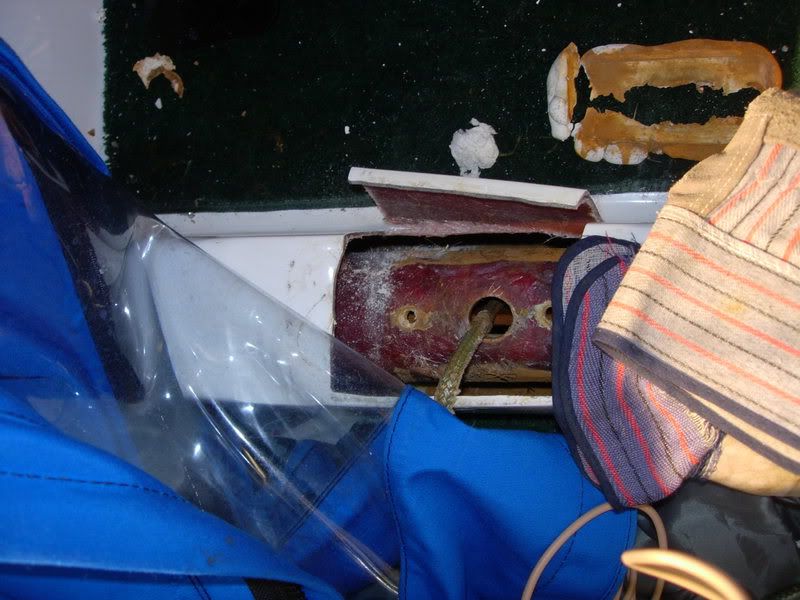


 then through bolt two bolts on bottom. I didnt like the studs into fiberglass approach so I did SS nuts/bolt with the heads down in the CB trunk and the nuts up top. The CB might hit the bolt heads hard up - I figure I will check it for wear spots and then just drop it a bit if I see evidence of that.