

This has been discussed before a while ago, but I don’t believe there was a definitive conclusion. From everything I have read and heard from a salty or two is that you drop your traveler to leeward when it’s windy. When it’s windy, however, it is necessary to depower. One way to depower is by inducing twist on the mainsail. Traveler to leeward minimizes twist while traveler to centerline or even to windward will induce twist. Why then, would one drop the traveler to leeward when depowering is in order? What sayeth yee Mac-ers?
Leon
Twisting out with the traveler
-
Richard O'Brien

- Captain
- Posts: 653
- Joined: Fri May 14, 2004 8:20 am
- Location: Lakewood, CO. Mercury 60hp bigfoot M0427B404
I just traded my traveler fiddle blocks for triple blocks. I have only used it once, but that was promising. The stock setup required too much muscle. In addition, I made the two lines to the travel cleats into one loop. Now, in heavy upwind the trimmer, or just me, can grab the loop, and pull the traveler to windward. Simultaneously, they grab the the sheet, and let it out about a foot when the puffs hit, and then pull it back towards center after it passes. The helmsman points more to the wind during the puff, then back off after it passes also. I have never had much success when we left the traveler to leeward? I go by the knotmeter, as I also never had much success during those periods looking up the mast to see if the battens were parallel to the boom? If it's a really big microburst, nothing helps. The boat goes over, dumps the air, rounds up, and I look below to see if the porta-potty went airborne. I actually got that on film once
-
bscott

- Admiral
- Posts: 1143
- Joined: Mon Mar 08, 2004 2:45 pm
- Sailboat: MacGregor 26X
- Location: Arvada, Colorado 2001 X, M rotating mast, E-tec 60 with Power Thruster, "HUFF n Puff"
You have three main sail controls, traveler position, main sheet and main halyard. You can induce twist by droping the traveler to leeward and ease the main sheet and main halyard. As far as the jib is concerned, move the jib car back to induce twist into the jib.
Unless you have a good crew on board, reefing is alot easier.
Unless you have a good crew on board, reefing is alot easier.
-
delevi

- Admiral
- Posts: 2184
- Joined: Fri May 06, 2005 1:03 am
- Location: San Francisco Catalina 380, former 26M owner
- Contact:
Why would you loosen the main halyard in in windy conditions, and how would that induce twist? Also, traveler to leeward is less twist due to more of a downward pull from the mainsheet vs. traveler to windward would mean more mainsheet out for the same sail angle, therefore no downward pull, thus allowing the sail to twist out.
-
MrBarry
- Deckhand
- Posts: 44
- Joined: Fri Jul 27, 2007 7:35 am
- Location: Melb, Oz; 06 26M E-tec 60
- Contact:
traveller positioning
Straight from the sailing manual :
"If you can't keep the leaning angle below 25 degrees,
flatten the mainsail with halyard and outhaul. Flatten
the jib or genoa by tightening the halyard. Loosen the
vang to allow the top of the mainsail to twist downwind
and spill wind. Move the jib deck pulley to the rear of
the track to let wind spill out of the top of the jib."
On the M with a traveller, this means leaving it approximately centred, depending on just how high you're trying to point and how much you need to depower to avoid excessive leaning.
Plenty of sailing books and old salts with tell you additionally to haul on the mainsheet as hard as you can. Goal being to "flatten" or remove draft from the sail.
And they are right......provided you have enough righting moment and are not overcanvassed.
The big advantage of the traveller is to be able to set sail shape and then adjust its angle to the wind as required.
In windy conditions the traveller can be ridden by the crew and dropped with the gusts allowing the helmsman to keep a more consistant course.
James
"If you can't keep the leaning angle below 25 degrees,
flatten the mainsail with halyard and outhaul. Flatten
the jib or genoa by tightening the halyard. Loosen the
vang to allow the top of the mainsail to twist downwind
and spill wind. Move the jib deck pulley to the rear of
the track to let wind spill out of the top of the jib."
On the M with a traveller, this means leaving it approximately centred, depending on just how high you're trying to point and how much you need to depower to avoid excessive leaning.
Plenty of sailing books and old salts with tell you additionally to haul on the mainsheet as hard as you can. Goal being to "flatten" or remove draft from the sail.
And they are right......provided you have enough righting moment and are not overcanvassed.
The big advantage of the traveller is to be able to set sail shape and then adjust its angle to the wind as required.
In windy conditions the traveller can be ridden by the crew and dropped with the gusts allowing the helmsman to keep a more consistant course.
James


-
bscott
- Admiral
- Posts: 1143
- Joined: Mon Mar 08, 2004 2:45 pm
- Sailboat: MacGregor 26X
- Location: Arvada, Colorado 2001 X, M rotating mast, E-tec 60 with Power Thruster, "HUFF n Puff"
There are three (3) other main sail control features: vang, cunningham and backstay. Twist in the main is the upper 20-25% of the main. The traveler is moved slightly off center to leeward to keep the bottom of the main flat, the vang is hard, the cunningham is hard, the backstay(s) are hard, the main halyard is eased to allow the top of the sail to easy to leeward and you now have twist.
The traveler, when on a close haul in heavy wind should be on center or slightly off and played out in a puff to maintain the flat main. I'm not sure why you'd want to induce twist in the main--too many things to do and so little time to do them. The Mac is not a J boat.
The traveler, when on a close haul in heavy wind should be on center or slightly off and played out in a puff to maintain the flat main. I'm not sure why you'd want to induce twist in the main--too many things to do and so little time to do them. The Mac is not a J boat.
-
MrBarry
- Deckhand
- Posts: 44
- Joined: Fri Jul 27, 2007 7:35 am
- Location: Melb, Oz; 06 26M E-tec 60
- Contact:
Easing the main halyard just creates more draft and drops the boom height. So in overpowered conditions, you wouldn't do it.
If you're not ready to reef, but are over powered, allowing the main to twist out is very effective at reducing heel. Only takes a couple of seconds!
Not a Mac, but a good example of twist
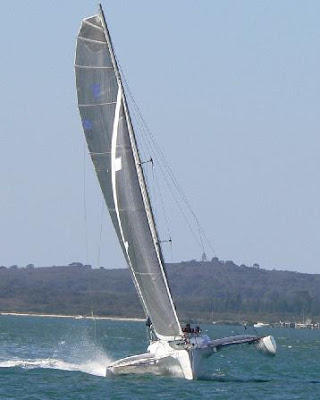
James
edit for clarity.
If you're not ready to reef, but are over powered, allowing the main to twist out is very effective at reducing heel. Only takes a couple of seconds!
Not a Mac, but a good example of twist
James
edit for clarity.
Last edited by MrBarry on Sun Sep 23, 2007 5:54 pm, edited 1 time in total.
-
delevi
- Admiral
- Posts: 2184
- Joined: Fri May 06, 2005 1:03 am
- Location: San Francisco Catalina 380, former 26M owner
- Contact:
Thanks guys. I understand the concept of twist and how to control it. Still don't quite see why you would loose the halyard when the need is to depower. I think the additional draft would create more power/drag than you would eliminate with the twist. Back to the original question... specifically directed to the mainsail: As per the consensus so far about traveler to center or windward to spill air from the top portion of the sail, what would be the advantage of dropping it to leeward and sheeting hard if you're close to being overpowered, yet not quite time to reef. To quote/paraphrase Sailing for Dummies "When the wind picks up, drop the traveler to leeward." I personally disagree with this, and it seems like the rest of you do as well. I'm trying to figure out the logic used by Sailing for Dummies as well of what a couple of other experienced sailors told me.
Nice picture of that trimaran, by the way.
Leon
Nice picture of that trimaran, by the way.
Leon
-
Richard O'Brien
- Captain
- Posts: 653
- Joined: Fri May 14, 2004 8:20 am
- Location: Lakewood, CO. Mercury 60hp bigfoot M0427B404
I'm with you Leon I don't think our travelers have the advantage of combing mounted travelers. Ours have too much angle and too little travel. Other boats also have travelers mounted below the companionway boards, but they have longer travelers, and more mechanical advantage. I believe the Catalina 250 is one.delevi wrote:quote/paraphrase Sailing for Dummies "When the wind picks up, drop the traveler to leeward." I personally disagree with this,
I pull the traveler to windward in the middle of the tack, and leave it there. It is far easier to adjust the sheet then, rather than fight the traveler sticking along the track. I suppose you could let the traveler to leeward in a blow, but It's harder to get it back afterwards, and i'd rather just head up a little more then fall off after the blow passes.
-
Currie

- Captain
- Posts: 621
- Joined: Fri Feb 02, 2007 12:31 pm
- Location: Michigan ---- '04 26M "Take Five" 50HP Suzuki efi 4-stroke
My 2 cents...
To me there are two sets of situations and intentions. I agree with the traveler to leeward if my intention is to blade the mainsail to the max, and fly a full aerfoil...IOW - Tighten the halyard, tighten the outhaul and cunningham (if you have it), and run the traveler out as far leeward as makes sense with the amount of blading your able to pull off. The mainsheet will be pulling pretty much straight down, hard, contributing to the blade. If the traveler is *too* far leeward, you won't be able to haul in enough, and it will need to be brought up closer to center.
Then...if *that* situation becomes overpowered, then it's time to spill, (which is a whole different intention) at which point the traveler should be brought to center (or even windward), to ease the downward tension and allow twist.
Does that make any sense?
~Bob
To me there are two sets of situations and intentions. I agree with the traveler to leeward if my intention is to blade the mainsail to the max, and fly a full aerfoil...IOW - Tighten the halyard, tighten the outhaul and cunningham (if you have it), and run the traveler out as far leeward as makes sense with the amount of blading your able to pull off. The mainsheet will be pulling pretty much straight down, hard, contributing to the blade. If the traveler is *too* far leeward, you won't be able to haul in enough, and it will need to be brought up closer to center.
Then...if *that* situation becomes overpowered, then it's time to spill, (which is a whole different intention) at which point the traveler should be brought to center (or even windward), to ease the downward tension and allow twist.
Does that make any sense?
~Bob
Last edited by Currie on Sun Sep 23, 2007 4:38 pm, edited 1 time in total.

-
MrBarry
- Deckhand
- Posts: 44
- Joined: Fri Jul 27, 2007 7:35 am
- Location: Melb, Oz; 06 26M E-tec 60
- Contact:
Perhaps what they meant by
"Sailing for Dummies "When the wind picks up, drop the traveler to leeward."
was to ride the gusts, as some of us are saying, rather than leaving it there. They really didn't make that clear though did they......
Sorry Leon - I wasn't clear before re easing the halyard....under overpowered conditions....you wouldn't.
Currie summed it up well. We are talking about two different modes.
James
"Sailing for Dummies "When the wind picks up, drop the traveler to leeward."
was to ride the gusts, as some of us are saying, rather than leaving it there. They really didn't make that clear though did they......
Sorry Leon - I wasn't clear before re easing the halyard....under overpowered conditions....you wouldn't.
Currie summed it up well. We are talking about two different modes.
James