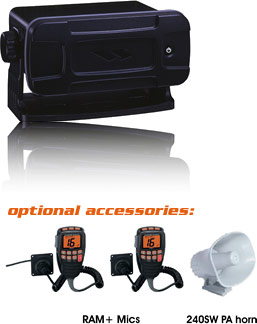
VHF, Handheld or fixed

A forum for discussing topics relating to MacGregor Powersailor Sailboats
User avatar
MSN-Travelers
Chief Steward
Posts: 74
Joined: Tue Jul 18, 2006 9:56 am
Sailboat: Venture 25
Location: SE Wisconsin ... "Witchcraft" ... `99 Beneteau Oceanis 352 w/ Yanmar 27

VHF, Handheld or fixed

Post by MSN-Travelers »

New owner headed out into the Great Lakes. I'm trying to get all the gear the Coast Guard requires and a VHF radio is something I'm not really familiar with.

I had been leaning toward an ICOM M422 because it looks nice and is loaded with feature I don’t really understand. Did I say it looks nice?!?

I'm looking for recommendations on a VHF radio. Handheld vs. fixed and why. And one last question on radios … is a license required?

Thanks

Paul
:macm:
User avatar
DLT
Admiral
Posts: 1516
Joined: Mon Dec 06, 2004 10:24 am
Location: Kansas City 2005M 40hp ETEC

Post by DLT »

No license is required for recreational boaters in the US.

Since the M has a rather small pedestal, I went with the Standard Horizon Phantom PS2000, which is mounted out of sight with only the handset at the pedestal.

Image

I mounted the antenna on the mast support.
eric3a

Post by eric3a »

..
Last edited by eric3a on Tue Mar 11, 2008 7:53 am, edited 1 time in total.
Frank C

Post by Frank C »

Welcome aboard, Paul. Amplifying my earlier (email) comments on this topic, one big difference in choosing fixed or handheld has to do with transmission power, and its related distance potential for successful communications.

IIRC, a fixed unit transmits at either 5 watts or 25 watts (where's Hamin-Rich when needed?). The height of antenna, gunnel or masthead, impacts the length of the radio's "line of sight" which is another factor in operating distance. It's also important to recognize that a masthead antenna is shorter when heeled, and very much shorter when capsized.

Since I've never sailed beyond sight of land I've not felt any need for more power than the 1 or 5 watts offered by a handheld. Of course, carrying two handhelds adds the safety factor of redundancy. And since a fixed unit is frequently below decks, I've always questioned their convenience. If I was to elect a fixed unit I'd most likely choose Uniden's UM525 (~$200) mainly for its optional wireless microphone (~$150).
User avatar
Duane Dunn, Allegro
Admiral
Posts: 2459
Joined: Fri Jan 02, 2004 6:41 pm
Sailboat: MacGregor 26X
Location: Bellevue, Wa '96 26x, Tohatsu 90 TLDI and Plug In Hybrid Electric drive
Contact:

Post by Duane Dunn, Allegro »

I have both a fixed VHF (just inside the companionway to port) and a handheld.

The fixed one was in the boat when I bought it. While it is easy for the mic to reach into the cockpit it is hard to use for 99% of what you want a VHF for which is listening. Turned up loud enough to hear in the cockpit it bothers everyone else on the boat, particularly those below.

Because of this we bought an inexpensive handheld to use at the pedestal. It is the only VHF that has been turned on on my boat for the last 3 years. It drops easily into a cup holder at the pedestal.

While a handheld has less power, and with it's small low antenna less range, we have found it has met every need we have. As I said, most of the time you are just listening anyway and it receives local traffic just as well as the fixed unit. It's worked great for the few conversations we have had, mainly calling ahead to marina's to get slip assignments. We did talk to the Coast Guard once to get instructions on how they wanted us to go around the Trident sub they were escorting.

A VHF is not Coast Guard required equipment. On our recent inspection by the Coast Guard they did not ask at all about a VHF. Still, everyone should have one on board for safety purposes, preferably one with DSC capabilities connected to your GPS.

There are a few handheld DSC capable VHF's. There is one with an internal GPS so it always has your position, and a couple others that are connected to the GPS when they are in their cradle which could be located at the helm. If I were buying again I would look for one of the DSC handhelds, particularly if it was going to be the only VHF on the boat. Having the DSC capabilities greatly enhances it's contribution to safety in an emergency situation. It seems silly to me that every handheld VHF made doesn't have a GPS receiver in it like all the current cell phones do.

No license required, if you do get a DSC one you have to register your MMSI. Not only is it the ID used for distress calls but it is essentially the phone number for your VHF and can be used for other purposes besides emergencies.

Good reading
http://navcenter.org/marcomms/boater.htm
http://navcenter.org/marcomms/gmdss/dsc.htm
http://navcenter.org/marcomms/gmdss/whydsc.txt
User avatar
ssichler
First Officer
Posts: 342
Joined: Thu May 04, 2006 9:22 am
Location: Redondo Beach, CA 06 M 60hp E-Tec

Post by ssichler »

A couple years ago on the way back from Catalina I was flagged down by small sailboat that had run out of gas motoring with no wind. They had a hand held VHF and couldn't raise the Coast Guard to call for vessel assist.
User avatar
Chip Hindes
Admiral
Posts: 2166
Joined: Mon Jan 05, 2004 6:13 am
Location: West Sand Lake, NY '01X, "Nextboat" 50HP Tohatsu

Post by Chip Hindes »

Just last week I bought Frank's suggested Uniden 525 and the matching WHAM4 mike to replace my original fixed mount. Both on sale at Defender; the price was $155 and $105. The reason I replaced my perfectly good fixed mount was the availablity of DSC.

Anticipating the "I don't need DSC if I'm not going offshore" objections, I say, quite respectfully, phhfffftttt! I don't have nearly enough time to explain why you ought to have DSC, so trust me, on the Great Lakes you want it, and it only costs a few $$ more.

The fixed mount with DSC and WHAM is the best of both worlds, base unit mounted inside the cabin where both the radio and you are protected and you can use in comfort, while the full function wireless mike is usable from anywhere on the boat.

I have a good handheld as well. Until I got the new fixed mount this one was essentially my primary, with the fixed mount as backup.

The advantage of a handheld is of course, you can take it with you. I frequently use mine in the dinghy, but it is technically illegal to use it from shore. This rule is broken so frequently it's barely worth mentioning.

If you contemplate traveling to foreign countries, including the Bahamas, Mexico, and I believe even Canada, you are supposed to get a ship station radio license. Again, this rule is ignored more often than it's followed.
User avatar
Terry
Admiral
Posts: 1487
Joined: Thu Feb 19, 2004 2:35 pm
Sailboat: MacGregor 26M
Location: Vancouver, B.C. Canada. '03 26M - New Yamaha 70

Post by Terry »

I have the exact same setup as Chip and think it is way cool, the wham4 was a bit of a splurge but in hindsight it is a must have. I hated the handheld with its poor range and constant battery draining and now relegate it to the dinghy. In Canada the VHF operators certificate is mandatory and Power Squadrons has it covered in one of their courses. The hand held is a waste of money, if you are just starting out get the Uniden 525 with whamx4 and forget the handheld.
User avatar
Chinook
Admiral
Posts: 1730
Joined: Sun Feb 26, 2006 7:20 pm
Location: LeavenworthWA 2002 26x, Suzuki DF60A

Post by Chinook »

I started out with just a handheld, with the consideration that in Northwest waters, hills and mountains limit transmission range sufficiently that the advantages of a 25 watt set can't really be realized. That worked fine until we went back east, where things are very flat. We had problems contacting some bridges on the ICW, and we had experiences where we could hear friends we'd met talking, but couldn't call them back. In some cases we had intermediate boats relaying our calls. Ended up installing a radio while in Florida, and it was very handy when we got out to the Bahamas. It allowed us to pick up NOAA weather in the western Bahamas, and we could hear the Marsh Harbor cruisers net from a long way off. I installed the radio inside the cabin, but with a cockpit speaker on the port side of the companionway, which enables me to hear clearly from the wheel. Having both the handheld and fixed radios is nice redundancy, and also lets me talk to the mother ship, when I'm out in the dink or ashore shopping.
albion
First Officer
Posts: 280
Joined: Sun Apr 09, 2006 11:25 pm
Location: Medina Ohio 2007 Mac26M Suzuki 50hp Hull#M1494g607

Uniden Oceanus

Post by albion »

I bought a Uniden Oceanus . If you read my posts I FINALLY GOT A DEAL. You can see what I paid and the way I got it so cheap.O riginally it was $139.00 I got it for $89.00.I like the fixed mount as its nice to beable to sit in the cabin and listen to all the radio traffic in comfort. Frank, thanks for the tip ( lousy reception when capsized.)[/b]
James V
Admiral
Posts: 1705
Joined: Sat Jan 22, 2005 9:33 am
Sailboat: MacGregor 26M
Location: Key West, Fl USA, 26M 06, Merc 50hp BF "LYNX"

Post by James V »

I have both. I used the handheld for a while and had trouble with people hearing me. I know have an ICOM with a remote mike. When the wind is blowing to hard I can go below and be able to be heard. Nice setup.
Frank C

Post by Frank C »

That failure of a masthead antenna is an obscure, but harsh, reality. Though it creates terrific line-of-sight, a masthead antenna could be worthless, exactly when it is most needed. Because that reality is possibly obscure, it's worth illuminating "the obvious."
User avatar
Don T
Admiral
Posts: 1084
Joined: Fri Jan 02, 2004 7:13 pm
Sailboat: MacGregor 26X
Location: 95 2600 "SS OTTER" - Portland OR - Tohatsu 50 - Hull#64 (May 95)

Post by Don T »

Hello,
I was told by the CG that they can get info on your boat and respond more quickly in an emergency if you have a liscense. The FCC keeps the records up to date. I don't know how true that is but that's what they told me.
James V
Admiral
Posts: 1705
Joined: Sat Jan 22, 2005 9:33 am
Sailboat: MacGregor 26M
Location: Key West, Fl USA, 26M 06, Merc 50hp BF "LYNX"

Post by James V »

Frank C - I have put my antenna on the mast support arch. I have been in Bimini and received weather on the hand held VHF (55 miles away). The main thing about being heard is if the receiver has the squelch turned up. It does not matter if you have a high antenna then. I can rarely get another boat when underway. A lot of people cruise with the VHF off.

2 other things to consider is lightening strikes, (your antenna goes first, your radio second) and motoring mast down.

Register your new VHF. With the new DSC you will be known right away and if you have it hooked up to your GPS it will send your position as well. If you are going to get an SSB, you should waite because your will have a different number and will have to take the VHF to the shop to get changed.
User avatar
jasper
Chief Steward
Posts: 97
Joined: Sat Jan 20, 2007 9:33 am
Location: Canada '98 Mac 26X2226E898 Yamaha 25T

Post by jasper »

Just a note on US boaters travelling to Canada. The regulations are that your boat has to comply with the regulations of the country of origin/registration/licensing.
As mentioned above, the only requirement in Canada for recreational boaters is the ROC(M) which is a certificate of competency to operate the VHF. A station license is not a requirement, but optional. However, if you have a DSC radio and intend programming a MMSI # into it for Distress
calling on Ch70 then a station license makes good sense.
Why DSC? Well, just listen to all the unnecessary, undisciplined calling on CH 16 on a summer weekend. As well, the ability to link to your GPS and deliver your position along with your unique MMSI# which identifies your boat to Coast Guard.
As for the handheld VHF, ok for close communication on 1w, but when competing for air-space with 25w traffic your 5w will at times be hard to pick up.
I trained as a marine radio operator in the early 1970's. For voice, we used 2182khz, morse 500khz and of course 156.8mhz VHF my ear still turns to listen when I hear morse code and I still remeber all those Q-codes and military z-codes. We only used VHF for harbour traffic and line of sight ship communication. It was more than obvious when conducting radio traffic, the boats that had good, powerful radios and moreover better than adequate atennas .
The 5w and small antenna of the hand-held greatly reduce efficiency.
The one thing I would stress as in previous posts is, remember your VHF radio is only as good as your antenna. When positioning the antenna: correct length, correct placement on the boat and correct angle when mounting are just as important as the positioning of your steering compass. Of couse as the angle of the antenna keeps changing when sailing, reception and transmission are affected.
I don't agree with anyone turning off their VHF when sailing, you may be the only one close enough to answer a distress call in time to save lives.
Post Reply