

You can't lump internal combustion engines under one blanket statement, and you can't extrapolate experience with Diesels to Otto cycle outboards. A Diesel operates on a totally different thermodynamic cycle than an Otto cycle outboard, and they behave differently. Ottos get their best efficiency at something close to the max torque point, which is a fraction of max RPM; typically well below 2000RPM.More damage is done to internal combustion engines when they are run at low rpms as opposed to the high range....I seriously doubt that WOT is doing any damage and is probably running much more efficient than 2000 rpm.
Does running WOT for an extended time cause enginge damage
-
Chip Hindes

- Admiral
- Posts: 2166
- Joined: Mon Jan 05, 2004 6:13 am
- Location: West Sand Lake, NY '01X, "Nextboat" 50HP Tohatsu
That is one really big assumption that because I worked for Detroit Diesel that I only had experience with diesel engines. You should look into how much Detroit Diesel is involved in the marine and not just diesel. As any branch of G.M. they have a huge umbrella of powerplants they design and service.
You did not quote the part of my post that really does apply to this thread and that is when outboard carburated engines slobbers fuel and build carbon deposits at low rpms. I would have to say that most Macs have carburated engines.
You did not quote the part of my post that really does apply to this thread and that is when outboard carburated engines slobbers fuel and build carbon deposits at low rpms. I would have to say that most Macs have carburated engines.
-
Frank C
Valid point that carburetors must compromise their fuel delivery at part throttle, somewhat washing the rings and cylinder walls with raw fuel.
However, not sure you can validly assume that most Macs have careburetors ... if that's true, I'd guess that it is only by a small percentage like 55 percent - and steadily reducing. Part-throttle cruise, at various altitudes, were the criteria that drove my 4-stroke EFI choice ... in 1999.
However, not sure you can validly assume that most Macs have careburetors ... if that's true, I'd guess that it is only by a small percentage like 55 percent - and steadily reducing. Part-throttle cruise, at various altitudes, were the criteria that drove my 4-stroke EFI choice ... in 1999.
-
Chip Hindes
- Admiral
- Posts: 2166
- Joined: Mon Jan 05, 2004 6:13 am
- Location: West Sand Lake, NY '01X, "Nextboat" 50HP Tohatsu
Look at Frank's BSFC curvesthat is when outboard carburated engines slobbers fuel and build carbon deposits at low rpms
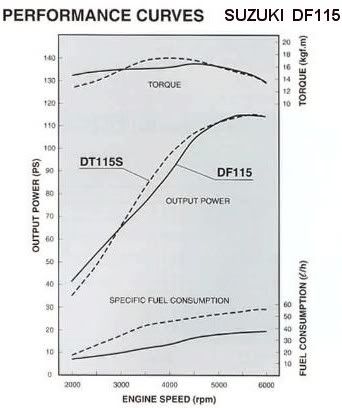
Lower speed, better BSFC. That's typical of all 4 stroke outboards, whether carbureted or fuel injected, and of TLDI type two strokes. Not typical only of carbureted two strokes. That may be some significant percentage of existing motors, but the percentage is declining steadily as most (all?) new motors are four strokes and TLDI two strokes.
Can't say the carbon buildup part is completley wrong, but it's a generalization against which I'd argue. Few engines die from carbon buildup, and you can easily clear it out with an occasional high speed run.
-
aya16

- Admiral
- Posts: 1362
- Joined: Fri Feb 18, 2005 6:29 am
- Location: LONG BEACH CALIF Mac M 04 WHITE
Real world use, I have a classic 50 2 stroke outboard on my 13 foot whaler that sees wot evertime its used (trill, get there as fast as possible)
Its been run in salt water fresh water sat for a year at a time and expected to fire up everytime. The point is the thing is twenty two years old. Water pump change every two years lower gear oil changed at same time. new plugs and fresh gas. I just used it last week on a vacation for a week again same thing the motor just keeps on going.
The amount of use the mac engine sees and if your proped right the engine should last a long time. Outboard motors are made to run hard
and the manufacture that puts one out that cant will pay dearly in sales.
But I also think that backing off on the throttle a liitle will be better for the engine in the long run, Thats why I think the Mac needs a 90 rateing. The little fifty is just enough to plane and no more. And its screaming at full throttle to do it. 10, 20, 30, 40 more hp will make the mac perform
with out working so hard. There is a big diff. in the way the mac handles when it planes then when its almost up on plane.
Im still up in the air about going with a 90 at about #60 more it shouldnt effect the sailing. and if going to a 70 that will weigh the same as a 90 Ill take the 90 and keep off the throttle.
My take on the Mac engine is starting to change. I bought the boat as a sailer first and I have noticed that almost all my long distance trips are under power. Thats what got me thinking about a bigger engine, But
Im starting to question this in me. I run to catalina and run back most of the time, I can sail in either direction if I want to from where Im at.
Getting there is supose to be half the fun so I think Ill sail most of the time now, if theres wind of course. I sail almost every weekend and dont have any real place to go and cover about 30 miles. I think its a mind frame thing so Ill try a diff. way going over to the island for awhile.
When Scott Rick and I were sailing part way back last time It sure was a sight to see three or four Macs coming from a couple miles back and passing us at warp speed though.
sorry to stray from the subject a little.
Its been run in salt water fresh water sat for a year at a time and expected to fire up everytime. The point is the thing is twenty two years old. Water pump change every two years lower gear oil changed at same time. new plugs and fresh gas. I just used it last week on a vacation for a week again same thing the motor just keeps on going.
The amount of use the mac engine sees and if your proped right the engine should last a long time. Outboard motors are made to run hard
and the manufacture that puts one out that cant will pay dearly in sales.
But I also think that backing off on the throttle a liitle will be better for the engine in the long run, Thats why I think the Mac needs a 90 rateing. The little fifty is just enough to plane and no more. And its screaming at full throttle to do it. 10, 20, 30, 40 more hp will make the mac perform
with out working so hard. There is a big diff. in the way the mac handles when it planes then when its almost up on plane.
Im still up in the air about going with a 90 at about #60 more it shouldnt effect the sailing. and if going to a 70 that will weigh the same as a 90 Ill take the 90 and keep off the throttle.
My take on the Mac engine is starting to change. I bought the boat as a sailer first and I have noticed that almost all my long distance trips are under power. Thats what got me thinking about a bigger engine, But
Im starting to question this in me. I run to catalina and run back most of the time, I can sail in either direction if I want to from where Im at.
Getting there is supose to be half the fun so I think Ill sail most of the time now, if theres wind of course. I sail almost every weekend and dont have any real place to go and cover about 30 miles. I think its a mind frame thing so Ill try a diff. way going over to the island for awhile.
When Scott Rick and I were sailing part way back last time It sure was a sight to see three or four Macs coming from a couple miles back and passing us at warp speed though.
sorry to stray from the subject a little.
Sorry more off subject--
I don't know how many have seen the original macx video and brochure, and I have never seen the one on the m, but the general theme behind the x advertising was how great the x is becuz u can power to Catalina(specifically) then spend the weekend sailing around once there.
This obviously was a bullseye with me since I live right next to LA harbor. The 50 is adequate but after a few loaded down trips it became obvious the boat would do so much better with a bit more power. My 90 has been sensational, and I honestly don't notice performance difference when sailing bout the harbor-- boat seems more stable to me. I was introduced to and spoiled by the sensation of sailing on a Catalina 42--that's what led me to the Mac. Anyone who has sailed on a boat like that knows that long distance sailing is a different world compared to a Mac-- the Mac's light weight can make her pitch back and forth a bit uncomfortably over even small wind waves, while the big boys cut right through.
Sailing in a group, such as the one going to Ensenada, would be worth the rougher ride, just for the camraderie alone. That is something(even the wife says she'd come along!) I eventually want to do.
Rolf
I don't know how many have seen the original macx video and brochure, and I have never seen the one on the m, but the general theme behind the x advertising was how great the x is becuz u can power to Catalina(specifically) then spend the weekend sailing around once there.
This obviously was a bullseye with me since I live right next to LA harbor. The 50 is adequate but after a few loaded down trips it became obvious the boat would do so much better with a bit more power. My 90 has been sensational, and I honestly don't notice performance difference when sailing bout the harbor-- boat seems more stable to me. I was introduced to and spoiled by the sensation of sailing on a Catalina 42--that's what led me to the Mac. Anyone who has sailed on a boat like that knows that long distance sailing is a different world compared to a Mac-- the Mac's light weight can make her pitch back and forth a bit uncomfortably over even small wind waves, while the big boys cut right through.
Sailing in a group, such as the one going to Ensenada, would be worth the rougher ride, just for the camraderie alone. That is something(even the wife says she'd come along!) I eventually want to do.
Rolf
-
delevi

- Admiral
- Posts: 2184
- Joined: Fri May 06, 2005 1:03 am
- Location: San Francisco Catalina 380, former 26M owner
- Contact:
I run my E-Tec 50 WOT frequently. Nowhere in the manual did it say not to run WOT for extended periods of time. I love the engine. I only wish I had the 90. Sure, running WOT frequently may shorten the life a bit, but hey, if you got it, us it. The engine is there to serve you, not the other way around. Of course, throttle vs WOT gives you twice the gas mileage, at least on my engine. Quite intrigued by the argument between you engineer types. Sounds like there is no one clear answer.
Fair Winds,
Leon
Fair Winds,
Leon
-
MAC26X

- Chief Steward
- Posts: 89
- Joined: Fri Dec 31, 2004 12:57 pm
- Location: Sandusky, OH 2001 Mac26X Anne Marie Honda 50
There is not a single answer but I have a fair amount of experience with 2 and 4 cycle engines. Wear is caused primarily by friction and heat. High RPMs are not a problem within the manufacturer's design range, unless there is insufficient lubrication or excessive heat. If the motor is propped wrong and WOT is well below the recommended rpm, you are lugging it and creating excess heat. If your mfg recommends 6000 as WOT and your prop limits you to 4800 WOT you will see more wear. Also, backing of from 100% power to 75% power will likely not slow down much but save much gas.
-
James V
- Admiral
- Posts: 1705
- Joined: Sat Jan 22, 2005 9:33 am
- Sailboat: MacGregor 26M
- Location: Key West, Fl USA, 26M 06, Merc 50hp BF "LYNX"
Per my Mer dealier, No. I have run WOT at 5100 rpms on a 50 hp Mer Bigfoot for 6 hours and had no problems. I think that of the 225 hours on the motor about 75 have been WOT. So far no problems. I did have a vacume hose come off and put it back on with a tie wrap with advice from the dealier. I do not think that this was from WOT but ruff seas, too fast and a too much Corrosion-X.
-
Chip Hindes
- Admiral
- Posts: 2166
- Joined: Mon Jan 05, 2004 6:13 am
- Location: West Sand Lake, NY '01X, "Nextboat" 50HP Tohatsu
Take any motor (your choice) which should last for 1500-2000 hours or more without a major failure.
Now give me anecdotal reports that it has made it 6, 60 or 600 hours at WOT, or 250 hours or 500 or even 1000 hours total and has not self destructed.
I'm not impressed. You still have another 1000-1500 hours to go.
Now give me anecdotal reports that it has made it 6, 60 or 600 hours at WOT, or 250 hours or 500 or even 1000 hours total and has not self destructed.
I'm not impressed. You still have another 1000-1500 hours to go.
-
Billy
- First Officer
- Posts: 439
- Joined: Tue Jan 06, 2004 3:50 pm
- Location: Dunn NC 2001-26X140 "XX"(DoubleCross)
OK, I've held off "putting my dog in this fight", but I'm going to show my ignorance here and express my opinion. First, I'm going to say no to hurting the engine provided it has the correct prop. Now to elaborate.
I think the question probably should have been " Does running at the manufacturer's established operating range for an extended time cause engine damage?"
WOT does not mean "redline" and I don't think is usually used by outboard manufacturers. To get the optimum performance, the prop should be matched so when the engine is in this rpm range the throttle is fully advanced (thus WOT). The operating rpms (ex. 5900-6100) assigned by the manufacturer is not the maximum the engine is capable of running. Many will run much higher rpms before the rev limiter comes into play. The manufacturer has already backed off what the engine is capable of doing in establishing a rpm operating/performance range.
2nd point. A marine engine is not like a car engine, but more closely related to an engine used in a semi, generator, pump, etc. That is one that is under constant load. Engines in this type of application list hp at an operating range (ex. diesel tractor--2800 rpm working load). Same as an outboard. When components (prop in our case) are matched correctly, the load keeps the engine from over-revving.
As for the outboard engine lasting longer at a slower rpm, sure it will. Is it more economical @ lower rpms, again yes. But it will take longer to get to the destination and have to run longer. So do the math--time/speed/rpms. I'm sure there's some additional wear @ the higher rpms but it's probably fractional and I choose not to worry about it. Maybe some extra wear, but I doubt self destruction (which is what I assumed was the real question). I'll probably wear out before the engine.
Car engine manufacturers rate their hp different. (Maximum hp vs. operating hp) Their maximum hp is usually rated near 6000 mark--not a place that is normal for driving on the highway and usually only reached when going into passing gear. One probably only uses the rated hp on a car less than 1% of the time--many never reach it. Here is where one sees the "red line", not to be confused with the operating rpm of the outboard (and its WOT). On a car there is no constant load.
If it makes you feel good, running a 50 HP outboard @ 3500-4000 rpm (producing probably 25-30 hp), then do it. Isn't that what boatings about--feeling good.
As to the original question of running WOT for an extended time damage the engine---- I don't think so if you're talking about the manufacturer's #s. There is difference between damage & wear.
Now for those that profess an outboard is better off at 3/4 throttle, I have one more question. Do you do the same with your lawn mower?
Remember, this was just an opinion, so feel free to blow holes into it.
I think the question probably should have been " Does running at the manufacturer's established operating range for an extended time cause engine damage?"
WOT does not mean "redline" and I don't think is usually used by outboard manufacturers. To get the optimum performance, the prop should be matched so when the engine is in this rpm range the throttle is fully advanced (thus WOT). The operating rpms (ex. 5900-6100) assigned by the manufacturer is not the maximum the engine is capable of running. Many will run much higher rpms before the rev limiter comes into play. The manufacturer has already backed off what the engine is capable of doing in establishing a rpm operating/performance range.
2nd point. A marine engine is not like a car engine, but more closely related to an engine used in a semi, generator, pump, etc. That is one that is under constant load. Engines in this type of application list hp at an operating range (ex. diesel tractor--2800 rpm working load). Same as an outboard. When components (prop in our case) are matched correctly, the load keeps the engine from over-revving.
As for the outboard engine lasting longer at a slower rpm, sure it will. Is it more economical @ lower rpms, again yes. But it will take longer to get to the destination and have to run longer. So do the math--time/speed/rpms. I'm sure there's some additional wear @ the higher rpms but it's probably fractional and I choose not to worry about it. Maybe some extra wear, but I doubt self destruction (which is what I assumed was the real question). I'll probably wear out before the engine.
Car engine manufacturers rate their hp different. (Maximum hp vs. operating hp) Their maximum hp is usually rated near 6000 mark--not a place that is normal for driving on the highway and usually only reached when going into passing gear. One probably only uses the rated hp on a car less than 1% of the time--many never reach it. Here is where one sees the "red line", not to be confused with the operating rpm of the outboard (and its WOT). On a car there is no constant load.
If it makes you feel good, running a 50 HP outboard @ 3500-4000 rpm (producing probably 25-30 hp), then do it. Isn't that what boatings about--feeling good.
As to the original question of running WOT for an extended time damage the engine---- I don't think so if you're talking about the manufacturer's #s. There is difference between damage & wear.
Now for those that profess an outboard is better off at 3/4 throttle, I have one more question. Do you do the same with your lawn mower?
Remember, this was just an opinion, so feel free to blow holes into it.
-
Dimitri-2000X-Tampa

- Admiral
- Posts: 2043
- Joined: Fri Jan 02, 2004 5:36 am
- Sailboat: MacGregor 26X
- Location: Tampa, Florida 2000 Mercury BigFoot 50HP 4-Stroke on 26X hull# 3575.B000
I don't run my lawnmower at WOT...probably more like 80%.. although, the deck is rather blue, so that must be the answer.
Although I do like going fast at times, I like the challenge of using as little fuel as possible too...both in my boat, and my big V8 SUV where you can see the needle move if you floor it.
If the wind is under 10 mph, I will frequently motor sail which uses a lot less gas and keeps all my electrical toys going longer.
Although I do like going fast at times, I like the challenge of using as little fuel as possible too...both in my boat, and my big V8 SUV where you can see the needle move if you floor it.
If the wind is under 10 mph, I will frequently motor sail which uses a lot less gas and keeps all my electrical toys going longer.
-
James V
- Admiral
- Posts: 1705
- Joined: Sat Jan 22, 2005 9:33 am
- Sailboat: MacGregor 26M
- Location: Key West, Fl USA, 26M 06, Merc 50hp BF "LYNX"
BK - We could not run at WOT crossing from the Keys to Bimini. We had 2 25's with us. Although I wanted to.
When going from Ft Myers to the Keys, I do my best to go WOT giving good enough wind and seas. 150 miles total. I just do not have enough time until I go full time cruising. I took 16 hours this trip going south. Too much wind and waves. My best was from Marathon to Everglades City, about 90 miles in 6 hours. All WOT.
The crossing from North Key Largo to Bimini was very calm. We had a little head wind and light seas. On the way back in was near glass condition and the wind picked up a little on the beam. Really nice 12 hours each way from harbor to harbor.
When going from Ft Myers to the Keys, I do my best to go WOT giving good enough wind and seas. 150 miles total. I just do not have enough time until I go full time cruising. I took 16 hours this trip going south. Too much wind and waves. My best was from Marathon to Everglades City, about 90 miles in 6 hours. All WOT.
The crossing from North Key Largo to Bimini was very calm. We had a little head wind and light seas. On the way back in was near glass condition and the wind picked up a little on the beam. Really nice 12 hours each way from harbor to harbor.
James, 12 hours each way means about 4 MPH for the 55 miles cruise to Bimini. There was talk about having 2 classes of boats going, sail and powersail. 4 MPH is a little slow for a powersailer. Even though WOT may be too much for 55 miles, I think 8-10MPH would be minimum.
I was wondering how Hemingway's old hangout, The Complete Angler, is doing after it burned down? Did you stop by? That was going to be one of the highlights going there for me. Was anything for sale as momentos from the bar?
I was wondering how Hemingway's old hangout, The Complete Angler, is doing after it burned down? Did you stop by? That was going to be one of the highlights going there for me. Was anything for sale as momentos from the bar?