

What is the consensus on installing an inverter near (above) batteries?
I have a Catalina 30 (Ok, so I used to be a Mac owner, but I just can't seem to leave this forum!) and I was given an inexpensive 1000W inverter as a gift. The instructions say to keep it away from the batteries due to explosion hazard. The one place that's most convenient is above the batteries. I have a shelf on top of the batteries that would separate the inverter from the batteries, but both would be in the same compartment. I also have a battery charger that was set up by a previous owner in that same compartment.
I notice that Paul S has installed an inverter right next to his battery. Has he blown up yet? If hydrogen rises and his inverter is lower, then is it not a problem?
Am I in danger installing it in the battery compartment?
Also, the chassis ground connection is very close to the positive battery connection on the inverter (1/8 inch or so). This seems way too close. I don't think I want to hook up the chassis ground or it might arc. What do you think? I have a picture of the inverter connection I could upload if I knew how.
Any comments would be much appreciated!
Thanks,
Rob
Installing an Inverter
-
Catigale

- Site Admin
- Posts: 10421
- Joined: Fri Jun 11, 2004 5:59 pm
- Sailboat: MacGregor 26X
- Location: Admiral .............Catigale 2002X.......Lots of Harpoon Hobie 16 Skiffs....Island 17
- Contact:
THe danger of explosion from hydrogen evolution from batteries is often over-stated imho. YOu dont get much hydrogen from a battery unless you are pulling a lot of current from it or are charging it hard.
WHile the explosive limit in air is very wide (4-75%) the gas is so low in density it quickly will find its way out of the bilge, etc and disperse.
A 12V DC system lacks enough potential to arc 1/8 inch in air, but I would worry about something shifting in transit and those terminals touching - with spectacular results.
PErhaps you could insulate those terminals really well to protect them.
If you are going to use the inverter for 100-200 Watts AC I wouldnt worry about the H2 evolution issue.
WHile the explosive limit in air is very wide (4-75%) the gas is so low in density it quickly will find its way out of the bilge, etc and disperse.
A 12V DC system lacks enough potential to arc 1/8 inch in air, but I would worry about something shifting in transit and those terminals touching - with spectacular results.
PErhaps you could insulate those terminals really well to protect them.
If you are going to use the inverter for 100-200 Watts AC I wouldnt worry about the H2 evolution issue.
-
Billy
- First Officer
- Posts: 439
- Joined: Tue Jan 06, 2004 3:50 pm
- Location: Dunn NC 2001-26X140 "XX"(DoubleCross)
I guess ignorance is bliss, so I'm only showing what I did, not what is wise & correct. I installed my inverter just above my battery bank (3) about 4 years ago. So far no explosions.What is the consensus on installing an inverter near (above) batteries?
 I wanted to keep the wires reasonably short as possible.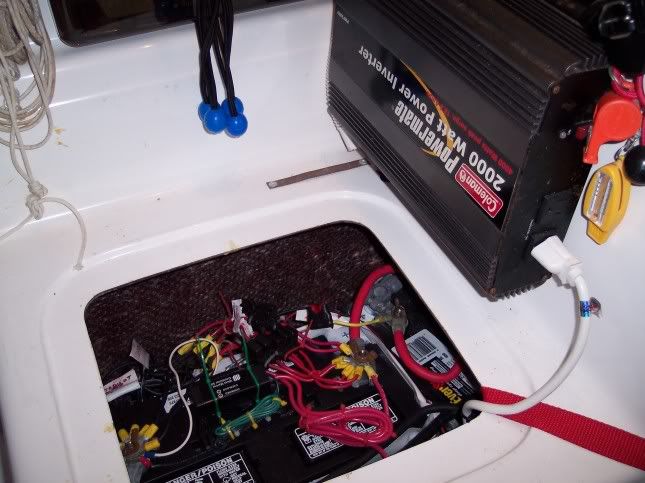
And I use this for AC, microwave, computer/printer, and oh yeah, blender.

-
James V
- Admiral
- Posts: 1705
- Joined: Sat Jan 22, 2005 9:33 am
- Sailboat: MacGregor 26M
- Location: Key West, Fl USA, 26M 06, Merc 50hp BF "LYNX"
1000 watts, WOW. Let's see 1000 watts divided by 12V = 83.333 amps draw. The batteries will last about 1(?) hour and they will bubble with what ever gasses at that load. H2 + ?????
Are you sure you want to do this?
Might be Ok for a short while at full load but for any lenght of time I would recommend that you get a 1000 watt or bigger Generator.
I have a small 175 watt that I can plug into the 12V outlet. This is enough to run my computer and charge my cell phone.
Are you sure you want to do this?
Might be Ok for a short while at full load but for any lenght of time I would recommend that you get a 1000 watt or bigger Generator.
I have a small 175 watt that I can plug into the 12V outlet. This is enough to run my computer and charge my cell phone.
-
RandyMoon

- Captain
- Posts: 779
- Joined: Mon Sep 13, 2004 7:05 pm
- Sailboat: MacGregor 26M
- Location: Rockwall, TX Lake Ray Hubbard 2005M #0690 L405 Tohatsu TLDI 90 (Rhapsody in Blue)
I guess I am a sissy, but I respect the idea that hydrogen is very explosive. I have taken hydrogen in a compressed state and quicky cracked the valve. It does combust very easily.
Personally, I would mount an inverter away from my batteries, even though the amount of hydrogen is miniscule.
Just picture this post on this board..... "Sailor Mounts An Inverter On His Cat 30 and is Blown Up."
It is not worth the risk IMHO. Safety warnings are given for a reason.
Personally, I would mount an inverter away from my batteries, even though the amount of hydrogen is miniscule.
Just picture this post on this board..... "Sailor Mounts An Inverter On His Cat 30 and is Blown Up."
It is not worth the risk IMHO. Safety warnings are given for a reason.
-
Tahoe Jack

- First Officer
- Posts: 309
- Joined: Tue Jul 13, 2004 9:50 pm
- Location: Lake Tahoe Nevada 2001 26X Evin/Suz 50..'Octopus'...
Installing an Inverter
My 2001 26X is equipped with one batt in the OEM position under the port jump seat, and we added the second forward, under the starboard V-berth accessway. We installed a 1500W inverter under the port bench seat with a 1-2-both-off Perko switch and a 10/20/35A Vector smart charger (WalMart). This location is midway between batts, connected with 2ga welding cable, and seems to work well......haven't blown up up yet  I would consider passing the 1000W along and getting at least a 1500 or maybe the Coleman 2000W if you have many AC toys in your future. Mine was from Costco and under $75US. This will cover a small microwave, small fridge, LCD TV, Margarita blender etc etc. BTW, we use the Honda 2000EU to charge up off shore or away from Marina.
Have Fun Jack
I would consider passing the 1000W along and getting at least a 1500 or maybe the Coleman 2000W if you have many AC toys in your future. Mine was from Costco and under $75US. This will cover a small microwave, small fridge, LCD TV, Margarita blender etc etc. BTW, we use the Honda 2000EU to charge up off shore or away from Marina. Have Fun Jack
-
They Theirs

- Captain
- Posts: 790
- Joined: Tue Dec 27, 2005 1:42 pm
Is it not a contradiction that the square wave inverter tells you not to mount next to the battery, and then advises you to use large cable as short as possible to reduce resistance. Short cables and mount outside the battery storage area?
I bought one; it is still in the box. I find the generator gang objectionable at anchor, but Im seeing the light when it comes to larger applications. Dont ask for a bake potato from the Microwave!
I bought one; it is still in the box. I find the generator gang objectionable at anchor, but Im seeing the light when it comes to larger applications. Dont ask for a bake potato from the Microwave!
-
Catigale
- Site Admin
- Posts: 10421
- Joined: Fri Jun 11, 2004 5:59 pm
- Sailboat: MacGregor 26X
- Location: Admiral .............Catigale 2002X.......Lots of Harpoon Hobie 16 Skiffs....Island 17
- Contact:
James - unless you have an oddball computer that has a DC supply built in, you are probably taking your 12 VDC from battery, converting it to AC in the inverter, then convering it back to DC in the computer power supply.
Thats not a biggie since they dont draw that much power, but you would be a lot less complex to put in a 12 VDC socket and just plug in 'direct'
Same for cell phone..I just use an auto adapter.
Thats not a biggie since they dont draw that much power, but you would be a lot less complex to put in a 12 VDC socket and just plug in 'direct'
Same for cell phone..I just use an auto adapter.
-
James V
- Admiral
- Posts: 1705
- Joined: Sat Jan 22, 2005 9:33 am
- Sailboat: MacGregor 26M
- Location: Key West, Fl USA, 26M 06, Merc 50hp BF "LYNX"
Catigale - I have an IBM. From what I have read, the computers need a fairly constant 12V and the boats 12 to 14+ volts can damage the computer. IBM new laptop maker has come out with a 12V to 240V adaptor for about $ 100. I just do not use it that much yet on the boat to justify the cost.
I have heard of people just going straight from the battery without any damage.
I have heard of people just going straight from the battery without any damage.
-
Night Sailor

- Admiral
- Posts: 1007
- Joined: Mon Dec 26, 2005 4:56 pm
- Sailboat: MacGregor 26X
- Location: '98, MACX1780I798, '97 Merc 50hp Classic, Denton Co. TX "Duet"
Why mount?
NO one says you have to mount an inverter. I use ours only for computer work, or power tool work on board. During those times it's resting on the dinette table, powerd by the OEM battery cables to the forward house battery located under the foreward dinette seat. When not in use it's stored right next to the battery case of that forward battery box. I didn't want to give up any wall or floor space to thepermanent mounting of the inverter since it's not used every day, or even every trip.
If I found it useful to mount the inverter, I'd do so on the aft side of the aft head wall, then run the cables under the floor to the aft house battery in the OEM battery location under the aft galley seat. That way ventilation, or accidentally touching a hot heat sink is not a problem. And a few more feet of heavy gauge cable si not going to effect performance noticeably.
Since my charger has a handle it is easy to move around, and since it has a LCD screen on front to indicate voltage, amperage, and amp/hours used, I'd like it to be readily visible. The foregoing location suits those wants. It does mean however using a longer power cord for whatever appliances I would want to plug in.
If you still want to use one of the old fashioned wet lead acid batteries that vent hydrogen, simply put the battery in a proper box, vent the box to the outside. Those kinds of sealable, vented battery boxes are available at RV and travel trailer supply stores.
If I found it useful to mount the inverter, I'd do so on the aft side of the aft head wall, then run the cables under the floor to the aft house battery in the OEM battery location under the aft galley seat. That way ventilation, or accidentally touching a hot heat sink is not a problem. And a few more feet of heavy gauge cable si not going to effect performance noticeably.
Since my charger has a handle it is easy to move around, and since it has a LCD screen on front to indicate voltage, amperage, and amp/hours used, I'd like it to be readily visible. The foregoing location suits those wants. It does mean however using a longer power cord for whatever appliances I would want to plug in.
If you still want to use one of the old fashioned wet lead acid batteries that vent hydrogen, simply put the battery in a proper box, vent the box to the outside. Those kinds of sealable, vented battery boxes are available at RV and travel trailer supply stores.
-
Rob (1992 26S)
- Just Enlisted
- Posts: 15
- Joined: Fri Jan 09, 2004 10:36 pm
That's why I love this forum....
lots of people here have opinions and further suggestions. I love it.
Of course! I don't need a permanent mount for the inverter. I just need it to run the dvd/tv for the kids and to heat up a bottle of formula every once in a while. Most of the time I'm at a marina with shore power anyway. So I will forget about the permanent mount, and just use it when I'm underway or on the hook. No worries now about that explosion since I can place the inverter outside the compartment.
By the way, I have 2 Trojan T105 6V batteries in series to give me 225Ah from the house battery away from the dock, and another dedicated starting battery. That means we can watch Toy Story 9 times before we run out of juice! I don't think I'll tell the kids that.
The inverter was on sale at Canadian Tire for 1/2 price - $75. It is made by Xantrex. I would have preferred 1200 or 1500 W, but they are always too much and never on sale. (Canadian Tire has them on sale right now for $75 again - so go get yours!)
Thanks again for all your input!
-Rob
Of course! I don't need a permanent mount for the inverter. I just need it to run the dvd/tv for the kids and to heat up a bottle of formula every once in a while. Most of the time I'm at a marina with shore power anyway. So I will forget about the permanent mount, and just use it when I'm underway or on the hook. No worries now about that explosion since I can place the inverter outside the compartment.
By the way, I have 2 Trojan T105 6V batteries in series to give me 225Ah from the house battery away from the dock, and another dedicated starting battery. That means we can watch Toy Story 9 times before we run out of juice! I don't think I'll tell the kids that.
The inverter was on sale at Canadian Tire for 1/2 price - $75. It is made by Xantrex. I would have preferred 1200 or 1500 W, but they are always too much and never on sale. (Canadian Tire has them on sale right now for $75 again - so go get yours!)
Thanks again for all your input!
-Rob
-
Catigale
- Site Admin
- Posts: 10421
- Joined: Fri Jun 11, 2004 5:59 pm
- Sailboat: MacGregor 26X
- Location: Admiral .............Catigale 2002X.......Lots of Harpoon Hobie 16 Skiffs....Island 17
- Contact:
I dont know if the IBMs are more sensitive to input DC than other brands, James, maybe one of the IBM design team members here can help you with that.
The accessories business for computer companies is huge margin, so they will tell people stuff to push them to OEM stuff, Ive found. Dell even put a chip into their internal power supplies so that off brand auto adapters wouldnt charge their batteries (citing safety concerns about charging their batteries of course)........
A DC battery (with the motor shut off) is about as good a constant DC supply as you can get - I think most power bricks are loosely regulated and will have more voltage variation than a battery ....
The accessories business for computer companies is huge margin, so they will tell people stuff to push them to OEM stuff, Ive found. Dell even put a chip into their internal power supplies so that off brand auto adapters wouldnt charge their batteries (citing safety concerns about charging their batteries of course)........
A DC battery (with the motor shut off) is about as good a constant DC supply as you can get - I think most power bricks are loosely regulated and will have more voltage variation than a battery ....
-
Bobby T.-26X #4767
- Captain
- Posts: 906
- Joined: Mon Jan 05, 2004 10:48 am
- Sailboat: MacGregor 26X
- Location: Oceanside Harbor, CA
Re: That's why I love this forum....
i lke that concept. 2 monster 6 volts, that is.Rob (1992 26S) wrote:By the way, I have 2 Trojan T105 6V batteries in series to give me 225Ah from the house battery away from the dock, and another dedicated starting battery. That means we can watch Toy Story 9 times before we run out of juice! -Rob
however, with a battery combiner for charging, what type of battery should one use for the motor?
that is, it's usually recommended that for the best charge and life cycle, use three new same type batteries and install at the same time.
-
James V
- Admiral
- Posts: 1705
- Joined: Sat Jan 22, 2005 9:33 am
- Sailboat: MacGregor 26M
- Location: Key West, Fl USA, 26M 06, Merc 50hp BF "LYNX"
Catigale - Thanks for the data. For right now I will stick to my little 110 volt transformer. It's paid for.
Bobby T - It really depends on what you want to do with your boat. Battery life is from 4 to 6 years. It depends on if you drain it down below 11.9 V.
The cruisers are claiming that the Big golf cart batteries are best. Others say the AGM's are better.
How big depends on space and your expected needs.
Starting battery is usually smaller than the house batteries. Check with who made your motor.
It is best not to mix batteries types and they should, if possible be about the same age.
Bobby T - It really depends on what you want to do with your boat. Battery life is from 4 to 6 years. It depends on if you drain it down below 11.9 V.
The cruisers are claiming that the Big golf cart batteries are best. Others say the AGM's are better.
How big depends on space and your expected needs.
Starting battery is usually smaller than the house batteries. Check with who made your motor.
It is best not to mix batteries types and they should, if possible be about the same age.
-
Scott

- Admiral
- Posts: 1654
- Joined: Tue May 18, 2004 12:46 pm
- Sailboat: Venture 25
- Location: 1978 Catalina 22 with all the Racing Goodies!! 4 horse fire breathing monster on the transom
I thought I'd point out that small car style inverters are inexpensive and effective if all you want to do is run a TV, stereo or charge a laptop or cell phone.
We keep one of these in each of our trucks and have 1 fellow that runs a TV off of one.
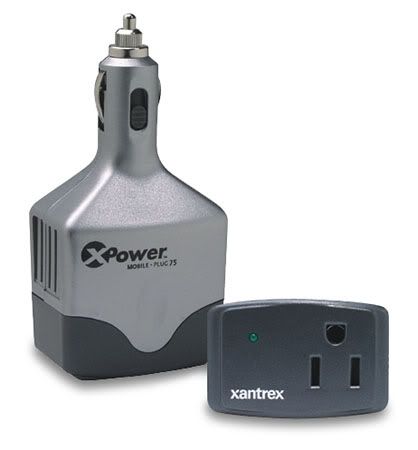
You couldnt run a Microwave on one or make fish daquiris with your blender but they only cost like $10
We keep one of these in each of our trucks and have 1 fellow that runs a TV off of one.
You couldnt run a Microwave on one or make fish daquiris with your blender but they only cost like $10