

While THIRD DAY is not a Mac, some of the same battery and solar issues apply, so I'll throw this out to the Mac owners in seeking some advice.
Well I have been racking my brain here trying to find out what is the best way to set up a solar power system for THIRD DAY (36ft Pearson 1978 Ketch). We are on a Mooring with no shore power, which increases the importance in keeping the bilge pump working in an emergency and keeping the batteries topped off and ready to go.
What I have now. I currently have four group 27 wet cells at 115AH each divided into two banks with a simple 1-all-2-off Perko switch. So that is a total of 460AH. Currently no refrigeration or loads other than lighting, Radar, GPS and small occasional miscellaneous items. The current alternator is a Motorola 60AMP with a voltage Regulator (original 1978 items).
What I want to have one day . I will upgrade and enlarge my battery bank prior to serious long term cruisingbut this simple set up will work for now and is installed and paid forif you know what I mean. I will also add refrigeration, probably a 12v system.so that will add seriously to the load. I will upgrade and install a new Belmar (or similar) 110amp alternator with a smart regulator. And surely increase the daily load demand as I prepare to make a 1-2 year cruising trip with a family of 4.
what are your suggestions? I would like to have some solar panels feeding the batteries through a regulator/controller of some sort. The questions and problems come up in what type and configuration? There are so many different types of units out there with price tags all over the place! West Marine is advertising Sunsie brand but damn they are expensive at $699.99 for a 4A/20AH/65W unit (based upon 5hrs average daily sunlight), $849.99 for a 6A/30AH/100W unit, $999.99 for a 8A/40AH/130W unit, upupand up from there. Of course that doesnt include a regulator or controller or all the mounting hardware! So what is a Poor boy to do?
Any suggestions or comments or advice would be greatly appreciated as I try and figure out my option, but just as importantly, how to do it cost affectively!
Time to harness the SUNGoing Solar
-
richandlori

- Admiral
- Posts: 1695
- Joined: Wed Aug 18, 2004 8:08 pm
- Location: Living Aboard in Morro Bay, CA
- Contact:
-
Frank C
The KISS wind generator is a pretty good solar generator, only one BoatBuck and it works at night. Unsure about the best solar panels, but I really admired this guy's "implementation" of power options on a Hunter 25:
Hunter 25 on the hook w/watermaker on port rail;
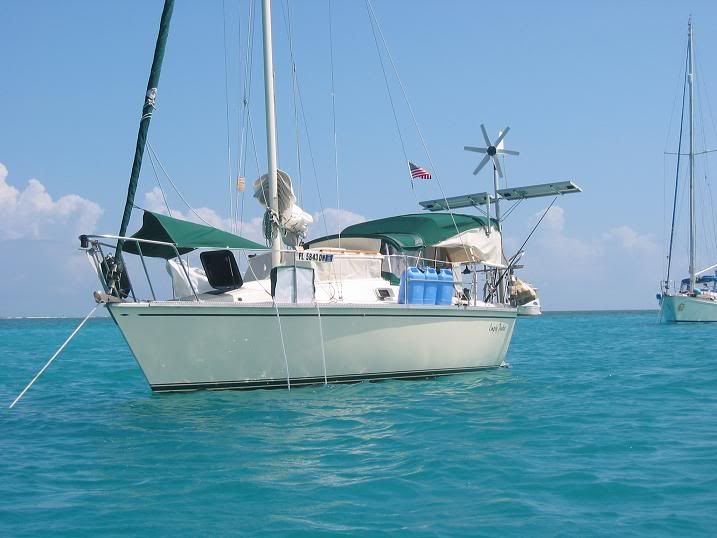
With 3 options for Power;
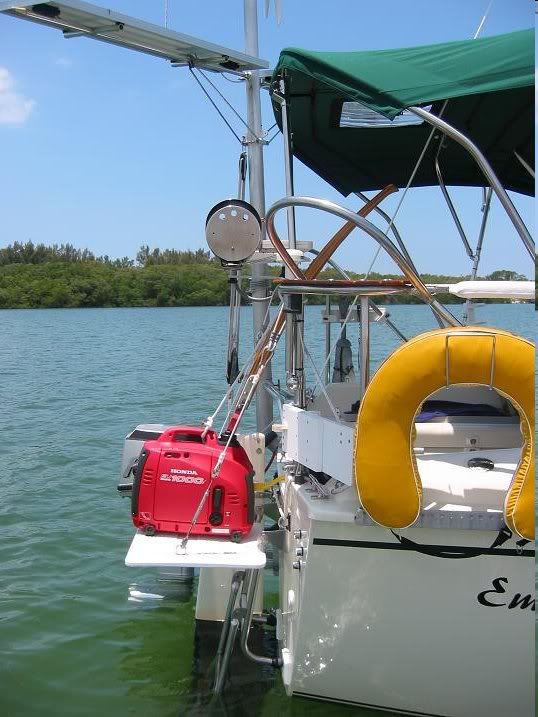
Rotate & tilt as appropriate;
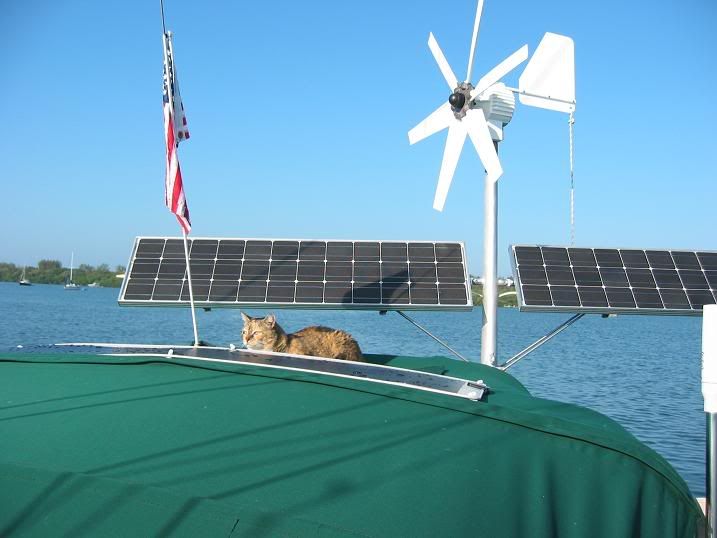
Or, stow to get underway.
Very nice Hunter (& apparently, it worked)!
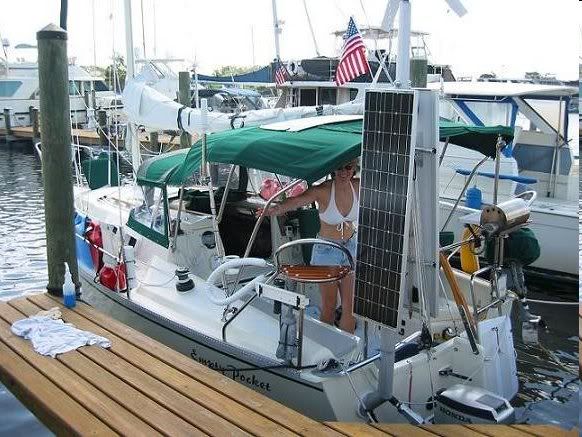
Hunter 25 on the hook w/watermaker on port rail;
With 3 options for Power;
Rotate & tilt as appropriate;
Or, stow to get underway.
Very nice Hunter (& apparently, it worked)!

-
Bobby T.-26X #4767

- Captain
- Posts: 906
- Joined: Mon Jan 05, 2004 10:48 am
- Sailboat: MacGregor 26X
- Location: Oceanside Harbor, CA
that hunter has a bit too many extras for my taste.
however, i do like the idea of flexible panels.
this one puts out 20 watts and weighs only 2#. it's 12' by 6'.

while this one puts out 32 watts and is 5#.

both are around $300 and are so flexible that you can roll them up and store in the rear berth.
however, i do like the idea of flexible panels.
this one puts out 20 watts and weighs only 2#. it's 12' by 6'.
while this one puts out 32 watts and is 5#.
both are around $300 and are so flexible that you can roll them up and store in the rear berth.
-
Divecoz

- Admiral
- Posts: 3803
- Joined: Sat Oct 16, 2004 2:54 pm
- Sailboat: MacGregor 26M
- Location: PORT CHARLOTTE FLORIDA 05 M Mercury 50 H.P. Big Foot Bill at Boats 4 Sail is my Hero
Frank C
Doesn't the Hunter have a web site ?? Did he she they do an extended around Florida cruise ?? Looks the Hunter very familiar as does she for some reason . . . .
-
richandlori
- Admiral
- Posts: 1695
- Joined: Wed Aug 18, 2004 8:08 pm
- Location: Living Aboard in Morro Bay, CA
- Contact:
-
Frank C
-
kmclemore

- Site Admin
- Posts: 6256
- Joined: Sun Feb 08, 2004 9:24 am
- Sailboat: MacGregor 26X
- Location: Ambler, PA -- MACX2018A898 w/ Suzuki DF60AV -- 78 BW Harpoon 4.6 -- 2018 Tahoe 550TF w/ 150 Merc
Hi, Rich. This topic has been discussed in pretty great detail in a previous topic thread but that thread is now locked. So, here's a combination of my entries from there, with an added pic I didn't have before:
(edit: updated the link for the Kyocera panel)Here's the model I went with:
Kyocera multi-crystalline silicon 40 Watt Panel
It puts out 40 watts and fits perfectly on top of the sliding hatch. I mounted it on small nylon bushings to keep it up off the hatch and allow some cooling air to get underneath, and used a tightly coiled appliance wire to take up the slack from opening and closing of the hatch. The bushing method also prevents the sunlight from heating up the hatch.
...I know it's going to be subject to some shadows when I'm under sail... but there really isn't a lot of other space on the Mac where I could put it. And I don't really walk on the slider very much anyway. The panel is a *very* sturdy unit with a thick cell and strong alloy frame - don't think I'd want to step on it with all my weight, but if you do it would probably take it.
...I ran mine through a solid-state Morningstar "SunGuard" controller. It's small and light, it prevents night drain and has pulse wave charging for maximum charge with minimum gassing. Nice little unit, and Morningstar has a great reputation in the business. I mounted it on the bulkhead right near the batteries. (my two batteries are located under the port side v-berth.)

Last edited by kmclemore on Fri Apr 14, 2006 12:31 pm, edited 1 time in total.
-
Jeff S
- First Officer
- Posts: 371
- Joined: Tue Jun 08, 2004 2:13 pm
- Location: Cherry Point, NC 2000 26X Tohatsu 50
I have 2 of the USF-11's (from the bottom picture- smaller model) on the top of the sliding hatch. Their rated power is 0.62amps each (1.24 amps for both, 20W total power). I have found it keeps the batts topped off while away from the boat (nice to extend battery life and keep batts charged for next trip), but not significant for extended battery life during a cruise- slight help. I would figure out your power drain (day and night expected based on your current and planned electrical demands), and then figure out how long you plan to run your motor each day on average figuring in the alternate output (60 amp or 110 if you upgrade). Then determine your extra power needs. I would figure in a factor of at least 10% extra and then that should give you a starting point in your search for power. 2 USF-32 (64 watts, 3.9a) mats might work nicely- but they are fairly expensive also. I do like the Sunsei charge controller that is available for $40.Bobby T.-26X #4767 wrote:that hunter has a bit too many extras for my taste.
however, i do like the idea of flexible panels.
this one puts out 20 watts and weighs only 2#. it's 12' by 6'.
while this one puts out 32 watts and is 5#.
both are around $300 and are so flexible that you can roll them up and store in the rear berth.
Jeff S
On Edit- On deck I recommend the flexible mats- they are unobtrusive and can be stepped on.
The other side of the equation...
This doesn't really answer your question, and I'm not saying don't use solar or wind power, but don't forget the other side of the equation. There's no substitute for reducing power demands. A small savings in amp-hours can make a huge difference in the investment and space required to provide it.
For example, our fixed mount VHF is rated to consume 0.5A in standby, which would be 12 AH/day if left on 24 hours. IIRC, our handheld VHF is rated to run 18 hours on a 1400 mAH internal battery charge. That's about 2AH/day to power it from the 12VDC system. I'm not saying the handheld is anywhere near a substitute for a mast-mounted antenna and 25W fixed mount VHF in an emergency, but it makes a lot more sense to make it the 24x7 "watch" radio. 10 AH is the daily output of a 40W solar panel mounted horizontally at the summer solstice, and a 60W solar panel at the equinoxes. I'm not guaranteeing the actual draws are as stated by the manufacturers, or that the savings are that great, but they are significant.
I wouldn't be surprised if similar savings can be had with a handheld GPS vs fixed-mount, but one way to conserve power with either is to leave them off as much as possible and just turn them on to take fixes. Same for the transducer and soundings. Radar can be a huge power consumer, but the "watchman" mode available in most can also save power.
Anchor and navigation lights are another big AH consumer because of the length of time they're on. LED units may be expensive, but not as expensive as the solar required to power the incandescent versions. They can also save considerable power with cabin lighting, but generally don't illuminate as evenly as incandescents.
At roughly 2AH/flush, that LectraSan can also add up with a family aboard.
Do the math on a cold plate for the boat's ice box and balance that against ice when near ports and going the no-refrigeration route when not.
Keep in mind that solar panels on a sailboat are seldom horizontal. Sometimes they're tilted closer to the sun, but often tilted away from it, when heeling. Panels are often shaded on a sailboat, and even the rigging can cause the more efficient mono and multicrystaline panels to drop output significantly. The thin film panels, like the flexible ones, aren't as bad about this, but they take approximately twice the area for the same output as the crystaline.
Wind generators appear attractive at first glance, but keep in mind their rated output is at a wind speed much higher than the average you're likely to see, and that output goes down with the square of the decrease from that rated speed. Most don't output anything at all below about 7 knots of wind.
Balmar alternators and charge controls are good, and can help you make the most of your diesel run time (as can AGM batteries), but don't forget alternators draw about 1 HP per 25A from the engine, which has less than rated HP at cruise rpm. Increasing the power taken by the alternator leaves less to drive the prop, and you may find you need a lower pitch prop to not overload the diesel at cruise operation. With the batteries heavily discharged, you should still be able to reach the diesel's max rated rpm, with the exhaust smoking. Also don't forget that alernator output goes down with an increase in engine compartment heat.
Just some thoughts... hope they help.
--
Moe
For example, our fixed mount VHF is rated to consume 0.5A in standby, which would be 12 AH/day if left on 24 hours. IIRC, our handheld VHF is rated to run 18 hours on a 1400 mAH internal battery charge. That's about 2AH/day to power it from the 12VDC system. I'm not saying the handheld is anywhere near a substitute for a mast-mounted antenna and 25W fixed mount VHF in an emergency, but it makes a lot more sense to make it the 24x7 "watch" radio. 10 AH is the daily output of a 40W solar panel mounted horizontally at the summer solstice, and a 60W solar panel at the equinoxes. I'm not guaranteeing the actual draws are as stated by the manufacturers, or that the savings are that great, but they are significant.
I wouldn't be surprised if similar savings can be had with a handheld GPS vs fixed-mount, but one way to conserve power with either is to leave them off as much as possible and just turn them on to take fixes. Same for the transducer and soundings. Radar can be a huge power consumer, but the "watchman" mode available in most can also save power.
Anchor and navigation lights are another big AH consumer because of the length of time they're on. LED units may be expensive, but not as expensive as the solar required to power the incandescent versions. They can also save considerable power with cabin lighting, but generally don't illuminate as evenly as incandescents.
At roughly 2AH/flush, that LectraSan can also add up with a family aboard.
Do the math on a cold plate for the boat's ice box and balance that against ice when near ports and going the no-refrigeration route when not.
Keep in mind that solar panels on a sailboat are seldom horizontal. Sometimes they're tilted closer to the sun, but often tilted away from it, when heeling. Panels are often shaded on a sailboat, and even the rigging can cause the more efficient mono and multicrystaline panels to drop output significantly. The thin film panels, like the flexible ones, aren't as bad about this, but they take approximately twice the area for the same output as the crystaline.
Wind generators appear attractive at first glance, but keep in mind their rated output is at a wind speed much higher than the average you're likely to see, and that output goes down with the square of the decrease from that rated speed. Most don't output anything at all below about 7 knots of wind.
Balmar alternators and charge controls are good, and can help you make the most of your diesel run time (as can AGM batteries), but don't forget alternators draw about 1 HP per 25A from the engine, which has less than rated HP at cruise rpm. Increasing the power taken by the alternator leaves less to drive the prop, and you may find you need a lower pitch prop to not overload the diesel at cruise operation. With the batteries heavily discharged, you should still be able to reach the diesel's max rated rpm, with the exhaust smoking. Also don't forget that alernator output goes down with an increase in engine compartment heat.
Just some thoughts... hope they help.
--
Moe
-
Pouw Geuzebroek

- Engineer
- Posts: 179
- Joined: Mon Jan 12, 2004 11:22 am
- Location: Aalsmeer (NL) The Netherlands (Europe) 1999 X 'Travelling Light' Yamaha 9.9 high thrust
I have the BP MSX 30 watt panel already for 5 years now and it still works great.
BP MSX
It is very thin so I have installed it behind the mast, so the sliding hatch slides over it. If I notice on a hot day that the fridge is using up too much power, I just close the hatch for a while and the battery gets charged again. You can buy them in Canada via the internet.
BP MSX
It is very thin so I have installed it behind the mast, so the sliding hatch slides over it. If I notice on a hot day that the fridge is using up too much power, I just close the hatch for a while and the battery gets charged again. You can buy them in Canada via the internet.
I find it interesting that once the oil companies began buying up solar panel manufacturers, a lot of the good panels were discontinued. That includes after BP bought Solarex (and their semi-flexible MSX "Lite" panels, which are now on the discontinued products page). I really liked Andreas Haffner's installation of them on the companionway hatch.
I wonder if that has anything to do with the Uni-Solar flexible panels being discontinued? Did a big oil company buy them out too? Or is it they've shifted production to "solar shingles?"
--
Moe
I wonder if that has anything to do with the Uni-Solar flexible panels being discontinued? Did a big oil company buy them out too? Or is it they've shifted production to "solar shingles?"
--
Moe
-
kmclemore
- Site Admin
- Posts: 6256
- Joined: Sun Feb 08, 2004 9:24 am
- Sailboat: MacGregor 26X
- Location: Ambler, PA -- MACX2018A898 w/ Suzuki DF60AV -- 78 BW Harpoon 4.6 -- 2018 Tahoe 550TF w/ 150 Merc
Yeah, that's a nice installation, Moe. The only advantage I can see of my setup is that the raised panel does double duty - it both generates power and acts as an 'umbrella' for the hatch cover, since it stands about 1/2" off the hatch and air can flow underneath, keeping things a bit cooler than without the panel. However, if the solar panels are laying flat on the roof, the dark panels asorb a heck of a lot of heat and that heat is then transfered to the cabin through the hatch cover.

I currently have six 120w flexible solar panels feeding a BatteryMINDer Charger. They can be tossed atop the bimini, laid out on deck, or wherever there is room...
I also have a Honda eu1000 generator.
Together, these easily provide all the power I currently need, to include my 12v refridgerator and companionway mounted AC unit.
Of course, if I was going to add a 12vdc air conditioning system and/or water maker, etc., then I would probably look at a wind generator, such as the Air-X Marine. Of course, these can be noisy. More importantly, at least for a Mac, is they look to be problematic to mount. This is probably less of an issue for your bigger boat, and certainly less of an issue for those with good metal working skills and tools...
I also have a Honda eu1000 generator.
Together, these easily provide all the power I currently need, to include my 12v refridgerator and companionway mounted AC unit.
Of course, if I was going to add a 12vdc air conditioning system and/or water maker, etc., then I would probably look at a wind generator, such as the Air-X Marine. Of course, these can be noisy. More importantly, at least for a Mac, is they look to be problematic to mount. This is probably less of an issue for your bigger boat, and certainly less of an issue for those with good metal working skills and tools...