

Back when trailer boating, empty ballast, dragging my son on a tube was a major part of our boating, I swapped the origional 50hp honda for an evenrude/johnson 120 with power tilt.
I now have the boat in a slip where I never let the ballast out, only use the engine to get in and out of the marina, so the boat is now 100% a sailboat vs the earlier powerboat usage.
There are plenty of discussions on which engines to use, but my question is specific to sailing performance.
Is having that big chunk of metal hanging off the back hurting my sailing performance, or does the boat just not care?
Thinking all aspects, handling, pointing, speed, stability, etc....
My engine approx 350lbs vs newer 30hp 4 stroke approx 160, so I guess about 200 lbs difference?
Fore/Aft weight balance vs. sailing performance.
-
leefrankpierce
- First Officer
- Posts: 249
- Joined: Fri Oct 06, 2017 5:13 am
- Sailboat: MacGregor 26X
- Location: Dallas Ft-Worth Texas
Fore/Aft weight balance vs. sailing performance.
26X in Dallas Fort-Worth area Texas
Slip at Eagle Mountain Lake

Slip at Eagle Mountain Lake
-
NiceAft

- Admiral
- Posts: 6765
- Joined: Tue Feb 01, 2005 7:28 pm
- Sailboat: MacGregor 26M
- Location: Upper Dublin,PA, USA: 2005M 50hp.Honda4strk.,1979 Phantom Sport Sailboat, 9'Achilles 6HP Merc 4strk
Re: Fore/Aft weight balance vs. sailing performance.
Just speculation on my part.
How does it look at the waterline. Bow down? Stern down? Nice and level? If not a vast difference from level, I would think there is not a balance problem. I don’t think a port/starboard variance would be caused by the motor.
Speed may be better with the lighter motor. Handling
Again, just speculation on my part.
How does it look at the waterline. Bow down? Stern down? Nice and level? If not a vast difference from level, I would think there is not a balance problem. I don’t think a port/starboard variance would be caused by the motor.
Speed may be better with the lighter motor. Handling
Again, just speculation on my part.
Ray ~~_/)~~
-
leefrankpierce
- First Officer
- Posts: 249
- Joined: Fri Oct 06, 2017 5:13 am
- Sailboat: MacGregor 26X
- Location: Dallas Ft-Worth Texas
Re: Fore/Aft weight balance vs. sailing performance.
Here is the only picture I have that might show how it sits.
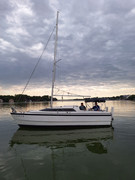
I suppose I could add ballast to the nose and see what i think.
Recently I was into my front most compartment under the bed, will have to remove some foam.
Play sand?
Anone have better idea?
I suppose I could add ballast to the nose and see what i think.
Recently I was into my front most compartment under the bed, will have to remove some foam.
Play sand?
Anone have better idea?
26X in Dallas Fort-Worth area Texas
Slip at Eagle Mountain Lake
Slip at Eagle Mountain Lake
-
NiceAft
- Admiral
- Posts: 6765
- Joined: Tue Feb 01, 2005 7:28 pm
- Sailboat: MacGregor 26M
- Location: Upper Dublin,PA, USA: 2005M 50hp.Honda4strk.,1979 Phantom Sport Sailboat, 9'Achilles 6HP Merc 4strk
Re: Fore/Aft weight balance vs. sailing performance.
Is that photo with the 30HP?
If not, do nothing until the new motor is on the stern. If yes, then sandbags could work. Maybe a heavier anchor
If not, do nothing until the new motor is on the stern. If yes, then sandbags could work. Maybe a heavier anchor
Ray ~~_/)~~
-
Russ

- Admiral
- Posts: 8357
- Joined: Thu Oct 11, 2007 12:01 pm
- Sailboat: MacGregor 26M
- Location: Bozeman, Montana "Luna Azul" 2008 M 70hp Suzi
Re: Fore/Aft weight balance vs. sailing performance.
My Suzuki DF70 specs at 341-348 lbs. And there are a LOT of Mac with that motor that BWY installed on them.
I don't think the weight is going to make much of an impact. Our boats sail like bleach bottles anyway. Sailing performance isn't a biggie.
Probably the biggest sail performance issue is the age/quality of your sails. My main is stretched out, and performance takes a hit. But it's a Mac and I"m happy to be floating on the water and moving.
I don't think the weight is going to make much of an impact. Our boats sail like bleach bottles anyway. Sailing performance isn't a biggie.
Probably the biggest sail performance issue is the age/quality of your sails. My main is stretched out, and performance takes a hit. But it's a Mac and I"m happy to be floating on the water and moving.
--Russ
-
leefrankpierce
- First Officer
- Posts: 249
- Joined: Fri Oct 06, 2017 5:13 am
- Sailboat: MacGregor 26X
- Location: Dallas Ft-Worth Texas
Re: Fore/Aft weight balance vs. sailing performance.
That is my current setup with the 120.
I had thought of bringing it home and adding a "keel" to the boat.
Something like a 3 inch rib down the center, or even a rib down each side so that at 15 degrees, it gives the water something to push against.
I envision using wood encapsulated in fiberglass, but would love it I could find something like a strip of lead so could add more weight at the same time.
Watching https://www.youtube.com/@SampsonBoatCo and https://www.youtube.com/@boatworkstoday has me envisioning improvements.
Have seen posts about adding skeggs for powered control, do not remember any for improving sailing.
26X in Dallas Fort-Worth area Texas
Slip at Eagle Mountain Lake
Slip at Eagle Mountain Lake
-
Be Free

- Admiral
- Posts: 1926
- Joined: Fri Nov 23, 2012 6:08 pm
- Sailboat: MacGregor 26X
- Location: Steinhatchee, FL
Re: Fore/Aft weight balance vs. sailing performance.
Short answer: it will hurt your sailing performance.leefrankpierce wrote: ↑Wed Dec 24, 2025 12:04 pm Back when trailer boating, empty ballast, dragging my son on a tube was a major part of our boating, I swapped the origional 50hp honda for an evenrude/johnson 120 with power tilt.
I now have the boat in a slip where I never let the ballast out, only use the engine to get in and out of the marina, so the boat is now 100% a sailboat vs the earlier powerboat usage.
There are plenty of discussions on which engines to use, but my question is specific to sailing performance.
Is having that big chunk of metal hanging off the back hurting my sailing performance, or does the boat just not care?
Thinking all aspects, handling, pointing, speed, stability, etc....
My engine approx 350lbs vs newer 30hp 4 stroke approx 160, so I guess about 200 lbs difference?
Long answer:
Extra weight is always going to affect sailing performance and most of it is going to be negative. You will need more wind to get the boat to begin to move and more wind to keep it moving relative to what it would have done with the smaller engine. On the plus side you will have a bit more momentum to carry you through waves, small "dead spots", and tacks. On the whole, it's probably a small net negative but not enough to worry about unless you are racing.
The bigger problem is not that you have extra weight but that all of the extra weight on or behind the transom. This makes your bow is high and your stern is low. You should always try to keep the boat "on her lines" for your best performance.
Whether your bow is high or low you will increase the wetted area of the hull which increases the drag on the hull and slows you down. With the stern down you are also turning the largest and flattest "powerboat" part of the hull into a brake by digging it deeper into the water and tilting it (slightly) against your forward motion. There is no positive effect. Try to get the boat to sit level in the water when it is loaded and crewed.
Having the bow high will tend to reduce weather helm and conversely increase lee helm. It is generally less desirable (and less safe) to have lee helm vs weather helm. Lee helm will make the boat more likely to turn away from the wind in a gust and increases the likelihood of an accidental gybe. This is potentially a dangerous negative.
Having the stern low will modify the angle of the rudders and make them less effective. It is possible that the rudders will be more likely to "kick up" unexpectedly depending on the angle and your speed. There is no positive outcome from this and potentially an expensive negative.
Having the bow high may increase "hobby horsing" where the bow rises and falls excessively in waves. This is triggered by wave height and frequency in concert with your speed. It won't happen all of the time but when it does it will cause extra strain on the rigging and to a lesser extent, the sails. All negative.
Having the stern low makes you more susceptible to being "pooped" by following waves. In a perfect world that is an irritation. As the world becomes less perfect it becomes more serious.
With the stern low you are probably keeping the engine well drain submerged. There are several potential problems that can happen with that drain, particularly as old as it is. If any of them happen you will take on water, possibly a lot of water. If you don't have all of your original flotation you may have a very serious problem.
The solution:
You need to get the boat to sit level (fore-aft) for maximum performance. Since you are already carrying more weight than you did before the engine change adding additional weight to the bow is not your best option. Instead, try to move as much existing weight as you can from the rear of the boat into the bow. A spare anchor, anchor chain, water supplies, or tools would be good candidates. Remove items from the aft berth (heaviest first) and if you can't get them into the bow (v berth) at least try to get them as close to the compression post (preferably in front of it) as you can. If you are like me, you probably have some stuff in the aft berth that does not really need to be there anyway and really should be left at home.
Bill
2001 26X Simple Interest
Honda BF40D
"If I were in a hurry I would not have bought a sailboat." Me
2001 26X Simple Interest
Honda BF40D
"If I were in a hurry I would not have bought a sailboat." Me
-
beechkingd
- Chief Steward
- Posts: 88
- Joined: Mon May 13, 2019 3:41 am
- Location: Central VA
Re: Fore/Aft weight balance vs. sailing performance.
Don't put less than a 50 on it. They can't get on plane with ballast, and can barely go fast enough for it to drain. With ballast at full power the boat is unstable and hard to control. My 26X came with a 30 from the PO and I installed a 90, keep the engine you have. My boat sailed as good or better with the 90 on it, it's a Mac after all.
If you want to have a boat that sails better, you would be better off buying a keel boat. Macs go for way more than an equivalent a typical "real" sailboat. You could sell your well setup mac for likely double the cost of a comparable keel boat.
If you want to have a boat that sails better, you would be better off buying a keel boat. Macs go for way more than an equivalent a typical "real" sailboat. You could sell your well setup mac for likely double the cost of a comparable keel boat.
-
NiceAft
- Admiral
- Posts: 6765
- Joined: Tue Feb 01, 2005 7:28 pm
- Sailboat: MacGregor 26M
- Location: Upper Dublin,PA, USA: 2005M 50hp.Honda4strk.,1979 Phantom Sport Sailboat, 9'Achilles 6HP Merc 4strk
Re: Fore/Aft weight balance vs. sailing performance.
A very interesting post to start the new year.
Not being someone who has researched replacing my Mac, this statement really got my attention. There are always some forum members who are looking to sell their Mac. This could be good news for them.
beechkingd wrote: ↑Thu Jan 01, 2026 5:16 am Don't put less than a 50 on it. They can't get on plane with ballast, and can barely go fast enough for it to drain. With ballast at full power the boat is unstable and hard to control. My 26X came with a 30 from the PO and I installed a 90, keep the engine you have. My boat sailed as good or better with the 90 on it, it's a Mac after
If you want to have a boat that sails better, you would be better off buying a keel boat. Macs go for way more than an equivalent a typical "real" sailboat. You could sell your well setup mac for likely double the cost of a comparable keel boat.
Not being someone who has researched replacing my Mac, this statement really got my attention.
Can you document thisYou could sell your well setup mac for likely double the cost of a comparable keel boat.
There are always some forum members who are looking to sell their Mac. This could be good news for them.Ray ~~_/)~~
-
kmclemore

- Site Admin
- Posts: 6281
- Joined: Sun Feb 08, 2004 9:24 am
- Sailboat: MacGregor 26X
- Location: Ambler, PA -- MACX2018A898 w/ Suzuki DF60AV -- 78 BW Harpoon 4.6 -- 2018 Tahoe 550TF w/ 150 Merc
Re: Fore/Aft weight balance vs. sailing performance.
Ray, I think this is largely true - perhaps not double the value, but certainly walking away with a fair bit of cash in hand. You may recall my discussion in this forum regarding the resale value of Macs vs conventional boats - Macs typically retain a much higher percentage of their original sales price than conventional sailboats.NiceAft wrote: ↑Thu Jan 01, 2026 6:12 am Not being someone who has researched replacing my Mac, this statement really got my attention.Can you document thisYou could sell your well setup mac for likely double the cost of a comparable keel boat.
- Kevin McLemore, Mac Site Admin
-
Be Free
- Admiral
- Posts: 1926
- Joined: Fri Nov 23, 2012 6:08 pm
- Sailboat: MacGregor 26X
- Location: Steinhatchee, FL
Re: Fore/Aft weight balance vs. sailing performance.
I'd have to agree that 50hp is a good low-end if you plan on getting the boat fully up on a plane. My 40hp will get into a semi-planing mode well above hull speed but it never gets all the way in front of the bow wave.beechkingd wrote: ↑Thu Jan 01, 2026 5:16 am Don't put less than a 50 on it. They can't get on plane with ballast, and can barely go fast enough for it to drain. With ballast at full power the boat is unstable and hard to control. My 26X came with a 30 from the PO and I installed a 90, keep the engine you have. My boat sailed as good or better with the 90 on it, it's a Mac after all.
If you want to have a boat that sails better, you would be better off buying a keel boat. Macs go for way more than an equivalent a typical "real" sailboat. You could sell your well setup mac for likely double the cost of a comparable keel boat.
As to the specific statement that they "can't get on plane with ballast", I would question the need or wisdom of trying to do so with the ballast in. I've run my
at full throttle with the ballast in on occasion but never for any significant length of time. It is horrendously inefficient, not to mention slow. On the rare occasion when I've done so the boat did not feel at all "unstable and hard to control", it just felt like I was carrying a half-ton or so of unnecessary weight.I know the manual suggests around 8 MPH to drain the ballast but in my experience the ballast will drain (albeit slower) at half that speed. Unless I'm in a hurry I'll open the valve and start dumping the ballast at 4 MPH or so. By the time the tank is empty the boat will be doing the suggested 8 MPH (roughly hull speed). I have no doubt that even a 20 HP would fail to provide enough speed to empty the tank. Perhaps some with smaller outboards could verify that.
The difference in weight between a typical (modern) 30 HP and a 90 HP outboard would not be much more than having an additional adult on board so I would not expect it to have any significant affect on sailing performance (in an
). The OP's question was primarily regarding weight distribution and how that would affect performance. His photo showed a significant stern-down attitude and that will affect sailing performance, even on a Mac.Bill
2001 26X Simple Interest
Honda BF40D
"If I were in a hurry I would not have bought a sailboat." Me
2001 26X Simple Interest
Honda BF40D
"If I were in a hurry I would not have bought a sailboat." Me
-
beechkingd
- Chief Steward
- Posts: 88
- Joined: Mon May 13, 2019 3:41 am
- Location: Central VA
Re: Fore/Aft weight balance vs. sailing performance.
With the 30 I could see it drain at about 8-10 MPH, some would empty below that but not much. It was a real handful trying to keep it straight at that speed with the rudders up!Be Free wrote: ↑Thu Jan 01, 2026 8:38 am I'd have to agree that 50hp is a good low-end if you plan on getting the boat fully up on a plane. My 40hp will get into a semi-planing mode well above hull speed but it never gets all the way in front of the bow wave.
As to the specific statement that they "can't get on plane with ballast", I would question the need or wisdom of trying to do so with the ballast in. I've run my
I know the manual suggests around 8 MPH to drain the ballast but in my experience the ballast will drain (albeit slower) at half that speed. Unless I'm in a hurry I'll open the valve and start dumping the ballast at 4 MPH or so. By the time the tank is empty the boat will be doing the suggested 8 MPH (roughly hull speed). I have no doubt that even a 20 HP would fail to provide enough speed to empty the tank. Perhaps some with smaller outboards could verify that.
The difference in weight between a typical (modern) 30 HP and a 90 HP outboard would not be much more than having an additional adult on board so I would not expect it to have any significant affect on sailing performance (in an
With the 90 it would still do 21-23 MPH with the ballast in, no need to spend time emptying to get away from shore. It's also 100x more stable with the ballast full vs empty and the mast up, I never trusted it empty unless the water was glass smooth. Certainly wouldn't pull a tube with the mast up and the ballast empty doing tight circles. Efficiency vs stability isn't something I wanted to play with, it certainly was fun when I had it.
Trading for a monohull with a lead keel is such an improvement if you actually just want/need to sail.
-
beechkingd
- Chief Steward
- Posts: 88
- Joined: Mon May 13, 2019 3:41 am
- Location: Central VA
Re: Fore/Aft weight balance vs. sailing performance.
What needs to be documented? Mac's have held their value quite well vs regular sailboats, you've been around here for a long time so I'm pretty sure you're quite well aware. His boat looks well setup and has a big engine. I would suspect in the season it could go for 15-20k for the reason he (and I) purchased it, sailing and powerboating with a family in one package. A nice monohull can be had for half that price any day of the week, you need to know what your looking at obviously, but the same goes for buying a Mac.
-
NiceAft
- Admiral
- Posts: 6765
- Joined: Tue Feb 01, 2005 7:28 pm
- Sailboat: MacGregor 26M
- Location: Upper Dublin,PA, USA: 2005M 50hp.Honda4strk.,1979 Phantom Sport Sailboat, 9'Achilles 6HP Merc 4strk
Re: Fore/Aft weight balance vs. sailing performance.
I understand what your point is, I’m just finding it hard to believe it’s accurate.
Mac’s do hold their value well, but they were so significantly cheaper to purchase brand new. I bought one brand new in 2004 (2005 model), and a comparable keel boat was considerably more. Even with our boats holding their value, the price difference was so great.
In 2004 I purchased my 2005 with a boat load :~) of extras for $34,000. The factory sail away price with standard features & trailer was $19,990. A comparable keel boat was 10’s of thousands more than $34,000.
I find it hard to believe (would enjoy it being so) we now have the more expensive boat. So yes, documentation would be nice.i would thoroughly enjoy being wrong; i would not be offended.
The sail away price for the 2003 M was $16,990.
Mac’s do hold their value well, but they were so significantly cheaper to purchase brand new. I bought one brand new in 2004 (2005 model), and a comparable keel boat was considerably more. Even with our boats holding their value, the price difference was so great.
In 2004 I purchased my 2005
with a boat load :~) of extras for $34,000. The factory sail away price with standard features & trailer was $19,990. A comparable keel boat was 10’s of thousands more than $34,000.I find it hard to believe (would enjoy it being so) we now have the more expensive boat. So yes, documentation would be nice.i would thoroughly enjoy being wrong; i would not be offended.
The sail away price for the 2003 M was $16,990.
Ray ~~_/)~~
-
beechkingd
- Chief Steward
- Posts: 88
- Joined: Mon May 13, 2019 3:41 am
- Location: Central VA
Re: Fore/Aft weight balance vs. sailing performance.
There is nice 2000 Catalina 250 for 8k, and a 1995 Hunter 25 near me for 5k, both look decent. Look around, the Macs are desirable and go for decent amount of money compared to the more refined production sailboats.NiceAft wrote: ↑Thu Jan 01, 2026 11:31 am I understand what your point is, I’m just finding it hard to believe it’s accurate.
Mac’s do hold their value well, but they were so significantly cheaper to purchase brand new. I bought one brand new in 2004 (2005 model), and a comparable keel boat was considerably more. Even with our boats holding their value, the price difference was so great.
In 2004 I purchased my 2005
I find it hard to believe (would enjoy it being so) we now have the more expensive boat. So yes, documentation would be nice.i would thoroughly enjoy being wrong; i would not be offended.
The sail away price for the 2003 M was $16,990.