Be Free wrote: ↑Fri Sep 12, 2025 11:00 am
Your design is starting to take shape. Good job! I think keeping your outboard connected directly to your lead battery is a very good idea.
Some design goals to consider:
- If you don't have any loads on the start battery other than the starter then you should never wake up to find it dead. You shouldn't but you will so get a booster pack. Murphy always finds a way onboard.
- A single positive bus bar and a single negative bus bar can make wiring neater.
- One properly sized and fused positive cable will be the only thing connected to your positive post.
- One properly sized negative cable will be the only thing connected to your negative post.
- All charge sources can be connected directly to the positive and negative bus.
- Unless you have a good reason (and on a plastic boat I can't think of one) all of your DC negative cables should be connected together, preferably at a common bus bar.
- Over-current devices protect wires. They should trip well before the wire can be damaged and never trip under normal loads. Nuisance trips are more than a nuisance. They are either a design problem or a failing over-current device.
- Safety equipment (VHF, AIS, radar, horn, navigation lights, steaming light, anchor light, bilge pump) should be connected to a dedicated circuit.
- If possible put each on its own dedicated circuit.
- Avoid using switched circuits. If the master switch (usually your Perko) is on, then the safety equipment should be powered. If the safety equipment does not have its own switch (ex: some AIS units) then a switched circuit would be preferable.
- Low voltage DC circuits will have significant voltage drop over surprisingly short distances. Some devices don't care; some are very picky. Current is not the only reason to use a larger wire. Sometimes you have to do it to keep your voltage at an acceptable level.
- Almost every electrical thing you bring from home is going to need a lot more power to run than you probably expect. Make sure you really want it and design for it appropriately.
- TANSTAAFL.
- If you change voltage (think USB charger in 12V socket) you will consume more power than the charger is providing.
- If you change DC to AC (inverter) you will consume more power than the inverter is providing (sometimes a lot more).
- If you charge a battery (tablet, phone, laptop...) by plugging into an inverter you will use a lot more power than the battery is receiving.
- Try to maximize inefficient operations (see above) during times when you have excess power production (shore power, daytime with solar, ...)
Finally, regardless of what you end up doing, label and document every wire, switch, connection, and fuse. I can guarantee that you will not remember what you did or where it was no matter how clear it is in your mind today. "Future You" will thank "Present You" next year when that "thing" stops working in the middle of the night.
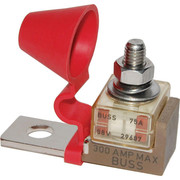
I don't show the negative load runs on the sketch but that top blue box with black dots is the negative bus bar. I don't have the positive bus bar installed, as the fuse block serves that purpose, all four runs to the distributed switch panels in different parts of the boat are separately fused there within 7" of the battery. I'm adding the breaker before it mainly as a load shut-off, I like having the supply and load breakers as isolated shut-offs next to the battery for trouble shooting.
My 1+2+all switch is still under the aft seat and is strictly a disconnect for the starter battery from the motor. I already have my second 40A fuse installed to connect the starter battery to the DC-DC converter, but it's main benefit would be to charge back from the alternator to the house battery while motoring on cloudy days, an edge case scenario in Arizona.
Completing the wiring is gonna take more time than we have on our short trips up to Lake Powell, when we're also living on the boat. We've decided that on our next trip up, we're going to put the boat in, anchor it, then drive the trailer into town and have a shop pull the axle to repair a sheared off lug and do the bearings, not something I'm going to attempt in a public lot. When it's done we'll pull the boat out and try our second tow from Lake Powell down to Lake Pleasant on the North side of Phoenix. There we can make day trips to the boat from Tucson to work on projects or day sail without it requiring planning a multi-night trip. That's the plan for the start of year two on Millennium Guppy anyway...