

Hi MacOwners,
I am looking at getting new fuel tank(s) for the Mac Gregor 26M.
I really liked the 17-gallon aluminium ones offered by BWY but they are little bit expensive.
I have a Evinrude 50hp Etec outboard what tank or tanks do other members have or would recommend that I can order in Europe?
Thanks a lot
-Agi-
Fuel Tanks 26M
-
kmclemore

- Site Admin
- Posts: 6293
- Joined: Sun Feb 08, 2004 9:24 am
- Sailboat: MacGregor 26X
- Location: Ambler, PA -- MACX2018A898 w/ Suzuki DF60AV -- 78 BW Harpoon 4.6 -- 2018 Tahoe 550TF w/ 150 Merc
Re: Fuel Tanks 26M
I own a 26X, but if you’ll check previous postings on this forum, where this has been discussed before, you’ll find that the way to go with the 26M is to buy (4) 6-gallon tanks. These are much easier to maneuver around*, easier to transport, and they fit in the 26M’s lockers. Here’s the tank that I believe fits best, but I don’t know about European availability.
Others here can confirm if this is the correct tank and perhaps opine on EU availability.
https://www.scepter.com/products/marine ... rine-tank/
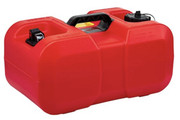
*(12 gallons of gasoline weighs about 77.2 lbs / 35 Kilos)
Others here can confirm if this is the correct tank and perhaps opine on EU availability.
https://www.scepter.com/products/marine ... rine-tank/
*(12 gallons of gasoline weighs about 77.2 lbs / 35 Kilos)
- Kevin McLemore, Mac Site Admin
-
Russ

- Admiral
- Posts: 8395
- Joined: Thu Oct 11, 2007 12:01 pm
- Sailboat: MacGregor 26M
- Location: Bozeman, Montana "Luna Azul" 2008 M 70hp Suzi
Re: Fuel Tanks 26M
Availability in Greece might be difficult. I don't know what regs and products are available there.
I do like the idea of 4 x 6 gal tanks with quick connects.
I have 2 x 12 gal moeller tanks that are aging and I'm a bit concerned.
These tanks are discussed in this thread.
viewtopic.php?f=8&t=30547&p=375261#p375261
https://www.boatid.com/moeller-marine/1 ... 013lp.html
Again, European products might be difficult to obtain. Best to measure the space and go searching, keeping in mind the top clearance of the cockpit hatch. It seems the newer tanks have caps that might exceed clearances.
I do like the idea of 4 x 6 gal tanks with quick connects.
I have 2 x 12 gal moeller tanks that are aging and I'm a bit concerned.
These tanks are discussed in this thread.
viewtopic.php?f=8&t=30547&p=375261#p375261
https://www.boatid.com/moeller-marine/1 ... 013lp.html
Again, European products might be difficult to obtain. Best to measure the space and go searching, keeping in mind the top clearance of the cockpit hatch. It seems the newer tanks have caps that might exceed clearances.
--Russ
-
Agi
- Chief Steward
- Posts: 62
- Joined: Sun Jun 01, 2025 10:44 am
- Sailboat: MacGregor 26M
- Location: Athens
Re: Fuel Tanks 26M
Thanks a lot for your answers!!!
@kmlemore didnt thought about that idea! Thanks to @RUSS I found them on amazon. Are these the correct ones?
https://www.amazon.com/Scepter-10506-Un ... B01BNBCRRS
But isn't it difficult to switch the connection? Do I have to buy something extra for this to be able to switch fast and easy?
@Russ I even like that big one, so I dont have to switch so often I have to ask the company if and what the costs will be to sent them to Greece
unfortunately I couldn't open the link the read the thread? Would it be possible to sent it again? Thanks a lot
And one last question how many km/ miles can I do with a 12 gal tank and 50hp evinrude motor ? round about?
Thanks a lot again! (sorry for these questions but I am completely new )
Corrected Amazon link. -KBM
@kmlemore didnt thought about that idea! Thanks to @RUSS I found them on amazon. Are these the correct ones?
https://www.amazon.com/Scepter-10506-Un ... B01BNBCRRS
But isn't it difficult to switch the connection? Do I have to buy something extra for this to be able to switch fast and easy?
@Russ I even like that big one, so I dont have to switch so often
I have to ask the company if and what the costs will be to sent them to Greece unfortunately I couldn't open the link the read the thread? Would it be possible to sent it again? Thanks a lot
And one last question how many km/ miles can I do with a 12 gal tank and 50hp evinrude motor ? round about?
Thanks a lot again! (sorry for these questions but I am completely new
)Corrected Amazon link. -KBM
-
Agi
- Chief Steward
- Posts: 62
- Joined: Sun Jun 01, 2025 10:44 am
- Sailboat: MacGregor 26M
- Location: Athens
Re: Fuel Tanks 26M
This is what I found on amazon.com:
"Scepter 6 Gallon Portable Marine Gas Can, Boat Fuel Tank with 2-Way Vented Cap, Built-In Fuel Gauge and Pick-Up, Top Handle, EPA & CARB Compliant, Underseat Design, 19.3"L x 12.2"W x 10.2"H (10511)"
Are these the correct ones @ klcmelore
"Scepter 6 Gallon Portable Marine Gas Can, Boat Fuel Tank with 2-Way Vented Cap, Built-In Fuel Gauge and Pick-Up, Top Handle, EPA & CARB Compliant, Underseat Design, 19.3"L x 12.2"W x 10.2"H (10511)"
Are these the correct ones @ klcmelore
-
OverEasy
- Admiral
- Posts: 3000
- Joined: Mon Sep 28, 2020 11:16 am
- Sailboat: MacGregor 26X
- Location: NH & SC
Re: Fuel Tanks 26M
Hi Agi!
The choice of maximizing fuel capacity with a pair of large tanks 12 gallon tanks vs a quad old smaller 6 gallon tanks is an interesting topic.
There are merits for each approach.
The four smaller 6 gallon tanks does make it much easier to get tanks filled ashore both on/off the boat but moving four tanks can pose its own creative challenges. The pair of larger 12 gallon tanks are generally a bit much to move around for just about anyone and tend I think to be more along the lines of fixed in placed applications where they are refueled from a fuel dock type facility for the most part although portable transfer tanks with wheels are available. Either way it’s a lot of weight to contend with.
We have a Mac26X with dual 12 gallon tanks that we leave in place and use the marina refueling dock when afloat and when ashore we refuel at the gas station pull through. That it what works for us.
To fuel consumption of an Evinrude 50 hp is a kinda subjective thing to estimate as it depends on how fast you want to go.
It’s kinda hard to provide an estimate.
Your maximum range is going to be better at slower water speeds like under 6 mph which is the generic hull speed for a Mac26M or Mac26X. As you know Hull resistance increases as through water speed increases up to where the hull is up on plane (which I understand may be a bit higher with an M vs. an X) at which point the resistance diminishes somewhat.
There is also the aspect of what particular engine model you have. I believe that the most fuel efficient Evinrude was the E-TEC version that has been reported to consume about 4.5 to 4.7 gal/hr at full throttle. So assuming a conservative 12 mph that could give you about 2.67 miles per gallon or roughly a 64 mile through the water range for 24 gallons of fuel.
An older version 50 hp 2-stroke engine may consume 5.5 gallons per hour (or more) at full power. So in that case a conservative 12 mph could give you a 2.18 miles per gallon or roughly a 52 mile through the water range for 24 gallons of fuel.
That’s a 12 mile difference in estimated range.
Note that the term ‘through the water’ is my attempt to address the aspect of water current. A boat only cares about the water it is moving through… it doesn’t care about relative ground speed. One way to address that is to periodically take a moment to look at your indicated GPS (which gives you your relative ground speed) at a particular boat heading then turn the boat around 180 degrees (at the same engine power setting) to go in the exact opposite direction for a minute and see what your indicated GPS ground speed now is. The difference is the water current speed you are moving through. So if your first ground speed is 12 mph and your second speed is 9 mph then you are moving with a current of about 3 mph in your first direction for that given power setting. This is an important aspect to consider when wanting to estimate your anticipated fuel range.
We do this as we do our cruises primarily on tidal river estuaries subject to tidal current reversals throughout the day/night that can change dramatically. The basic river seaward flow is about 2 mph. A lowering tide at peak flow can add about 2 to 4 mph to that (depending upon where we are) to give an out going current of about 4 to 6 mph at peak. A rising tide on the other hand would give a water speed of about 2 to 4 mph in the opposite direction at peak flow. So when attempting to estimate what the anticipated ground map range we can accomplish for a given amount of fuel it’s an important aspect to consider.
As a personal practice when motor cruising we plan our trips on the 1/3 fuel rule.
—> For day trips it’s 1/3 of the initial fuel available for the out bound leg. 1/3 of the initial fuel available for the return leg. 1/3 of the initial fuel available for reserve to address any SNAFUS (and hopefully avoid any FUBARS).
—> For distance point to point trip travels we calculate our worst case condition for water current flow and plan our destinations based off of no more than 2/3 of the initial fuel capacity to maintain at least a 1/3 of initial fuel capacity as reserve to address any SNAFUS (and hopefully avoid any FUBARS).
And then there are the direction and strength winds to consider……


Hope this might have been useful.
You have a very interesting and beautiful region of the world to be out on the water!
Please post pictures!
Best Regards,
Over Easy
The choice of maximizing fuel capacity with a pair of large tanks 12 gallon tanks vs a quad old smaller 6 gallon tanks is an interesting topic.
There are merits for each approach.
The four smaller 6 gallon tanks does make it much easier to get tanks filled ashore both on/off the boat but moving four tanks can pose its own creative challenges. The pair of larger 12 gallon tanks are generally a bit much to move around for just about anyone and tend I think to be more along the lines of fixed in placed applications where they are refueled from a fuel dock type facility for the most part although portable transfer tanks with wheels are available. Either way it’s a lot of weight to contend with.
We have a Mac26X with dual 12 gallon tanks that we leave in place and use the marina refueling dock when afloat and when ashore we refuel at the gas station pull through. That it what works for us.
To fuel consumption of an Evinrude 50 hp is a kinda subjective thing to estimate as it depends on how fast you want to go.
It’s kinda hard to provide an estimate.
Your maximum range is going to be better at slower water speeds like under 6 mph which is the generic hull speed for a Mac26M or Mac26X. As you know Hull resistance increases as through water speed increases up to where the hull is up on plane (which I understand may be a bit higher with an M vs. an X) at which point the resistance diminishes somewhat.
There is also the aspect of what particular engine model you have. I believe that the most fuel efficient Evinrude was the E-TEC version that has been reported to consume about 4.5 to 4.7 gal/hr at full throttle. So assuming a conservative 12 mph that could give you about 2.67 miles per gallon or roughly a 64 mile through the water range for 24 gallons of fuel.
An older version 50 hp 2-stroke engine may consume 5.5 gallons per hour (or more) at full power. So in that case a conservative 12 mph could give you a 2.18 miles per gallon or roughly a 52 mile through the water range for 24 gallons of fuel.
That’s a 12 mile difference in estimated range.
Note that the term ‘through the water’ is my attempt to address the aspect of water current. A boat only cares about the water it is moving through… it doesn’t care about relative ground speed. One way to address that is to periodically take a moment to look at your indicated GPS (which gives you your relative ground speed) at a particular boat heading then turn the boat around 180 degrees (at the same engine power setting) to go in the exact opposite direction for a minute and see what your indicated GPS ground speed now is. The difference is the water current speed you are moving through. So if your first ground speed is 12 mph and your second speed is 9 mph then you are moving with a current of about 3 mph in your first direction for that given power setting. This is an important aspect to consider when wanting to estimate your anticipated fuel range.
We do this as we do our cruises primarily on tidal river estuaries subject to tidal current reversals throughout the day/night that can change dramatically. The basic river seaward flow is about 2 mph. A lowering tide at peak flow can add about 2 to 4 mph to that (depending upon where we are) to give an out going current of about 4 to 6 mph at peak. A rising tide on the other hand would give a water speed of about 2 to 4 mph in the opposite direction at peak flow. So when attempting to estimate what the anticipated ground map range we can accomplish for a given amount of fuel it’s an important aspect to consider.
As a personal practice when motor cruising we plan our trips on the 1/3 fuel rule.
—> For day trips it’s 1/3 of the initial fuel available for the out bound leg. 1/3 of the initial fuel available for the return leg. 1/3 of the initial fuel available for reserve to address any SNAFUS (and hopefully avoid any FUBARS).
—> For distance point to point trip travels we calculate our worst case condition for water current flow and plan our destinations based off of no more than 2/3 of the initial fuel capacity to maintain at least a 1/3 of initial fuel capacity as reserve to address any SNAFUS (and hopefully avoid any FUBARS).
And then there are the direction and strength winds to consider……
Hope this might have been useful.
You have a very interesting and beautiful region of the world to be out on the water!
Please post pictures!
Best Regards,
Over Easy
-
kmclemore
- Site Admin
- Posts: 6293
- Joined: Sun Feb 08, 2004 9:24 am
- Sailboat: MacGregor 26X
- Location: Ambler, PA -- MACX2018A898 w/ Suzuki DF60AV -- 78 BW Harpoon 4.6 -- 2018 Tahoe 550TF w/ 150 Merc
Re: Fuel Tanks 26M
Yep, they are the ones. Here's a link to the manufacturer's page on them:Agi wrote: ↑Fri Sep 26, 2025 6:27 am This is what I found on amazon.com:
"Scepter 6 Gallon Portable Marine Gas Can, Boat Fuel Tank with 2-Way Vented Cap, Built-In Fuel Gauge and Pick-Up, Top Handle, EPA & CARB Compliant, Underseat Design, 19.3"L x 12.2"W x 10.2"H (10511)
Are these the correct ones @ klcmelore
https://www.scepter.com/products/marine ... rine-tank/
- Kevin McLemore, Mac Site Admin
-
kmclemore
- Site Admin
- Posts: 6293
- Joined: Sun Feb 08, 2004 9:24 am
- Sailboat: MacGregor 26X
- Location: Ambler, PA -- MACX2018A898 w/ Suzuki DF60AV -- 78 BW Harpoon 4.6 -- 2018 Tahoe 550TF w/ 150 Merc
Re: Fuel Tanks 26M
The advantage to individual 6-gallon tanks is that you can get them filled on shore and carry them aboard... petrol is usually much less expensive on land than at a marina. The savings over time could be considerable.
Not difficult to do at all. The tank takes a quick-connect that can be switched very rapidly. Here is a link to the type of quick-connect. You can likely find something similar in your local boat supply store.
https://www.scepter.com/products/marine ... connector/
That really depends on how you motor! If you run at about 2000-2800 rpms, or, as Rich noted, at about 6 mph / 10 Kph, where most Mac's often do best in terms of miles-per-gallon / Km-per-liter, then you'll get much better mileage than if you run at wide open throttle. The weight of your boat with all your modifications, how many people and how much equipment is on board the boat, how clean your boat's bottom is, any tidal or water flow currents, the weather & wind conditions, and the type and condition of your motor all play a BIG part in how much mileage you'll get. This is something you'll have to discover with your own boat, and nobody can give you a truly accurate number on that, and even a reasonable guess may be far off from what you experience on your boat. As Rich noted, though, always leave yourself plenty of 'reserve' petrol on any trip, as you may burn more than you think!
- Kevin McLemore, Mac Site Admin
-
Agi
- Chief Steward
- Posts: 62
- Joined: Sun Jun 01, 2025 10:44 am
- Sailboat: MacGregor 26M
- Location: Athens
Re: Fuel Tanks 26M
Thanks a lot for all your answers!!!
Unbelievable what a great energy in this group is!
@Overeasy -> I will not forget to post pictures as soon as everything is ready ( I think that it will take several months until the boat is finally on my name and is ready to "sail" (have to make the boat first ready because it was standing still the last 15years in a parking area outside the sea). But the motor is good I checked it by an mechanic of Evinrude it has only 18hours on it.
I found this fuel tank 25 liter:
https://www.nuovarade.com/product.php?p ... goryId=222
Code Title Capacity Length Width Height Fuel Gauge
44789 Fuel Portable Tank 25lt w/Gauge & Filter 25lt 440mm 295mm 210mm Yes
When I compare the diameters with the fuel tanks that you sent me 2 of them should fit in the MacGregor 26M in each side.
That would be really great than I would have in total (4x25lit) 100 liters.
What do you think?
Should I buy even for this fuel tanks this connector @kmclemore?
Universal Marine Tank Fittings, 11553, 3/8" Barb Female, 1/4" Male NPT Quick Connector
And is there something else that I should buy for the fuel tanks extra?
Maybe even another question: (As you see I have really no idea!
Sorry for that! But I do my best to learn as fast as possible and really appreciate your help!!!
What battery would you recommend me? What would be the best that I could buy for such a boat? I am not planning to place solars at this moment.
I am thinking to buy a portable power station and connect it to a solar panel? What do you think about this idea? Or should I place solar pannels on the boat and connect it to the batteries? I find it a very difficult decision. I can imagine that this is something that I cant do it on my own and I will have to call an electrician for boats and they are very expensive.
Thanks a lot
-Agi-
Unbelievable what a great energy in this group is!
@Overeasy -> I will not forget to post pictures
as soon as everything is ready ( I think that it will take several months until the boat is finally on my name and is ready to "sail" (have to make the boat first ready because it was standing still the last 15years in a parking area outside the sea). But the motor is good I checked it by an mechanic of Evinrude it has only 18hours on it. I found this fuel tank 25 liter:
https://www.nuovarade.com/product.php?p ... goryId=222
Code Title Capacity Length Width Height Fuel Gauge
44789 Fuel Portable Tank 25lt w/Gauge & Filter 25lt 440mm 295mm 210mm Yes
When I compare the diameters with the fuel tanks that you sent me 2 of them should fit in the MacGregor 26M in each side.
That would be really great than I would have in total (4x25lit) 100 liters.
What do you think?
Should I buy even for this fuel tanks this connector @kmclemore?
Universal Marine Tank Fittings, 11553, 3/8" Barb Female, 1/4" Male NPT Quick Connector
And is there something else that I should buy for the fuel tanks extra?
Maybe even another question: (As you see I have really no idea!
Sorry for that! But I do my best to learn as fast as possible and really appreciate your help!!!
What battery would you recommend me? What would be the best that I could buy for such a boat? I am not planning to place solars at this moment.
I am thinking to buy a portable power station and connect it to a solar panel? What do you think about this idea? Or should I place solar pannels on the boat and connect it to the batteries? I find it a very difficult decision. I can imagine that this is something that I cant do it on my own and I will have to call an electrician for boats and they are very expensive.
Thanks a lot
-Agi-
-
kurz

- Admiral
- Posts: 1321
- Joined: Mon Dec 06, 2010 9:07 am
- Sailboat: MacGregor 26M
- Location: Zürich, Switzerland, Europe
Re: Fuel Tanks 26M
Power
Go with a Power Station. Will work.
One of my first mods was Solar and fridfe Box...
I have two 50w Solar Panels AT the Stock arch for the Mast. you can See IT in the mods section. So nothing is to Do. Power is there... This is Gokd for me aß I am so lazy.
Go with a Power Station. Will work.
One of my first mods was Solar and fridfe Box...
I have two 50w Solar Panels AT the Stock arch for the Mast. you can See IT in the mods section. So nothing is to Do. Power is there... This is Gokd for me aß I am so lazy.
-
OverEasy
- Admiral
- Posts: 3000
- Joined: Mon Sep 28, 2020 11:16 am
- Sailboat: MacGregor 26X
- Location: NH & SC
Re: Fuel Tanks 26M
Hi Agi!
Currently batteries (pun intended ) are in a state of flux with all the different variations of design, construction and chemistry. Making a comprehensive list with the various advantages/disadvantages would be a bit daunting.
I would be cautious though about it when it comes to your engine start battery.
Your Evinrude engine was designed for use with a 12 Volt DC lead acid battery for both starting AND charging.
That said it might be best to simply stick with the original 12 Volt lead-acid batteries when it comes to the engine related aspect.
If you really need a separate LiFe or other exotic battery system for you “house” use you may find it beneficial to have that on an entirely different circuit from your engine.
Other battery types have different voltages that will most likely cause potentially significant problems for your existing engine.
Not even sure that there is even a possible means of modification that would reliably address those issues.
LiFe batteries of the type generally used for general marine run at around 14.6 Volt DC. This is 2.6 volts higher than the stater or alternator/generator of your Evinrude engine was designed to operate.. the excess voltage will over tax the starter motor windings… maybe not initially but it will over repeated uses. The alternator/generator voltage regulation system will never reach the 14.6 volts that the LiFe battery wants to get to… this will potentially adversely impact both the LiFe battery as well as the alternator/generator voltage regulation system.
There are several articles I read where consequential damage has occurred to engines due to the inherent voltage aspects.
From what I’ve read in passing (not a through, definitive or exhaustive investigation by any means):
To deal with the starter issues compensate for that one would have to source a specialized high current DC-to-DC converter or power resistor to drop the the voltage upper limit to 12 Volts DC.
To deal with the aspect of the alternator/generator voltage regulation a couple of things have to be accounted for… the alternator/generator was designed for 12 Volts DC so those field coils need to be provided with that voltage, not 14.6 volts…. Then the output from the engine voltage regulator (whose output was designed to go into a 12 volt lead acid battery) will need a DC-to-DC converter to step up the voltage to 14.6 volts… then there is the aspect of how to not have the engine charging system running full-on all the time even though the LiFe battery is charged.
There are several others on the forum with MUCH more in-depth knowledge and practical experience that can better address this aspect.
All I am saying is be cautious in your approach to avoid disappointment or equipment damage.
Might I suggest that you actually try using your vessel in as simple a configuration to start with and then evoke it as your particular use/needs lead you?
The equipment is constantly changing which brings new options to market.
Best Regards,
Over Easy
Currently batteries (pun intended
) are in a state of flux with all the different variations of design, construction and chemistry. Making a comprehensive list with the various advantages/disadvantages would be a bit daunting.I would be cautious though about it when it comes to your engine start battery.
Your Evinrude engine was designed for use with a 12 Volt DC lead acid battery for both starting AND charging.
That said it might be best to simply stick with the original 12 Volt lead-acid batteries when it comes to the engine related aspect.
If you really need a separate LiFe or other exotic battery system for you “house” use you may find it beneficial to have that on an entirely different circuit from your engine.
Other battery types have different voltages that will most likely cause potentially significant problems for your existing engine.
Not even sure that there is even a possible means of modification that would reliably address those issues.
LiFe batteries of the type generally used for general marine run at around 14.6 Volt DC. This is 2.6 volts higher than the stater or alternator/generator of your Evinrude engine was designed to operate.. the excess voltage will over tax the starter motor windings… maybe not initially but it will over repeated uses. The alternator/generator voltage regulation system will never reach the 14.6 volts that the LiFe battery wants to get to… this will potentially adversely impact both the LiFe battery as well as the alternator/generator voltage regulation system.
There are several articles I read where consequential damage has occurred to engines due to the inherent voltage aspects.
From what I’ve read in passing (not a through, definitive or exhaustive investigation by any means):
To deal with the starter issues compensate for that one would have to source a specialized high current DC-to-DC converter or power resistor to drop the the voltage upper limit to 12 Volts DC.
To deal with the aspect of the alternator/generator voltage regulation a couple of things have to be accounted for… the
alternator/generator was designed for 12 Volts DC so those field coils need to be provided with that voltage, not 14.6 volts…. Then the output from the engine voltage regulator (whose output was designed to go into a 12 volt lead acid battery) will need a DC-to-DC converter to step up the voltage to 14.6 volts… then there is the aspect of how to not have the engine charging system running full-on all the time even though the LiFe battery is charged.There are several others on the forum with MUCH more in-depth knowledge and practical experience that can better address this aspect.
All I am saying is be cautious in your approach to avoid disappointment or equipment damage.
Might I suggest that you actually try using your vessel in as simple a configuration to start with and then evoke it as your particular use/needs lead you?
The equipment is constantly changing which brings new options to market.
Best Regards,
Over Easy
-
Agi
- Chief Steward
- Posts: 62
- Joined: Sun Jun 01, 2025 10:44 am
- Sailboat: MacGregor 26M
- Location: Athens
Re: Fuel Tanks 26M
Thanks guys for your answers 
That’s a very interesting point „OverEasy“ and you are right
first I will focus on bringing and starting the MacGregor that’s more than enough for the beginning.
I will a battery only for the engine and if I do in the future modifications I will use a different circle and batteries.
Which battery would you recommend me only for the engine?
Which would be the biggest and the best that I could take and that will even last long ?
?
Would you recommend me to have even two batteries for the engine? Or is one enough?
Thanks again

That’s a very interesting point „OverEasy“ and you are right
first I will focus on bringing and starting the MacGregor that’s more than enough for the beginning.
I will a battery only for the engine and if I do in the future modifications I will use a different circle and batteries.
Which battery would you recommend me only for the engine?
Which would be the biggest and the best that I could take and that will even last long
 ?
? Would you recommend me to have even two batteries for the engine? Or is one enough?
Thanks again
-
kurz
- Admiral
- Posts: 1321
- Joined: Mon Dec 06, 2010 9:07 am
- Sailboat: MacGregor 26M
- Location: Zürich, Switzerland, Europe
Re: Fuel Tanks 26M
Just to say...
I have just ONE Battery for starting the mercury60 Ob, and
I also use it for the rest like fridge, AP...
It is a lifepo4.
It is the Winston Life Y Po 4.
No electronics inside. Direct wiring.
60Ah
Much less weight than lead.
Works now for 4 years.
No change in Motor or Solar Regulator.
Easy peasy,
I have just ONE Battery for starting the mercury60 Ob, and
I also use it for the rest like fridge, AP...
It is a lifepo4.
It is the Winston Life Y Po 4.
No electronics inside. Direct wiring.
60Ah
Much less weight than lead.
Works now for 4 years.
No change in Motor or Solar Regulator.
Easy peasy,
-
OverEasy
- Admiral
- Posts: 3000
- Joined: Mon Sep 28, 2020 11:16 am
- Sailboat: MacGregor 26X
- Location: NH & SC
Re: Fuel Tanks 26M
Hi Agi & Kurz!
Regarding battery type… Personally I use a dual Battery system on our Mac26X with switches to control tandem or singular use and charging.
We use dual purpose MARINE grade Start/Store batteries.
These are designed to operated in the kinetic dynamics of a bouncing heeling boat.
With this setup we can charge one battery while using the other which can allow us to always have one fully charged battery for starting purposes… I don’t know about you but I’d personally like to avoid hand pull starting a 60hp outboard while out on the water.
As mentioned the exotic battery arena is growing and some may have developed systems that can work with engines designed for 12 volts but I’d also caution to look carefully at the ‘fine print’ and specifications. Not knowing the specifics of what Kurz is operating I’m not in a position to critique anything specifically. Because something works for the moment isn’t to say it isn’t going to be problematic or that damage inflicted doesn’t have an accumulative effect.
Many old outboard engines are bone head simple without any electronics and only a magneto ignition/charging system.
There are now also many older outboards that DO have engine control modules and solid state ignition as well as alternators and digital voltage regulators that were engineered specifically for 12 volt DC.
Add to that there are newer outboards with even more advanced digital ignition and engine control modules and charging systems that were designed for 12 volt DC.
There is a large variety of potential variability and capability out there but have a common feature of being designed an built to operate within a 12 volt DC environment. At this time I’m not aware of and internal combustion ,2-stroke or 4-stroke, outboard engine that was designed to operate on/in anything other than 12 volt DC environment. That’s not to say people haven’t been able to get away with things outside of the manufacturers design, but what damage may occur or when it may can be challenging to predict.
What I can relate is what I’ve read and experienced …
I’ve known of automotive engine control module frying with the mere connection to 14.6 Volt LiFe or other Lithium batteries.
I’ve also known of automotive alternator/voltage regulators being over tasked with attempting to charge 14.6 LiFe or other Lithium batteries.
I’ve also known of entertainment and communication radio systems getting smoked when connected to 14.6 volt LeFe or other Lithium batteries.
An engine ignition or engine control module can be a PITA to replace.
An alternator and or voltage regulator system can also be a PITA to replace.
Either can also be expensive and will inevitably occur when it’s needed…
So from my perspective why would I deliberately choose to potentially stress a working functional system especially when the functional benefit is so limited?
The battery Kurz is utilizing might have worked out how to provide just 12 volts output for starting and may also have the capability of internally changing 12 volts to 14.6 volts and not over task tge charging system of the engine. At this moment I just don’t know.
For my application which is cruising locally and for extended durations I’ve found that a pair of standard 12 volt lead-acid batteries is both reliable and affordable as well as operating within the engine manufacturer’s specifications/recommendations.
If at sometime in the future we ever decide to need more than what we currently have then we’d probably consider a prepackaged system like a Jackery (sp?) or other similar system with a built in inverter for house use along with mated solar panels. The capability, cost and reliability of these prepackaged systems are making them more affordable by the day (not factoring the ever changing dynamic aspects of tariffs which is a consideration as of late… it’s just the reality of things today).
As said before, it’s your boat and your rules.
Best Regards,
Over Easy
Regarding battery type… Personally I use a dual Battery system on our Mac26X with switches to control tandem or singular use and charging.
We use dual purpose MARINE grade Start/Store batteries.
These are designed to operated in the kinetic dynamics of a bouncing heeling boat.
With this setup we can charge one battery while using the other which can allow us to always have one fully charged battery for starting purposes… I don’t know about you but I’d personally like to avoid hand pull starting a 60hp outboard while out on the water.
As mentioned the exotic battery arena is growing and some may have developed systems that can work with engines designed for 12 volts but I’d also caution to look carefully at the ‘fine print’ and specifications. Not knowing the specifics of what Kurz is operating I’m not in a position to critique anything specifically. Because something works for the moment isn’t to say it isn’t going to be problematic or that damage inflicted doesn’t have an accumulative effect.
Many old outboard engines are bone head simple without any electronics and only a magneto ignition/charging system.
There are now also many older outboards that DO have engine control modules and solid state ignition as well as alternators and digital voltage regulators that were engineered specifically for 12 volt DC.
Add to that there are newer outboards with even more advanced digital ignition and engine control modules and charging systems that were designed for 12 volt DC.
There is a large variety of potential variability and capability out there but have a common feature of being designed an built to operate within a 12 volt DC environment. At this time I’m not aware of and internal combustion ,2-stroke or 4-stroke, outboard engine that was designed to operate on/in anything other than 12 volt DC environment. That’s not to say people haven’t been able to get away with things outside of the manufacturers design, but what damage may occur or when it may can be challenging to predict.
What I can relate is what I’ve read and experienced …
I’ve known of automotive engine control module frying with the mere connection to 14.6 Volt LiFe or other Lithium batteries.
I’ve also known of automotive alternator/voltage regulators being over tasked with attempting to charge 14.6 LiFe or other Lithium batteries.
I’ve also known of entertainment and communication radio systems getting smoked when connected to 14.6 volt LeFe or other Lithium batteries.
An engine ignition or engine control module can be a PITA to replace.
An alternator and or voltage regulator system can also be a PITA to replace.
Either can also be expensive and will inevitably occur when it’s needed…
So from my perspective why would I deliberately choose to potentially stress a working functional system especially when the functional benefit is so limited?
The battery Kurz is utilizing might have worked out how to provide just 12 volts output for starting and may also have the capability of internally changing 12 volts to 14.6 volts and not over task tge charging system of the engine. At this moment I just don’t know.
For my application which is cruising locally and for extended durations I’ve found that a pair of standard 12 volt lead-acid batteries is both reliable and affordable as well as operating within the engine manufacturer’s specifications/recommendations.
If at sometime in the future we ever decide to need more than what we currently
have then we’d probably consider a prepackaged system like a Jackery (sp?) or other similar system with a built in inverter for house use along with mated solar panels. The capability, cost and reliability of these prepackaged systems are making them more affordable by the day (not factoring the ever changing dynamic aspects of tariffs which is a consideration as of late… it’s just the reality of things today).As said before, it’s your boat and your rules.
Best Regards,
Over Easy
-
kurz
- Admiral
- Posts: 1321
- Joined: Mon Dec 06, 2010 9:07 am
- Sailboat: MacGregor 26M
- Location: Zürich, Switzerland, Europe
Re: Fuel Tanks 26M
Why you Talk about 14.6V from my lifepo4? If it was like this, you could not load.
Lead is 12.5 to 12.8V. My Winston is 13.0 to 13.2V fully loaded.
You get Problems with overheating your alternator, of you have the Lifepo4 AT an alternator that can give 80A. So the lifepo4 will suck this 80A for a longer time than a lead Battery and IT can overheat.
In my Case IT is not possible, as the OB gives max 10A in the Winston. this is so less so that it dies not get Much heat.
Winston will not work in modern car intelligent Systems. The let the lead Batteries AT 80%loaded, and whyle braking the System loads. As a Winston has a little higher voltage IT will never get loaded as VW thinks the Battery is full.
I am Lucky having a Motor that does Not 'think' to Much.
Lead is 12.5 to 12.8V. My Winston is 13.0 to 13.2V fully loaded.
You get Problems with overheating your alternator, of you have the Lifepo4 AT an alternator that can give 80A. So the lifepo4 will suck this 80A for a longer time than a lead Battery and IT can overheat.
In my Case IT is not possible, as the OB gives max 10A in the Winston. this is so less so that it dies not get Much heat.
Winston will not work in modern car intelligent Systems. The let the lead Batteries AT 80%loaded, and whyle braking the System loads. As a Winston has a little higher voltage IT will never get loaded as VW thinks the Battery is full.
I am Lucky having a Motor that does Not 'think' to Much.