

Now that I have started racing, I'm torn on which strategy to use on the downwind leg - dead run or broad reach?
Research seems to indicate that in the case of most boats, a broad reach provides better Velocity Made Good.
Thing is, the 26S is not "most boats". It is far lighter than other boats of its size, and drag can be minimized by raising the centerboard when running dead downwind. Also, the centerboard, being much narrower than a keel would be on a boat its size, is going to allow more side-slipping on a broad reach than dead downwind, having a negative effect on VMG.
Experience, of course, is the only way to sort this out, and my 26S seems to achieve the best VMG going dead downwind. I base this on three experiences.
In a "Fun Race" (a casual cruise along a set course to the restaurant on the other side of the lake), I was able to pass a 36' keelboat flying a spinnaker flying only my main and Genoa.
In a recent race, on the downwind leg, I was able to pass a 30' keelboat even as my foredeck crew was having trouble setting the whisker pole.
Also in a recent race, a 36' keelboat which had been gaining on us peeled off on a broad run and jibed back toward the mark. We stayed on the dead run and beat them to the mark. It seems to me that had they stayed on the downwind course they would have passed us and beat us to the mark.
Each of these situations was in very light to light air. In some cases I was employing the vang, in others not. In no instance was I raising the centerboard.
My questions to those with insight are:
1. Given that running dead downwind appears to be giving me an advantage (at least in light air), should I just stick with that, or am I sacrificing VMG with that approach?
2. Does raising the centerboard really help that much? It seems that it presents very little surface area when compared to that of the hull, but on the other had it does create some turbulence.
3. Do you think that the choice to run downwind or on a broad reach will depend on the wind speed?
Thanks in advance for your thoughts!
Strategy for downwind leg
-
Stickinthemud57

- Captain
- Posts: 786
- Joined: Thu Nov 12, 2020 7:50 am
- Sailboat: MacGregor 26S
- Location: Grapevine, Texas
- Contact:
Strategy for downwind leg
The key to inner peace is to admit you have a problem and leave it at that.
-
Jimmyt

- Admiral
- Posts: 3402
- Joined: Sat Jul 18, 2015 9:52 am
- Sailboat: MacGregor 26M
- Location: Mobile AL 2013 26M, 60 Etec
Re: Strategy for downwind leg
It would really help if you could tell us what boats you're beating instead of the general description "keel boat". But, you can compare PHRF numbers (you are in the low 200's likely), and see if you are supposed to be beating them. For example, an island Packet 31, with a PHRF of 201, might be a good match in the right conditions. However, in light conditions, the lighter boat (you) is likely to have an advantage. A j/30, on the other hand, (PHRF ~140), should walk away from you. Of course, there is the variable of how good each skipper and crew are.
In the little bit of class racing I've done, I have never seen a boat break off and reach on the downwind leg. Everyone ran downwind; in our class and the others. The other legs were a hodge-podge of approaches - broad reach at higher boat speed and closer reach at lower boat speed - each looking for best vmg to the mark. All that to say, if it's a downwind leg and your boat is good downwind, I'd stick with it until it proves to be a bad idea. It's hard for me to imagine broad reaching and gybing being faster than running DDW on a true downwind course. If the wind shifts after the race starts, that's another matter. I would stick with running DDW regardless of wind speed (again, unless wind direction changes after the race starts).
Raising and lowering dagger boards, swing keels, etc. is going to be an interesting question. Personally, I don't think the juice is worth the squeeze. I'd stick to sail trim and strategy. Plus, you are adding one more chance to screw up when you round the mark (forgetting to drop the keel or dagger). But, that's just my opinion.
Are you using any sort of chart plotter or other racing navigation aid that gives you vmg toward each mark?
In the little bit of class racing I've done, I have never seen a boat break off and reach on the downwind leg. Everyone ran downwind; in our class and the others. The other legs were a hodge-podge of approaches - broad reach at higher boat speed and closer reach at lower boat speed - each looking for best vmg to the mark. All that to say, if it's a downwind leg and your boat is good downwind, I'd stick with it until it proves to be a bad idea. It's hard for me to imagine broad reaching and gybing being faster than running DDW on a true downwind course. If the wind shifts after the race starts, that's another matter. I would stick with running DDW regardless of wind speed (again, unless wind direction changes after the race starts).
Raising and lowering dagger boards, swing keels, etc. is going to be an interesting question. Personally, I don't think the juice is worth the squeeze. I'd stick to sail trim and strategy. Plus, you are adding one more chance to screw up when you round the mark (forgetting to drop the keel or dagger). But, that's just my opinion.
Are you using any sort of chart plotter or other racing navigation aid that gives you vmg toward each mark?
Jimmyt
P-Cub-Boo
2013 26M, Etec 60, roller Genoa, roller main
Cruising Waters: Mobile Bay, Western Shore, Fowl River
P-Cub-Boo
2013 26M, Etec 60, roller Genoa, roller main
Cruising Waters: Mobile Bay, Western Shore, Fowl River
-
Jimmyt
- Admiral
- Posts: 3402
- Joined: Sat Jul 18, 2015 9:52 am
- Sailboat: MacGregor 26M
- Location: Mobile AL 2013 26M, 60 Etec
Re: Strategy for downwind leg
In the matter of broad reaching vs running on the downwind leg, if you had polars for your boat, you might be able to refine your strategy. Not sure you can generalize that VMG will be better on a broad reach, all things considered, for all boats and wind speeds.
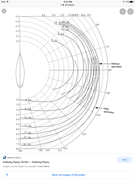
Taking the polars for a Hallberg-Rassy 39 (grabbed at random), we can see that at 8 kn wind speed, we can do 4 kn boat speed DDW with our spinnaker. If we crack off 45 deg (135 on polar), we can now make 5.7 kn boat speed - which gives us about 4.02 kn VMG. So, we maybe gained a grinch by cracking off and getting our boat speed up, but we added a gybe with a spinnaker.
At 12 kn wind, 5.65 kn DDW. Crack off to 135 and boat speed is 7.1 kn. VMG is 5.0 kn. So, at this wind speed, DDW appears to be the better choice.
In short, it's complicated.
Disclaimer: Not an extremely experienced racer or tactician.
Taking the polars for a Hallberg-Rassy 39 (grabbed at random), we can see that at 8 kn wind speed, we can do 4 kn boat speed DDW with our spinnaker. If we crack off 45 deg (135 on polar), we can now make 5.7 kn boat speed - which gives us about 4.02 kn VMG. So, we maybe gained a grinch by cracking off and getting our boat speed up, but we added a gybe with a spinnaker.
At 12 kn wind, 5.65 kn DDW. Crack off to 135 and boat speed is 7.1 kn. VMG is 5.0 kn. So, at this wind speed, DDW appears to be the better choice.
In short, it's complicated.
Disclaimer: Not an extremely experienced racer or tactician.
Jimmyt
P-Cub-Boo
2013 26M, Etec 60, roller Genoa, roller main
Cruising Waters: Mobile Bay, Western Shore, Fowl River
P-Cub-Boo
2013 26M, Etec 60, roller Genoa, roller main
Cruising Waters: Mobile Bay, Western Shore, Fowl River
-
Stickinthemud57
- Captain
- Posts: 786
- Joined: Thu Nov 12, 2020 7:50 am
- Sailboat: MacGregor 26S
- Location: Grapevine, Texas
- Contact:
Re: Strategy for downwind leg
Good point. I need to take notes next time!
True dat...Jimmyt wrote: ↑Wed Jul 13, 2022 1:09 pm Raising and lowering dagger boards, swing keels, etc. is going to be an interesting question. Personally, I don't think the juice is worth the squeeze. I'd stick to sail trim and strategy. Plus, you are adding one more chance to screw up when you round the mark (forgetting to drop the keel or dagger). But, that's just my opinion.
Not to that level yet. Trying not to get anymore spendy than I already tend to be!
Yeah, I could not seem to find any polars for the 26S (no big shock there).
I think I may just keep my eyes open and see if anyone else employs that technique successfully. The one time I saw it done it did not seem to work.
The key to inner peace is to admit you have a problem and leave it at that.
Re: Strategy for downwind leg
All things being equal, a sailboat traveling at around 130 to 135% off the wind will be faster than going directly downwind.
-
Jimmyt
- Admiral
- Posts: 3402
- Joined: Sat Jul 18, 2015 9:52 am
- Sailboat: MacGregor 26M
- Location: Mobile AL 2013 26M, 60 Etec
Re: Strategy for downwind leg
As the polars clearly show... However, I believe the question was; how should he run the downwind leg of a race? Should he sail at 130-135 (or some other heading) for higher boat speed, gybing to the mark, or 180 straight toward the mark; to achieve the highest VMG to the mark - if it's a true downwind leg?
For those that are a tad rusty in trigonometry, if you have a true downwind leg, and you crack off to 135 (wind angle), your boat speed will be faster than DDW. However, you are now sailing a course that takes you wide of the mark. So, your VMG (velocity made good) or speed that's getting you closer to the mark; is only 0.707 x boat speed (for 135 to wind only - other angles have other adjustments - based on cosine of wind angle). In our Hallberg Rassy example, at lower wind speed, VMG was close to equal - although gybing a 39 foot boat with full sail, flying a spinnaker might eat up the small VMG advantage. At any rate, the higher wind speed showed VMG was clearly better sailing DDW.
If we only had polars for our boats...

Jimmyt
P-Cub-Boo
2013 26M, Etec 60, roller Genoa, roller main
Cruising Waters: Mobile Bay, Western Shore, Fowl River
P-Cub-Boo
2013 26M, Etec 60, roller Genoa, roller main
Cruising Waters: Mobile Bay, Western Shore, Fowl River
Re: Strategy for downwind leg
Sail the leg at 130 to 135. Dead downwind is the slowest point of sail. You do not need polars to tell you this.
There is no such thing as a true downwind leg, especially when sailing on a lake.
When my daughter was ready to learn to sail and race on her own, I purposely sent her to a two-week-long sailing school on a medium-sized lake at the foot of a mountain range.
If you want to learn how the wind behaves and how it impacts your boat, lake sailing is king. I'll take a seasoned lake sailor as a navigator any day of the week.
There is no such thing as a true downwind leg, especially when sailing on a lake.
When my daughter was ready to learn to sail and race on her own, I purposely sent her to a two-week-long sailing school on a medium-sized lake at the foot of a mountain range.
If you want to learn how the wind behaves and how it impacts your boat, lake sailing is king. I'll take a seasoned lake sailor as a navigator any day of the week.
-
Stickinthemud57
- Captain
- Posts: 786
- Joined: Thu Nov 12, 2020 7:50 am
- Sailboat: MacGregor 26S
- Location: Grapevine, Texas
- Contact:
Re: Strategy for downwind leg
Thank you, one and all, for your responses. Little gems in each one!
There are several aspects to this question that make answering it in any definitive fashion tricky at best, and maybe impossible.
1. The Mac 26S is not a popular racing boat ( ), thus lacks the analytical tools like polars and/or the collective experience of those who race them.
2. Even if (1) were not the case, other factors would come into play - Genoa or 100% jib, wind speed, leg distance, crew proficiency, skill at the helm, and others.
3. Without any other S's to go up against, testing the strategy in real time is just not practical.
As a beginning racer I accede to the notion that I must initially follow the boats in front of me and emulate them, learning the basics of sailing, rules, and strategy. After that comes learning the strengths and weaknesses inherent to my particular boat, and exploit or avoid them as appropriate. Sometimes there are shortcuts (drawing from the experience of others), but sometimes there's nothing but hard-won personal experience.
Keep it coming, learning with each response...
There are several aspects to this question that make answering it in any definitive fashion tricky at best, and maybe impossible.
1. The Mac 26S is not a popular racing boat (
), thus lacks the analytical tools like polars and/or the collective experience of those who race them.2. Even if (1) were not the case, other factors would come into play - Genoa or 100% jib, wind speed, leg distance, crew proficiency, skill at the helm, and others.
3. Without any other S's to go up against, testing the strategy in real time is just not practical.
As a beginning racer I accede to the notion that I must initially follow the boats in front of me and emulate them, learning the basics of sailing, rules, and strategy. After that comes learning the strengths and weaknesses inherent to my particular boat, and exploit or avoid them as appropriate. Sometimes there are shortcuts (drawing from the experience of others), but sometimes there's nothing but hard-won personal experience.
Keep it coming, learning with each response...
The key to inner peace is to admit you have a problem and leave it at that.
Re: Strategy for downwind leg
Hi Stick-
First, when you race, sail selection is key. You should have a 150 and blade jib. If cost gets in the way, go for the 150. Attempting to race with only a jib is like racing a car without tires.
Second: Don't try to overanalyze things. It will drive you crazy.
Third: Whatever you do, do not get involved in politics. You will eventually find that grown adults behave like children when it comes to winning a $1.00 ribbon. It can get quite toxic.
Fourth: Read and re-read the rules. Then read them again. Half of the fleet will be waiting for someone to screw up so they can protest.
Fifth: You already know what the club's courses are. PRACTICE! Most winning teams are out there on non-race nights working out the kinks and testing.
If you are a numbers guy, forget about the PHRF ratings. The Mac S/D will never sail to those numbers. The 26 S/D, Catalina 250 WB, and Hunter 260 are all water-ballasted boats and have almost identical PHRFs. The Catalina will be the fastest due to its masthead rig and location and shape of its daggerboard.
First, when you race, sail selection is key. You should have a 150 and blade jib. If cost gets in the way, go for the 150. Attempting to race with only a jib is like racing a car without tires.
Second: Don't try to overanalyze things. It will drive you crazy.
Third: Whatever you do, do not get involved in politics. You will eventually find that grown adults behave like children when it comes to winning a $1.00 ribbon. It can get quite toxic.
Fourth: Read and re-read the rules. Then read them again. Half of the fleet will be waiting for someone to screw up so they can protest.
Fifth: You already know what the club's courses are. PRACTICE! Most winning teams are out there on non-race nights working out the kinks and testing.
If you are a numbers guy, forget about the PHRF ratings. The Mac S/D will never sail to those numbers. The 26 S/D, Catalina 250 WB, and Hunter 260 are all water-ballasted boats and have almost identical PHRFs. The Catalina will be the fastest due to its masthead rig and location and shape of its daggerboard.
-
Stickinthemud57
- Captain
- Posts: 786
- Joined: Thu Nov 12, 2020 7:50 am
- Sailboat: MacGregor 26S
- Location: Grapevine, Texas
- Contact:
Re: Strategy for downwind leg
Thanks for all of that!
By "blade jib" and am assuming you mean a 100%, correct? I have one and use it when wind is above about 15 MPH. Much higher than that and weather helm becomes an issue. Tricky part there is which is more important, clean sailing on windward leg or 50% more foresail on downward. Maybe having more "rail meat" would help.
Good point on fractional vs masthead rigs. I have my eye on an upgrade offered by BWY that moves the top of the jib much closer to the top, increases the square footage of the jib, and and allows it to run inside the lifelines. Including LiteSkin sails, that upgrade is just under $3600, half of what I paid for the boat. To me, it seems a tad crazy to spend that much just to improve the racing ability of a not-built-for-racing boat. Perhaps I need to remind myself that hobbies and rational behavior often go hand-in-hand.
+1 on reading the rules. I have them on my phone and review them often. We are cut a good deal of slack in Fleet 7, but once I go to a regular fleet, I will be held to a higher standard.
I hear you regarding the borderline toxic mentality of some racers. You would think it is the America's Cup given the amount of money and energy they put into what is supposed to be a fun hobby. Type A personalities can be perplexing to us more laid-back types.
There are so many factors that PHRF can't possibly address that I don't put a whole lot of stock in it. I do get a kick from out-sailing boats that are supposed to be faster than mine, though.
In the end, it's all about a fun day on the water with like-minded people. I intend to stay focussed on that!
By "blade jib" and am assuming you mean a 100%, correct? I have one and use it when wind is above about 15 MPH. Much higher than that and weather helm becomes an issue. Tricky part there is which is more important, clean sailing on windward leg or 50% more foresail on downward. Maybe having more "rail meat" would help.
Good point on fractional vs masthead rigs. I have my eye on an upgrade offered by BWY that moves the top of the jib much closer to the top, increases the square footage of the jib, and and allows it to run inside the lifelines. Including LiteSkin sails, that upgrade is just under $3600, half of what I paid for the boat. To me, it seems a tad crazy to spend that much just to improve the racing ability of a not-built-for-racing boat. Perhaps I need to remind myself that hobbies and rational behavior often go hand-in-hand.
+1 on reading the rules. I have them on my phone and review them often. We are cut a good deal of slack in Fleet 7, but once I go to a regular fleet, I will be held to a higher standard.
I hear you regarding the borderline toxic mentality of some racers. You would think it is the America's Cup given the amount of money and energy they put into what is supposed to be a fun hobby. Type A personalities can be perplexing to us more laid-back types.
There are so many factors that PHRF can't possibly address that I don't put a whole lot of stock in it. I do get a kick from out-sailing boats that are supposed to be faster than mine, though.
In the end, it's all about a fun day on the water with like-minded people. I intend to stay focussed on that!
The key to inner peace is to admit you have a problem and leave it at that.
Re: Strategy for downwind leg
A blade jib is a completely different animal when compared to a standard working jib.
It's a tall, skinny sail with a high clew. Battens along the leech aid in shape.
It is flown inside the stays and requires tracks and cars (like the X and M) to further shape the sail based on wind conditions.
The sail is used primarily for upwind legs in a race.
It's a tall, skinny sail with a high clew. Battens along the leech aid in shape.
It is flown inside the stays and requires tracks and cars (like the X and M) to further shape the sail based on wind conditions.
The sail is used primarily for upwind legs in a race.
-
Newell

- First Officer
- Posts: 439
- Joined: Sat Feb 07, 2004 1:42 pm
- Sailboat: MacGregor 26X
- Location: Layton, Utah, 96X Fast Sunday, 89D Windancer
Re: Strategy for downwind leg
Just catching up on this post.
"If you are a numbers guy, forget about the PHRF ratings. The Mac S/D will never sail to those numbers. The 26 S/D, Catalina 250 WB, and Hunter 260 are all water-ballasted boats and have almost identical PHRFs. The Catalina will be the fastest due to its masthead rig and location and shape of its daggerboard." PSNA
My 26D has never been passed or beaten in a informal or sanctioned race by any of the above. I have placed behind a J24 and U20. Mostly, I have beaten the C250 WB with my 26X. Your mileage may vary.
"If you are a numbers guy, forget about the PHRF ratings. The Mac S/D will never sail to those numbers. The 26 S/D, Catalina 250 WB, and Hunter 260 are all water-ballasted boats and have almost identical PHRFs. The Catalina will be the fastest due to its masthead rig and location and shape of its daggerboard." PSNA
My 26D has never been passed or beaten in a informal or sanctioned race by any of the above. I have placed behind a J24 and U20. Mostly, I have beaten the C250 WB with my 26X. Your mileage may vary.
Newell
Fast Sunday 96X Windancer 89D
Fast Sunday 96X Windancer 89D
-
Stickinthemud57
- Captain
- Posts: 786
- Joined: Thu Nov 12, 2020 7:50 am
- Sailboat: MacGregor 26S
- Location: Grapevine, Texas
- Contact:
Re: Strategy for downwind leg
I don't consider myself a numbers guy, but when you outsail a boat and beat it to the finish line by exactly 1 minute only to find out their PHRF puts them 43 seconds ahead of you, you realize that race outcomes are sometimes determined by PHRF. Ask me how I know.Newell wrote: ↑Sun Feb 05, 2023 7:51 pm Just catching up on this post.
"If you are a numbers guy, forget about the PHRF ratings. The Mac S/D will never sail to those numbers. The 26 S/D, Catalina 250 WB, and Hunter 260 are all water-ballasted boats and have almost identical PHRFs. The Catalina will be the fastest due to its masthead rig and location and shape of its daggerboard." PSNA
My 26D has never been passed or beaten in a informal or sanctioned race by any of the above. I have placed behind a J24 and U20. Mostly, I have beaten the C250 WB with my 26X. Your mileage may vary.
I am confident that I will do well against the cruisers, and don't expect to outsail the J-boats. For me, it's all about fun and improving myself and my crew.
The key to inner peace is to admit you have a problem and leave it at that.
-
KingRichard
- Deckhand
- Posts: 37
- Joined: Fri Jul 01, 2022 4:48 pm
- Sailboat: MacGregor 26S
- Location: Reno, NV
Re: Strategy for downwind leg
Good thread!
Back to one of your original comments/questions/thoughts. Paraphrasing - Does the 26S tend more toward being faster DDW than other boats? As the owner of one, I think yes. It really has that gut feel, which is why I suspect you asked. I for one am glad to know someone else had the same idea.
Playing with my spinnaker like a kite the boat even seems to start to lift, like more than expected... As for the keel I could go either way, but given the man power I would, however not at the expense of well trimmed sails. Also, my keel is aft rigged, to just below the tiller handle, so that's an option.
One final thought - I've had my boat for awhile and put in a small bilge/sink/deck hosing off pump. When I dream of racing, I imagine myself pumping the ballast going DDW
Back to one of your original comments/questions/thoughts. Paraphrasing - Does the 26S tend more toward being faster DDW than other boats? As the owner of one, I think yes. It really has that gut feel, which is why I suspect you asked. I for one am glad to know someone else had the same idea.
Playing with my spinnaker like a kite the boat even seems to start to lift, like more than expected... As for the keel I could go either way, but given the man power I would, however not at the expense of well trimmed sails. Also, my keel is aft rigged, to just below the tiller handle, so that's an option.
One final thought - I've had my boat for awhile and put in a small bilge/sink/deck hosing off pump. When I dream of racing, I imagine myself pumping the ballast going DDW
-
Stickinthemud57
- Captain
- Posts: 786
- Joined: Thu Nov 12, 2020 7:50 am
- Sailboat: MacGregor 26S
- Location: Grapevine, Texas
- Contact:
Re: Strategy for downwind leg
I would say my 26S as rigged is a bit faster than the other boats in my non-spinnaker fleet, DDW or otherwise.KingRichard wrote: ↑Wed Feb 08, 2023 8:26 pm Good thread!
Back to one of your original comments/questions/thoughts. Paraphrasing - Does the 26S tend more toward being faster DDW than other boats? As the owner of one, I think yes. It really has that gut feel, which is why I suspect you asked. I for one am glad to know someone else had the same idea.
Playing with my spinnaker like a kite the boat even seems to start to lift, like more than expected... As for the keel I could go either way, but given the man power I would, however not at the expense of well trimmed sails. Also, my keel is aft rigged, to just below the tiller handle, so that's an option.
One final thought - I've had my boat for awhile and put in a small bilge/sink/deck hosing off pump. When I dream of racing, I imagine myself pumping the ballast going DDW
Question - what do you mean when you say your keel is "aft rigged"? 26S, correct?
The key to inner peace is to admit you have a problem and leave it at that.