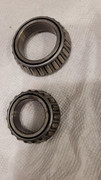
I lost a bearing on the highway on the way to launch this year. I knew that I had to change it, because I felt a little roughness in the rotation when I took the trailer off its jackstands this year. I store the trailer with the weight off of the wheels, and spin the wheels as often as weather allows. In my spring wheel-spin I could tell that the wheel was rough. So, lesson learned: don't ignore even the smallest roughness in a wheel verification.
I made it safely off the highway with the wheel attached, but it came off in my hands when removing the lugs. It was just the rust around the brake drums that kept the wheel attached as I exited the highway.
A ratchet-strap is a good piece of kit to have, to strap up an axle to the frame (on a dual axle trailer) if one wheel departs. So is a 12V air pump and extension cord, to bring the remaining single-tire up to its max-load pressure (I run at 50 PSI on 4 wheels, but on 3 the single wheel should be at 65 psi). I'm also going to add two Bulldog trailer jacks welded on to the trailer frame just behind the axles. They will be used instead of a jack for the next inevitable problem, and also make storing the trailer easier. The SUV jack is just barely up to the task, and takes a lot of effort.
Here's a large-size image of the trailer on the side of the road. The stress on the remaining 50 PSI tire is apparent.
All that was left of the assembly was the castle nut and some shreaded bearing parts. The spindle was all scratched up, but still looks perfectly straight. The inner ring of the inside bearing was left on the spindle; the ring is visible in the photo below:
Parts should be here later today. I'll post progress photos.
This is the first time that I've done trailer bearing work, so I didn't know any of the parts. I didn't realize that the inner bearing ring was still attached as I first looked at it. I was able to use the hook-end of a hammer to bang the ring off of the spindle, and used a file and sandpaper to smooth out the spindle. With a bit of grease and some effort, I can now get the old ring on and off the spindle.
The new parts are on order. The bearings, cups and seals were only about $15 each, so $30 per wheel. I ordered a new back-plate and electric brake drum, and I'll post the total cost a bit later.
For those as unfamiliar as I was with the assembly, it looks like this (upper row for my trailer):
The backplate of the brake assembly (part 20) has four threaded studs that go through the four holes on the spindle (the un-numbered part on the diagram above, at the far left). There are four nuts to install from the back of the spindle to hold everything in place. I found that my brake assembly only had three of the four bolts installed, and the empty stud was well rusted showing that it had been like that for a while. I didn't even know that was something to inspect.


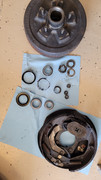


 I'm firmly in the 2x4 and hammer category!