

About every 12 to 18 months we go through the desulfation of our batteries with the desulfation mode on our battery charger. On our Sterling Power Pro Charge Ultra (sounds like a space vehicle or something) there is an equalization/de sulfation mode. Since we use the batteries for 8 to 9 months of the year, they get a lot of recharging. We use the same 4 trojan 105 six volt batteries in the boat and our converted cargo travel camper. We have used them for 6 years and they are still working just fine. We can go 4 to 6 days without charging. Not sure how much it helps but we do it. The charger puts out 15.6 volts at 6 amps and in a few minutes the batteries sound like they are boiling or bubbling. It usually runs about 4 hrs and then reverts to normal charging. They do tell you to check the fluid levels before starting and make sure they are at normal levels. You will definitely have to add water after they finish. I have never sat there and checked the volts and amps during the whole process. So not sure if it starts at 15.6 and then goes down over time or if it stays at 15.6 volts. I was wondering if anyone else did this with their batteries and how they accomplished the same task.
Richard
annual desulfation of our batteries
-
Russ

- Admiral
- Posts: 8402
- Joined: Thu Oct 11, 2007 12:01 pm
- Sailboat: MacGregor 26M
- Location: Bozeman, Montana "Luna Azul" 2008 M 70hp Suzi
Re: annual desulfation of our batteries
Very interesting.
I assume you are doing this with the batteries out of the boat as the gases are dangerous in closed areas.
I found this article that seems encouraging.
https://www.motortrend.com/how-to/impp- ... t-fiction/
I assume you are doing this with the batteries out of the boat as the gases are dangerous in closed areas.
I found this article that seems encouraging.
https://www.motortrend.com/how-to/impp- ... t-fiction/
--Russ
-
ris

- Captain
- Posts: 715
- Joined: Sat Feb 28, 2015 4:27 pm
- Sailboat: MacGregor 26X
- Location: Frostproof Florida
Re: annual desulfation of our batteries
I did not know they made devices just to do desulfation on batteries. The De Sulfation is one of the modes into which you can put the Sterling battery charger. The charger also has a temp sensor that is hooked to the batteries. We have never let our batteries get below 65% state of charge as measured by our Balmar Smart Guage. No I did not take the batteries out of the boat or their compartments. I think our Mac's are pretty ventilated even when closed up. We usually have the front hatch and companion way open when working on the boat. It has been in the 80's so we had a fan running also. I have seen engine rooms of boats with 5 times the batteries we have that charge while the motor is running and know of no problems. But we do not have a bilge pump either. We assessed the risk of no bilge pump and charging batteries the same. Not a problem. It would be interesting to know how much actual flammable gas is released form 4 six volt batteries charging from 65% charge to 100% charge. There are several articles about battery charging areas that are sealed with a couple hundred batteries up to 5000 batteries being charged that had problems when the ventilation failed. Thanks Rus for the article on desulfation devices.
Richard
Richard
-
NiceAft

- Admiral
- Posts: 6800
- Joined: Tue Feb 01, 2005 7:28 pm
- Sailboat: MacGregor 26M
- Location: Upper Dublin,PA, USA: 2005M 50hp.Honda4strk.,1979 Phantom Sport Sailboat, 9'Achilles 6HP Merc 4strk
Re: annual desulfation of our batteries
I once had a customer who was a serious collector of Corvettes. I saw six of them, he had more.
What I noticed, was that this was attached to the battery on every car.
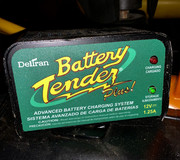
I have had one for years.
What I noticed, was that this was attached to the battery on every car.
I have had one for years.
Ray ~~_/)~~
-
Russ
- Admiral
- Posts: 8402
- Joined: Thu Oct 11, 2007 12:01 pm
- Sailboat: MacGregor 26M
- Location: Bozeman, Montana "Luna Azul" 2008 M 70hp Suzi
Re: annual desulfation of our batteries
Richard,
If you have your boat is open as you say, I'm sure ventilation is plenty adequate. The "bubbling" you describe sounds like batteries I've seen off-gassing. However, with a small amount of air movement, I'm sure it is dissipated.
This is a very interesting topic. The Motortrend article documented recovering a "dead" battery back to life with the process. If that can be done, I'm sure as working battery can be extended as well.
If you have your boat is open as you say, I'm sure ventilation is plenty adequate. The "bubbling" you describe sounds like batteries I've seen off-gassing. However, with a small amount of air movement, I'm sure it is dissipated.
This is a very interesting topic. The Motortrend article documented recovering a "dead" battery back to life with the process. If that can be done, I'm sure as working battery can be extended as well.
--Russ
-
rsvpasap

- First Officer
- Posts: 250
- Joined: Fri Dec 13, 2013 2:05 pm
- Sailboat: MacGregor 26X
- Location: Seattle, WA
Re: annual desulfation of our batteries
I have six 109 AH Walmart 27DC 12V batteries (4 under the aft dinette seat, 2 in the bow). They cost less than $100 each, are available at any Walmart and are manufactured by Johnson Controls. I generally change the older one or two batteries each year without waiting for them to fail, the oldest one is currently 4 years old. I have a ProMariner ProNautic 1250P 50 amp charger which is the same as your Sterling ("Sterling" and "Promariner" are British vs USA branding of the same chargers.) My charging sources are 200w solar, Honda eu2000i, efoy 80 and shorepower. My daily power usage is about 90 AH in summer, 120 AH in winter. I have often run the batteries down to 12.05 amps and frequently hit them with a short term load with the microwave, 1200w airfryer or even Caframo space heater on 600 or 900 watt settings for up to 20 minutes that temporarily draws them down to 11.5 amps under load (Xantrex Prowatt 2000 inverter.) I often only recharge the batteries to 80-85% (through "bulk absorption" phase only) to minimize generator run time. I equalize / desulfate the batteries twice each year using shorepower. I open the hatches, turn on the house fans and generally don't hang out in the cabin during the process. The charge rate does slowly come down from 15.6 over the four hour equalization phase. In 5+ years of doing things this way, I have never had a battery fail. If one did fail, I would just take it out of the system until I got to shore to replace it.
-
dlandersson

- Admiral
- Posts: 5023
- Joined: Fri Aug 27, 2010 10:00 am
- Sailboat: MacGregor 26X
- Location: Michigan City

-
Be Free

- Admiral
- Posts: 1981
- Joined: Fri Nov 23, 2012 6:08 pm
- Sailboat: MacGregor 26X
- Location: Steinhatchee, FL
Re: annual desulfation of our batteries
Richard,
My charger goes through an equalization process like you describe every (I think) 30 charge cycles. That works out to a couple of times a year for me. It's an important part of keeping flooded lead acid batteries in good health. Without it the electrolyte tends to become striated with a higher concentration of acid at the bottom of the battery. True deep cycle batteries (like your T105's) have more area under the plates where "crud" can fall without shorting them out. If your strongest electrolyte is concentrated in an area where there are no plates you don't get the efficiency you need out of them. As the electrolyte heats up convection will mix the electrolyte back to an even concentration throughout the cell. The higher current also helps to move some of the lead sulfate crystals back into solution. It is the formation of lead sulfate in the battery that is the usual "killer" of true deep cycle batteries.
Nice Aft,
The battery tender you show in your picture is another part of good FLA battery health. The primary cause of battery sulfation is leaving the battery in a discharged state. The battery tender provides a low current source to the battery at just above the battery full-charge voltage. This keeps the battery "topped up" electrically and greatly reduces the formation of lead sulfate on the plates. Marine/RV chargers have this function built into the main charger. Cars and motorcycles that are not used often will benefit greatly from having them connected between uses.
My charger goes through an equalization process like you describe every (I think) 30 charge cycles. That works out to a couple of times a year for me. It's an important part of keeping flooded lead acid batteries in good health. Without it the electrolyte tends to become striated with a higher concentration of acid at the bottom of the battery. True deep cycle batteries (like your T105's) have more area under the plates where "crud" can fall without shorting them out. If your strongest electrolyte is concentrated in an area where there are no plates you don't get the efficiency you need out of them. As the electrolyte heats up convection will mix the electrolyte back to an even concentration throughout the cell. The higher current also helps to move some of the lead sulfate crystals back into solution. It is the formation of lead sulfate in the battery that is the usual "killer" of true deep cycle batteries.
Nice Aft,
The battery tender you show in your picture is another part of good FLA battery health. The primary cause of battery sulfation is leaving the battery in a discharged state. The battery tender provides a low current source to the battery at just above the battery full-charge voltage. This keeps the battery "topped up" electrically and greatly reduces the formation of lead sulfate on the plates. Marine/RV chargers have this function built into the main charger. Cars and motorcycles that are not used often will benefit greatly from having them connected between uses.
Bill
2001 26X Simple Interest
Honda BF40D
"If I were in a hurry I would not have bought a sailboat." Me
2001 26X Simple Interest
Honda BF40D
"If I were in a hurry I would not have bought a sailboat." Me
-
OverEasy
- Admiral
- Posts: 3021
- Joined: Mon Sep 28, 2020 11:16 am
- Sailboat: MacGregor 26X
- Location: NH & SC
Re: annual desulfation of our batteries
Nice post on desupidation of flooded lead acid (FLA) batteries.
We have a golf cart with batteries that have sat for at least 10+ years that would be a good test of how effective this technology could be….
There are I believe eight 6-volt deep cycle batteries.
Replacements would cost about $275 each or $2000 total.
One of these desulfurization charger/RE conditioners would cost less than one of these batteries.
We’ll see if we can give this a try towards the end of January and let you all know how it turns out.
Nothing ventured, nothing gained ….. but the use of the golf cart that has been taking up space for the past decade…
Thanks!
Best Regards
Over Easy


We have a golf cart with batteries that have sat for at least 10+ years that would be a good test of how effective this technology could be….
There are I believe eight 6-volt deep cycle batteries.
Replacements would cost about $275 each or $2000 total.
One of these desulfurization charger/RE conditioners would cost less than one of these batteries.
We’ll see if we can give this a try towards the end of January and let you all know how it turns out.
Nothing ventured, nothing gained ….. but the use of the golf cart that has been taking up space for the past decade…
Thanks!
Best Regards
Over Easy


-
opie

- Captain
- Posts: 895
- Joined: Tue Nov 16, 2004 5:40 am
- Sailboat: MacGregor 26X
- Location: Wilmington, NC
Re: annual desulfation of our batteries
Ris,
I suggest using a hygrometer to check your batteries' specific gravity. Also, since you mentioned the brand, I read everything I could on the Trojan 105 website technical section and learned a few things. One is, equalization (desulfation) needs to be done more often than your schedule, in most cases.
I suggest using a hygrometer to check your batteries' specific gravity. Also, since you mentioned the brand, I read everything I could on the Trojan 105 website technical section and learned a few things. One is, equalization (desulfation) needs to be done more often than your schedule, in most cases.
-
Be Free
- Admiral
- Posts: 1981
- Joined: Fri Nov 23, 2012 6:08 pm
- Sailboat: MacGregor 26X
- Location: Steinhatchee, FL
Re: annual desulfation of our batteries
+1 on the hydrometer. It's the only way to really know the actual health of the battery. In the end what goes on inside a battery is a chemical reaction and the hydrometer let's you know if you still have enough of the raw components in solution to sustain that reaction after the battery is charged.opie wrote: ↑Thu Dec 30, 2021 3:54 am Ris,
I suggest using a hygrometer to check your batteries' specific gravity. Also, since you mentioned the brand, I read everything I could on the Trojan 105 website technical section and learned a few things. One is, equalization (desulfation) needs to be done more often than your schedule, in most cases.
Everything I've read seems to indicate that 12 to 18 months is a bit long to wait between equalization charges but you can't argue with his results. If he's gotten 6 years out of them (so far) that's right at the top end of the expected lifetime for a T105. If it ain't broke...
Bill
2001 26X Simple Interest
Honda BF40D
"If I were in a hurry I would not have bought a sailboat." Me
2001 26X Simple Interest
Honda BF40D
"If I were in a hurry I would not have bought a sailboat." Me
-
opie
- Captain
- Posts: 895
- Joined: Tue Nov 16, 2004 5:40 am
- Sailboat: MacGregor 26X
- Location: Wilmington, NC
Re: annual desulfation of our batteries
BeFree,
Thanks for your gentle way of pointing out my incorrect 'hygrometer' reference.
Yes, you can't argue with success.
Thanks for your gentle way of pointing out my incorrect 'hygrometer' reference.
Yes, you can't argue with success.
-
OverEasy
- Admiral
- Posts: 3021
- Joined: Mon Sep 28, 2020 11:16 am
- Sailboat: MacGregor 26X
- Location: NH & SC
Re: annual desulfation of our batteries
Hi Opie!
Your not the only one to have gained a bit of knowledge reading up on desulfidation…
I learned that my “old” tech charger and charging one battery at a time was doing something similar to the desulfidation process when occasionally charging at the high rate (start) setting. From what I’ve read the occasional high current setting would have been driving the sulfide toon back into solution as verified by the regular checking with a hydrometer. Apparently my “new” tech smart charger doesn’t act in a similar way due to not having a high (start) charge rate as well as having different charging circuitry.
“Old” charger has a distinctive pulsating DC oscilloscope trace (like my Dad’s half wave tube rectifier glow in the dark battery charger) while “new” charger has much more of a less distinct (if not flat) waveform.
Still, the desulfidation units have nice battery temp probes and other aspects that are good things to have been specifically designed to address desulfidation.
Best Regards
Over Easy
Your not the only one to have gained a bit of knowledge reading up on desulfidation…
I learned that my “old” tech charger and charging one battery at a time was doing something similar to the desulfidation process when occasionally charging at the high rate (start) setting. From what I’ve read the occasional high current setting would have been driving the sulfide toon back into solution as verified by the regular checking with a hydrometer. Apparently my “new” tech smart charger doesn’t act in a similar way due to not having a high (start) charge rate as well as having different charging circuitry.
“Old” charger has a distinctive pulsating DC oscilloscope trace (like my Dad’s half wave tube rectifier glow in the dark battery charger) while “new” charger has much more of a less distinct (if not flat) waveform.
Still, the desulfidation units have nice battery temp probes and other aspects that are good things to have been specifically designed to address desulfidation.
Best Regards
Over Easy
-
Be Free
- Admiral
- Posts: 1981
- Joined: Fri Nov 23, 2012 6:08 pm
- Sailboat: MacGregor 26X
- Location: Steinhatchee, FL
Re: annual desulfation of our batteries
I confuse them so often I had to double check myself. I actually used the wrong term in my original draft.
Bill
2001 26X Simple Interest
Honda BF40D
"If I were in a hurry I would not have bought a sailboat." Me
2001 26X Simple Interest
Honda BF40D
"If I were in a hurry I would not have bought a sailboat." Me
-
ris
- Captain
- Posts: 715
- Joined: Sat Feb 28, 2015 4:27 pm
- Sailboat: MacGregor 26X
- Location: Frostproof Florida
Re: annual desulfation of our batteries
Thanks for telling me I might need to do this more often. I have not studied the info about Trojan 105 batteries. I will do this. I have read that some sailors get 10,12 even 15 years out of their open lead acid batteries. The key to this is checking fluid levels, using distilled water and never letting them get to 50% or less on state of charge.