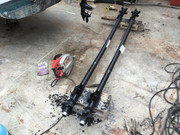
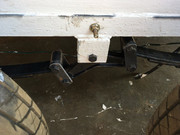
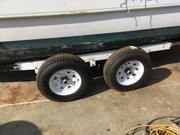
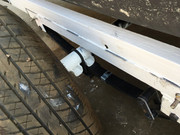
Personally I think it’s great that Sheppie62 has upgraded his trailer with those really nice axles and springs.
His allowing for axle adjustment is very perceptive of the need to take into account the uniqueness of a vessel that has been and will be modified to suit an owners desires.
Those are a great improvement over some of the trailers we looked at under the MacGregors we looked at in our search.
The POs of OverEasy did a great job selecting the twin axle galvanized bolted SeaLion trailer and we are VERY appreciative to have it.
There were several other boats we looked at where we just would not have felt they were safe to have them leave the driveways or fields they were in.
While I’ve designed, fabricated and spec’d trailers for personal and industrial use I have always appreciated other peoples constructive perspectives and the kindness they have shown in passing on good information and ideas by doing the same.
On my very first trailer to carry 3000 lbs on a single axle a mentor pointed out to me that I would be shortening the potential useful life of the design if I was to weld “C-channels” back to back as that would inevitably trap moisture and I would have no way to effectively protect those captured surfaces after welding. I heeded his advice by changing it to a spaced off design. At the same time I made up two sections, one of each design, and left them to the elements after painting. The back-to-back design was crap after about five years while the spaced one was still almost as good as new.
I later did the same for a box beam where one was weld sealed with an 1/8 inch diameter hole to simulate production weld pinholes on the bottom side and the exterior painted and the comparison one open on each end and painted inside and out. Both were grit blasted inside and out (prior to painting.) The open ended one was again nearly as good as new after five years exposure. The sealed one was a badly rust flaked interior while the outside looked fine.
I also did a set of accelerated salt fog tests on open ended box beam sections that had been vapor degreased.
Painting was accomplished utilizing a commercially available penetrating oil rust inhibiting paint.
A- One was with the original mill scale.
B- One was with the original mill scale but painted on the exterior.
C- One was with the original mill scale but painted on both the interior and exterior.
D- One was grit blasted to remove the mill scale on the exterior only and painted on the exterior.
E- One was grit blasted to remove the mill scale on the exterior only and painted on both the interior and exterior.
F- One was even grit blasted to remove the mill scale on bothe the exterior and interior and then painted on both the interior and exterior.
The best result after a 2000 hour exposure was sample F, next in descending order were E, D, C, B then worst was A.
Sample E is what was used for the production application given the substantial difficulties in being able to adequately grit blasted the interior surfaces.
Sample E was far and away superior to D, C, B and A.
The mill scale once it was compromised allowed for a trapped moisture migration path along the interface with the base metal in each case sample with mill scale.
Having a mill scale free surface performed substantially better.
Just some real world experience tid-bit that might be useful to anyone interested.
Best Regards,
Over Easy