


The discussion on sailing anarchy is a guy trying to account for the leeway in his determination of wind direction - based on his instrument readings; all so he knows whether or not to fly his spinnaker on the next leg. As I stated above, the leeway has a minimal effect on the boat velocity vector. I guess you are making the point that it is related based on the anarchy posts. If so, yes - like ragu; it's in there.
Now, to reality. What are the tolerances (accuracy, percent error, etc) of the various pieces of instrumentation he's using to attempt this calculation? Is the juice worth the squeeze? If you are worried about this level of information, you are probably a serious racer looking for that last tiny bit of edge, or you are doing mental gymnastics and inviting your fellow forum buddies to join in. Either way, it's good clean fun.
In the abstract, it's a sporty geometry problem. Trying to do an actual calculation under racing conditions, that is actually meaningful, is much trickier, as the boat heading and true velocity vector are constantly changing. Unless your wind instruments are mounted on some sort of gimbal, the angle of heel is likely to throw them off a few points (also constantly changing).
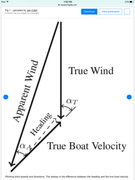
Look at the diagram below and notice the relative magnitudes of the velocity vectors, and the amount of change to the true wind calc due to a few degrees of leeway - even if you could get the instrumentation corrected to calculate it all fairly accurately. Do you really need to know true wind velocity that accurately to know whether or not to fly the spinnaker on the next leg?
The only thing I need to know is if the Admiral is tired of looking at those plain white sails and wants to see the pretty one for awhile.


 )
)