

Hi, all
The floor in the cabin our 26X 2001 has a weak/soft spot or two (gives in a bit and crackles when stepping on it), in the area between the bathroom/large bench on the aft side of the table, and the small bench (where the batteries are located) next to the "kitchen", and even a bit forward from there.
What support material is there beneath the floor? Is it possible that it has rotted and need to be replaced? If so, how to get in there?
Thanks!
Cabin floor giving in - solution?
-
richter372001

- Engineer
- Posts: 171
- Joined: Wed Oct 10, 2007 9:42 pm
- Sailboat: MacGregor 26X
- Location: SF Bay Area or Dalmatia, Croatia

-
Spector

- First Officer
- Posts: 266
- Joined: Sun Jun 10, 2012 6:53 pm
- Sailboat: MacGregor 26X
- Location: Calgary AB, 98 26X 'Cenoté' 2002 Yamaha 60 HP
- Contact:
Re: Cabin floor giving in - solution?
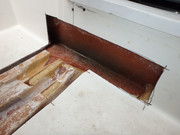
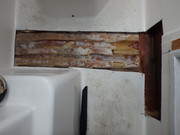
I had a ballast tank crack repaired in that area. Here are a few photos. Its foam covered with fiberglass to create ribs
Cenoté 1998 
Calgary AB
MYCBC member
Calgary AB
MYCBC member
-
NiceAft

- Admiral
- Posts: 6714
- Joined: Tue Feb 01, 2005 7:28 pm
- Sailboat: MacGregor 26M
- Location: Upper Dublin,PA, USA: 2005M 50hp.Honda4strk.,1979 Phantom Sport Sailboat, 9'Achilles 6HP Merc 4strk
Re: Cabin floor giving in - solution?
Good photos 
richter, do your faults in the floor resemble the parallel spacing of the spaces between ribs?
richter, do your faults in the floor resemble the parallel spacing of the spaces between ribs?
Ray ~~_/)~~
-
richter372001
- Engineer
- Posts: 171
- Joined: Wed Oct 10, 2007 9:42 pm
- Sailboat: MacGregor 26X
- Location: SF Bay Area or Dalmatia, Croatia
Re: Cabin floor giving in - solution?
Phew.....no pics, sorry, but there is absolutely nothing to see, anyway. And I have not really tried to test and see whether there is a pattern to the softness. The floor looks fine, but now that I've seen Spector's pics (thank you!), it seems the fiberglass ribs are collapsing.
Anyone know a possible cause? I thought water that got to the styrofoam; boy, was I off...
From the pics it seems the only way to remedy (however that could be done) the problem would be to cut the floor and get underneath?
Spector, do you happen to have photos of the floor once you covered the ribs again? How did you do it?
I would HATE to have to cut the floor. Perhaps putting some kind of a hard floor over the entire area to spread the pressure would work?
Teak?
Greetings
Srdjan
Anyone know a possible cause? I thought water that got to the styrofoam; boy, was I off...
From the pics it seems the only way to remedy (however that could be done) the problem would be to cut the floor and get underneath?
Spector, do you happen to have photos of the floor once you covered the ribs again? How did you do it?
I would HATE to have to cut the floor. Perhaps putting some kind of a hard floor over the entire area to spread the pressure would work?
Teak?
Greetings
Srdjan
-
Spector
- First Officer
- Posts: 266
- Joined: Sun Jun 10, 2012 6:53 pm
- Sailboat: MacGregor 26X
- Location: Calgary AB, 98 26X 'Cenoté' 2002 Yamaha 60 HP
- Contact:
Re: Cabin floor giving in - solution?
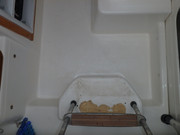
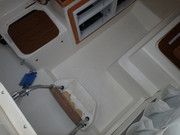
I didn't do the repair myself. A local repair place did it. They replicated the non skid pattern pretty well. Fairly standard fiberglass work involved.
Cenoté 1998
Calgary AB
MYCBC member
Calgary AB
MYCBC member
-
richter372001
- Engineer
- Posts: 171
- Joined: Wed Oct 10, 2007 9:42 pm
- Sailboat: MacGregor 26X
- Location: SF Bay Area or Dalmatia, Croatia
-
macowneril2015
- Engineer
- Posts: 193
- Joined: Tue Nov 10, 2015 5:51 pm
- Sailboat: MacGregor 26X
- Location: Downtown Chicago, 2001 26X, 2001 50 Hp Nissan (NS50D2)
Re: Cabin floor giving in - solution?
I have started having this issue as well between the galley and the part of the "booth seating" closest to the head, I was planning to inspect it further and see if I can easily remedy it.richter372001 wrote: ↑Mon May 18, 2020 10:59 am Phew.....no pics, sorry, but there is absolutely nothing to see, anyway. And I have not really tried to test and see whether there is a pattern to the softness. The floor looks fine, but now that I've seen Spector's pics (thank you!), it seems the fiberglass ribs are collapsing.
Anyone know a possible cause? I thought water that got to the styrofoam; boy, was I off...
From the pics it seems the only way to remedy (however that could be done) the problem would be to cut the floor and get underneath?
Spector, do you happen to have photos of the floor once you covered the ribs again? How did you do it?
I would HATE to have to cut the floor. Perhaps putting some kind of a hard floor over the entire area to spread the pressure would work?
Teak?
Greetings
Srdjan
-
macowneril2015
- Engineer
- Posts: 193
- Joined: Tue Nov 10, 2015 5:51 pm
- Sailboat: MacGregor 26X
- Location: Downtown Chicago, 2001 26X, 2001 50 Hp Nissan (NS50D2)
Re: Cabin floor giving in - solution?
I have started having this issue as well between the galley and the part of the "booth seating" closest to the head, I was planning to inspect it further and see if I can easily remedy it.richter372001 wrote: ↑Mon May 18, 2020 10:59 am Phew.....no pics, sorry, but there is absolutely nothing to see, anyway. And I have not really tried to test and see whether there is a pattern to the softness. The floor looks fine, but now that I've seen Spector's pics (thank you!), it seems the fiberglass ribs are collapsing.
Anyone know a possible cause? I thought water that got to the styrofoam; boy, was I off...
From the pics it seems the only way to remedy (however that could be done) the problem would be to cut the floor and get underneath?
Spector, do you happen to have photos of the floor once you covered the ribs again? How did you do it?
I would HATE to have to cut the floor. Perhaps putting some kind of a hard floor over the entire area to spread the pressure would work?
Teak?
Greetings
Srdjan

Re: Cabin floor giving in - solution?
I also cut out a section of the sole in this area. What I found was that there were bits of untrimmed fiberglass matting that the factory didn't bother to trim away. It was not an issue because it had been suspended in the foam. As the foam deterioriated, the sole began to give a little underfoot, which caused the loose matting to make that crunching sound. The good news is that it is not a sign of weakening fiberglass sole or the tank beneath. It is the loss of foam only. It is annoying, to be sure, but the only way to fix it would be to cut up the floor. Trust me, putting back the sole as nicely as the pics in this thread, matching the non-skid, is anything but routine. I am very impressed by the job done on his sole.
Last edited by svcricket on Thu Sep 10, 2020 11:58 am, edited 1 time in total.
Michael Hetzer
S/V "Cricket"
1999 26X
S/V "Cricket"
1999 26X
-
Catigale

- Site Admin
- Posts: 10421
- Joined: Fri Jun 11, 2004 5:59 pm
- Sailboat: MacGregor 26X
- Location: Admiral .............Catigale 2002X.......Lots of Harpoon Hobie 16 Skiffs....Island 17
- Contact:
Re: Cabin floor giving in - solution?
Very Faustian...I am very impressed by the job done on his sole.
-
richter372001
- Engineer
- Posts: 171
- Joined: Wed Oct 10, 2007 9:42 pm
- Sailboat: MacGregor 26X
- Location: SF Bay Area or Dalmatia, Croatia
Re: Cabin floor giving in - solution?
Here I am, some time later, just to specify that the soft spot(s) are right outside the "drawers", in the "hallway", ie. the narrow part between the galley and the centerboard housing. The part next to the step is firm, as is the part in front of the toilet door. The space between those two is soft.svcricket wrote: ↑Thu Sep 10, 2020 7:19 am I also cut out a section of the sole in this area. What I found was that there were bits of untrimmed fiberglass matting that the factory didn't bother to trim away. It was not an issue because it had been suspended in the foam. As the foam deterioriated, the sole began to give a little underfoot, which caused the loose matting to make that crunching sound. The good news is that it is not a sign of weakening fiberglass sole or the tank beneath. It is the loss of foam only. It is annoying, to be sure, but the only way to fix it would be to cut up the floor. Trust me, putting back the sole as nicely as the pics in this thread, matching the non-skid, is anything but routine. I am very impressed by the job done on his sole.
Still have not pulled the trigger to cut it. Am thinking of a wooden grid that would distribute the weight from that section to the firm surfaces....
-
OverEasy
- Admiral
- Posts: 2895
- Joined: Mon Sep 28, 2020 11:16 am
- Sailboat: MacGregor 26X
- Location: NH & SC
Re: Cabin floor giving in - solution?
Might I make a suggestion?
The problem I believe is more of an acoustic/cosmetic issue due to the overtime use deterioration of the thin fiberglass over soft ‘rubber’ foam technique that the factory originally employed to make the floor stiffener structure.
I do believe that MacGregor did design in an overall structural element tying the floor to the hull to a limited extent.
As MacGregor ‘did not’ carry this fully throughout the structure I would believe that it is of limited interface overall and primarily to give the floor a self leveling support at assembly of the interior floor shell to the hull shell. As such it isn’t a critical aspect to hull integrity or to the inner floor shell per-se.
That said I don’t believe it is necessary to cut open the floor to address the issue.
I believe that you can fix the problem with a proper application of a flexible filler foam. Preferably one that doesn’t retain water.
One material that comes to mind is “injectable isocyanurate foam” like that used to insulate basement walls. It is generally available at places like Home Depot, Lowe’s, Menards, etc…
Isocyanurate foam are relatively durable and yet are relatively rigid when cured.
An alternative would be the “GREAT STUFF POND FOAM” which is designed for water/wet environments and has a closed cell structure.
Yet another alternative is boat flotation foam which is a two part catalytic reaction foam but has to be poured in generally. When it ‘kicks-off’ it expands and conforms to the void space. This isn’t a problem generally unless constrained without an exit for the surplus to escape. (Note: If constrained it has the ability to actually jack up the floor and push down on the hull causing deformation or one, the other, or both
 which generally isn’t a good idea.
The approach would be to access the “open” channels not currently filled with the original ‘rubber” foam.
From looking at our Mac26X this can be done at either side of the interior floor as accessible from the battery-box/galley/bench on the port side. There is also access from the aft dinette bench/dinette floor/fwd dinette bench/ center access under the Vee-berth.
Once one has the spacing figured out of the non factory foam ribs one could drill small diameter access holes at either side and center of the interior walk way to insert the delivery tube for the injectable foam at roughly 6 inch or so I ntervals along the empty channels.
I would highly suggest you Firmly Apply a WIDE strip of painters tape to the floor prior to drilling the holes and leave it in place until finished injecting the foam. The tape gives you the ability to accurately mark hole locations and makes clean up much easier.
To inject the foam, Start at the center hole of a channel and inject enough foam until you see the expanding foam show up at the adjacent holes. Then skip over the adjacent hole and got to the next hole. Repeat working your way out from the center to ensure you actually fill the void but not over fill. Take your time and let the foam expand each time it is injected. Try not to over fill the void space. The foam needs to expand fully to cure properly. So you might want to work on several void channels in a sequence.
The side access give you opportunity to see that you have the foam expanded across the void channel.
NOTE: I’d suggest that you only fill the void channels involved with the felt floor softness or scrunchiness. You don’t want to make a situation where if water gets in the center section it is trapped.
- Let the foam fully cure for about 24 hours before cleaning up what has expanded through the holes.
Touching it while soft only makes a god awful mess.
- Use a couple layers of nitrile disposable gloves (that way you can peel off a dirty one and still have a clean one underneath to put a replacement glove over. Expandable foams LOVE to stick to human skin and doesn’t clean off well.
- Use a mask when drilling fiberglass and vacuum up dust as you go.
==>>PLEASE use a mask.
(I use a vacuum while drilling to avoid dust from the get go)
==>>Use safety glasses, PLEASE.
When done cleaning up make a small hollow at each injection hole about 1/8 to 1/4 inch deep into the foam.
Clean each hole surface area with a damp acetone rag (wear gloves and PPE and ventilate the area constantly with fresh air).
Have no ignition sources. Blow air INTO the cabin area so fumes DO NOT FLOW THROUGH THE FAN MOTOR.
Then you can use thinned white gel-coat in a disposable syringe (available from West Marine and other suppliers) to apply just enough mixed gel-coat to fill the hole to the top of floor surface texture. The gel-coat will generally cure flat or suck in a little and make your floor uniform without an extensive amount of fiberglass work. I’d just leave the filled holes alone after curing if you worked neatly.
Get a a beverage of your choice and sit back somewhere comfortable and realize you saved yourself a major fiberglassing headache and refinishing job that unless you do that stuff all the time is really hard to make blend in and not be noticeable forever.
The isocyanurate foam and the ‘GREAT STUUF POND FOAM” will last for decades.
Hope this helps.
Your boat/Your rules.
Regards,
Over Easy

The problem I believe is more of an acoustic/cosmetic issue due to the overtime use deterioration of the thin fiberglass over soft ‘rubber’ foam technique that the factory originally employed to make the floor stiffener structure.
I do believe that MacGregor did design in an overall structural element tying the floor to the hull to a limited extent.
As MacGregor ‘did not’ carry this fully throughout the structure I would believe that it is of limited interface overall and primarily to give the floor a self leveling support at assembly of the interior floor shell to the hull shell. As such it isn’t a critical aspect to hull integrity or to the inner floor shell per-se.
That said I don’t believe it is necessary to cut open the floor to address the issue.
I believe that you can fix the problem with a proper application of a flexible filler foam. Preferably one that doesn’t retain water.
One material that comes to mind is “injectable isocyanurate foam” like that used to insulate basement walls. It is generally available at places like Home Depot, Lowe’s, Menards, etc…
Isocyanurate foam are relatively durable and yet are relatively rigid when cured.
An alternative would be the “GREAT STUFF POND FOAM” which is designed for water/wet environments and has a closed cell structure.
Yet another alternative is boat flotation foam which is a two part catalytic reaction foam but has to be poured in generally. When it ‘kicks-off’ it expands and conforms to the void space. This isn’t a problem generally unless constrained without an exit for the surplus to escape. (Note: If constrained it has the ability to actually jack up the floor and push down on the hull causing deformation or one, the other, or both
which generally isn’t a good idea.The approach would be to access the “open” channels not currently filled with the original ‘rubber” foam.
From looking at our Mac26X this can be done at either side of the interior floor as accessible from the battery-box/galley/bench on the port side. There is also access from the aft dinette bench/dinette floor/fwd dinette bench/ center access under the Vee-berth.
Once one has the spacing figured out of the non factory foam ribs one could drill small diameter access holes at either side and center of the interior walk way to insert the delivery tube for the injectable foam at roughly 6 inch or so I ntervals along the empty channels.
I would highly suggest you Firmly Apply a WIDE strip of painters tape to the floor prior to drilling the holes and leave it in place until finished injecting the foam. The tape gives you the ability to accurately mark hole locations and makes clean up much easier.
To inject the foam, Start at the center hole of a channel and inject enough foam until you see the expanding foam show up at the adjacent holes. Then skip over the adjacent hole and got to the next hole. Repeat working your way out from the center to ensure you actually fill the void but not over fill. Take your time and let the foam expand each time it is injected. Try not to over fill the void space. The foam needs to expand fully to cure properly. So you might want to work on several void channels in a sequence.
The side access give you opportunity to see that you have the foam expanded across the void channel.
NOTE: I’d suggest that you only fill the void channels involved with the felt floor softness or scrunchiness. You don’t want to make a situation where if water gets in the center section it is trapped.
- Let the foam fully cure for about 24 hours before cleaning up what has expanded through the holes.
Touching it while soft only makes a god awful mess.
- Use a couple layers of nitrile disposable gloves (that way you can peel off a dirty one and still have a clean one underneath to put a replacement glove over. Expandable foams LOVE to stick to human skin and doesn’t clean off well.
- Use a mask when drilling fiberglass and vacuum up dust as you go.
==>>PLEASE use a mask.
(I use a vacuum while drilling to avoid dust from the get go)
==>>Use safety glasses, PLEASE.
When done cleaning up make a small hollow at each injection hole about 1/8 to 1/4 inch deep into the foam.
Clean each hole surface area with a damp acetone rag (wear gloves and PPE and ventilate the area constantly with fresh air).
Have no ignition sources. Blow air INTO the cabin area so fumes DO NOT FLOW THROUGH THE FAN MOTOR.
Then you can use thinned white gel-coat in a disposable syringe (available from West Marine and other suppliers) to apply just enough mixed gel-coat to fill the hole to the top of floor surface texture. The gel-coat will generally cure flat or suck in a little and make your floor uniform without an extensive amount of fiberglass work. I’d just leave the filled holes alone after curing if you worked neatly.
Get a a beverage of your choice and sit back somewhere comfortable and realize you saved yourself a major fiberglassing headache and refinishing job that unless you do that stuff all the time is really hard to make blend in and not be noticeable forever.
The isocyanurate foam and the ‘GREAT STUUF POND FOAM” will last for decades.
Hope this helps.
Your boat/Your rules.
Regards,
Over Easy

-
ris

- Captain
- Posts: 705
- Joined: Sat Feb 28, 2015 4:27 pm
- Sailboat: MacGregor 26X
- Location: Frostproof Florida
Re: Cabin floor giving in - solution?
Richter, my X has been making probably the same noise in that same area since 2015. We put a nice piece of carpet down the aisle and it muffles the slight noise. Also you notice the floor movement less when you walk on it. No cracks have developed so we just forget about it. It’s a boat noise not a safety issue.
Richard
Richard