


This may have wandered a little off topic, but to contuinue with the holed situation; If you have the means on board to dive over and temporarily patch the damage and make it watertight, install the companionway cover and bail the cabin out with a 5 gallon bucket.
Greg
questions about mod's safety
-
Scott

- Admiral
- Posts: 1654
- Joined: Tue May 18, 2004 12:46 pm
- Sailboat: Venture 25
- Location: 1978 Catalina 22 with all the Racing Goodies!! 4 horse fire breathing monster on the transom
We put two batteries in the forward section of the V-berth. It did require moving quite a bit of foam. All of the foam from this mod and from running wires under cockpit coaming was relocated to various locales in the boat.
There is a significant amount of unuseable space behind the lower inner liner. Some of our blocks had to be cut to thin them down enough to fit. Any that wouldnt stay put by force or friction were contact cemented in.
There is a significant amount of unuseable space behind the lower inner liner. Some of our blocks had to be cut to thin them down enough to fit. Any that wouldnt stay put by force or friction were contact cemented in.

safe upgrades
Farm and Tractor(?), sell a lot of small trailers. The trailers come stacked 3 or more high with 12"x12"x18" closed-cell bocks between them(4 per trailer). They were begging for people to take them off their hands.
I figure each one gives about 100 lbs boyancy and I got 9 to fill in every "extra" nook and cranny in my boat, plus any odds and ends foam I end up with.
If I could realistically form these block, I figure I'd be able to add a few more.
I figure each one gives about 100 lbs boyancy and I got 9 to fill in every "extra" nook and cranny in my boat, plus any odds and ends foam I end up with.
If I could realistically form these block, I figure I'd be able to add a few more.
-
Divecoz

- Admiral
- Posts: 3803
- Joined: Sat Oct 16, 2004 2:54 pm
- Sailboat: MacGregor 26M
- Location: PORT CHARLOTTE FLORIDA 05 M Mercury 50 H.P. Big Foot Bill at Boats 4 Sail is my Hero
Re: safe upgrades
SURV69 wrote:Farm and Tractor(?), sell a lot of small trailers. The trailers come stacked 3 or more high with 12"x12"x18" closed-cell bocks between them(4 per trailer). They were begging for people to take them off their hands.
I figure each one gives about 100 lbs boyancy and I got 9 to fill in every "extra" nook and cranny in my boat, plus any odds and ends foam I end up with.If I could realistically form these block, I figure I'd be able to add a few more.
You can form them with a heat gun BTW . . .
I would have no doubt that those blocks have a lot of buoyancy . . As a diver I am very Neg Buoy . . and so much as a small puff of air in the first Atm. brings me up . . and I weight over 200lbs( that is not to say I am 200 lbs neg btw ) but to see lets head out to my pool and see just how hard it is to sink one of those blocks hum very hard no doubt because its not easy to sink a noodle if you bunch it up or a small 14" diameter plastic ball. The biggest problem I have had with bringing things off the bottom was the initial breaking force . . So IMHO a little buoyancy goes a long ways in most cases.
-
Divecoz
- Admiral
- Posts: 3803
- Joined: Sat Oct 16, 2004 2:54 pm
- Sailboat: MacGregor 26M
- Location: PORT CHARLOTTE FLORIDA 05 M Mercury 50 H.P. Big Foot Bill at Boats 4 Sail is my Hero
Yes 62 lbs pcf
I guess that's nice to know but what you need to know I would think. . is what is the built-in buoyancy capabilities when new. . .and what is the buoyancy ratio of everything you have added ahhhhh that b.r. that is where it truly gets sticky . I weight over 200 lbs and sink like a rock even in salt water one breath and up I go. . the fat guy next to me may weigh 180 and needs an anchor to get down . . So knowing the buoyancy of every item is necessary ? BTW should that be sw or fw
Instead I would cut one of those block's into 1/4 and see what it will support then reduce the weight by say 10 to 15% and then for safety sake just assume everything you add is dead weight ?? That might well work and it would guarantee success especially if you find places to put all that foam . . foam open cell foam in a closed in area breeding bacteria like a science class experiment on steroids hum how do I seal the foam ? AND where does the foam really belong?? Is it wrong to turn turtle rather than sink????
I'll answer the last one. . . if its up to me sink or turn turtle just call me Tortuga Man
Instead I would cut one of those block's into 1/4 and see what it will support then reduce the weight by say 10 to 15% and then for safety sake just assume everything you add is dead weight ?? That might well work and it would guarantee success especially if you find places to put all that foam . . foam open cell foam in a closed in area breeding bacteria like a science class experiment on steroids hum how do I seal the foam ? AND where does the foam really belong?? Is it wrong to turn turtle rather than sink????
I'll answer the last one. . . if its up to me sink or turn turtle just call me Tortuga Man
-
Chip Hindes

- Admiral
- Posts: 2166
- Joined: Mon Jan 05, 2004 6:13 am
- Location: West Sand Lake, NY '01X, "Nextboat" 50HP Tohatsu
Well, if your cabin is full of water, something is already seriously wrong with your boat, so regardless of any other considerations, that's definitely a problem.Has anybody been in a Mac when the cabin filled with water...How much of a problem is this?
But to answer the implied question is, I believe: Yes, it's going to be a problem.
I believe you can assume the boat will continue to float, regardless of how much stuff you've added. There are some items that are dead, sinking weight. Anchors, motors, pots and pans, canned goods, tools and the like, certainly deadweight. But humans and much of their personal gear: clothing, bedding, packaged food, etcetera, are very close to neutrally buoyant. Some of the other stuff you might have aboard: coolers, wakeboards, extra PFDs, and like that, will provide additional floatation to counteract some of the deadweight. If it looks like you have to stay with the boat for awhile to await rescue, and your life depends on it, you need to consider jettisoning as much deadweight as you can; of course without endangering yourself or your passengers.
This only applies if you haven't (foolishly, IMO) removed a lot of the floatation.
But another question: will the boat remain bolt upright and stable, mast in the air as shown in the video, so you can sit on the cockpit seats and wait for rescue? In other than dead calm with no current, I doubt it. It might be marginally more stable in the mast up position, but in adverse weather or current- the kind of conditions in which you're likely to have filled the cabin with water in the first place- my gut feeling is that it will take very little to roll the it. If the sails are still up, once they're in the water, I believe the boat is likely to remain on its side or turtle; it might even do 360s. In whatever attitude the boat assumes, if it rolls and you're still in or near it, there's a real danger you could get tangled in the sails or rigging, held under and drowned. So, if the boat is not stable, you might even condsider entering the water (with your PFD and/or anything else that floats, of course) and moving away from it.
If you assume everything is dry weight, you'll wind up with more floatation than you need, but it will give you some margin of safety. And you need some. A boat that just barely floats at the surface will spend most of its time under it in waves.
For example, while batteries and the outboard need about 100% of their weight in bouyancy, water and fuel brought on board don't. Fuel actually gives you about 2 lbs per gallon of positive bouyancy, and the air in the tanks adds some, of course. But the tank becomes neutrally bouyant when the air and fuel float out of it. That 75 lb ice chest is at least neutrally bouyant. The ice is positive until it melts and the foam insulation is positive, possibly or probably enough to offset any negatively bouyant contents, even if it isn''t air-tight.
Much of the other stuff you bring aboard is close to neutrally bouyant when submerged. Clothing and linens, for example. While canned goods may be negative, they may partially be offset by sealed bags of food. It may be worth using a fish scale to weigh items in a swimming pool.
You want the floatation and any positively bouyant items inside the boat as high as possible so the weight like batteries sits as low underwater as possible and have a lever arm to fight the mast and boom on their tall lever arms. You want to get the sails down and off the mast, especially if they're wet. If you have vented batteries and are in saltwater, you want to stay out of the cabin and away from the chlorine gas they produce. You want the floatation distributed to keep the boat as level as possible.
Lots of things to consider, and while the odds of being swamped are extremely low, being prepared for it may turn out to be priceless.
For example, while batteries and the outboard need about 100% of their weight in bouyancy, water and fuel brought on board don't. Fuel actually gives you about 2 lbs per gallon of positive bouyancy, and the air in the tanks adds some, of course. But the tank becomes neutrally bouyant when the air and fuel float out of it. That 75 lb ice chest is at least neutrally bouyant. The ice is positive until it melts and the foam insulation is positive, possibly or probably enough to offset any negatively bouyant contents, even if it isn''t air-tight.
Much of the other stuff you bring aboard is close to neutrally bouyant when submerged. Clothing and linens, for example. While canned goods may be negative, they may partially be offset by sealed bags of food. It may be worth using a fish scale to weigh items in a swimming pool.
You want the floatation and any positively bouyant items inside the boat as high as possible so the weight like batteries sits as low underwater as possible and have a lever arm to fight the mast and boom on their tall lever arms. You want to get the sails down and off the mast, especially if they're wet. If you have vented batteries and are in saltwater, you want to stay out of the cabin and away from the chlorine gas they produce. You want the floatation distributed to keep the boat as level as possible.
Lots of things to consider, and while the odds of being swamped are extremely low, being prepared for it may turn out to be priceless.
As Chip points out, being around the rigging would be hazardous, and I'd think that would be even more so if it was loose. As long as the mast was holding it tight, I'd probably want it to stay that way. OTOH, if the mast had broken or broke loose at the base, having a cable cutter might come in handy.
-
Frank C
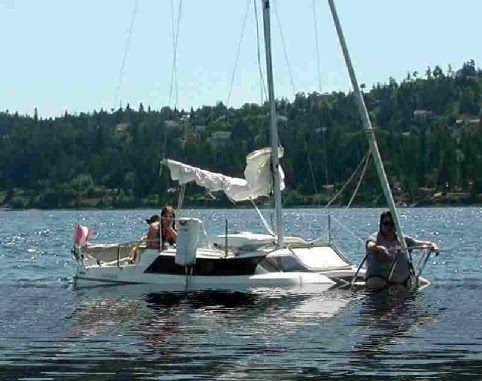
I'm pretty sure that those reports where the boat was dipping the mast, turtled or just non-self-righting were universally due to ballasting errors. The most dangerous example would be the case where ballast tank was about half-full, creating severe instability and then helping to maintain the mast at horizontal. (It's important to recognize that a leaking stern gate valve could cause partial ballast to sneak-up on us ... ).ALX357 wrote:If the boat were on its side swamped, would it be possible and a good idea to unpin the mast and forestay, pull it sternward so it doesn' continue to lever the boat over. ?
I have a picture somewhere that illustrates the 26X ACTUALLY DOES have a fair degree of stability, even when flooded. I'll post it if I can find it.

-
Frank C
-
ALX357

- Admiral
- Posts: 1231
- Joined: Thu Jul 22, 2004 6:09 am
- Location: Nashville TN -- 2000 MacGregor 26X, Mercury two-stroke 50hp
... boat is grounded, sank three feet to lie flat on the mud;  that's why guy on the bow hasn't pitch-poled it under, or turtled it......
for example, the Cumberland River looks a mile wide in places, upriver from Old Hickory Lock and Dam, channel 60 feet deep for maybe a hundred yards width, then its 4 or 5 feet deep the rest of the way over the flooded plain to the shore. One second you're over 45 feet of water, then right past the channel marker, depth finder says you could drag the centerboard. Constantly got to watch the marker buoys for when the channel crosses the river unexpectedly. OK for the X-boat, not a a good place for the M. I use bungee cord stock for the rudder hold-down lines too.
that's why guy on the bow hasn't pitch-poled it under, or turtled it...... for example, the Cumberland River looks a mile wide in places, upriver from Old Hickory Lock and Dam, channel 60 feet deep for maybe a hundred yards width, then its 4 or 5 feet deep the rest of the way over the flooded plain to the shore. One second you're over 45 feet of water, then right past the channel marker, depth finder says you could drag the centerboard. Constantly got to watch the marker buoys for when the channel crosses the river unexpectedly. OK for the X-boat, not a a good place for the M. I use bungee cord stock for the rudder hold-down lines too.