All About Boat Batteries

A forum for discussion of how to rig and tune your boat or kicker to achieve the best sailing performance.
Post Reply
User avatar
Neo
Admiral
Posts: 1093
Joined: Fri Jan 30, 2015 4:29 pm
Sailboat: MacGregor 26M
Location: Central Coast, NSW, Australia

Re: All About Boat Batteries

Post by Neo »

Inquisitor wrote: Fri Dec 18, 2020 6:01 am.....Doesn't this data permit some battery health evaluation... ??
I'm kinda reading it like there's too much (and some incomplete) data here ... so maybe it's best to go back to basics.
When it works well your battery will make a good cranking battery .... Except it is not a sealed Lead-Acid, which means it could exhale hydrogen (and other toxic gasses) while it's charging .... I'm sure you understand the "Big Bang Theory" of hydrogen applies in your Mac too :D
But putting that to one side for the moment, the first thing to consider is battery capacity retention over time. A good unused battery will still put out well over 12volts days and weeks after it's been charged.
The next thing to consider is it ability to handle a high current (heavy) load. But the load needs to be constant to get enough time to measure it effects on your battery properly. That's why I've said previously "It's worth investing in a cheap $25 battery load tester to see what happening with your battery". ....https://tinyurl.com/yyepz7k3
With your unsealed battery I'm sure you know that all cells need to be covered/topped up with distilled water (or battery water) but it's also good to check the "Specific Gravity" of the fluid to highlight a dud cell. https://tinyurl.com/y8tbqkm4

My guess is your battery has Sulfation in one or more cells. So if I owned your battery, after top-up and charging I would....
1. Wait 3 days and check the voltage and off and on a load .... and if that's not Ok I would...
2. Assume it has Sulfation and put it on am Intelligent High Voltage Pulse Charger (HVPC) ... I have one similar to this https://tinyurl.com/yaaenezv
3. Measure the Specific Gravity in each cell.

Please note a HVPC can break a battery (and any device connected to the battery at the time) ... but there's nothing to lose if the battery is not working properly anyway.

Hope all my rambling helps :|
All the best.
:macm: Neo
"Whatever floats ya boat" 8)
User avatar
Jimmyt
Admiral
Posts: 3402
Joined: Sat Jul 18, 2015 9:52 am
Sailboat: MacGregor 26M
Location: Mobile AL 2013 26M, 60 Etec

Re: All About Boat Batteries

Post by Jimmyt »

Inquisitor wrote: Fri Dec 18, 2020 6:01 am Obviously I'm changing the house side to Lithium, but I'm keeping the AutoCraft Deep Cycle Marine/RV battery (24DC-1) for the starter side. Its old... not like me old, but dog years yes. I wonder if you can help me diagnose if the battery is still something I can rely on. Here are some things I can state now, but if you need some other info, just let me know... I'll jury-rig any test you need.
  • Besides being old, a symptom that makes me question it, and that I've already mentioned somewhere... is it seems to struggle starting the Merc 60. And a little more descriptive... it seems to struggle even on the first start, but doesn't seem to get worse even after ten, twenty starting attempts. It seems like my memory of batteries in cars going bad, will hit good on the first, but by second or third attempt they weaken and are gone by the fifth.
  • A wise individual suggested to make sure the leads are clean and tight. I did on the battery side, but did not check the motor side yet. Too southern cold outside, so I took the battery out and its on my desk next to me in the warmth. :)
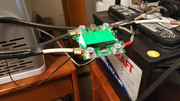
  • I'm testing a fridge for the boat viewtopic.php?f=8&t=28046 and have this gizmo to test it Image
  • Thought it might have significant info for evaluating my battery health. This is the data and everything I know. Don't know what bit is significant, so give all:
    • I did an Internet search, but it doesn't look like the current battery. One hit said it is rated at 75 - 85 amp hours.
    • I fully charged it, but don't really know when the start reading of 12.65 V was taken. Meaning... if I let it rest long enough after pulling the charger. How long is needed?
    • The test is a low current rate: Fridge pulls 2.4 amps when compressor is on, 0.09 amps when not. 62% duty cycle
    • Test is twelve hours in and used 18.74 amp-hours.
    • The voltage is down to 12.12 V whether the compressor is running and 12.24 V when not.
Doesn't this data permit some battery health evaluation... I've used some percentage of amp-hours and is this the voltage it should be at in its capacity run-down curve???
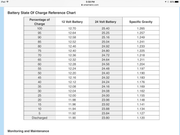
Generic resting voltages are 12.7 volts fully charged; 12.2 volts @ 50% (time to recharge for lead-acid).

You have to let the battery rest for quite awhile to get the reading (hours preferred).

The resting voltage is not an easy parameter to deal with due to the need to rest the battery to take a good reading. That's why Ray's fancy gauge uses all of that magic black box logic.

So, if you fully charged the battery and let it rest for several hours and read 12.65volts, I might not be too alarmed. If you pulled it right off the charger and read that I'd say you have an issue. When I shut off the charger, my batteries hang over 13 volts for awhile before sliding slowly to 12.7 volts.

Same issue with loading. When I load the battery, the voltage drops, sometimes to about 12.1 volts. Then, after resting, rebounds to 12.5 or 12.6 depending on the duration and magnitude obviously.

So, Neo kinda has a point that the info might be, or might not be useful in determining the condition. Taken with the cranking symptom, I'd be suspicious that it might be going bad.

If you only got 18.7 amp-hours from fully charged to 50%, then yeah that would tell us something. But those voltages would have to be resting voltages to make that determination.

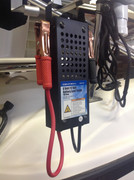
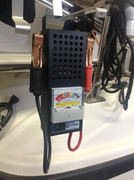
I'm gonna pile on with Neo on the load bank tester suggestion. It's crude, but it will tell you if the battery has any punch left in it. I got mine at HF and I (and my buddies) use it quite a bit.

Image

Image

I have had batteries get weak in the past, but the last several cranking batteries just fell off a cliff. My last deep cycle marine just wouldn't take a charge and give much usable power.

It's cold. Good time to go to the tool store and get a battery tester. Or, if you're isolating, a small online shopping spree!
Jimmyt
P-Cub-Boo
2013 26M, Etec 60, roller Genoa, roller main
Cruising Waters: Mobile Bay, Western Shore, Fowl River
User avatar
Inquisitor
Captain
Posts: 926
Joined: Mon Apr 23, 2007 5:24 pm
Sailboat: MacGregor 26M
Location: North Carolina Mountains

Re: All About Boat Batteries

Post by Inquisitor »

Neo wrote: Fri Dec 18, 2020 2:24 pm I'm kinda reading it like there's too much (and some incomplete) data here ... so maybe it's best to go back to basics.
Jimmyt wrote: Fri Dec 18, 2020 5:13 pm
You have to let the battery rest for quite awhile to get the reading (hours preferred).

The resting voltage is not an easy parameter to deal with due to the need to rest the battery to take a good reading. That's why Ray's fancy gauge uses all of that magic black box logic.

So, if you fully charged the battery and let it rest for several hours and read 12.65volts, I might not be too alarmed. If you pulled it right off the charger and read that I'd say you have an issue. When I shut off the charger, my batteries hang over 13 volts for awhile before sliding slowly to 12.7 volts.
Thank you both...

I saw that device posted earlier. The link's picture had no size reference and I falsely assumed it was something that fit in my hand to be so cheap. And I rationalized that... there is no way that thing can draw enough current to "load up" a 100 Ahr battery. This time, I looked further and see its quite huge. The price of that doesn't keep me from buying (we all need more toys) but I really wanted to understand and evaluate better than just BAD, GOOD. I wanted a percentage of pass/fail

I started researching more in earnest when I posted that... I knew what I puked-out was like a proper school engineering problem... you are given too much information and you have to decide what to throw away. I came across this article (https://www.scubaengineer.com/documents ... graphs.pdf) that helps me understand things. It mentions that the rest voltages can give a ballpark, but taking the reading should be done while charging or discharging which explains the need for that loading meter. However, I still don't see how that device can make a judgment call of BAD/GOOD. It seems to me like it could accurately tell you the percentage capacity the battery is sitting. But unless you know how much amp-hours have been taken out before the reading and how much is 100%, it has no way to tell BAD/GOOD. Confused. :?

Please check my logic on this... but from what I've learned so far, I think to do a quantified test, I need to:
  1. Charge it till it can't take any more.
  2. Let it rest hours? (Thanks JimmyT. I would have waited a couple of minutes)
  3. Take a reading - It should be 12.70 volts.
  4. Discharge using my amp-hour meter to get how much is being used.
  5. Get it down XX.XX volts??? (How much is a resting bounce back?)
  6. Stop discharging wait till it rests (hours?)
  7. If it rests and bounces back above 12.20 volts, go to (4) and repeat.
  8. Once its rest voltage is 12.20 volts, get the amp-hour number, multiply it by 2X and I have the amp-hours available in my battery. If its near the 75-85 amp-hours, its good enough if its like... less than 30 amp-hours, time to punt it to the road.
I know the easy way is just use the damn meter. Its cold, I'm board and I want to understand what's going on... and it really won't take much of my active participation and the boat isn't going out till Spring.
Odysseus, expert on the Siren's call
User avatar
Jimmyt
Admiral
Posts: 3402
Joined: Sat Jul 18, 2015 9:52 am
Sailboat: MacGregor 26M
Location: Mobile AL 2013 26M, 60 Etec

Re: All About Boat Batteries

Post by Jimmyt »

You are correct. The load tester will only tell you that your battery can deliver "X" amps under load when fully charged. You test it for just a few seconds. The load is a resistor bank that might smoke the first time you use it (mine did). It's a good way to check a cranking battery or a dual purpose battery that has a cranking amp rating on the label. It is a fully-charged surge test only.

1. Fully charge battery
2. Perform load test
3. Pass/fail

You are looking for higher definition view, which I can certainly appreciate. Further, if you have true deep cycle batteries, cranking amp testing might not tell you the whole story.

The test you propose seems logical. I'm not sure whether the amp-hour rating is at complete discharge, or some other state of charge. You may have a basis for assuming that the amp-hour rating is to full discharge, but that would be new information to me. All of that to say, once you've done your test and have amp-hours to 50% charge, do you multiply by 2? Intuitively, that doesn't seem correct for lead-acid batteries that shouldn't be discharged below 50%. I would have assumed that the amp-hour rating was down to the recommended safe state of charge. But maybe the marketing guys decided the bigger number would sell more batteries... :? Please let me know if you have found the definition of the amp-hour rating that describes final state of charge.

Generic lead-acid resting voltage chart.

Image

Interesting article. It is likely that Ray's magic gauge is using families of these type curves to determine state of charge.
Jimmyt
P-Cub-Boo
2013 26M, Etec 60, roller Genoa, roller main
Cruising Waters: Mobile Bay, Western Shore, Fowl River
User avatar
Inquisitor
Captain
Posts: 926
Joined: Mon Apr 23, 2007 5:24 pm
Sailboat: MacGregor 26M
Location: North Carolina Mountains

Re: All About Boat Batteries

Post by Inquisitor »

Jimmyt wrote: Sat Dec 19, 2020 8:09 am You are correct. The load tester will only tell you that your battery can deliver "X" amps under load when fully charged. You test it for just a few seconds. The load is a resistor bank that might smoke the first time you use it (mine did). It's a good way to check a cranking battery or a dual purpose battery that has a cranking amp rating on the label. It is a fully-charged surge test only.

1. Fully charge battery
2. Perform load test
3. Pass/fail

You are looking for higher definition view, which I can certainly appreciate. Further, if you have true deep cycle batteries, cranking amp testing might not tell you the whole story.

The test you propose seems logical. I'm not sure whether the amp-hour rating is at complete discharge, or some other state of charge. You may have a basis for assuming that the amp-hour rating is to full discharge, but that would be new information to me. All of that to say, once you've done your test and have amp-hours to 50% charge, do you multiply by 2? Intuitively, that doesn't seem correct for lead-acid batteries that shouldn't be discharged below 50%. I would have assumed that the amp-hour rating was down to the recommended safe state of charge. But maybe the marketing guys decided the bigger number would sell more batteries... :? Please let me know if you have found the definition of the amp-hour rating that describes final state of charge.

Generic lead-acid resting voltage chart.

Image

Interesting article. It is likely that Ray's magic gauge is using families of these type curves to determine state of charge.
Doing some more surfing, it appears no-one wants to admit what they do. I universally saw where they don't want you going below 50% if you want to use your battery next month. To me that says do the test above and the amp-hour I get is what I never go below, but also marketing says they count that bottom 50% to make it sound impressive.

Many of my searches come to these guys - https://batteryuniversity.com/learn/art ... _batteries

I guess I just assumed that the hour rating of a battery was to full discharge and I didn't want to do that because of the damage it does to the battery. One reference said that doing 100% discharge even on a deep-cycle brought it down to a mere 130 cycles! OUCH. But I will keep looking and will note a reference if I find it.
Odysseus, expert on the Siren's call
User avatar
Inquisitor
Captain
Posts: 926
Joined: Mon Apr 23, 2007 5:24 pm
Sailboat: MacGregor 26M
Location: North Carolina Mountains

Re: All About Boat Batteries

Post by Inquisitor »

OK... enough reading.

I'm going to try to get a real-world number that counts and document it here. Here are the steps I'm going to perform in case someone wants to achieve the same end-goal OR for me to do something extra OR to keep me from doing something stupid!
  1. My charger is just an old Craftsman 2/10/50 amp unit.
  2. In progress now - I'm going to use the 50 amp setting. The meter says its actually outputting around 12 amps. Hopefully this might reduce any Sulfation I have going on.
  3. According to the charging chart https://www.scubaengineer.com/documents ... graphs.pdf and this being about C/5 for the battery, I need to charge up to about 15.9 volts indicated... by my cheasy free Harbor Freight volt meter.
  4. Let the battery rest and document it as it drifts down to a constant voltage... hopefully somewhere around 12.7 volts. Record the time.
  5. Use a watt-meter to get a real live amp-hour reading.
  6. Hook it up to a load that is hopefully near one of the C/x rates in the discharge curves of the above document.
  7. Stop the test when it cross left of the 50% SOC.
  8. Let it rest until the voltage goes constant. Hopefully this should be the 12.2 volts.
  9. Record the amp-hours for 50% capacity.
Sound good?
Odysseus, expert on the Siren's call
User avatar
Jimmyt
Admiral
Posts: 3402
Joined: Sat Jul 18, 2015 9:52 am
Sailboat: MacGregor 26M
Location: Mobile AL 2013 26M, 60 Etec

Re: All About Boat Batteries

Post by Jimmyt »

Keep an eye on it while charging. I don't know that your charger will continue to force 12 amps into it as it approaches full charge. I don't believe I've ever seen any of my chargers do that. So, I don't know that 15.9 volts is a realistic voltage for the gear you're using. I would focus more on giving it plenty of time, then check the resting voltage to see if you've made 12.7.

Otherwise, I like the protocol,

If you watch it and it continues to force 12 amps in, tell me to go pound sand! :)
Jimmyt
P-Cub-Boo
2013 26M, Etec 60, roller Genoa, roller main
Cruising Waters: Mobile Bay, Western Shore, Fowl River
User avatar
Inquisitor
Captain
Posts: 926
Joined: Mon Apr 23, 2007 5:24 pm
Sailboat: MacGregor 26M
Location: North Carolina Mountains

Re: All About Boat Batteries

Post by Inquisitor »

Jimmyt wrote: Sat Dec 19, 2020 10:39 am If you watch it and it continues to force 12 amps in, tell me to go pound sand! :)
I'd never do that :) you're my guardian angle to keep me from doing stupid stuff!

... but I have been checking.

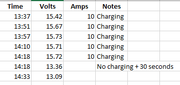
Charger is down to 10 amps, with battery at 15.67V.

From chart 10 amps is about C/8... which says 100% SOC should be 15.5 V.

What are the ramifications good/bad of going over 100%. Their chart goes to 120%.
Odysseus, expert on the Siren's call
User avatar
Jimmyt
Admiral
Posts: 3402
Joined: Sat Jul 18, 2015 9:52 am
Sailboat: MacGregor 26M
Location: Mobile AL 2013 26M, 60 Etec

Re: All About Boat Batteries

Post by Jimmyt »

Inquisitor wrote: Sat Dec 19, 2020 10:50 am
Jimmyt wrote: Sat Dec 19, 2020 10:39 am If you watch it and it continues to force 12 amps in, tell me to go pound sand! :)
I'd never do that :) you're my guardian angle to keep me from doing stupid stuff!

... but I have been checking.

Charger is down to 10 amps, with battery at 15.67V.

From chart 10 amps is about C/8... which says 100% SOC should be 15.5 V.

What are the ramifications good/bad of going over 100%. Their chart goes to 120%.
If I'm your guardian angle (angel?), you're scraping rock bottom... :D

You said you're using a free volt meter if I recall correctly. So, it could be off a bit +/-. I'd look for the plateau where the voltage flattens out vs time, or the charging current falls off, or the 120% point; whichever comes first. Then, I'd rest the battery and see where the voltage is.

I'd love to tell you that I know it's ok to charge a battery to 120%, but I've never gotten in the weeds like this before. You are rapidly approaching the limits of my minimal battery knowledge. So, I'll throw in a question or two when I don't understand something. Otherwise, I'll enjoy you documenting the experiment. Great stuff! Thanks for sharing!
Jimmyt
P-Cub-Boo
2013 26M, Etec 60, roller Genoa, roller main
Cruising Waters: Mobile Bay, Western Shore, Fowl River
User avatar
Inquisitor
Captain
Posts: 926
Joined: Mon Apr 23, 2007 5:24 pm
Sailboat: MacGregor 26M
Location: North Carolina Mountains

Re: All About Boat Batteries

Post by Inquisitor »

We must be sharing a common brain cell. :D

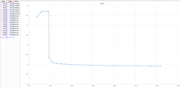
I didn't relish the thought of this thing going nuclear, but I went out and sure enough the voltage/current had stayed the same over about thirty minutes.

Image

It is resting quietly back in the warmth of my desk while I watch another wonderful showing by UT. :cry:
Odysseus, expert on the Siren's call
User avatar
Neo
Admiral
Posts: 1093
Joined: Fri Jan 30, 2015 4:29 pm
Sailboat: MacGregor 26M
Location: Central Coast, NSW, Australia

Re: All About Boat Batteries

Post by Neo »

Sorry to be a "stick in the mud" here but we are talking about the possible qualification and revival (unlikely) on what is clearly an out of (use-by) date cranking battery. :?
So on a cost and effort analysis ... compared to the work being put in at the moment .... How long would it take and how much would it cost to just go and buy a new battery :?: :?: :|
All the best.
:macm: Neo
"Whatever floats ya boat" 8)
User avatar
Jimmyt
Admiral
Posts: 3402
Joined: Sat Jul 18, 2015 9:52 am
Sailboat: MacGregor 26M
Location: Mobile AL 2013 26M, 60 Etec

Re: All About Boat Batteries

Post by Jimmyt »

Neo wrote: Sat Dec 19, 2020 3:29 pm Sorry to be a "stick in the mud" here but we are talking about the possible qualification and revival (unlikely) on what is clearly an out of (use-by) date cranking battery. :?
So on a cost and effort analysis ... compared to the work being put in at the moment .... How long would it take and how much would it cost to just go and buy a new battery :?: :?: :|
Sometimes it's more about the journey than the destination. Kinda goes with the sailing mentality. 8)

Why? Because we can. Plus he's bored out of his skull. :wink:
Jimmyt
P-Cub-Boo
2013 26M, Etec 60, roller Genoa, roller main
Cruising Waters: Mobile Bay, Western Shore, Fowl River
User avatar
Neo
Admiral
Posts: 1093
Joined: Fri Jan 30, 2015 4:29 pm
Sailboat: MacGregor 26M
Location: Central Coast, NSW, Australia

Re: All About Boat Batteries

Post by Neo »

Jimmyt wrote: Sat Dec 19, 2020 4:21 pmSometimes it's more about the journey than the destination.
100% agree Jimmy :wink:
All the best.
:macm: Neo
"Whatever floats ya boat" 8)
User avatar
Inquisitor
Captain
Posts: 926
Joined: Mon Apr 23, 2007 5:24 pm
Sailboat: MacGregor 26M
Location: North Carolina Mountains

Re: All About Boat Batteries

Post by Inquisitor »

Jimmyt wrote: Sat Dec 19, 2020 4:21 pm
Neo wrote: Sat Dec 19, 2020 3:29 pm Sorry to be a "stick in the mud" here but we are talking about the possible qualification and revival (unlikely) on what is clearly an out of (use-by) date cranking battery. :?
So on a cost and effort analysis ... compared to the work being put in at the moment .... How long would it take and how much would it cost to just go and buy a new battery :?: :?: :|
Sometimes it's more about the journey than the destination. Kinda goes with the sailing mentality. 8)

Why? Because we can. Plus he's bored out of his skull. :wink:
Actually some several posts back I actually had written... "Ah! I should just go out and get a starter battery." but I erased it. Because...

Like he said (and I originally) I'm bored out of my skull. :wink: :wink: But it is also a challenge and a learning experience and I have the training wheels on with all you kind, gentle experts. :) This thread has been great, but it seems to have WAY too much black-magic (BM) boxes that do everything but feed you. (G-rated version)

This science project may just save someone else's battery... for free. I didn't buy a load meter BM. I didn't buy the high-rate, pulse charger BM. I didn't buy the super expensive battery monitor BM... BM... BM... I just clipped a "FREE" Harbor Freight volt meter and used a 40 year old Craftsman charger, a little dark science, a little research and a lot of experience from this kind and gentle audience, mentors, saints and gentleman.

Are you butter'd enough? :P

Besides the patient deserves it... I left the boat with Batty (and her older sister) in my Father-in-laws field for over three years. Lonely, unattended. No solar panels, not within a hundred yards of a wall outlet. When I finally decided to resurrect the boat, my F.I.L and I were brushing it off, removing lichen from the sides, filling the tires... when all of a sudden deep in the bowels, Batty grumbles the bilge pump and pee's on my shoe. AFTER THREE YEARS OF NEGLECT.

SUCH Charisma, such stamina, such spunk, such disrespect... How could I put Batty out to pasture or Napa Hades?

She is no spoiled cranky battery. She's from the working side of the tracks... she's a mutt, deep-cycle marine battery. She was born on August 2013. She and I are Leo's... We will prevail!

https://www.youtube.com/watch?v=0VkrUG3OrPc

Image
Odysseus, expert on the Siren's call
User avatar
Inquisitor
Captain
Posts: 926
Joined: Mon Apr 23, 2007 5:24 pm
Sailboat: MacGregor 26M
Location: North Carolina Mountains

Re: All About Boat Batteries

Post by Inquisitor »

Jimmyt wrote: Sat Dec 19, 2020 11:22 am You said you're using a free volt meter if I recall correctly. So, it could be off a bit +/-.
Visiting my father this weekend... he's lending me a Beckman Tech 310. Is that any count?

Right now, Batty's feeling frisky:
Free HF Meter 12.91 V
Beckman 310 12.87 V
Odysseus, expert on the Siren's call
Post Reply