Connect solar to Blue Sea system combiner

A forum for discussing topics relating to MacGregor Powersailor Sailboats
User avatar
BOAT
Admiral
Posts: 4969
Joined: Fri Oct 19, 2012 5:12 pm
Sailboat: MacGregor 26M
Location: Oceanside, CA MACMJ213 2013 ETEC60

Re: Connect solar to Blue Sea system combiner

Post by BOAT »

yukonbob wrote: Thu Jan 09, 2020 8:30 am
The thing you guys have been posting about is the batteries being all connected during alternator charging. That is an issue.
That is an issue but not the one I have been discussing. B2B or DC/DC is what should be installed when mixing battery chemistry, voltage etc. With same battery type and a VSR/ARC you still get the most efficiency and longer battery life by putting all charge sources into the largest most used (usually the house bank).
Don't most people separate the starting battery? I just assumed that was common practice. :| I always separate everything from the high cranking startup line voltages - they just cause too much havoc with all the rest of the stuff unless you shut everything down before you start up. I suppose if your starting the engine with all the batteries then for sure you're right it does not really matter but gee wiz, I would shut off the refrigerator and air and the lights and the inverter before I hit the starter button - you really need to protect all your stuff if your going to do it that way. The sudden voltage drop could fry your electric freezer.
User avatar
Tomfoolery
Admiral
Posts: 6135
Joined: Tue Jul 05, 2011 7:42 am
Sailboat: MacGregor 26X
Location: Rochester, NY '99X BF50 'Tomfoolery'

Re: Connect solar to Blue Sea system combiner

Post by Tomfoolery »

BOAT wrote: Thu Jan 09, 2020 8:03 amHe said if you do get the dual units to go all the way and get the optional idle control and all the other stuff Mercedes offers on their big rig diesel trucks. It's all available on the Sprinter too, (well, it was in 2004).
Mine came with that, which I tested when I checked it out, but haven't used since. I think it's typical in fire/rescue and ambulance type applications, from what I've read.
BOAT wrote:You need to treat your Sprinter just like a big rig diesel. You can park all night long with the dash AC running and use way less fuel than running an AC residential or roof unit off a generator. When I got the van they told me if you are sleeping overnight in the Texas truck stop in summer just leave the engine on all night with the ac running and you will be fine. And that's just what we do.
Can't do that since they went to an EGR and DEF tank with SCR exhaust system. Idling clogs things up. Even running too lightly loaded ain't good.

This is a problem on the big diesels I design into our stuff - too much unloaded or idling time and the EGR system (primarily) gets loaded. Cost's $10-15k to replace parts and wheel the Caterpillar guy in to plug in and 'reauthorize' the engine to run, and down time is far more expensive than the parts and labor. :x
User avatar
BOAT
Admiral
Posts: 4969
Joined: Fri Oct 19, 2012 5:12 pm
Sailboat: MacGregor 26M
Location: Oceanside, CA MACMJ213 2013 ETEC60

Re: Connect solar to Blue Sea system combiner

Post by BOAT »

Tomfoolery wrote: Thu Jan 09, 2020 9:00 am
BOAT wrote: Thu Jan 09, 2020 8:03 amHe said if you do get the dual units to go all the way and get the optional idle control and all the other stuff Mercedes offers on their big rig diesel trucks. It's all available on the Sprinter too, (well, it was in 2004).
Mine came with that, which I tested when I checked it out, but haven't used since. I think it's typical in fire/rescue and ambulance type applications, from what I've read.
BOAT wrote:You need to treat your Sprinter just like a big rig diesel. You can park all night long with the dash AC running and use way less fuel than running an AC residential or roof unit off a generator. When I got the van they told me if you are sleeping overnight in the Texas truck stop in summer just leave the engine on all night with the ac running and you will be fine. And that's just what we do.
Can't do that since they went to an EGR and DEF tank with SCR exhaust system. Idling clogs things up. Even running too lightly loaded ain't good.

This is a problem on the big diesels I design into our stuff - too much unloaded or idling time and the EGR system (primarily) gets loaded. Cost's $10-15k to replace parts and wheel the Caterpillar guy in to plug in and 'reauthorize' the engine to run, and down time is far more expensive than the parts and labor. :x
Wow, that does suck. I totally forgot that new trucks use a DEF tank now. I don't have a DEF tank. That is a little piece of government that is not on my Sprinter. Good Lord, I think my espar diesel heater puts out more pollutants than your idling Sprinter does - why do they make you run a DEF tank on your truck and not on my espar which is available to buy to this day??

I think that whole DEF tank thing is a crock, but what do I know.
User avatar
yukonbob
Admiral
Posts: 1918
Joined: Mon Feb 14, 2011 6:54 pm
Sailboat: Other
Location: Whitehorse Yukon

Re: Connect solar to Blue Sea system combiner

Post by yukonbob »

BOAT wrote: Thu Jan 09, 2020 8:54 am
yukonbob wrote: Thu Jan 09, 2020 8:30 am
The thing you guys have been posting about is the batteries being all connected during alternator charging. That is an issue.
That is an issue but not the one I have been discussing. B2B or DC/DC is what should be installed when mixing battery chemistry, voltage etc. With same battery type and a VSR/ARC you still get the most efficiency and longer battery life by putting all charge sources into the largest most used (usually the house bank).
Don't most people separate the starting battery? I just assumed that was common practice. :| I always separate everything from the high cranking startup line voltages - they just cause too much havoc with all the rest of the stuff unless you shut everything down before you start up. I suppose if your starting the engine with all the batteries then for sure you're right it does not really matter but gee wiz, I would shut off the refrigerator and air and the lights and the inverter before I hit the starter button - you really need to protect all your stuff if your going to do it that way. The sudden voltage drop could fry your electric freezer.
Yes and no. Most factory systems are setup with 3 way selector switch 1/2/both/off. When starting you'd select your start and crank, but that creates the problem of voltage drop on electronics etc as you mentioned. Whats even crazier is running charging inputs through the selector switch so you have to manually select which bank is being charged 1/2/both, this comes with the ability to fry your alternator by someone selecting the off setting on the switch (this is also common from factory). This: https://www.bluesea.com/products/8686/D ... ment_Panel keeps the two banks completely separate from each other, so no voltage drop on sensitive electronics (plus the added bonus of 24 hour fuse protected circuits); this has its own issues so some prefer using 3 battery selector switches as shown in the diagram i posted earlier. Slightly more complex but comes with the ability to completely isolate a bank, or use the blue seas panel and a couple shut off switches or just pull the cables of a suspected bad bank for isolation in the event of a shorted cell.
User avatar
BOAT
Admiral
Posts: 4969
Joined: Fri Oct 19, 2012 5:12 pm
Sailboat: MacGregor 26M
Location: Oceanside, CA MACMJ213 2013 ETEC60

Re: Connect solar to Blue Sea system combiner

Post by BOAT »

yukonbob wrote: Thu Jan 09, 2020 10:28 am
. This: https://www.bluesea.com/products/8686/D ... ment_Panel keeps the two banks completely separate from each other, so no voltage drop on sensitive electronics (plus the added bonus of 24 hour fuse protected circuits);
Ok Yeah :P that's a cool device - Based on what I read in your link I think every boat should have one - one of the major problems with our perko switches from the factory is that you can thoughtlessly switch batteries while the engine is running and fry all kinds of stuff including the alternator on the outboard engine!

I would not use one on the van because the two systems are completely separate except for the B2B and the honk'in switch I put in to do an emergency start from the lithium batteries and I have a label I made that says: "OPEN ALL BREAKERS BEFORE USING EMERGENCY START!!" BUT I think I definitely would like one of those 8686 units on 'boat'.

Does it allow you to switch batteries under power too??
User avatar
yukonbob
Admiral
Posts: 1918
Joined: Mon Feb 14, 2011 6:54 pm
Sailboat: Other
Location: Whitehorse Yukon

Re: Connect solar to Blue Sea system combiner

Post by yukonbob »

BOAT wrote: Thu Jan 09, 2020 10:52 am
yukonbob wrote: Thu Jan 09, 2020 10:28 am
. This: https://www.bluesea.com/products/8686/D ... ment_Panel keeps the two banks completely separate from each other, so no voltage drop on sensitive electronics (plus the added bonus of 24 hour fuse protected circuits);
Ok Yeah :P that's a cool device - Based on what I read in your link I think every boat should have one - one of the major problems with our perko switches from the factory is that you can thoughtlessly switch batteries while the engine is running and fry all kinds of stuff including the alternator on the outboard engine!

I would not use one on the van because the two systems are completely separate except for the B2B and the honk'in switch I put in to do an emergency start from the lithium batteries and I have a label I made that says: "OPEN ALL BREAKERS BEFORE USING EMERGENCY START!!" BUT I think I definitely would like one of those 8686 units on 'boat'.

Does it allow you to switch batteries under power too??
There is no need to switch batteries under power as all charging sources should be directed to the house bank and connected with a ARC/VRS/DC/DC so charging is taken care of. For discharge its basically an on/off switch for dual isolated banks. There is a combine feature if you needed to combine the banks. The house panel comes off the 8686 with a 100a breaker and the x3-24 hour circuits that are breaker protected and stay on even when switch is set to 'off' these are for bilge pumps, alarms etc.
http://assets.bluesea.com/files/resourc ... s/6343.pdf see the wiring instructions in attached link. It will clarify.

The caveat with the 8686 is that if you had a bad cell in your start bank and combined both banks to use the radio, the bad cell would drain your other bank and leave you dead in the water. So if your house bank was internally shorted sitting at 9V and you combined with your healthy 12.5v house bank, your start would drain into your house and leave you with no juice to start your engine in a short period. You can rectify this by adding one or two on/off switches on each bank to lock one out then use combine feature to start, or simply disconnect the bad bank. The 3 switch method could also do the same above scenario if an unaware user combined a bad bank with a good one, but isolating the bad bank is a matter of selecting the correct bank and isolating the other within the three switches.
I installed the 8686 and am very happy with it. I run the primary and secondary bilge pumps off two of the 24h circuits and the 3 way fire/fume/water alarm off the third, no dimming lights when starting and no shutting down the electronics.
User avatar
yukonbob
Admiral
Posts: 1918
Joined: Mon Feb 14, 2011 6:54 pm
Sailboat: Other
Location: Whitehorse Yukon

Re: Connect solar to Blue Sea system combiner

Post by yukonbob »

I'll add that the blue seas installation diagram shows connecting the terminal to either the starter or alternator. It is also quite common to run the positive charging cable from the alternator to the starting lug on the starter which runs back to the switch...not an ideal setup but just clarifying that note.
User avatar
BOAT
Admiral
Posts: 4969
Joined: Fri Oct 19, 2012 5:12 pm
Sailboat: MacGregor 26M
Location: Oceanside, CA MACMJ213 2013 ETEC60

Re: Connect solar to Blue Sea system combiner

Post by BOAT »

I run a separate 12 volt panel that goes directly to the batteries for that:
Image
auto pilot and navigation does not get turned off at the perko (or water pump bilge and so forth) I can't remember who told me to run those direct.
I like everything to have it's own circuit so one thing does not shut down the other.
It does mean running a few more wires:
Image
but I like the ability to be selective about what I shut down before the perko.
I guess the idea behind this was that if I added solar you could run these essentials selectively even with the perko off. Someone here on the site told me to do this in case of battery failure - was it you? I can't remember who told me to do this. :?
User avatar
Starscream
Admiral
Posts: 1561
Joined: Tue Nov 03, 2009 10:08 am
Sailboat: MacGregor 26X
Location: Montreal, Quebec. 2002 26X - Suzi DF90A

Re: Connect solar to Blue Sea system combiner

Post by Starscream »

yukonbob wrote: Wed Jan 08, 2020 11:42 pm Regarding the long term storage switch:” 9- “An ACR will allow the start battery to drain into the house battery and leave it depleted.” = FALSE
This statement takes us directly to Myth & Lore #9 “An ACR will allow the start battery to drain into the house battery and leave it depleted.”

The fully charged resting voltage of a typical lead acid battery is about 12.72V. At any voltage above this point there is really no usable energy stored when discharging (see image below).

By now I know you are understanding it, but if not, this one is really quite simple. The ACR normally opens/un-parallels at just above or just at the 100% SOC point of a lead acid battery. If either battery bank dips below 12.8V the relay opens within 30 seconds. If it dips to 12.35V, the relay opens in just 10 seconds. The answer to this myth is that it is indeed false that an ACR will allow the start battery to discharge into the house bank. Your start battery cannot discharge into your house bank in 10 or 30 seconds.

The discharge graph below (voltage is the red line) was a typical marine battery undergoing a 20 hour capacity test. The battery was fully charged, equalized and had an open circuit voltage before the discharge test of 12.95V or what we refer to as a “surface charge“, despite having rested for a full 24 hours prior to the test. Because this was a 130Ah rated battery the discharge rate was 6.50A (130Ah / 20 hours = 6.5A discharge rate). At data point #1 the battery was at 12.95V and by data point 2 the battery was already below the open/isolated/un-parallel voltage of the ACR at 12.76V. You are seeing that correctly, by the time this battery hit 12.76V a paltry 0.002Ah worth of energy had been removed. If the ACR opens at 12.8V how much can we discharge either bank by? This answer is nothing worth even really discussing…“

Other stuff:
“One of the most common blunders we see on cruising boats is leaving the alternator wired to charge the starting battery first. This is most often the result of the Blue Sea Systems instructions not being very clear. “

“Why is it best to charge the house first? There are a number of reasons to do this but the best reason is to ensure the bank that needs the most charging is actually getting it and getting it as efficiently as possible.

#1 With large house banks wiring charging sources to the HOUSE bank means more efficient charging and more optimal voltage sensing for the alternator.

#2 With large house banks, wiring charging sources to the HOUSE bank means less chance of what is called relay-cycling. Please take the time to read the link below. Blue Sea Systems covers relay cycling very well so there is no sense in us repeating it.
https://www.bluesea.com/support/articl ... ing_Relays
#3 By wiring charge sources to the larger HOUSE bank the relay contacts need to pass just a few amps at best in order to charge the start battery. By feeding all charging to START means the relay must be able to handle the full rated current of the alternator and we are utilizing it at max duty cycle. We are also passing the charging current through multiple more terminations and fuses and there will be additional voltage drop.“

Not saying that your setup is wrong, wont work or will burn your boat down, but batteries are expensive and I like to get the most of of them, there’s also the environmental factor.
OK, it's starting to become clear, thanks for that detailed explanation.

Just to clarify the switch, it is only there to stop the ACR's minuscule power consumption during storage. It draws a very small amount of current that could drain the batteries over a few months.

I think for my needs, I'm happy with the system the way it is. With my batteries set up the way they are, with a single selector switch, I don't really have separate start and house batteries anyway. Whichever battery is selected runs whatever house loads are on, and starts the motor.
User avatar
BOAT
Admiral
Posts: 4969
Joined: Fri Oct 19, 2012 5:12 pm
Sailboat: MacGregor 26M
Location: Oceanside, CA MACMJ213 2013 ETEC60

Re: Connect solar to Blue Sea system combiner

Post by BOAT »

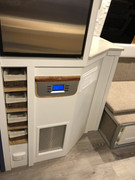
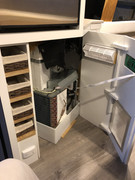
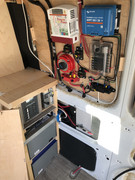
ncartercalfrac wrote: Wed Jan 08, 2020 12:45 pm I would like to see how you organized the inside of that cabinet. That is a lot of services in one spot.
So to button up the questions here is the picture request:

cabinet closed:
Image
cabinet open:
Image
and here it is when it was under construction to show where the batteries and charger are:
Image
User avatar
Tomfoolery
Admiral
Posts: 6135
Joined: Tue Jul 05, 2011 7:42 am
Sailboat: MacGregor 26X
Location: Rochester, NY '99X BF50 'Tomfoolery'

Re: Connect solar to Blue Sea system combiner

Post by Tomfoolery »

BOAT wrote: Thu Jan 09, 2020 9:16 am
Tomfoolery wrote: Thu Jan 09, 2020 9:00 am
BOAT wrote: Thu Jan 09, 2020 8:03 amHe said if you do get the dual units to go all the way and get the optional idle control and all the other stuff Mercedes offers on their big rig diesel trucks. It's all available on the Sprinter too, (well, it was in 2004).
Mine came with that, which I tested when I checked it out, but haven't used since. I think it's typical in fire/rescue and ambulance type applications, from what I've read.
BOAT wrote:You need to treat your Sprinter just like a big rig diesel. You can park all night long with the dash AC running and use way less fuel than running an AC residential or roof unit off a generator. When I got the van they told me if you are sleeping overnight in the Texas truck stop in summer just leave the engine on all night with the ac running and you will be fine. And that's just what we do.
Can't do that since they went to an EGR and DEF tank with SCR exhaust system. Idling clogs things up. Even running too lightly loaded ain't good.

This is a problem on the big diesels I design into our stuff - too much unloaded or idling time and the EGR system (primarily) gets loaded. Cost's $10-15k to replace parts and wheel the Caterpillar guy in to plug in and 'reauthorize' the engine to run, and down time is far more expensive than the parts and labor. :x
Wow, that does suck. I totally forgot that new trucks use a DEF tank now. I don't have a DEF tank. That is a little piece of government that is not on my Sprinter. Good Lord, I think my espar diesel heater puts out more pollutants than your idling Sprinter does - why do they make you run a DEF tank on your truck and not on my espar which is available to buy to this day??

I think that whole DEF tank thing is a crock, but what do I know.
Glossary for those not familiar with modern Tier IV (final) diesels:

SCR: Selective Catalytic Reducer (converts nitrous oxides, or NOx, to nitrogen and water using DEF)
DEF: Diesel Exhaust Fluid (32.5% urea, 67.5% de-ionized or distilled water)
EGR: Exhaust Gas Recirculation valve (recirculates exhaust to intake to keep cylinders coolers thereby lowering NOx formation in the first place)
DPF: Diesel Particulate Filter (function is obvious from the name, but can be a big PITA when the engine 'regenerates' to burn off accumulated soot)

BOAT - the whole concept of the SCR actually works well, when it's all working well, and the exhaust from my Jeep GC diesel was actually slightly sweet smelling. No eye burning, and no visible smoke (which the DPF plays a part in of course). I don't yet know what the exhaust smells like on the van, as it doesn't fit in the garage, where I'd notice the exhaust smell.

But reducing NOx is never a bad thing. Just the execution is often or usually problematic. Diesels with this equipment need to be run hard enough to get and stay hot, and that's just not possible on many type of stationary equipment, like the stuff I design. Hours of idling, or running under light load, is the norm. We take steps in concert with the engine manufacturers to minimize EGR soot build-up, but those valves have a bad reputation in the diesel world for a reason.

But on the topic of solar and battery power, what batteries are you using, and what is or are the amp-hour rating or ratings? I'm very happy with what the van came with, but it wasn't like I had a choice, as it's the only integrated system offered at the time.
User avatar
BOAT
Admiral
Posts: 4969
Joined: Fri Oct 19, 2012 5:12 pm
Sailboat: MacGregor 26M
Location: Oceanside, CA MACMJ213 2013 ETEC60

Re: Connect solar to Blue Sea system combiner

Post by BOAT »

But on the topic of solar and battery power, what batteries are you using, and what is or are the amp-hour rating or ratings? I'm very happy with what the van came with, but it wasn't like I had a choice, as it's the only integrated system offered at the time.
I like these guys:
https://battlebornbatteries.com/
And that is what I use. The real question is: Is there a battery manufacturer out there that specializes in the needs of sailboats???

Sailboats are special because we do not run an engine much like a power boat so the batteries get sporadic charging and the outboards tend to throw a lot of high voltages - add into that all these complications of perko switches and salt water and really - I don't know what's the best setup for a sailboat.

This part applies to both vans and sailboats:
If your charging 90% on solar I think bigger batteries and less of them are better because solar is a trickle charge and losses need to be minimized. BUT! bigger batteries catch fire and on boats a fire is more dangerous. Sailboats use the alternator the less so a bigger battery is good but installation must be PERFECT for safety.
If your charging 30% of the time on the alternator like I am (we move around a lot) then multiple smaller batteries are better and safer. Alternators are hard on the equipment and dividing up the storage makes maintenance and replacement less expensive. If one battery fails just swap it out - also you can bypass a bad battery. Powerboats should use multiple batteries.

On MY van:
We run only what we need: (2) 100 amp batteries and (3) 100 amp solar panels. That's enough to keep going 24/7 without any alternator input. The only electric we have is the refrigerator and water pump and lights. The water heater and stove is gas (we have enough under the van for about a year). The water heater can also run on AC, well, I guess really - with the charger on shore power EVERYTHING can run on AC except the stove. Heat in the van is diesel. (An espar diesel heater under the passenger seat).

On the boats the big deal is refrigeration of course - there are guys here on site that know exactly how much solar you need to maintain a reefer - they should comment - my rule of thumb is at least 200 watts for a small reefer but they would know better than I. Bigger sailboats have electric winches and that thing on the bow for raising the anchor (sorry, never had one) and air conditioners and a whole lot of stuff going on. I try yo keep things to a minimum on both the van and the boat because I am old and i still know how to shoot stars with a sextant and read charts and I have maps in the van and I carry firewood. I can survive fine without electricity if things break.
User avatar
Tomfoolery
Admiral
Posts: 6135
Joined: Tue Jul 05, 2011 7:42 am
Sailboat: MacGregor 26X
Location: Rochester, NY '99X BF50 'Tomfoolery'

Re: Connect solar to Blue Sea system combiner

Post by Tomfoolery »

BOAT wrote: Fri Jan 10, 2020 8:17 amThis part applies to both vans and sailboats:
If your charging 90% on solar I think bigger batteries and less of them are better because solar is a trickle charge and losses need to be minimized. BUT! bigger batteries catch fire and on boats a fire is more dangerous. Sailboats use the alternator the less so a bigger battery is good but installation must be PERFECT for safety.
That's where LiFePO batteries come in. The lithium iron types are far less susceptible to runaway and fire than lithium ion* like those in cell phones, though at a lower energy density, or at least that's what I've found out there on the web. Which must be true, of course. Oh, et je suis un mannequin français, au fait.
BOAT wrote:On the boats the big deal is refrigeration of course - there are guys here on site that know exactly how much solar you need to maintain a reefer - they should comment - my rule of thumb is at least 200 watts for a small reefer but they would know better than I.
The Norcold reefer/freezer (separate top door freezer) is AC/DC, and draws 48 VA on AC**, and about 40W on DC, and my experience is that it runs about 1/3 of the time in hot weather. So 200W of solar is probably a good rule of thumb, since you can only charge while the sun is strong, and there are losses in charging, plus other loads that have to be handled.

The smaller DE0041R, with just the single door and the little cold box freezer inside like a cube dorm fridge, actually has almost twice the published power draw, oddly enough.

*"ion" is unfortunately redundant, since all electro-chemical batteries work with ions, AFAIK.
**Volt-amps are always more than watts with any kind of reactive load, like motors or rectifiers.
Last edited by Tomfoolery on Fri Jan 10, 2020 9:12 am, edited 1 time in total.
User avatar
BOAT
Admiral
Posts: 4969
Joined: Fri Oct 19, 2012 5:12 pm
Sailboat: MacGregor 26M
Location: Oceanside, CA MACMJ213 2013 ETEC60

Re: Connect solar to Blue Sea system combiner

Post by BOAT »

Yes, sorry I made a mistake there I should have said:

(2) 100 amp batteries and (3) 100 WATT solar panels.

Sorry, I knew the panels were in watts not amps but did not type it in right (Man, I WISH I had 100 amp solar panels! - :P such a thing does not exist).

Yeah - on the reefers there is confusion about the power draw. That newest Compressor refrigerators get cold really fast - I mean REALLY FAST.

Our NORCOLD goes from 65 degrees off to 38 degrees in less than an hour! so the amp draw looks bad up front - that's 5 amps. If you leave it at the full setting like that it will pull 5 amps everytime it fires - so in that case it's ALL about insulation AND installation.

I learned a lot about the newer DC units. I had to have my T1090 ordered special by an upfitter (Sportsmobile) because they will not sell it to you. Even the dealers will not sell the T1090 to you. I even got a Canadian dealer to agree to try to get me one and Norcold would not sell it to him!

It's because the unit must be carefully insulated and installed - if you do it right - it will cycle only about 10% and stay very cold. When it DOES cycle (which is hardly ever if you installed it right) it does draw 5 amps so that's 600 watts and that is why they have that ridiculous spec on some of the smaller units. The T1090 is the only one specially designed to fit up against the roof of the Sprinter - that saves a TON of space in the van.

For night time it has a nite-mode setting: "reduced energy consumption and noise level" and I can tell you from experience that if you install it correctly on night setting it's totally silent - you can't hear the compressor at all - and the draw drops to under 300 watts. (So it's about 1/2) We find that we put it on nite-mode (2 amps) and wake up in the AM and forgot about it the temp still stays at 38 right through the early afternoon and we usually don't need to kick it back up to normal till after 2PM when things are getting pretty hot outside.
User avatar
yukonbob
Admiral
Posts: 1918
Joined: Mon Feb 14, 2011 6:54 pm
Sailboat: Other
Location: Whitehorse Yukon

Re: Connect solar to Blue Sea system combiner

Post by yukonbob »

Starscream wrote: Thu Jan 09, 2020 7:11 pm OK, it's starting to become clear, thanks for that detailed explanation.

Just to clarify the switch, it is only there to stop the ACR's minuscule power consumption during storage. It draws a very small amount of current that could drain the batteries over a few months.

I think for my needs, I'm happy with the system the way it is. With my batteries set up the way they are, with a single selector switch, I don't really have separate start and house batteries anyway. Whichever battery is selected runs whatever house loads are on, and starts the motor.
The standby draw is 0.015 amps so a super cheap auto start battery with a 60Ah capacity would take just over 6 months to discharge. A cheap deep cycle with 100ah capacity would take over 9 months and so on. If the switch is used for winter storage best practice is still to completely disconnect them as the parasitic draw from your system will almost certainly be 10 times the draw from the ARC.
Post Reply