BOAT wrote:
So the wave breaks over the side or the stern (or even the bow, for that fact) and crashes down onto the boat and there is water and foam and everything is all wet and the water rushes into the open companionway right on top of the battery compartment. It only takes about an 8 foot wave (VERY common out here certain times of the year) to break and make the top of the boat all wet.
I've not sailed the west coast, so I dont have a reference for what you guys have to deal with out there. Too bad Roger didn't factor that in to the design if its that big an issue in your waters.
With the higher companionway of the M, the whole cockpit would be awash before flowing into the cabin - that's a hull of a lot of water! Why is the companionway open in those conditions?? Its like driving a convertable with the top down in the rain and wondering why the rich corinthian leather seats are getting wet!
I have my plexiglass entry hatch made in two sections when I see that it is getting rough I usually install the bottom section & if I think it's going to get worse I'll install the top section & close the the sliding hatch & I'd think if I still going to have that much water coming into the cockpit I'm going to b having my mind on other issues like boat control. Only time u should b getting caught up in that situation would b a rogue wave if u know u r going into or even think u r going into a harbor with that situation all hatchs should b already closed
If I'm coming into a harbor with that situation, I'm going to look for another place to go, or wait for conditions to improve. I don't have the guts (or enough clean underwear) for an entry like that in my Mac.
Jimmyt wrote:If I'm coming into a harbor with that situation, I'm going to look for another place to go, or wait for conditions to improve. I don't have the guts (or enough clean underwear) for an entry like that in my Mac.
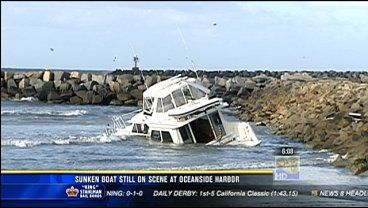
Not an option - Oceanside Harbor was built and partially funded by the Navy Corp Of Engineers because of this very issue - there was NO safe harbor between San Diego and Dana Point (almost 90 NM) and prior to the construction of Oceanside an average of 3 lives per year were lost to small craft on average trying to make safe harbor between San Diego and Orange County.
Since the construction of the Oceanside Small Craft Harbor that number has gone to ZERO.
The approach to the Harbor is navigable for those with experience with it and for those that are unsure about attempting it there is a patrol boat that will lead boaters safely into the harbor - Most folks who are concerned with the approach will just wait for one of the locals to enter the Harbor and follow them. I myself have led five (very large) power boats into the harbor in the fog at the same time! I don't know if that's a record but it was for me!
It's safe, and (usually) dry, but not always dry. I do get a little wet every now and then or at least get my docksiders soggy if the shoaling is really bad. Some years are better than others.
So, do your entries look like that, or have you got a technique that keeps the mast somewhat vertical? He appeared to be about 2 pounds of ballast away from a roll... I would never get anyone to go sailing after one incident like that.
And, it was probably funded by you and me with design and construction oversight by the US Army Corps of Engineers. The Corps does engineering and construction at the government's direction, including for the military. The are not in charge of directing funding, although they may be directed to study a situation such as this and determine that a harbor project is required to improve the situation. The government would still control funding - which occasionally causes the Corps.considerable grief...
Jimmyt wrote:So, do your entries look like that, or have you got a technique that keeps the mast somewhat vertical? He appeared to be about 2 pounds of ballast away from a roll... I would never get anyone to go sailing after one incident like that.
And, it was probably funded by you and me with design and construction oversight by the US Army Corps of Engineers. The Corps does engineering and construction at the government's direction, including for the military. The are not in charge of directing funding, although they may be directed to study a situation such as this and determine that a harbor project is required to improve the situation. The government would still control funding - which occasionally causes the Corps.considerable grief...
Yes, the Corp is indeed still involved and is also as you said experiencing grief. The Corp pays to dredge the mouth so they have access to the Del Mar boat basin that is used by the military. The Corp has on numerous occasions threatened to stop the dredging and on numerous occasions various mayors of the City of Oceanside have made trips to DC to petition the government to continue dredging - and every time The Corp has been compelled to resume operations for the good of public safety and the military. It's been a pain in their ass for many many years - I'm sure the Navy is taking advantage of the Army - but still - they are saving a lot of lives every year so it's really hard to stop - I think it's the USACE Los Angeles District that takes care of Oceanside.
We have lots of parades and celebrations here every year to honor the Army and the Navy. The Army and the Navy and the Marines are very popular in this town.
I'm sure the Corps District is happy to have the harbor project to maintain. Working for the US citizens and serving the military is their bread and butter. They would probably enjoy it more if there was a steady funding stream to cover the situation (if that's the issue), and/or a consistent political direction to follow. Ah, the joys of public service...
More importantly, can you get into the harbor under those conditions without dipping the sails? I wondered if you could time it and run the trough in by using the outboard. Inquiring minds want to know..
Jimmyt wrote:I'm sure the Corps District is happy to have the harbor project to maintain. Working for the US citizens and serving the military is their bread and butter. They would probably enjoy it more if there was a steady funding stream to cover the situation (if that's the issue), and/or a consistent political direction to follow. Ah, the joys of public service...
More importantly, can you get into the harbor under those conditions without dipping the sails? I wondered if you could time it and run the trough in by using the outboard. Inquiring minds want to know..
Oh, yes - you can motor and it's very safe unless you get near the shoal breakers - That's where the REAL danger is - the SHOAL BREAKERS - and the charts have warnings all over the place about them - It's okay to hit the shoal breakers going out because you ride over them because they are coming at you - but you can't go over the shoal breakers coming in because they pick up the back of the boat and will do your bow like a pile driver right into the sandy bottom. My neighbor pitch-poled his Boston Whaler in that shoaling zone coming in too far to the west one time -
I forgot to mention that the person in the Ketch is a local and he ALWAYS sails - that's why he was caught in the waves in the first place, his sails are probably more powerful than that dinky little Volvo diesel he has under the cockpit. The tack he is on is the normal tack we all take coming in - he is trying to match a long row of rocks on his upwind side that prevents him from pointing higher and on the other side is the east jetty - so the way to do it is to make a long approach like you would line up for a runway if in a plane - you hold a straight line right between the goal posts - you need to try to enter from the south - I can show you with Google Maps:
In the summer the wind comes from the west so this is an easy broad reach - but the northwest wind blows in the winter and these large waves come and that means he is pointing. He has got to hold that point as he approaches or he will hit the the rocks on the east side - if he tries entering too far from the west he will risk the shoal breakers. That's why he kept pointing all the way even when the wave picked him up - he knew he had to hold that line to miss the rocks. It's better to get a little wet than to get smashed on a lot of big rocks.
In my personal opinion he came in just a little bit too far to the south, normally when I am that close to the surf-line I will tack straight out to sea a little bit more west and then tack back towards the harbor but in a sloop making a couple of quick tacks is not big deal (just embarrassing in front of the other skippers) - making two quick tacks in a big ketch with two masts full is a lot harder so he was probably just a little lazy that day.
You get used to it - after a couple of times it does not bother you anymore. The sailboats just roll around on their sides for the most part - that's what happened to me the first few time in my A23 - I have not gotten caught in the shoal break in the mac - YET - but I'm sure it will do the same thing - spin around on it's side and slide around.
It's the the power boats that get really hammered in the shoal break - they do not have 'stuff' under their hull or ballast to make them turn sideways and slide on their side - the power boats just turn straight down the wave and pile right into the bottom bow first. That does happen but it's rare:
BOAT wrote:You get used to it - after a couple of times it does not bother you anymore. The sailboats just roll around on their sides for the most part - that's what happened to me the first few time in my A23 - I have not gotten caught in the shoal break in the mac - YET - but I'm sure it will do the same thing - spin around on it's side and slide around.
It's the the power boats that get really hammered in the shoal break - they do not have 'stuff' under their hull or ballast to make them turn sideways and slide on their side - the power boats just turn straight down the wave and pile right into the bottom bow first. That does happen but it's rare:
This has a LOT to do with "Battery Location" in my opinion. If salt water is okay for batteries then I say the current locations are good - BUT - if salt water is BAD for batteries, then i think the current location under the companionway is probably a pretty bad choice for a battery locations.
So I did not do all the upgrades I wanted to because I want to actually use the boat during the relatively short Chicago season and I have already been delayed enough. So when I go to install the separate fuse block and go to run the wires up to the switch panel, what is the best route? I know that the two batteries I have are 27's which was somewhat of a mistake due to their tight fit in aft galley area but I have made it work. I was also wondering the best location for the combiner and perko switch as I also intend to add shore power and a battery charge before next summer. I am open to making a major change for next season if that is suggested. You guys have suggested the forward galley seat which I should have done but I was unsure about ease of wire routing.