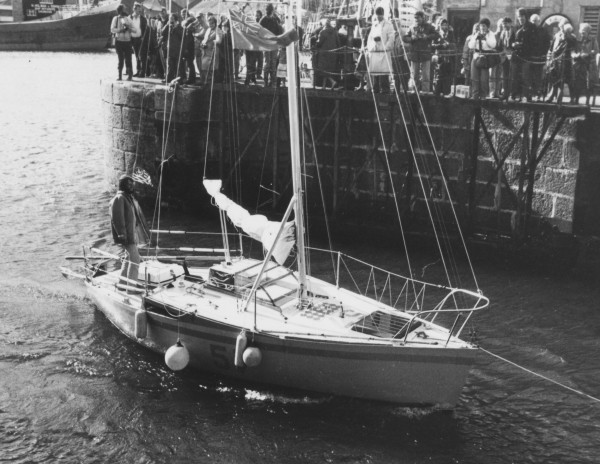
It's a great story. His boat sank strangely. He was extremely lucky and creative. His primitive navigation techniques were very accurate.
He speaks much to the inadequacy of life rafts. After this, I believe he worked on changing their design and emergency kits. One thing we take for granted is the ability to stand on something solid. Imagine not being able to stand for 76 days on a spongy rubber floor that moves under your weight and not being able to lay flat. Or the ability to pump air to re-inflate the raft (with a foot pump) without a solid floor.
It was also interesting to learn how many ships are not watching the water and passed him by without seeing his signals. He made "friends" with a school of fish that followed him and provided food. Meanwhile, sharks bumped his raft to "see what it was". The role of the school of fish at end of the story is almost spiritual.
For small sailboaters like us, this is a great read. Crossing oceans in such a small boat. Amazing.
Is it common for a boat to run into something and put a hole in the hull?? Is there any way to get statistics on such a thing?
This guy got a hole - no matter how good a sailor you are - no one can really be expected to save the boat if it's holed. I have always been afraid of getting a big hole - does it happen often?
BOAT wrote:Is it common for a boat to run into something and put a hole in the hull?? Is there any way to get statistics on such a thing?
This guy got a hole - no matter how good a sailor you are - no one can really be expected to save the boat if it's holed. I have always been afraid of getting a big hole - does it happen often?
There is a lot of stuff to run into in the ocean. This guy "thinks" he hit a whale. He doesn't know or will ever know. It sank his boat. The survival was the story. Amazing tale.
BOAT wrote:Is it common for a boat to run into something and put a hole in the hull?? Is there any way to get statistics on such a thing?
This guy got a hole - no matter how good a sailor you are - no one can really be expected to save the boat if it's holed. I have always been afraid of getting a big hole - does it happen often?
There is a lot of stuff to run into in the ocean. This guy "thinks" he hit a whale. He doesn't know or will ever know. It sank his boat. The survival was the story. Amazing tale.
I'm sorry guys but if there is one thing I can't stand when it comes to boat accidents is a mystery - I don't like the "know one will ever know" answer to boat mysteries - they give me the heebee jeebees and I don't care for them at all. My dad (who was one of the greatest Danish sailors on planet earth) was an insurance agent who insured all kinds of things including boats, and investigated accidents and salvage.
I'm a big believer of forensic science in regards to boat accidents and I would like more information why the parts of the boat were never recovered if it indeed had the flotation claimed in the story.
I'm never gonna accept any sinking with the "know one knows" scenario and many people like me just can't stand a maritime mystery - that's what drives guys like Ballard and Spence to continue the search for the USS Indianapolis and Shackletons' Endurance and guys like David Mearns want the truth. Me Too. I guess it's in my DNA - I am Danish and as I got older I discovered stuff about guys like Gunnar Thorson, and Ossian Sars and Johan Hjort and others. I read about a guy named Chatterton in a newspaper who was only a couple of years older than me when I was in college studying marine biology (that's when i confirmed my fear of fish and changed majors to psychology) and I followed Chatterton's career here and there as I got older and he mentions all these Danish people i never heard of. That's how I found out about them. And I even found this 14 year old Danish girl just a couple of years ago that sailed around the world in a sailboat. This stuff always intrigued me as a kid - James Cameron did a movie a couple of years ago that described me to a tee when I was a kid - I used to build cardboard submarines to play in when I was 7. James Cameron starts his movie with him as a kid playing in a cardboard submarine he made as a kid. It reminded me of me! I can't remember the movie, but I think in that movie he broke the deep sea submarine record.
I don't believe in shipwreck mysteries - they go against my very grain - there is always a reason - if we can get to the wreaks often we can solve the mystery. I'm glad the guy survived, but I still want to know why his boat got holed. Any boat owner that sails on the ocean should want to know.
BOAT wrote:I'm sorry guys but if there is one thing I can't stand when it comes to boat accidents is a mystery - I don't like the "know one will ever know" answer to boat mysteries - they give me the heebee jeebees and I don't care for them at all.
...why the parts of the boat were never recovered if it indeed had the flotation claimed in the story.
I agree with you. However, without a "body" you can't tell what was the cause of death. I'm not sure he said there was "flotation". There were air tight compartments which can become compromised. My guess is the boat finally sank. It was made of wood.
However, plenty of abandoned boats wash up on coasts and their stories are lost. I know people who lost boats in Hurricane Sandy and they have no idea what happened to them. The remnants of this guy's boat may have washed up in Africa or someplace in South America.
The story is not about the boat or the sinking. I barely remember that part. It's about the 76 days at sea and how totally inadequate the life raft was and how each day brought him either a solution or another problem. It's a good read. I love survival stories.
Things have changed much since then. EPIRBs were not monitored by satellites and he was depending on air traffic (which was non-existent where he was) to pick up the signal. I found it interesting that he spotted 9 ships and NONE saw him. Some were relatively close.
From his website "However, when something struck her during her return Atlantic crossing (I have always
presumed it was a whale, although a large shark or other creature are possibilities), she was badly
holed and filled with water. Even then,she did not give up easily. Her watertight compartments kept
her afloat (if barely), and gave me a critical chance to move essential survival equipment to my life
raft before becoming separated from her. When I last saw her,she had rolled over onto her port side,
with bow underwater, but she remained afloat. "
Considering how insignificant a life raft must appear on the open ocean, it's not surprising that 9 ships were sighted, but none noticed the raft. I expect that visual watches aren't very carefully maintained on most such ships. Easy for flares to even be missed. That scenario was reflected in the Robert Redford sailing movie All Is Lost. It seems to me that the best piece of survival gear in such situations might well be a hand held VHF radio with a well charged battery. If you're within visual sight of a ship, chances are fairly good that they would receive a VHF radio transmission. I suspect that radio monitoring is more likely to be maintained than a visual watch.
His situation in 1978 was a bit different from today. Handheld VHF were not invented yet. IPERBs were not monitored by satellite.
I would put money on a waterproof VHF in today's ditch bag.
I'm not discounting the value of all the traditional location aids mentioned here, but the problem with flares is that they are of a relatively short duration, are limited in supply and are difficult to see in bright light from far away. The watcher must be looking in the direction of the fired flare before it is fired for it to register as a manmade signal. They must also be fired at the right time when the ship is relatively close and generally steaming towards you (not a speck on the horizon steaming away as most movies depict). And even then, the chances are not good that someone is looking in the direction of the fired flare. Obviously, flares have a greater chance of being seen by potential rescuers in dark day conditions and at night.
The most valuable, simple and inexpensive day location aid is a simple mirror. With a bit of common sense they are easy to use and may be flashed in the direction of the rescuers for as long as they are visible to you (unlimited supply = greater chance of being seen). A mirror flash can be seen from very far away, is very bothersome and thus easily picked up by anyone on board even when they are not concentrating their vision in your direction. The intermittent continuous flash directs the rescuers' focus in your direction and registers it as a manmade signal. Always have a mirror in your survival kit.
With all due respect, many people will see the reflection from a mirror at sea as just another manifestation of reflected light by the action of the waves.
Now with a flare to initially grab their attention, THEN a mirror to help them locate you, I suggest you have both.
Very few of us sail far enough out into the ocean to be in a situation like that - most of us would be spotted by coastal traffic if we were sunk.
The idea of being way out there - no sight of land - out of the shipping lanes - and being in a place where you will most definitely go for a full week or two without seeing one single sign of civilization at all - not even some trash - can make you do desperate things. I read a story of a sailor in such a trans Atlantic situation who lost his radio and all electronics and he was amazed how alone he felt without all his old "toys" and he was surprised at how happy it made him to see a cigarette butt floating in the water after 2 weeks without a sighting of another boat or even a passenger jet.
I think most of us are not in such waters.
Still, i HATE unsolved boat stories - I want to know how he got that hole.