

I have a two battery system, and two circuits (a house circuit that right now just powers lights, but we may add some other small-load items; and another for the outboard). I have a battery selector.
What is the best way to connect them? Or should I? Right now they are separate, and the selector is only used to cut off the power to the outboard.
--john
Wiring Advice
-
paul I
- First Officer
- Posts: 421
- Joined: Tue Jul 19, 2011 5:43 am
- Sailboat: MacGregor 26X
- Location: Niagara Falls, NY 2000 26X w/Honda BF50 "NoneShallPass"
Re: Wiring Advice
Arent they already connected to the battery selector? the switch positions should allow for bat1, bat 2, combine, off. no?Interim wrote:I have a two battery system, and two circuits (a house circuit that right now just powers lights, but we may add some other small-load items; and another for the outboard). I have a battery selector.
What is the best way to connect them? Or should I? Right now they are separate, and the selector is only used to cut off the power to the outboard.
--john

Re: Wiring Advice
We need to determin if you want 2 electrical systems or 1 electrical system with the option of what battery you want to use. It sound like you are wired for the 1 electrical system with the option to select what battery to use now.
The important thing to remember is to use corect sized wire and quality wire. Pay the extra for Marine or MIL Spec wire. Us circut protection as close to the battery as possible.
See if you can draw how the electrical system is wired now and post it.
The important thing to remember is to use corect sized wire and quality wire. Pay the extra for Marine or MIL Spec wire. Us circut protection as close to the battery as possible.
See if you can draw how the electrical system is wired now and post it.
-
Russ

- Admiral
- Posts: 8345
- Joined: Thu Oct 11, 2007 12:01 pm
- Sailboat: MacGregor 26M
- Location: Bozeman, Montana "Luna Azul" 2008 M 70hp Suzi
Re: Wiring Advice
^ Thisgrady wrote: The important thing to remember is to use corect sized wire and quality wire. Pay the extra for Marine or MIL Spec wire. Us circut protection as close to the battery as possible.
Very important on a boat. Even more important on a trailered boat. Vibration and solid wire can cause fatigue (bend a wire back and forth enough times it will break) which leads to failures.
Our boats have a lot of vibration and more while on the road.
You need to plan out your DC wiring and how you want to do it. There are many ways.
Our boat has 1 house battery and 1 starter battery that are separate. They are only combined during charging.
--Russ
-
Interim
- First Officer
- Posts: 296
- Joined: Thu May 08, 2014 7:31 am
- Sailboat: MacGregor 26S
- Location: Great Plains
Re: Wiring Advice
I don't know how to post an image. I do have two circuits:
House circuit: Deep cycle battery that runs positive to the switch panel, and from there to the nav lights. Negative from lights runs directly back to the battery.
Outboard Circuit: Starter battery runs positive throught the selector, and then to the outboard. Negative from outboard directly to the battery.
The outboard circuit has marine grade cable, that I think is 4 guage but I'm not sure. It came with the boat.
My problem is that I don't know what I want (connected circuits, or keep them separate) or how to connect if I do want them connnected. Sounds like people do both. Is the value of connecting them in the ability to recharge? My starter battery seemed to keep well charged through the summer simply from the engine. My house battery stayed charged, but was only used about 4 hours in total. I plan to add a small solar recharge panel.
If it is reasonable to keep them separate, I will.
Thanks.
--john
House circuit: Deep cycle battery that runs positive to the switch panel, and from there to the nav lights. Negative from lights runs directly back to the battery.
Outboard Circuit: Starter battery runs positive throught the selector, and then to the outboard. Negative from outboard directly to the battery.
The outboard circuit has marine grade cable, that I think is 4 guage but I'm not sure. It came with the boat.
My problem is that I don't know what I want (connected circuits, or keep them separate) or how to connect if I do want them connnected. Sounds like people do both. Is the value of connecting them in the ability to recharge? My starter battery seemed to keep well charged through the summer simply from the engine. My house battery stayed charged, but was only used about 4 hours in total. I plan to add a small solar recharge panel.
If it is reasonable to keep them separate, I will.
Thanks.
--john
-
Tomfoolery

- Admiral
- Posts: 6135
- Joined: Tue Jul 05, 2011 7:42 am
- Sailboat: MacGregor 26X
- Location: Rochester, NY '99X BF50 'Tomfoolery'
Re: Wiring Advice
Go to http://www.tinypic.com, upload the image you want to post from your computer, and copy the link it gives you with the [img]and[/img] at the ends. Paste that directly into your post with a blank line before and after, and hit the Preview button to see how it looks. It will be small format, but will open in another window or tab when clicked on to a larger size, assuming the source image was larger.Interim wrote:I don't know how to post an image.
There are other pic hosting sites that don't require an account, but I'm just used to tinypic. I've been moving away from photobucket as cleaning out old
-
dxg4848
- First Officer
- Posts: 228
- Joined: Wed Feb 13, 2013 6:58 am
- Sailboat: MacGregor 26M
- Location: Cleveland, OH; 2009 26M; 60HP Etec
Re: Wiring Advice
I don't treat my batteries as house and starter. Both are the same and connected to selector switch and I use them one at a time alternating usage. For example I go sailing today and have switch in "1" position charging (via outboard) and using battery 1. When I go sailing next time I have switch in position "2" using/charging second battery. This way you can use outboard to charge both batteries. So basically I have single circuit that I alternate between both batteries. I also have shore power with dual charger so I don't rely just on outboard to charge batteries.
The benefit of such setup is if one battery fails you switch to second battery and can still start engine.
Aside from house/starter batteries I have two more group 32 deep cycle batteries connected in series for my 24 VDC trolling motor. I can easily troll for 4 - 5 hours at 1.5 - 2.5 mph while walleye fishing in Lake Erie. I also have my refrigerator on that 24 VDC power. Both trolling batteries are charged with shore power via second dual charger.
The benefit of such setup is if one battery fails you switch to second battery and can still start engine.
Aside from house/starter batteries I have two more group 32 deep cycle batteries connected in series for my 24 VDC trolling motor. I can easily troll for 4 - 5 hours at 1.5 - 2.5 mph while walleye fishing in Lake Erie. I also have my refrigerator on that 24 VDC power. Both trolling batteries are charged with shore power via second dual charger.
-
Interim
- First Officer
- Posts: 296
- Joined: Thu May 08, 2014 7:31 am
- Sailboat: MacGregor 26S
- Location: Great Plains
Re: Wiring Advice
Shore power is not an option for me, but I don't have trolling motors, depth finders, or refridgerators so we can take that out of the calculus.
If I folllowed your system, I would run about 10 minutes leaving the marina and 10 going back in each trip. We sail once or twice a week, but mostly once. If that would keep the batteries charged, then how do I wire it? Both positives I gather would go to the selector. Do I wire battery negative to battery negative, and then to the outboard? And if so, how do I wire the switch panel? Postive to the battery selector, and negative to either negative battery terminal?
I realize these are rookie questions. That is mostly because I am a rookie, with a dash of paranoia.
Thanks.
--john
If I folllowed your system, I would run about 10 minutes leaving the marina and 10 going back in each trip. We sail once or twice a week, but mostly once. If that would keep the batteries charged, then how do I wire it? Both positives I gather would go to the selector. Do I wire battery negative to battery negative, and then to the outboard? And if so, how do I wire the switch panel? Postive to the battery selector, and negative to either negative battery terminal?
I realize these are rookie questions. That is mostly because I am a rookie, with a dash of paranoia.
Thanks.
--john
-
Russ
- Admiral
- Posts: 8345
- Joined: Thu Oct 11, 2007 12:01 pm
- Sailboat: MacGregor 26M
- Location: Bozeman, Montana "Luna Azul" 2008 M 70hp Suzi
Re: Wiring Advice
You should inventory your power needs and their consumption.
Then calculate a method to charge batteries back. My guess is running the outboard isn't enough if you put any kind of sustained load on the batteries while out (radio etc.)
Changing all bulbs to LEDs will go a LONG way.
Most likely, a medium sized solar panel plugged in while you are away will keep your batteries charged.
If you have an A/B Both switch, you can connect the positives to A & B and toggle between them.
Then calculate a method to charge batteries back. My guess is running the outboard isn't enough if you put any kind of sustained load on the batteries while out (radio etc.)
Changing all bulbs to LEDs will go a LONG way.
Most likely, a medium sized solar panel plugged in while you are away will keep your batteries charged.
If you have an A/B Both switch, you can connect the positives to A & B and toggle between them.
-
dxg4848
- First Officer
- Posts: 228
- Joined: Wed Feb 13, 2013 6:58 am
- Sailboat: MacGregor 26M
- Location: Cleveland, OH; 2009 26M; 60HP Etec
Re: Wiring Advice
Interim wrote:Shore power is not an option for me, but I don't have trolling motors, depth finders, or refridgerators so we can take that out of the calculus.
If I folllowed your system, I would run about 10 minutes leaving the marina and 10 going back in each trip. We sail once or twice a week, but mostly once. If that would keep the batteries charged, then how do I wire it? Both positives I gather would go to the selector. Do I wire battery negative to battery negative, and then to the outboard? And if so, how do I wire the switch panel? Postive to the battery selector, and negative to either negative battery terminal?
I realize these are rookie questions. That is mostly because I am a rookie, with a dash of paranoia.
Thanks.
--john
You are correct. Connect both batteries (-) together and connect to engine and switch board. Connect (+) from each battery to selector switch inputs and selector switch output is connected to engine and switch board.
-
Highlander

- Admiral
- Posts: 5998
- Joined: Wed Sep 21, 2005 8:25 pm
- Sailboat: MacGregor 26M
- Location: Maccutter26M 2008 75HP Merc. 4/S Victoria BC. Can. ' An Hileanto'ir III '
- Contact:
Re: Wiring Advice
I have 1 start batt , 2 house batts
starter batt is connected to pos #1. house batts r connected to pos#2
when eng. is running on pos#1 starter batt gets charged , when on poss#2 house batt #1 gets charged & if I turn "on" on/off switch to #2 house batt in the bow then both house batts get charged
if I turn on pos# both all Btts can be charged
http://i844.photobucket.com/albums/ab1/ ... gbngf1.jpg
the battery isliator is inside the red plastic box along with a fuse panel
http://i844.photobucket.com/albums/ab1/ ... jigzo3.jpg
A dual stage smart battery charger 12amps 6/6 amps is also connected to all the batts , #1 charger to start batt, #2 charger goes to a battery isliator . & charges #1 house batt or if #2 house batt is turned on the Isliator will give the batt that needs the most charge charging or equally charge both house batts
the battery charger is behind the vent cowl on the left
http://i844.photobucket.com/albums/ab1/ ... uwv9ws.jpg
J
PS I also have three 40 Watt solar panels yet to b installed
starter batt is connected to pos #1. house batts r connected to pos#2
when eng. is running on pos#1 starter batt gets charged , when on poss#2 house batt #1 gets charged & if I turn "on" on/off switch to #2 house batt in the bow then both house batts get charged
if I turn on pos# both all Btts can be charged
http://i844.photobucket.com/albums/ab1/ ... gbngf1.jpg
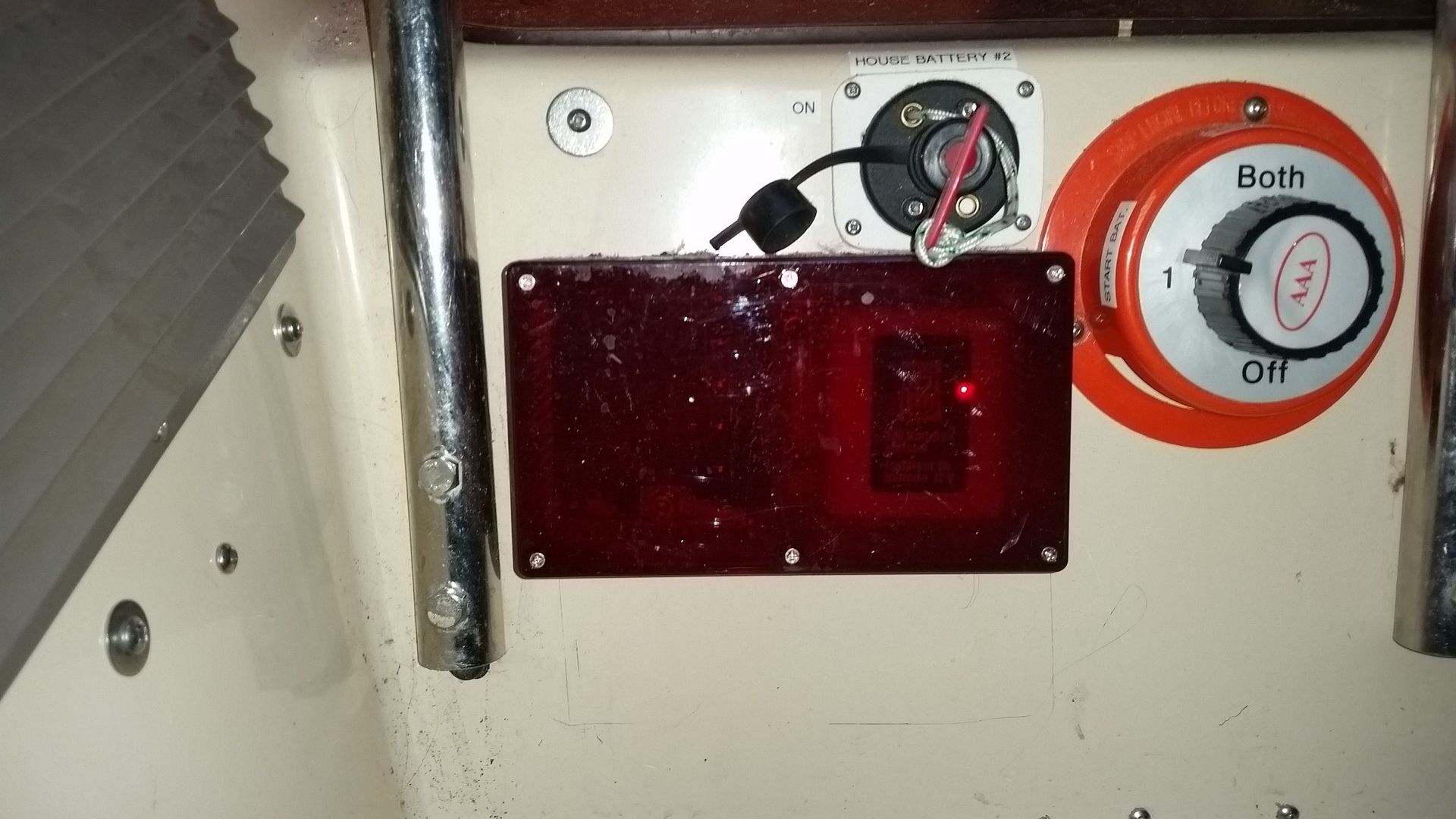
the battery isliator is inside the red plastic box along with a fuse panel
http://i844.photobucket.com/albums/ab1/ ... jigzo3.jpg
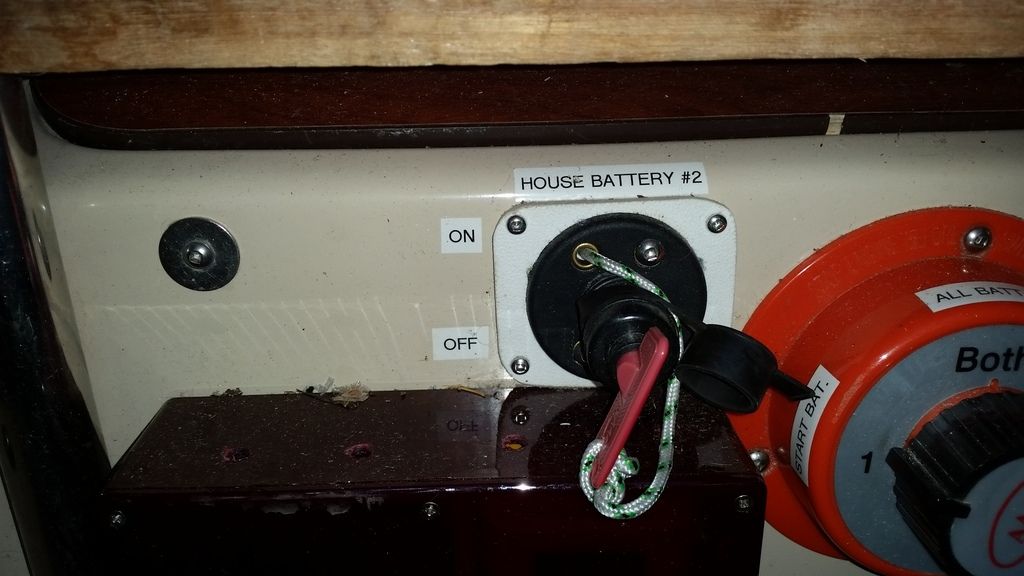
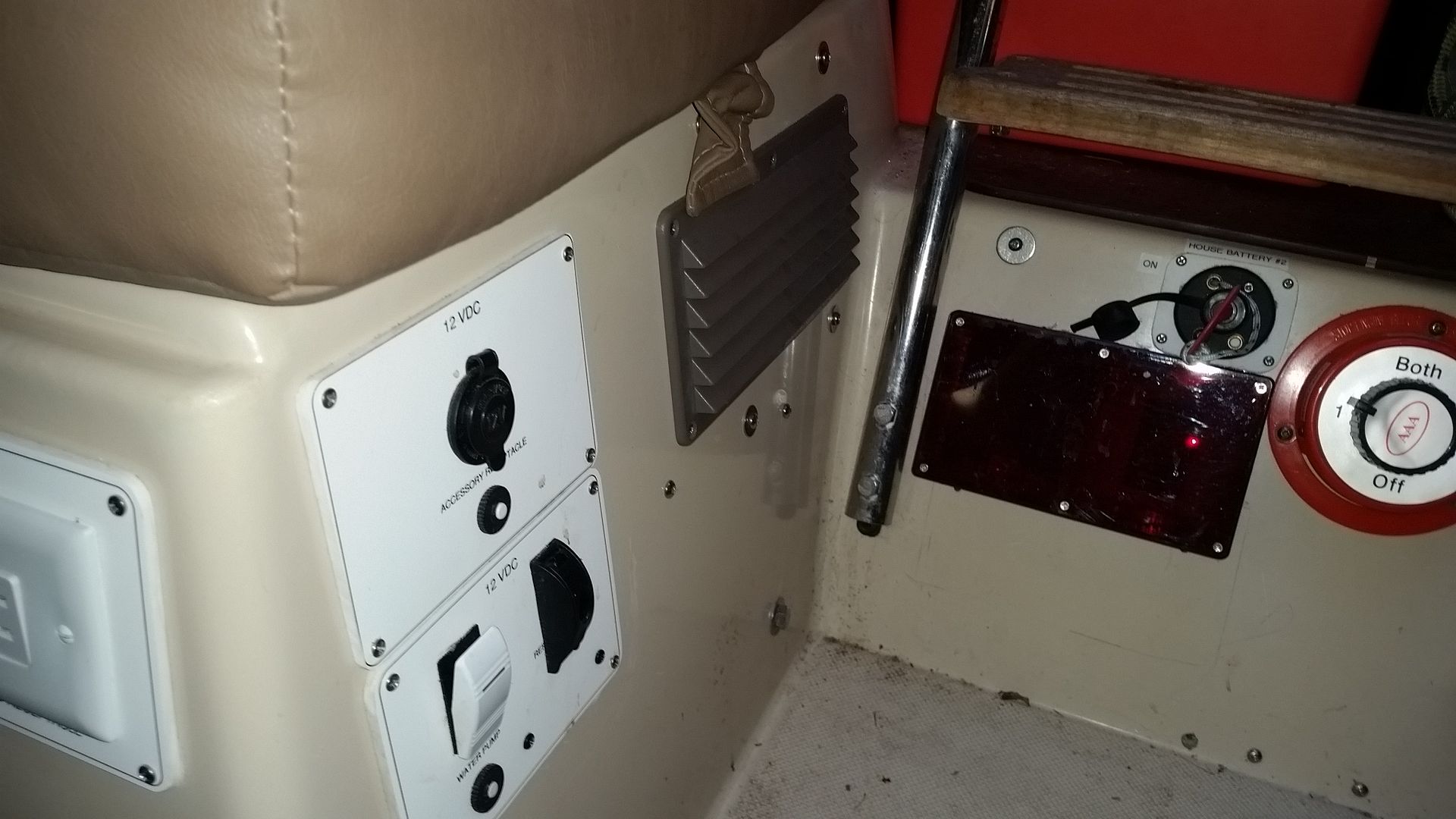
A dual stage smart battery charger 12amps 6/6 amps is also connected to all the batts , #1 charger to start batt, #2 charger goes to a battery isliator . & charges #1 house batt or if #2 house batt is turned on the Isliator will give the batt that needs the most charge charging or equally charge both house batts
the battery charger is behind the vent cowl on the left
http://i844.photobucket.com/albums/ab1/ ... uwv9ws.jpg
J
PS I also have three 40 Watt solar panels yet to b installed
-
vizwhiz
- Admiral
- Posts: 1388
- Joined: Mon Aug 23, 2010 9:48 pm
- Sailboat: MacGregor 26S
- Location: Central Florida
Re: Wiring Advice
Hey John (Interim), you might want to update your profile with location. It isn't uncommon for local members to happily make house calls for a small gift of...oh, i dunno...pizza, beer, or rum! 
Re: Wiring Advice
I did the dual circut design. One battery is for the engine, other is for the house. The house battery is charged with solar. The engine is charged with the engine. I put in an automatic tie together so ether system will keep the other one charged onece its battery is up around 12.9v
http://www.defender.com/product3.jsp?pa ... &id=605576
I use this to turn on and off and manually tie them together when needed.
https://www.bluesea.com/products/5511e/ ... ery_Switch
http://www.defender.com/product3.jsp?pa ... &id=605576
I use this to turn on and off and manually tie them together when needed.
https://www.bluesea.com/products/5511e/ ... ery_Switch
Re: Wiring Advice
Now back to the most important part, Circuit protection! Put current limiters, breakers(Fuses) on each circuit designed for the circuit size. A 100 amp limiter is not going to help when you short out a 22ga wire.
Here you can see each battery has a 100 amp limiter in its circuit. Have not tested yet to see if I can go down on that value. I do know that it is not to low have been operating with them for 2 years and have not blown one when starting the engine. You can also see the automatic battery combiner and also a shunt for reading current the system is using. Also the two black fuses are for the voltage reading of each battery. They have an appropriate size fuse in case they short.

Then from the battery selector switches I have a 40 amp limiter feeling the house system. Everytime you branch off your electrical system you need to reevaluate your circuit protection. Plan on every wire in your system has a chance of a direct short.

It is better to break down you circuits as much as possible. You do not want a short in the radio to take out your navigation lights.
Now to avoid direct shorts. Plan your wire routing and secure wires so they do not move a lot. Tywraps are you friend. You can also bond these to the boat to keep wires secure.
https://www.uline.com/Product/Detail/S- ... lsrc=aw.ds
However do not cut your tywraps like that. You will regret it later!!!!! When they are cut like that they will cut you next time you are working on it. You will look like you got in a fight with a cat.
Here you can see each battery has a 100 amp limiter in its circuit. Have not tested yet to see if I can go down on that value. I do know that it is not to low have been operating with them for 2 years and have not blown one when starting the engine. You can also see the automatic battery combiner and also a shunt for reading current the system is using. Also the two black fuses are for the voltage reading of each battery. They have an appropriate size fuse in case they short.
Then from the battery selector switches I have a 40 amp limiter feeling the house system. Everytime you branch off your electrical system you need to reevaluate your circuit protection. Plan on every wire in your system has a chance of a direct short.
It is better to break down you circuits as much as possible. You do not want a short in the radio to take out your navigation lights.
Now to avoid direct shorts. Plan your wire routing and secure wires so they do not move a lot. Tywraps are you friend. You can also bond these to the boat to keep wires secure.
https://www.uline.com/Product/Detail/S- ... lsrc=aw.ds
However do not cut your tywraps like that. You will regret it later!!!!! When they are cut like that they will cut you next time you are working on it. You will look like you got in a fight with a cat.
-
Russ
- Admiral
- Posts: 8345
- Joined: Thu Oct 11, 2007 12:01 pm
- Sailboat: MacGregor 26M
- Location: Bozeman, Montana "Luna Azul" 2008 M 70hp Suzi
Re: Wiring Advice
grady wrote:I did the dual circut design. One battery is for the engine, other is for the house. The house battery is charged with solar. The engine is charged with the engine. I put in an automatic tie together so ether system will keep the other one charged onece its battery is up around 12.9v
http://www.defender.com/product3.jsp?pa ... &id=605576
I use this to turn on and off and manually tie them together when needed.
https://www.bluesea.com/products/5511e/ ... ery_Switch
I like this. I have the same setup sans the manual switch. I may have to add that. Great idea.
I just learned about these. I may add one to each battery.Now back to the most important part, Circuit protection!
https://www.bluesea.com/products/5191/M ... 30_to_300A
