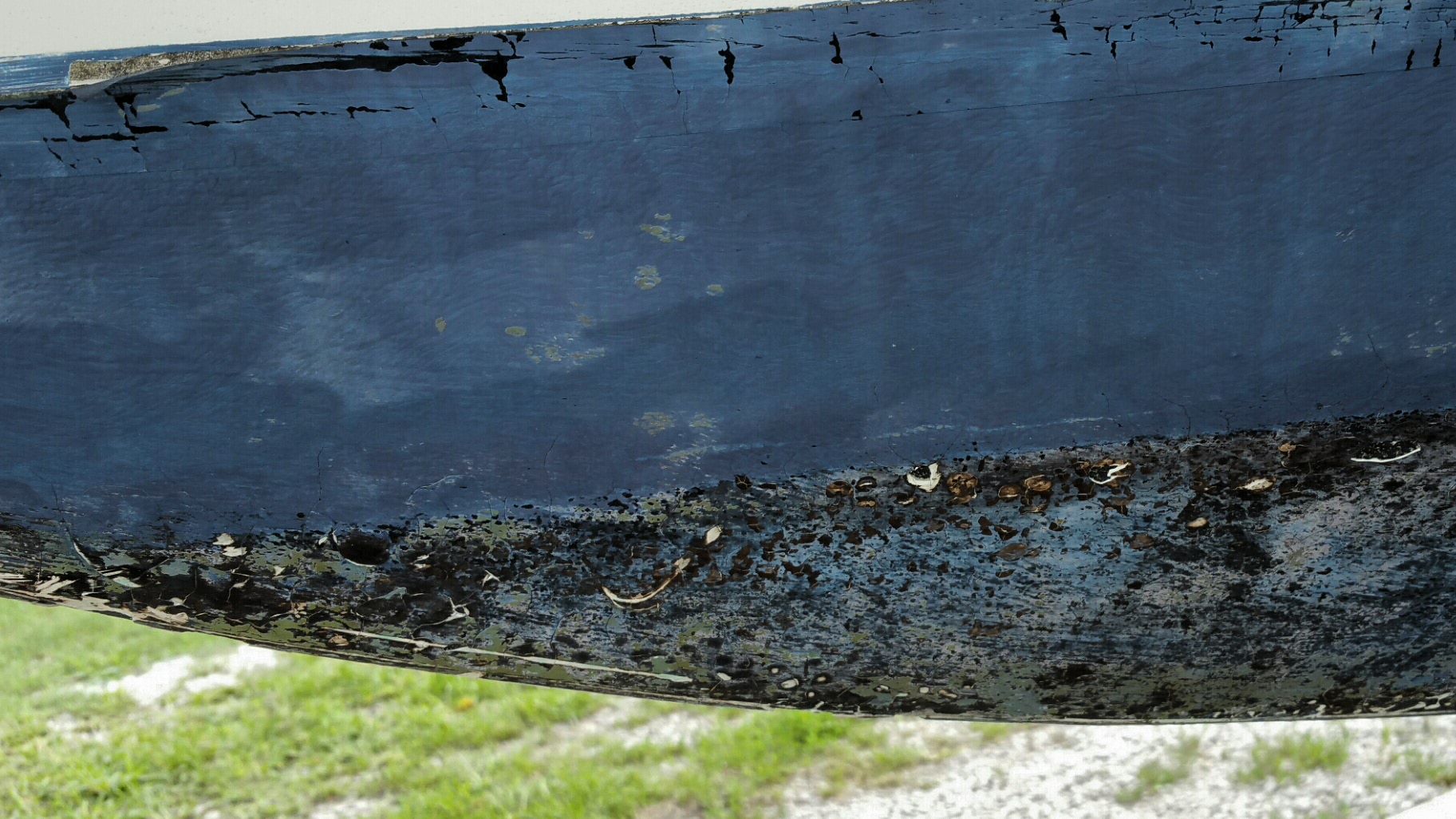
Been a while since I've posted out here. I've been working on my '69 venture 24. All the paint has to go so sanding is taking forever. I've burned up 1 belt sander and have used an untold amount of sandpaper. I recently picked up a pneumatic inline sander. Been using that with 36 grit paper. I still feel like I'm not making much progress. I've been thinking about trying out some citristrip paint & Varnish stripping gel. Has anybody used this on a their boat? I'm 90% disabled from some time in the Army so I'm trying to find something that would be a bit less labor intensive. Any thoughts?
Here's a bit of what I started with. I'll get a few of where I'm at now tomorrow if it will stop raining.
I'd say no to hiring kids personally. I haven't seen one in quite a while who'd want to do that work.
If you haven't scrapped off the bottom growth first then do that.
Then use an air powered disc grinder with sixty grit quality sanding discs.
Take the time to make it comfortable to use. Wear the mask and coveralls and gloves. It will go a lot quicker then a belt sander.
If you have a lot of time and are very weak then you can use a lightweight corded drill with the drill disc attachment and 36 grit mini discs. They can be bought in bulk from Amazon. You could do a few square feet a day. These tend not to make huge clouds of dust so less body protection is needed. I use them often for prepping small areas.
The forgoing assumes you need to remove all the bottom paint completely. For some reason.
Ix
Use paint stripper to get the majority of the paint off. Then use the disc sander to get the remaining off, and it will be roughed up enough to put your first coat of epoxy barrier coat on.
Can't tell exactly what is on your hull, but have seen pictures of similar looking bottoms on boats lifted out of the water by Travelifts. Their hulls are cleaned by marina workers using pressure washers that appear to do a good job. You might try one of those, if one is available.
Ken
Disclos: I recently received a nice pressure washer but have yet to use it on the boat so am interested in any applications on boats. It worked well on the sidewalks and the siding on the house so I'm a fan already.
PS: With my skill level, I personally would never use a disc sander or disc grinder on my fiberglass, unless for a repair. I would stick to the linear or belt sander as you have done. There probably are folks that could do it successfully but I would dig in here and there and get concave gouges. UGLY!
Every coat all the way to the glass is toast. Whoever owned this before me had not done any work to it in a very long time. I have a Dewalt disk sander, a random orbit, belt sander, and an air inline sander, along with hand sanding blocks. I have a plan to get it off the trailer soon so I can get to the spots under the bungs and rollers. I'm also planing to drop the center board out so I can sand all the epoxy off and redo it. I have a ton of work left to do and I hope to find a way to make it easier.
The ablative stuff from the olden days had a lot of metals in it that can make some sand papers ineffective. The actual paint particles that are poison to organisms are also metal and harder than some of the silicon and metallic particles on your sandpaper. You have a really nasty job ahead of you - that's why most folks back in the day would just slop more paint over the old stuff - (cuz it's so hard to remove).
Grinding is the right answer BUT you will grind into the fiberglass - this is a tough case. Most of the ones I have seen grinded down usually require a lot of fill to fix all the fiberglass that is lost in the process. Maybe there is a special sandpaper available for your belt sander that is designed to sand metal? (I thought there were some carbon sandpapers out there that were meant to cut steel - ? I dunno - we need some of the engineer guys to comment here).
There must be someone on the site here with some professional advice on this ? - this post needs comments from some people with experience on these old bottom paint jobs.
These older MACs are worth restoring, but how is it done?
I had 1/2' antifoul build up on my JOG boat, I used a chemical antifoul remover which worked OK, also you can use a heat gun not too hot and not too long to soften the antifoul, be sure to wear all the protective gear, especially a dust mask that stuff is lethal
Huh I guess grinding without screwing up the surface is some kind of lost art or something?
The secret is a light hi rpm machine and a good paper and a soft touch.
It might also scrape off with a sharp chisel.
The older paints were often modified epoxy or some such. Yes they were hard.
It might only cost a few hundred to have it sand blasted. Might check that option
Ix
well I started trying to grind some today. I got some [html=http://www.homedepot.com/p/3M-Sandblast ... lsrc=aw.ds]3M Sandblaster Medium Grit Clean-N-Strip Disc[/html] for my angle grinder. I started on the trailer to get the feel for it. then started on some of the bottom paint. It did take the paint off very quickly, but the "pink layer" (looks like bondo on a car, sands like steel forged in hades) is still really hard. I wouldn't care so much but the cracks in it bother me. I'm not sure that just putting a layer of west systems 105/205 epoxy with some 405 filliting filler in it would make it strong enough. here are some pictures i took today of where i am at now.
this is whats under the paint (the hades spawn pink layer)
and here is that same spot on the bow from an earlier post.
Oh, and yes every time I go work on it I wear these DeWalt goggles and this MSA Safety Works Respirator. They seem to work well. I also wear hearing protection as much for noise as keeping all that garbage out of my ears.
I'd say take everything off back to the factory gelcoat and asses the condition of that. That so called pink layer may be some type of old primer put on to cover up bad or damaged gelcoat. Before you go treating anything with epoxy you'll want to Make sure the surface you are putting it on is sound. If it's cracking or flaking, get rid of it. Use a coarser grit if you are having trouble with it. Looks like you got the actual bottom paint removal down pretty good.
As an aside, if you are just going to trailer the boat and use it once and a while, all you really need is just to get rid of the old bottom paint down to something reasonably hard and smooth. Put two new coats on and call it good. Boats that spend most of the time on a trailer don't really get water penitration into the hull.
I'd only bother with "doing it right" if you plan to use the boat extensively or take long cruises. Mines in the water most of the year. Therefor I spent the extra effort to make sure the hull had good epoxy paint and I inspect it carefully. If I just used the boat for weekend sailing and then took it out each time I surely wouldn't bother.
Ix
It will end up on the trailer most of the time. I want to make sure it's good enough that I don't have to worry about it for as long as I can. I don't even expect that it will ever see salt water. Just so much left to do. Lol
Ixneigh wrote:
The older paints were often modified epoxy or some such. Yes they were hard.
It might only cost a few hundred to have it sand blasted. Might check that option
Ix
wow ixneigh, I always wondered about this - I remember touching the bottom on some boats where the bottom paint had a run or something and that blob was hard like steel - it was like that stuff we used to use to glue steel parts together (you know, the gooey black stuff in one tube you mix with the pasty grey stuff in the other tube?) Man! That stuff dries HARD! It does not sand too well.
it looks like your making really good progress on your sanding!