


There are a couple concerns on your schematic. You are correct in your assumption that you can not charge the battery off your inverter. I would recommend placing the charger on it's own breaker prior to your AB switch. Now, about that switch... I personally would do away with it and plug whatever you wish to power directly into the inverter. 300 watts can not power a 30 amp panel. Inevitably, something with a large load is going to be inadvertently plugged in when you disconnect from shore power which could potentially release the magic smoke stored inside the inverter that makes it operate. Just my $0.02
Fair Winds,
Capt. Azzarac
Chameleon
Follow Chameleon's travels at: http://svchameleon.weebly.com/
DIY Shore Power Install
-
Wind Chime

- Captain
- Posts: 866
- Joined: Sun Jan 21, 2007 4:30 pm
- Sailboat: MacGregor 26X
- Location: Vancouver, B.C. Canada. 2000-26X, Suzuki-50hp, 8' Walker-Bay tender (with sailkit)
- Contact:
Re: DIY Shore Power Install
This is something I did not consider - Can someone help me understand if/why a 300 watt inverter will not run through a 30 amp breaker panel. Doesn't a 300 watt inverter at 12 volts put out 25 amps?
Azzarac wrote: .. 300 watts can not power a 30 amp panel.
-
Sumner

- Admiral
- Posts: 2375
- Joined: Sun Jan 04, 2009 3:20 pm
- Sailboat: MacGregor 26S
- Location: SE Utah
- Contact:
Re: DIY Shore Power Install
The inverter would be using 25 amps at 12 volts if it was producing 300 watts plus some more for the inefficiency of the conversion going from 12 volts to 110. But at 110 volts you only have about 2.7 amps to work with (300/110). Still 300 watts. Remember watts = volts * amps (25 * 12 = 300 and 2.7 * 110 = 300).Wind Chime wrote:This is something I did not consider - Can someone help me understand if/why a 300 watt inverter will not run through a 30 amp breaker panel. Doesn't a 300 watt inverter at 12 volts put out 25 amps?
Azzarac wrote: .. 300 watts can not power a 30 amp panel.
So the inverter's 110 voltage could go to the 30 amp panel but as soon as you had a 110 load of more than 2.7 amps then the smoke might happen
 ,
,Sumner
============================
Our MacGregor 26-S
Our Endeavour 37
Our Trips to Utah, Idaho, Canada, Florida
Mac-Venture Links
-
Wind Chime
- Captain
- Posts: 866
- Joined: Sun Jan 21, 2007 4:30 pm
- Sailboat: MacGregor 26X
- Location: Vancouver, B.C. Canada. 2000-26X, Suzuki-50hp, 8' Walker-Bay tender (with sailkit)
- Contact:
Re: DIY Shore Power Install
Thanks guys, I never converted it to the 110v calculation.
Got it - our 300 watt inverter running 110 volts through a 30 amp panel should handle a max load up to about 2.7 amps - so it should easily handle our TV/DVD that draws 53 watts (or .48 amps).
I guess I need to re-think if there is a better way to incorporate the inverted A/C into the same shore-power system. Would like something more permanent that what we are doing now. (Running extension cord(s) in the bilge from the inverter to TV, etc.)
Got it - our 300 watt inverter running 110 volts through a 30 amp panel should handle a max load up to about 2.7 amps - so it should easily handle our TV/DVD that draws 53 watts (or .48 amps).
I guess I need to re-think if there is a better way to incorporate the inverted A/C into the same shore-power system. Would like something more permanent that what we are doing now. (Running extension cord(s) in the bilge from the inverter to TV, etc.)
Sumner wrote:The inverter would be using 25 amps at 12 volts if it was producing 300 watts plus some more for the inefficiency of the conversion going from 12 volts to 110. But at 110 volts you only have about 2.7 amps to work with (300/110). Still 300 watts. Remember watts = volts * amps (25 * 12 = 300 and 2.7 * 110 = 300).Wind Chime wrote:This is something I did not consider - Can someone help me understand if/why a 300 watt inverter will not run through a 30 amp breaker panel. Doesn't a 300 watt inverter at 12 volts put out 25 amps?
Azzarac wrote: .. 300 watts can not power a 30 amp panel.
So the inverter's 110 voltage could go to the 30 amp panel but as soon as you had a 110 load of more than 2.7 amps then the smoke might happen
Sumner
-
RobertB

- Admiral
- Posts: 1863
- Joined: Sun Jun 05, 2011 7:42 pm
- Sailboat: MacGregor 26M
- Location: Clarksville, MD
Re: DIY Shore Power Install
I notice that you are really planning much around the inverter. My experience with these is that they really need a lot of battery power. How big is your battery bank? I run DC fans and refrigerator all night plus some laptop computer in the evening and that is why I use three batteries - two for the house load with one in reserve to start the engine. I would run the inverter off a DC plug and power your TV off that.
Also, looking at your diagram, it appears to be a self licking ice cream cone. You are powering the inverter off the battery (normal) but then powering the house AC system that in turns powers the battery charger. This is a good design to turn energy into heat - and become a good customer at the battery store.
Also, looking at your diagram, it appears to be a self licking ice cream cone. You are powering the inverter off the battery (normal) but then powering the house AC system that in turns powers the battery charger. This is a good design to turn energy into heat - and become a good customer at the battery store.
-
Wind Chime
- Captain
- Posts: 866
- Joined: Sun Jan 21, 2007 4:30 pm
- Sailboat: MacGregor 26X
- Location: Vancouver, B.C. Canada. 2000-26X, Suzuki-50hp, 8' Walker-Bay tender (with sailkit)
- Contact:
Re: DIY Shore Power Install
We have two 12v group-24 batteries (a third for longer trips)RobertB wrote:I notice that you are really planning much around the inverter. My experience with these is that they really need a lot of battery power. How big is your battery bank? .
As I mentioned, we are currently running the inverted A/C power from battery to inverter to extention cords in the bilge, so we are looking at a better system and it makes sense to try and incorporate it with the A/C shore-power if possible.RobertB wrote: I would run the inverter off a DC plug and power your TV off that. .
To avoid a power loop - I would have to turn off the 15amp breaker for the battery charger when running inverted A/C power through the A/C shore-power system.RobertB wrote: Also, looking at your diagram, it appears to be a self licking ice cream cone. You are powering the inverter off the battery (normal) but then powering the house AC system that in turns powers the battery charger. This is a good design to turn energy into heat - and become a good customer at the battery store.
I have been on many (bigger) boats that have only one set of electrical A/C outlets that run both shore-power and inverted A/C power.
How have they solved this issue? Is it just a matter of a bigger inverter in the system - even if I'm still only going to draw around 2.7 amps at 110v?
-
RobertB
- Admiral
- Posts: 1863
- Joined: Sun Jun 05, 2011 7:42 pm
- Sailboat: MacGregor 26M
- Location: Clarksville, MD
Re: DIY Shore Power Install
The idea to switch off the battery charger will work but is not a fail safe. Knowing my crew, it would get switched on and I would end up with dead batteries.
I am a fan of idiot proofing and if using the AC outlets is that important, would try to wire such that the battery charger could not be powered off the inverter.
BTW, the AC selector switch I believe is generally used to switch between shore power and generator.
I am a fan of idiot proofing and if using the AC outlets is that important, would try to wire such that the battery charger could not be powered off the inverter.
BTW, the AC selector switch I believe is generally used to switch between shore power and generator.
-
RobertB
- Admiral
- Posts: 1863
- Joined: Sun Jun 05, 2011 7:42 pm
- Sailboat: MacGregor 26M
- Location: Clarksville, MD
Re: DIY Shore Power Install
I may have missed it, but where are you locating your shore power connector? I was considering at the aft under the seat on the port side but this requires a pretty expensive bunch of wire (I was sizing at about 8 AWG for close to a 20 foot total cable length considering the routing). I am also considering on the starboard side outboard of the winch - this would minimized the run to several feet and 10 AWG would be adequate. Mine is a 30 amp service.
-
Wind Chime
- Captain
- Posts: 866
- Joined: Sun Jan 21, 2007 4:30 pm
- Sailboat: MacGregor 26X
- Location: Vancouver, B.C. Canada. 2000-26X, Suzuki-50hp, 8' Walker-Bay tender (with sailkit)
- Contact:
Re: DIY Shore Power Install
Our shore power through-hull connector in our 2000X will be on the port side just after of the galley port window. Same as in this photo below. This goes right into the area where the DC panel is, our AC panel will be installed below this.RobertB wrote:I may have missed it, but where are you locating your shore power connector?
http://www.macgregorsailors.com/modt/in ... ewimg=2312
-
Wind Chime
- Captain
- Posts: 866
- Joined: Sun Jan 21, 2007 4:30 pm
- Sailboat: MacGregor 26X
- Location: Vancouver, B.C. Canada. 2000-26X, Suzuki-50hp, 8' Walker-Bay tender (with sailkit)
- Contact:
Re: DIY Shore Power Install
After some insightful comments from Sumner and other board members here, along with a little more internet research – it seems I may need to rethink how I can; add A/C Inverted-Power into the A/C Shore-Power system.
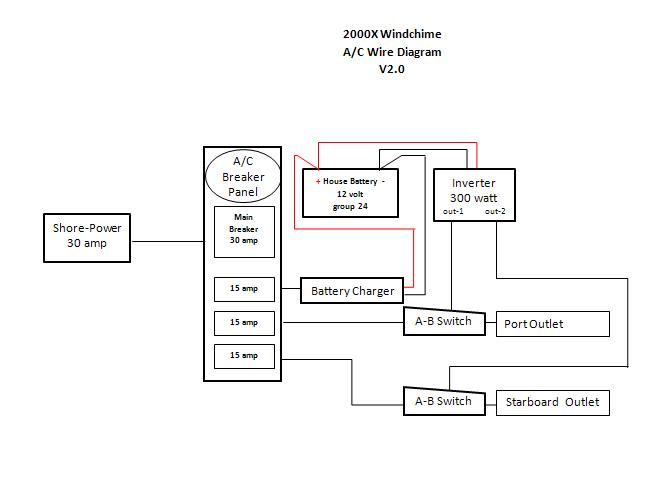
The big issue to solve is; how to use the same GFCI outlets, and avoid a power-loop between the battery charger and the A/C inverter.
I was proposing that an A-B power-selector-switch be installed “before” the A/C Shore-Power breaker panel (switch between A/C shore and A/C inverter). This is fine only if the inverter was somehow able to be “automatically” removed from the charging circuit. But having to ensure the battery charger breaker is manually turned “off” whenever using inverted A/C leaves the possibility for the breaker to be accidently left in the “on” position, and that would drain the batteries very fast with the inverter trying to charge the batteries. And as RobertB pointed out – this is not failsafe.
So I went back to the drawing board to find a failsafe solution, that even I can’t screw-up … and here’s my new thinking;
If the inverter has two A/C outputs (both fused) there is no need to run the “A/C Inverted-Power” through the “A/C Shore-Power” breaker panel for protection.
- use the existing two GFIC duel-plug outlets that are used for A/C Shore-Power system (one Portside / one Starboard side)
- install two A-B switches, one switch at each of the GFIC electrical outlets. (switch between A/C Shore-Power and A/C Inverter-Power)
- run two separate A/C wires from the inverter outputs, one to each of the two separate A-B switches (at the two GFIC duel-plug outlets)
- select “Shore” or “Inverted” A/C power at each individual GFIC outlet.
This way, each outlet would only receive A/C power from “one source” at a time. (Shore or Inverter). Even if the inverter was accidently turned on while connected to shore power there would still only be one A/C source to each outlet, so the two A/C systems (shore & inverted) would never meet.
The inverter is now removed from the battery charging system because the battery charger circuit could only receive power from the A/C "Shore-Power" system.
The big issue to solve is; how to use the same GFCI outlets, and avoid a power-loop between the battery charger and the A/C inverter.
I was proposing that an A-B power-selector-switch be installed “before” the A/C Shore-Power breaker panel (switch between A/C shore and A/C inverter). This is fine only if the inverter was somehow able to be “automatically” removed from the charging circuit. But having to ensure the battery charger breaker is manually turned “off” whenever using inverted A/C leaves the possibility for the breaker to be accidently left in the “on” position, and that would drain the batteries very fast with the inverter trying to charge the batteries. And as RobertB pointed out – this is not failsafe.
So I went back to the drawing board to find a failsafe solution, that even I can’t screw-up … and here’s my new thinking;
If the inverter has two A/C outputs (both fused) there is no need to run the “A/C Inverted-Power” through the “A/C Shore-Power” breaker panel for protection.
- use the existing two GFIC duel-plug outlets that are used for A/C Shore-Power system (one Portside / one Starboard side)
- install two A-B switches, one switch at each of the GFIC electrical outlets. (switch between A/C Shore-Power and A/C Inverter-Power)
- run two separate A/C wires from the inverter outputs, one to each of the two separate A-B switches (at the two GFIC duel-plug outlets)
- select “Shore” or “Inverted” A/C power at each individual GFIC outlet.
This way, each outlet would only receive A/C power from “one source” at a time. (Shore or Inverter). Even if the inverter was accidently turned on while connected to shore power there would still only be one A/C source to each outlet, so the two A/C systems (shore & inverted) would never meet.
The inverter is now removed from the battery charging system because the battery charger circuit could only receive power from the A/C "Shore-Power" system.

RobertB wrote:The idea to switch off the battery charger will work but is not a fail safe. Knowing my crew, it would get switched on and I would end up with dead batteries. I am a fan of idiot proofing and if using the AC outlets is that important, would try to wire such that the battery charger could not be powered off the inverter. BTW, the AC selector switch I believe is generally used to switch between shore power and generator.
Last edited by Wind Chime on Mon Oct 27, 2014 3:40 pm, edited 1 time in total.
-
Sumner
- Admiral
- Posts: 2375
- Joined: Sun Jan 04, 2009 3:20 pm
- Sailboat: MacGregor 26S
- Location: SE Utah
- Contact:
Re: DIY Shore Power Install
I might not of followed all of the above, but it sounds like lots of switches. Look into maybe using a relay that is rated for continuous duty and wire it so that it opens the circuit to the "charger" any time there is shore power present.
One switch like the one in one of your previous posts will send power to the outlets from either the shore power or the inverter,
Sumner
============================
Our MacGregor 26-S
Our Endeavour 37
Our Trips to Utah, Idaho, Canada, Florida
Mac-Venture Links
One switch like the one in one of your previous posts will send power to the outlets from either the shore power or the inverter,
Sumner
============================
Our MacGregor 26-S
Our Endeavour 37
Our Trips to Utah, Idaho, Canada, Florida
Mac-Venture Links
-
Wind Chime
- Captain
- Posts: 866
- Joined: Sun Jan 21, 2007 4:30 pm
- Sailboat: MacGregor 26X
- Location: Vancouver, B.C. Canada. 2000-26X, Suzuki-50hp, 8' Walker-Bay tender (with sailkit)
- Contact:
Re: DIY Shore Power Install
Sumner - you have the patience of a saint 
How does a "continuous duty relay" know there is "Shore-Power" only present?
Does it really know the difference between “Shore-Power” and “Inverter-Power” A/C in the system?
Would it not just open the circut to the charger for both sources of A/C?
How does a "continuous duty relay" know there is "Shore-Power" only present?
Does it really know the difference between “Shore-Power” and “Inverter-Power” A/C in the system?
Would it not just open the circut to the charger for both sources of A/C?
Sumner wrote: Look into maybe using a relay that is rated for continuous duty and wire it so that it opens the circuit to the "charger" any time there is shore power present.
One switch like the one in one of your previous posts will send power to the outlets from either the shore power or the inverter,
Sumner
-
Sumner
- Admiral
- Posts: 2375
- Joined: Sun Jan 04, 2009 3:20 pm
- Sailboat: MacGregor 26S
- Location: SE Utah
- Contact:
Re: DIY Shore Power Install
Wind Chime wrote:...How does a "continuous duty relay" know there is "Shore-Power" only present?...
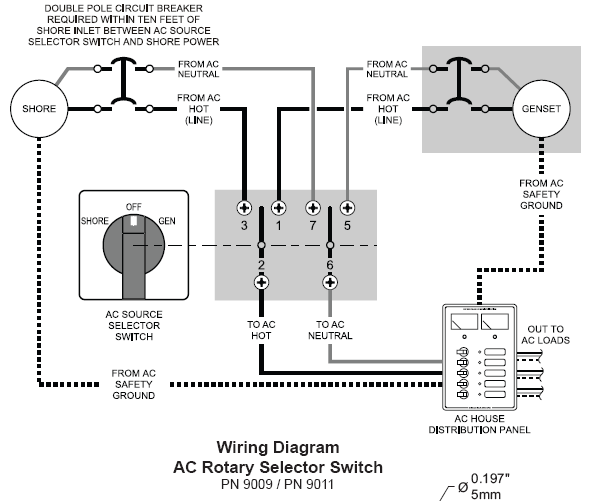
A couple ways to do it.
These would use an AC relay that can be operated continuously without damage or heat (I have more experience with DC relays so ask questions and shop wisely
):Option 1. You trigger the relay to "close" the circuit to the charger when there is current from the shore on the #3 and #7 terminals above. You will have that current when you plug the shore power in and switch the transfer switch to it.
Option 2. You trigger the relay to "open" the circuit to the charger when there is current from the inverter on the #1 and #5 terminals above.
Option 1 might have an advantage as the relay would only be consuming power when you are also connected to shore power whereas option 2 might be consuming power from your batteries. Both of these will depend on if the relay needs power to be normally "closed" or "open" depending on the situation,
Sumner
============================
Our MacGregor 26-S
Our Endeavour 37
Our Trips to Utah, Idaho, Canada, Florida
Mac-Venture Links
-
Wind Chime
- Captain
- Posts: 866
- Joined: Sun Jan 21, 2007 4:30 pm
- Sailboat: MacGregor 26X
- Location: Vancouver, B.C. Canada. 2000-26X, Suzuki-50hp, 8' Walker-Bay tender (with sailkit)
- Contact:
Re: DIY Shore Power Install
Option 1. You trigger the relay to "close" the circuit to the charger when there is current from the shore. You will have that current when you plug the shore power in and switch the transfer switch to it.Sumner wrote:Wind Chime wrote:...How does a "continuous duty relay" know there is "Shore-Power" only present?...
Sumner
Thanks! I would not never have considered an AC relay to solve this.
I agree that Option #1 (above) would work best. I'm not sure how seaworthy this type of relay would be, (I have not been able to find a "marine" version of this type of relay), and even though it would be installed behind the breaker panel area I would still probably install the relay into a pvc junction box to kept it away from the elements or accidental touching.
]Wiring: Generic 120V coil relays. How to wire a general purpose relay with a 120 Volt coil.
Operation:
The relay is typically used to start (or slave) a secondary device like a booster or exhaust fan. A 120 VAC coil means that you apply 120 VAC to the coil contacts (black wiring) to energize the relay and close the switched contacts (red wiring). When the 120 VAC to the coil contacts is removed, the relay de-energizes and the switched contacts open.
Diagram:
The diagram below shows 120V being applied to the coil contacts ( black wiring, terminals 7 and 8 ). The switched contacts are shown in red wiring, terminals 3 and 5. The 120V to the booster fan passes through the switched contacts to start and stop the fan.

-
Sumner
- Admiral
- Posts: 2375
- Joined: Sun Jan 04, 2009 3:20 pm
- Sailboat: MacGregor 26S
- Location: SE Utah
- Contact:
Re: DIY Shore Power Install
How much of the time will your boat be at sea with water and mist coming into the cabin. Sometimes I think they overplay this for boats like ours. Sure if I was going across oceans it would be different but I also see thousands of houses/businesses in Florida not much further from the water than the boats in the slips and I wonder if they all have 'marine grade' equipment in them.Wind Chime wrote:..... I'm not sure how seaworthy this type of relay would be....
Just make sure you protect it the best you can and mostly that it is rated for the current that it will see with the charger,
Sumner
============================
Our MacGregor 26-S
Our Endeavour 37
Our Trips to Utah, Idaho, Canada, Florida
Mac-Venture Links