

So I've been looking at Canted Keel technology, which is just showing up in large race sailboats. Long story short it's a lead bulb keel that can be swung laterally forty degrees (and by swung, I mean pushed with hydraulic actuators) to entirely counteract heel with whatever righting moment is necessary to keep the boat upright against windward pressure.
So far, they've been winning everything and are achieving a 30% increase in speed--very similar to cats in their performance. The Volvo 70' race boats are doing 30 knots as monohulls, which is unheard of.
But the technology is complex and the machinery has a lot of problems, not the least of which is that canted keels are not inherently stable--accidentally tack or gybe with the keel pointed the wrong direction and you've got an immediate capsize.
But the idea is good: Use weight to counteract heel when you need it to keep the boat at the correct angle. This is what we do when we order passengers to windward to counteract heel.
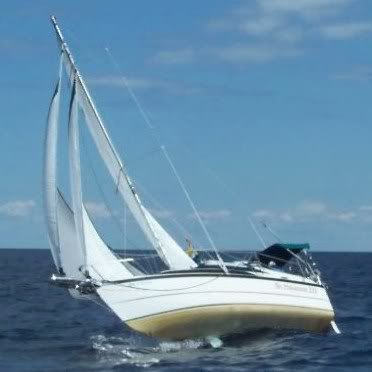
So it occurred to me how to do this quite simply in a Mac: Flood keel bulbs on the rudders. Because there are port and starboard rudders on a mac, when you heel one of the rudders comes out of the water. If that rudder had a flood bulk attached to it of some significant weight (say 50 lbs) that lifted out of the water just as the boat was coming to an optimal 15 degree heel, you would have a sudden righting moment just at the perfect amount of heel for maximum speed, and therefore a "wide" range of force that would exhibit that same sweet spot of heel. You would also have considerable righting moment for all greater angles of heel, but as soon as the neutral buoyancy bulb submerged the effect would be gone.
If the bulb's water inlets were on top, they would hold water when heeling, but would drain when pulled up. The bulbs could point well aft when up, and well forward of the rudders when down so that they could be weight balanced around the axis of steerage. This balance around the axis of steerage is important to counteracting the negative effects of additional steering weight, and you would likely want to disconnect the motor to lighten the steering load when using this technique.
Of course this would increase drag, but at speed, you will be heeling which means one bulb would be out of the water. Also, keeping optimal heel angle should more than compensate for the additional drag.
A cylinder 24" long and 8" in diameter will hold 50 lbs. of seawater.
Granted the stock rudders won't put up with this weight, but custom rudders designed for it would do the job quite well.
Anyone think of why this might be a bad idea considering that it's just shaping a different fiberglass rudder?
Mac compatible "canted keel" mod?
-
Highlander

- Admiral
- Posts: 5995
- Joined: Wed Sep 21, 2005 8:25 pm
- Sailboat: MacGregor 26M
- Location: Maccutter26M 2008 75HP Merc. 4/S Victoria BC. Can. ' An Hileanto'ir III '
- Contact:
Re: Mac compatible "canted keel" mod?
Well first of all with a 15% heel your rudders are anything but outa the water so their would not be much resistance to heel you gota get the boat over to 45% heel for that & I think at least 30-35% to get any kind of restance to heel so you are now more than double the best desired heel witch is 15-20% so kinda defeats the purpose & would be costly as now you would have to reinforce the transom & rudder brkt's
Now I can get the same result just by loading my boat right all heavy equip. is stored under the port & starboard seats along the full length of the hull as much as possible and no drag also keeping some weight forward in the V-berth helps when pointing
I like the Idea but ! costly & very time consuming would have to be a winter project for sure & you'd need an elect. winch to haul them rudders up !
I think a winged weighted Dagger board would be better also one of them dorsil fins you see in front of the D/B would get better pointing but that too would have to be retractable into the V-berth I guess
I need to move somewhere where it's warmer in the winter so as I can get mods like these done in the off season !
Lets us know how you make out if you deside to go with this mod ?
J
Now I can get the same result just by loading my boat right all heavy equip. is stored under the port & starboard seats along the full length of the hull as much as possible and no drag also keeping some weight forward in the V-berth helps when pointing
I like the Idea but ! costly & very time consuming would have to be a winter project for sure & you'd need an elect. winch to haul them rudders up !
I think a winged weighted Dagger board would be better also one of them dorsil fins you see in front of the D/B would get better pointing but that too would have to be retractable into the V-berth I guess
I need to move somewhere where it's warmer in the winter so as I can get mods like these done in the off season !
Lets us know how you make out if you deside to go with this mod ?
J
-
Crikey

- Admiral
- Posts: 1833
- Joined: Sun Apr 17, 2011 12:43 pm
- Sailboat: MacGregor 26M
- Location: Washago, Muskoka, Ontario, Canada, Earth, Singularity.Suzuki DF60A. Boat name: Crikey!
Re: Mac compatible "canted keel" mod?
I'm agreeing with the weighted daggerboard idea as being the best bang for the buck. I had read in a long past post of a mod involving small winglets on a daggerboard that also was increased in weight with expoxy sealed lead shot. It wasn't much weight, as I recall, and the shape of the main foil was also reprofiled top and bottom to accomodate the winglets, and provide a better fit in the box when running and retracted. I would love to hear a performance report on this mod after running it for this length of time.
It would seem that the re-engineering of the rudders for a weight effect, at the rear end of the boat could get excessive in both cost and drag and also after it all, be located in the wrong section of the boat. An interesting variation would be if you could section hinge the daggerboard near the top, then somehow crank it to one side or the other, without modifying the hull box. Would a bulb on the end of the daggerboard emulate a swath type design?
I love this stuff!
Ross
It would seem that the re-engineering of the rudders for a weight effect, at the rear end of the boat could get excessive in both cost and drag and also after it all, be located in the wrong section of the boat. An interesting variation would be if you could section hinge the daggerboard near the top, then somehow crank it to one side or the other, without modifying the hull box. Would a bulb on the end of the daggerboard emulate a swath type design?
I love this stuff!
Ross
-
mastreb

- Admiral
- Posts: 3927
- Joined: Wed Feb 09, 2011 9:00 am
- Sailboat: MacGregor 26M
- Location: Cardiff by the Sea, CA ETEC-60 "Luna Sea"
- Contact:
Re: Mac compatible "canted keel" mod?
So of course that is correct--I shouldn't have said that the rudder needed to be out of the water, just the bulb needs to be out of the water and it would be placed on the rudder at the point where it would be out of the water when ideal heel is reached--I'm guessing that's about half-way up but I'll do the math.Highlander wrote:Well first of all with a 15% heel your rudders are anything but outa the water so their would not be much resistance to heel you gota get the boat over to 45% heel for that & I think at least 30-35% to get any kind of restance to heel so you are now more than double the best desired heel witch is 15-20% so kinda defeats the purpose & would be costly as now you would have to reinforce the transom & rudder brkt's
My issue with daggerboard mods is that I trailer, and I'm quite certain that if I had a bulb or any other protrusion off the bottom of the daggerboard that it would get caught up on the trailer as we were bringing the boat aboard. What I like about the rudders is that I can kick them up and completely out of the water before I bring the boat near the trailer, using the engine as a rudder from that point on.
I'm also planning on the epoxy+lead shot mod to weight the daggerboard, but I do think I'm going to work up some forms for these rudders as well.
Matt
-
restless

- First Officer
- Posts: 421
- Joined: Wed Aug 05, 2009 1:55 pm
- Sailboat: MacGregor 26X
- Location: Sunny South England....uk
- Contact:
Re: Mac compatible "canted keel" mod?
Probl alot simpler to make some outriggers from old canoes, swing out style like a dragonfly trimeran.
-
technicalman

- Engineer
- Posts: 148
- Joined: Mon Dec 05, 2005 11:57 am
- Sailboat: MacGregor 26S
- Location: Palmdale
- Contact:
Re: Mac compatible "canted keel" mod?
I would think that this is the wrong boat for this application.
-
quintamala
- Deckhand
- Posts: 44
- Joined: Sat Jul 19, 2008 8:29 am
- Sailboat: MacGregor 26X
- Location: Rota, CADIZ (Spain)
Re: Mac compatible "canted keel" mod?
I found an interesting document on http://www.wumtia.soton.ac.uk/papers/HISWA2004AC.pdf
On page 5 of above document there is a graphic including water ballast boats.
On page 5 of above document there is a graphic including water ballast boats.
-
Crikey
- Admiral
- Posts: 1833
- Joined: Sun Apr 17, 2011 12:43 pm
- Sailboat: MacGregor 26M
- Location: Washago, Muskoka, Ontario, Canada, Earth, Singularity.Suzuki DF60A. Boat name: Crikey!
Re: Mac compatible "canted keel" mod?
Matt
Quintamala's paper provided some excellent hints dealing with aspects of daggerboard tabs and forward fins. I think the solution you seek has to do with enhancing mac stability at speed while sailing. It would be very interesting to combine all three, rudders - daggerboard - forward skeg, linked as a unit, to vector a larger righting moment while severly reducing the drag occuring soley from stalling rudders. Pointing ability and stability around the main axis of rotation would provide big improvements in handling under varying wind and sea conditions. An aileron on an existing daggerboard shouldn't be too hard to retrofit. its position could be determined by the mast rotation through a linkage or a real-time system (my choice), though its retraction would have to remain failproof.
You would still have to re-engineer the rudder system to take the sudden strain of a mid positioned rudder bulb encountering full immersion coming off the sweet spot into water contact. The righting moment of a 50lb bulb, in this position, relative to the centreline of the hull won't be contributing to a whole lot of rotation to a vertical orientation. Though your idea combined with complimentary mods elsewhere could be more effective as a whole.
Accomodating a bottom skeg or winglet would be contentious while dealing with a trailer but if you were only talking about a foot of difference, that could be overcome by deeper trailer linkup before hauling out.
Ross
Quintamala's paper provided some excellent hints dealing with aspects of daggerboard tabs and forward fins. I think the solution you seek has to do with enhancing mac stability at speed while sailing. It would be very interesting to combine all three, rudders - daggerboard - forward skeg, linked as a unit, to vector a larger righting moment while severly reducing the drag occuring soley from stalling rudders. Pointing ability and stability around the main axis of rotation would provide big improvements in handling under varying wind and sea conditions. An aileron on an existing daggerboard shouldn't be too hard to retrofit. its position could be determined by the mast rotation through a linkage or a real-time system (my choice), though its retraction would have to remain failproof.
You would still have to re-engineer the rudder system to take the sudden strain of a mid positioned rudder bulb encountering full immersion coming off the sweet spot into water contact. The righting moment of a 50lb bulb, in this position, relative to the centreline of the hull won't be contributing to a whole lot of rotation to a vertical orientation. Though your idea combined with complimentary mods elsewhere could be more effective as a whole.
Accomodating a bottom skeg or winglet would be contentious while dealing with a trailer but if you were only talking about a foot of difference, that could be overcome by deeper trailer linkup before hauling out.
Ross