Page 1 of 1
We're Sinking! Not really.
Posted: Mon Nov 13, 2006 7:24 am
by nchogberg
See "filing floatplan" in the pub.
Sat. night in Key Largo I decided to fill the ballast so perhaps the boat wouldn't be so tender while we were sleeping. Started cooking dinner and forgot about it. Crew was the wife our two 9yo boys a friend and myself. Well the friend and I went up on the bow to check out the stars.
The wife starts yelling "we're taking on water!". I run down to see water coming in from the bilge through the hole under the stairs.
I start pulling up the board in the v-berth and immediately know what happend. With our weight up front and and both plugs open the water was merrily coming up over the dam and into the bilge.
We got the bilge pump and cleaned it up no harm no foul.
Question. Whats the best way to get all the water out while on the trailer?
With the bow low and get the water from up front or bow high and get it from the back?
thanx...
Hawg
Posted: Mon Nov 13, 2006 9:03 am
by ssichler
According to my dealer a ShopVac.
Posted: Mon Nov 13, 2006 9:37 am
by K9Kampers
When I am faced with the same task, I just keep the boat level & bail / sponge out the bilge from under the galley and under the dinette aft seat. To get the very last bit of water, I'll lay a towel & sponges in the bilge then crank the bow down and wait a while, then crank the bow up and wait. Any water running down the slope absorbs into the towel. Working mid-ship gives the easiest access. Like ssichler says, try a shop vac.
Posted: Mon Nov 13, 2006 11:12 am
by beene
ballast flooding
Posted: Mon Nov 13, 2006 4:51 pm
by John McDonough
A few years back there was a thread which suggested removing the ballast plug under the V-berth and installing a fitting, and hose which is routed to the anchor locker drain. Of course there is a shut off valve in this line. You let the tank fill, put motor in rerverse, soon the water will fill the ballast tank and you should see a stream of water shooting out of the anchor tank drain hole. This way you know the tank is totally full and and then you just turn the valve to closed position. If knooberg had this mod, forgeting to close the valve would not lead to a bildge flood. I was just sinking, this will be my next boat project??.
Posted: Mon Nov 13, 2006 11:49 pm
by Frank C
Actually, my 26X was one of the first with a ballast vent hose up to the anchor locker. And it has no in-line valve, none needed IMO, my ballast tank is permanently open to the atmosphere. However, I defy anyone to use reverse gear and "superfill" the ballast tank so water shoots out the top of the vent ... not possible ... no way. Regardless of the lack of geyser, the mod is a real convenience. I gauge ballast fullness based upon standard fill-time, 6 to 7 minutes.
Edit per Dimitri's following comment:
Can anyone describe how a boat, even on her side, could possibly drain ANY ballast thru a winding-path, looped, one-inch hose? ... From where is the air (displacing that leaking ballast) going to enter the tank?
Posted: Tue Nov 14, 2006 4:46 am
by Dimitri-2000X-Tampa
Hey, wasn't there someone who put (or was thinking about putting) a whistle in the line so that when the ballast stopped filling (and pushing air out), the whistle would stop and you would know it was full?
I guess no valve may still be a problem if you turned her over on her side. If you didn't right the boat fairly quickly, then perhaps water would drain out of your vent and make it even harder to right the boat. Yes, of course its supposed to be self righting, but if you get a load of water in your sails and don't release the sheets, perhaps it might stay down even with the ballast full?
Posted: Tue Nov 14, 2006 7:37 pm
by ALX357
IMHO, even with a 1" winding hose path, an open vent ballast tank could allow ballast loss. While sailing, first on one tack then the other, and with the boat motion, I think air could find its way back up the vent to allow more ballast to leak out. The 1400 lbs of water, nearly half of it lifted above the vent hole, will force some out each time it can, and the air that goes back behind it, increasing each time, would alllow easier leakage progressively.
Have installed a floating ball valve, but not yet tested it. The principle is sound, air going both ways ok, but water rising in the vent pipe path will force the floating ball to close aginst the gasket, and prevent ballast loss.
Posted: Wed Nov 15, 2006 5:51 am
by Bill at BOATS 4 SAIL
Dimitri-2000X-Tampa wrote:Hey, wasn't there someone who put (or was thinking about putting) a whistle in the line so that when the ballast stopped filling (and pushing air out), the whistle would stop and you would know it was full?
I think it may have been Scott, who was going to put a ukulele in his.
UKELELE
Posted: Thu Nov 16, 2006 11:53 pm
by albion
UKELELE

Bill when I bought my boat from you, you told me you gave up the booze. Well that statement about a ukelele make me think you been hitting the bottle again. Ha ha. GEORGE . HMS WASPERTOM.
unvalved vent line......
Posted: Sat Nov 18, 2006 5:00 pm
by waternwaves
Frank, If I understand what you are saying correctly, then if you get a knockdown, the tank will start draining....... with that 3ft of head pressure from the now vertical orientation of the ballast tank.......
or am I missing something here.......
admittedly it will drain very slowly due to the long line, small diameter, and suction agaist the enclosed tank.......but it stills that it would half drain out given time......
Thanks
|>
Posted: Sat Nov 18, 2006 7:56 pm
by Frank C
Granting that I haven't yet devised an actual TEST of the concept .... IMO, BALLAST WON'T DRAIN AT ALL thru the open vent hose ... not a whit. Consider that the vent hose runs 8 feet along a winding path, AND that it HAS A LOOP (preventing back-draining of anchor mud) just before it connects to the anchor locker thru-hull (to starboard).
- 1. Would anyone dispute that, if floating with her port beam submerged, the anchor locker thru-hull is high-n-dry ... with absolutey ZERO draining potential?
2. If lying with starboard beam submerged, the loop in the vent hose is STILL ABOVE the highest level of ballast water ... so that too is essentially an air-to-air connection.
3. And ... even absent a loop in the vent hose, the ballast tank IS STILL effectively air-locked. There's simply NO WAY that an air bubble can pass thru that 8 feet of hose to replace the first (?) pint (?) of ballast that might drain from hull flexing ... the water and air will compete for space inside that tiny one-inch hose.
The only way that the ballast tank can drain thru an 8-foot vent hose, IMO, is by air leakage past the transom gate valve. That leakage will be SO SLOW (air seepage over a half-hour couldn't possilby exceed (?) 15 gallons of water) that it's immaterial to the issue of stability. If you haven't, after a half-hour, solved the problems preventing natural self-righting ... the vent hose certainly isn't contributing to your disaster.

Posted: Sun Nov 19, 2006 8:12 pm
by waternwaves
Thanks frank!
My 96 does not have the forward vent.
So I did not assume MAc put a loop in any hose up to the locker.
and btw..... Please dont lay it over and test on my account....

Having been over and bent and torn things....I dont recommend it.....heheheh
The only concern I would have in your statement is #2, I dont know where the vent comes up forward.... but if it is in the exact center of the boat and she is broached, the loop would just be another 20" of house and not be a loop.....as my ballast extends over three ft. past the CL of the boat. So I too think it would leak slowly
Anyone have the diameter of the forward vent hose so I can test and see?? Thanks
|>
Posted: Mon Nov 20, 2006 2:36 pm
by Frank C
WnW ... sorry to mislead, but Roger has never used a hose on any ballast tank vent, aft or forward. I added the vent hose myself to eliminate need of opening and closing the forward vent plug. I inserted a bronze hose nipple into the ballast vent hole, then routed a one-inch plastic hose through the v-berth flotation and up Roger's thru-hull on the stb bow. The hose forms a large vertical loop before connecting to the thru-hull. Rainwater from the anchor locker drains first out the thru-hull ... cannot drain back to the ballast tank.
Now that I ponder it, there's absolutely no way that ballast could drain with
either beam submerged. The starboard thru-hull itself would be submerged, trapping an air column within the vent hose. Maybe some pix will make it more clear ...
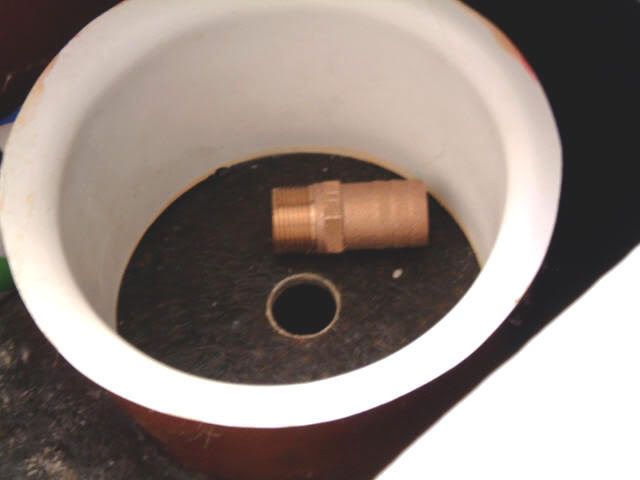
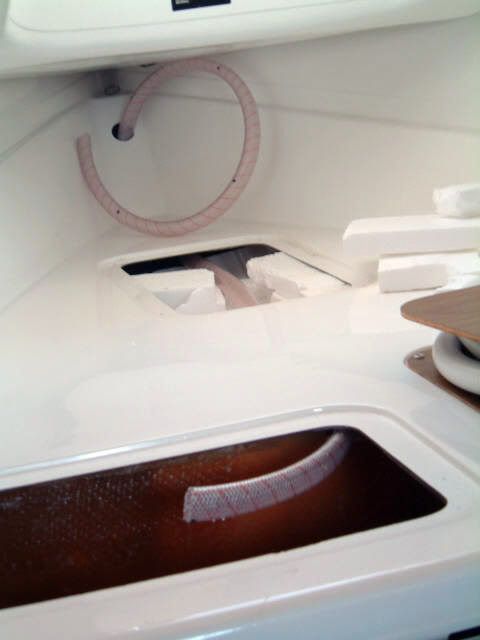

AIR HOSE CONNECTED TO BOW VENT
Posted: Tue Nov 21, 2006 8:33 am
by tidalwave
I also inserted a fitting to my

forward ballast vent and fed a hose
up to a bulkhead fitting in my anchor locker. It has worked like a charm
but I have had two questions myself about the water ballast tank...
How to know when the tank is 'completely full'...I installed a level sensor
into the ballast tank at the bow to let me know when the water in the tank was full...unfortunately there seems to be a four-to-six inch air gap, so the sensor never really sends a confirmation unless LOKI is pitching through the waves.
I also would like to know when the ballast tank has stopped filling...several people have stated they put a whistle in the forward air vent...but I have not been able to find an air whistle which would fit...anyone know where I can find a 'round' - pipe shaped whistle?