

Hi,
Ive measured the mast spreaders, and found out that they are not the same length.
The port side spreader is 44, the opposite starboard one is 42. I read Bruce Whitmores article about adjusting the shrouds, but found no info regarding spreaders length
Original boat manual does not help either. So far I was not able to found anything about spreader length. Should I cut the longest one to match the both spreaders? Or make them 44 each, or may be this is the way it was designed (which I doubt)
Yakov Mikhlin
P.S. Let me thank all of you for the sharing of all your knowledge and experience with us on this wonderful forum. This will be my second boating season. And for the person without previous boating experience this forum for me is a great treasure to the world of MacGregor.
Spreader length
-
Chip Hindes

- Admiral
- Posts: 2166
- Joined: Mon Jan 05, 2004 6:13 am
- Location: West Sand Lake, NY '01X, "Nextboat" 50HP Tohatsu
You don't say what kind of boat you have or when you got it. I'll assume it was used, 'cause I can pretty much guarantee it didn't come from the factory that way.
My hunch is the previous owner bent or broke a spreader at the mast fitting (that's usually where it occurs) and instead of replacing it he simply cut off the offending portion and reused the shortened spreader.
The shortened spreader sacrifices a certain amount of rig strength and stiffness, though admittedly probably not a lot. I were you I'd replace it. However, if you can get proper rig tension in its current configuration, it can't be too bad and you might decide a new one's not worth it.
If you decide to live with it, I'm about evenly disposed as to whether I'd recommend you keep the existing setup or cut off the other one to match.
My hunch is the previous owner bent or broke a spreader at the mast fitting (that's usually where it occurs) and instead of replacing it he simply cut off the offending portion and reused the shortened spreader.
The shortened spreader sacrifices a certain amount of rig strength and stiffness, though admittedly probably not a lot. I were you I'd replace it. However, if you can get proper rig tension in its current configuration, it can't be too bad and you might decide a new one's not worth it.
If you decide to live with it, I'm about evenly disposed as to whether I'd recommend you keep the existing setup or cut off the other one to match.

-
ALX357

- Admiral
- Posts: 1231
- Joined: Thu Jul 22, 2004 6:09 am
- Location: Nashville TN -- 2000 MacGregor 26X, Mercury two-stroke 50hp
....there are old threads in here where experienced and competent sailors and fitters have shortened the Mac spreaders by 8" each side, to gain closer Genoa sheeting angles, with no ill effects on structural strength after 2 years and more. The MacX outer stays rise vertically plumb from their chainplates to the spreader tips, but he S22 next to me at the marina has its outside stays angled inwards from the deck chainplates to the spreader ends, just as the Mac would if its spreaders were shorter. The S22 is a known to be a well-designed boat of great strength. The mast is almost as tall as the Mac's, and the spreaders are prolly half as long.
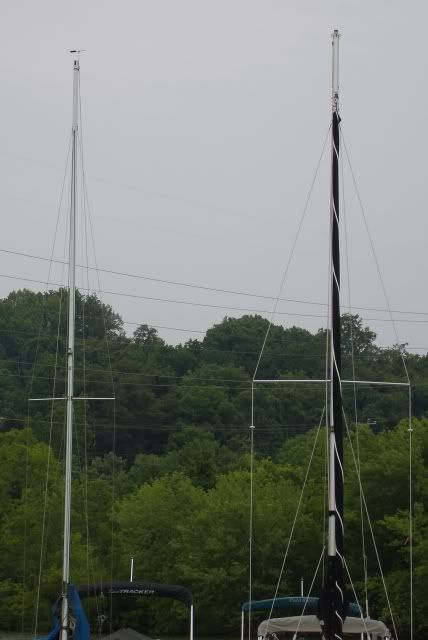
You will hear conflicting advice on this... plus rationalizations of why Roger made them that long, etc.
Keep in mind that Mac Spec requirements have been re-rationalized with model changes. eg. back-stays and centerboards.
Personally, I would like to shorten the spreaders, for Genoa sheeting angles and for mast-down storage, but (so far) have heeded the general current conscensus that it would weaken the structure.
You will hear conflicting advice on this... plus rationalizations of why Roger made them that long, etc.
Keep in mind that Mac Spec requirements have been re-rationalized with model changes. eg. back-stays and centerboards.
Personally, I would like to shorten the spreaders, for Genoa sheeting angles and for mast-down storage, but (so far) have heeded the general current conscensus that it would weaken the structure.
-
They Theirs

- Captain
- Posts: 790
- Joined: Tue Dec 27, 2005 1:42 pm
I believe this idea merits looking into, but we might take into account the strength of the mast section, the angle the upper shrouds from the hounds to the spreader tips. We might also take into account the swept back angle of the spreaders, the greater the angle, less bend from a backstay to help flatten the main when the breeze is up, over a certain amount of sweptback spreader angle, the bend is set with the upper shrouds and controlled by the lowers. (Somewhat static, but eliminates the need for a backstay and benefits sailing with less weight aloft and a large roach mainsail as the major driving force for ease of handling on modern rigs, with a small #3 jib. Easy to handle fractional rigs with swept back spreaders large mainsails use wider angles sailing down wind and set asymmetrical spinnakers to increase boat speed with the limited angle of the main against the sweptback spreaders....No DDW) Wider chain plates and spreaders allow a lighter rig as strength is increased. Boats with inboard chain plates and short spreaders might use two sets of spreaders to maintain column strength, with double upper shrouds. Shorter spreaders and inboard chain plates allow the overlapping #1 and #2 genoa to be sheeted close, to sail closer to the wind. Maintaining a tight headstay, limiting sag, will improve pointing along with well-shaped sails to enhance drive
