Herschel wrote: ↑Thu Jul 16, 2020 7:32 pmHere is the data on power usage from an anonymous buyer: "I think on initial startup when it is cooling from 80 degrees down to 30 or 35 I see about 4 amps of draw. Maybe slightly higher. In an ambient temperature environment of 75 degrees, it will run about 30% of the time. On the Eco setting that is about 2.4 amps, so divided that in 3rds and you will get your hourly consumption. I would bet on 20 to 25 amp hours / 24 hour period. I just installed mine on my sailboat last week. I am using a 100 watt flexible solar panel and my batteries are topped off after just three hours of sunlight in the morning. My panel can produce about 5 and 1/2 amps"
That solar output sounds about right, from what little I know of my own 300W system (3 x 100W). And that power usage rate sounds about right, too, also based on my own much larger Norcold AC/DC two-door top freezer unit at 5-6A DC running.
Herschel wrote: ↑Thu Jul 16, 2020 7:32 pmSo, say this is my new cooler/frig. If I got one of the Power stations, say the 500 watt one, I am essentially getting another "deep cycle" type battery, a lithium one, with a built-in controller for the solar and an inverter for possible 110 applications (read coffee pot). Right?
Right. Sort of. Forget the coffee pot, though, as it'll suck all the energy out of a Power Station unit, and probably exceed the max power output anyway. Coffee makers are usually around 1000W or so. Anything designed primarily to make heat is, as a general rule, very energy intensive. Like blow dryers, and cooking appliances, and so on. Better to use a portable propane or butane or alcohol stove to heat water and pour through a cone for coffee. I have a really nice little single-burner butane stove in a plastic carry case that's used just to boil water to pour through my Melita single-cup coffee cone. I think I paid about $14 for it a couple of years ago. Looks like this, but came with a case. Just sayin'.
https://www.hotelrestaurantsupply.com/WNC-PGS-1K.html
Herschel wrote: ↑Thu Jul 16, 2020 7:32 pmBut I will be paying more for the power I get through the Power Station because it is more expensive than a regular deep cycle battery (my Optimas are a bit pricy, but I really swear by them. Very long lasting and reliable).
You have to compare the Ah rating of each system, modified by how deeply you can discharge them. Lithiums can be depleted almost all the way without harm, and they can maintain output voltage almost all the way down to fully discharged. Other chemistries, not so much. Lead acid is the least able to deep-discharge without harm unless you get into true deep-cycle batts, like 6V golf cart and forklift batteries. But as a general rule, you can get the same useful energy out of a much smaller (in Ah rating) LiFePO4 battery than you can out of lead acid, with other chemistries somewhere in between.
Big Caveat: You have to use a charge controller specifically designed for the battery chemistry you're charging. Lithiums charge differently, and at different voltages, than lead acid which is different from AGM and so on. And there are different types of charge controllers, for that matter, with PWM types being cheapest (Pulse Width Modulated, which means it's simply switching on and off rapidly to control effective voltage), and MPPT (Maximum Power Point Tracking) types, which adjusts both voltage and current to best match the solar panel output to the battery charging requirements, and adjusts itself as clouds go by and things like that. They're the best controller type, but probably unnecessary for a single 100W panel, and far more expensive than simple PWM types.
Herschel wrote: ↑Thu Jul 16, 2020 7:32 pmIf I stay in marinas at night and do a fair amount of motoring during the day (50 h.p. Yamaha with alternator), my present battery bank can handle this cooler. But, if I wanted to "play around" with a portable solar system, the Power Station with solar could be a separate system from my boat battery banks, but I am drifting into the realm of buying a toy, not a practical or needed nautical system. Right?
Probably. I think, from what little I know about solar, that you could be well served just adding a solar panel and charge controller to your existing battery bank. Unless you need the inverter, too. In which case, the cost starts adding up. Probably should run a spreadsheet with costs for doing it both ways to at least see the cost difference. That has to be balanced against the convenience of each system, and the intended use, like taking it off the boat to use elsewhere.
Herschel wrote: ↑Thu Jul 16, 2020 7:32 pmOne more question. I am still curious about how to break into solar technology without the engineering degree. Do solar panels come with their own controller so you can just plug the wires into your house battery safely?

Normally, no. You need a controller (see above), but I've seen some on Amazon that come as a kit of sorts, with 100W panel and separate controller.
Little panels for just maintaining lead acid batteries during down times can be used without a controller, from what I understand, but you need real power here, so a controller is needed. Except for those lithium power units, which have the controller built in.
 ) - it's supposed to be 300W (3 x 100W). It puts out about 16 A now, with all three panels working, at solar noon on a clear day, way up here. Should be able to do a bit better down where you are, with the sun more directly overhead.
 ), but it certainly would be best to allow for at least a full 24 hrs without shore power, and some 'extra' solar just in case. But at least solar can be added bit by bit with time, with the right setup from the start.


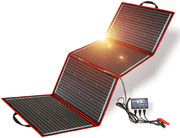
 )
)