Dinghy again..
Posted: Tue May 02, 2017 8:02 pm
So I've been working on a sub 30 pound dinghy that can be stored inside the boat. This is a 2nd attempt at the dingo folding dinghy and it also must convert into a trailer for my fold up bicycle. The idea is to not have to leave the dinghy behind when going on a shore expedition.
The first dingo folding panel boat was a disaster. It did fold.and it did row (badly) but it did not float. I could never adhere the hypalon fabric to the wood in a watertight way. Having fabric "hinges" was also bulky.
The whole thing was also too heavy. I made it out of 1/4 ply but did not epoxy it. It got waterlogged quickly. It was intended to be carried on the side of the boat like I do my paddle board. But it was too heavy too leaky and not very attractive. I shelved that until I decided the problem with dinghies (for me) is you have to leave them somewhere. I began to think of the dinghy as part of a system that included the bicycle (and the two dogs since I can't leave them on the boat all day). So I had another look at the folding boat concept.
Dingo 2 is much different. It has a flat bottom not a vee bottom. It has a punty nose instead of a sharp bow. Its shorter. It has no transom. It has been epoxy resin coated on both sides. Most importantly the hull is skinned with a standard size tarp easily bought online. This is folded at the corners like a Christmas wrapping and held in place by lashings. It can't leak because there are no seams. If the skin gets a hole it is patchable or irreplaceable. Like the original dingo, the panels are lashed together. The lashings form the hinge. The design incorporates a few other structural members and some other light line to hold it together. It rows as well as any pram style dinghy. I haven't tried it in bad weather yet but it should do ok. It will need to carry the bicycle me the dogs and a few bags of groceries and the sunshower.
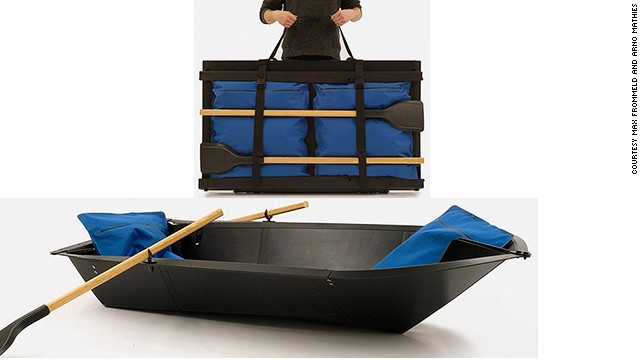
When folded it is 5 feet long 14 inches wide and 5 inches thick. It should fit in the back berth under the bicycle which is also back there.
Although dingo 2 could carry two smallish people, I feel that a 7 foot version would be more practical for a couple. It would be heavier, but two people could easily put it on deck without a sweat. The 7 foot version would break down into 2 sections 4 feet long that could be stored separately. You would have to join the panels together before assembly. The skin could be folded and stored or even used for something else like a sunshade. I currently have a 12 mm thickness tarp but that's not thick enough to Stand light beachings. A 24 mm would be better.
While the first version unfolded and was ready in about 3 minutes the 2nd one takes about 10 minutes from removing from car to boarding. (It fits in my prius!)
This is somewhat faster and much less actual work than an inflatable. Its also lighter than most inflatables. It is not as rugged though since the panels are as light as possible. If I built another one I would use really good plywood.
Ix
The first dingo folding panel boat was a disaster. It did fold.and it did row (badly) but it did not float. I could never adhere the hypalon fabric to the wood in a watertight way. Having fabric "hinges" was also bulky.
The whole thing was also too heavy. I made it out of 1/4 ply but did not epoxy it. It got waterlogged quickly. It was intended to be carried on the side of the boat like I do my paddle board. But it was too heavy too leaky and not very attractive. I shelved that until I decided the problem with dinghies (for me) is you have to leave them somewhere. I began to think of the dinghy as part of a system that included the bicycle (and the two dogs since I can't leave them on the boat all day). So I had another look at the folding boat concept.
Dingo 2 is much different. It has a flat bottom not a vee bottom. It has a punty nose instead of a sharp bow. Its shorter. It has no transom. It has been epoxy resin coated on both sides. Most importantly the hull is skinned with a standard size tarp easily bought online. This is folded at the corners like a Christmas wrapping and held in place by lashings. It can't leak because there are no seams. If the skin gets a hole it is patchable or irreplaceable. Like the original dingo, the panels are lashed together. The lashings form the hinge. The design incorporates a few other structural members and some other light line to hold it together. It rows as well as any pram style dinghy. I haven't tried it in bad weather yet but it should do ok. It will need to carry the bicycle me the dogs and a few bags of groceries and the sunshower.
When folded it is 5 feet long 14 inches wide and 5 inches thick. It should fit in the back berth under the bicycle which is also back there.
Although dingo 2 could carry two smallish people, I feel that a 7 foot version would be more practical for a couple. It would be heavier, but two people could easily put it on deck without a sweat. The 7 foot version would break down into 2 sections 4 feet long that could be stored separately. You would have to join the panels together before assembly. The skin could be folded and stored or even used for something else like a sunshade. I currently have a 12 mm thickness tarp but that's not thick enough to Stand light beachings. A 24 mm would be better.
While the first version unfolded and was ready in about 3 minutes the 2nd one takes about 10 minutes from removing from car to boarding. (It fits in my prius!)
This is somewhat faster and much less actual work than an inflatable. Its also lighter than most inflatables. It is not as rugged though since the panels are as light as possible. If I built another one I would use really good plywood.
Ix

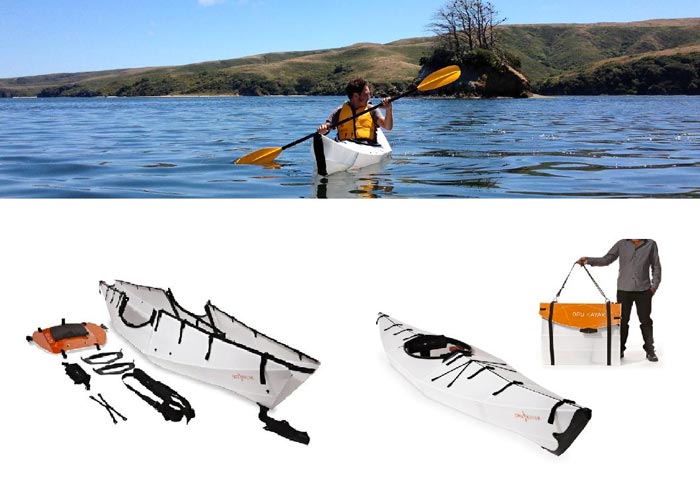


 but's it's pretty long....we shall see. The upside is that it performs like a real kayak and is very hard to "hole".
