Page 1 of 3

Heavy Weather Boating

Posted: Sun Apr 10, 2005 7:19 pm
by Greg
We haven't yet had our X boat in a situation that I would consider large seas'. In every situation I have encountered where the waves start mounting, I filled the ballast and took the waves at an angle and as long as I didn't fight the natural movement of the boat, she did fine.

I have read on several posts that the Mac handles following quartering seas (FQS) the worst and recently read that Joe 26M broached in FQS.

I am wondering what others with more experience have encountered and if any thing can be done to help the situation. If FQS is the worst, has anyone tried deploying a drogue, warp or if conditions permit, a little headsail when motoring? I have read some were going to try smaller rudders to help counteract the yawing, but it seems to me that a warp might work better. Is FQS only a problem when motoring and not when sailing? If FQS are a problem, is running with the swells better? I understand that the preferred method of running with the waves is to ride the back side of the swell, but I may not have enough power depending on the required speed. Is the FQS situation inherent because of the Mac design or common with other boats (sail or power)?

I appreciate any responses because I would like to learn from others experience with the Mac.

Thanks
Greg

Posted: Sun Apr 10, 2005 8:47 pm
by waternwaves
Greg,

for a little illustrative discussion of poor turns in zones of heavy waves/breakers ...

oops...

Was the worst thing I have ever turned in...had an element of rear quartering waves...and I did not do it anywhere near fast enough..... I have found it is not the size of waves that scares me off of Vancouver island....nor the lack of visibility.....(dont get seasick much.. and I have a good furuno radar...) but those damn rocks....Breakers sound different.....and breakers on your rear quarter are just plain scary any time when and worse when visbility sucks...you hear them before you can see them... and since you are sailing often down wind....you dont hear them till they are around you. I will literally go out an extra 15 milesfarther out to stay away from conditions that will turtle my mac......When it is SCA and fog..... I might go closer....but a gale in a mac is not something you want to do if you dont have to....

Equipment to help hold that heading..... an 8 ft...sea anchor/drogue would be nice... mine is about about 5ft in diameter....and cant hold much more than 4 or 5 pts (60 -75 deg) off the wind at times..I think it is just a little too small for a mac.

and as far as a little headsail....ask me again after I find a storm sail that will fit where the second forestay goes....

but as in kayaking.....its the breakers that get me..

But.....almost time to go back up to Barkley sound....anyone want to go??

Greg, being able to carry and control smaller rags is a limitation of the mac, but is not a shortcoming for most mac sailors....since most use the motor when it gets nasty..
I for one am also interested in improving the weatherability of my clorox bottle. But I am going to suggest....that before you change anything higher than the boom.... upgrade the steering/rudders and mounts before you go......ummm stiffly challenge a weather shore....

BTW...As far as adding metal for different heavy weather sailing.. at the top of the X mast.....has anyone internally reinforced the mast top to add additional gear for 2nd jib halyard and main topping or do you reuse the existing hardware and add a second sheave....? I have had boats with both.....and personally found that sheaves on a common shaft aloft are easier initially install But tend to twist the lines together, and tend to pull on the mounts more and twist damage, as well as flapping a bit more than singe sheave Tackle that is mounted independently.,... where the fastener mount is more in line with the tension load....and I think stiffer antenna bracket up there wont hurt me either.

Tripp, Mark, JohnB, Moe, Cat, Mark, Kevin , B@B4, YY, et. al. and all you other modifiers of glass and metal.......how crowded are your mast tops ??'

P.S No offense intended to any and all of all you other dedicated metal mashing glass grinding wire whipping dichotomous fuel using wind sucking dock denters such as myself, who I failed to mention above.

Posted: Tue Apr 12, 2005 6:46 pm
by Dave X2000 Jac
The term 'large seas" reminded me of a question I had been meaning to post on this board. Sorry in advance, but it looks like I have my opening. Frequently in this forum, sailors refer to waves using terms like "8 foot rollers" or "5 foot breakers". The technical definition of wave height or amplitude is the vertical distance from the resting position to the top of the crest. The total wave, including the trough would be twice the amplitude. When I have posted experiences on this forum, I have not used the technically correct distance. For example, if a wave causes my Mac to change its position up 4 feet, I call it a "4 foot wave". Yet, to be technically correct, I should say the wave height is 2 feet. I have been under the assumption that others on this board use the same numerical logic that I do. Is there anyone on this board, or any sailor in the world for that matter, who posts wave heights that are technically correct rather than logically correct?
It is not a big deal to me. I'm just curious.
Dave "Jac"

Posted: Tue Apr 12, 2005 7:19 pm
by Moe
Wave height is measured from the crest to the trough. Wave amplitude is wave height divided by two.

NOAA definition

US Navy training materials:

"In oceanography, wave height (fig. l-31) is the vertical distance, usually measured in feet, from the crest of a wave (the highest portion of a wave) to the trough of the wave (the lowest portion of the wave). This differs from the "wave height" or "amplitude" normally used in physics, in which the distance is measured from the "at rest" or midline position to the crests and troughs."

This one is the most descriptive.
Rutgers University Institute of Marine and Coastal Sciences

"Height (H) - vertical distance between a crest and trough.
Amplitude (A) - vertical distance from equilibrium surface to crest or trough (= H/2)."

If your Mac is going up and down 4' the nautically correct wave height is 4'.

Significant wave height (SWH) is the average height, as height is defined above, of the highest 1/3 of the waves. As I understand it, that value was established because it coincided with what experienced observers tended to report wave heights to be. With respect to SWH:

Most frequent wave height = 0.5 x SWH
Average wave height = 0.61 x SWH
Highest 10% = 1.29 x SWH (I've seen this as 1.34)
Rare peak wave height = 2.0 x SWH

When NOAA forecasts wave heights of 2-4' they aren't saying the waves are going to be that high. What they're saying is the SWH is likely to be 3 feet within a probability of +/- 1'. Bouy data also reports SWH.

--
Moe

Posted: Tue Apr 12, 2005 7:36 pm
by Casey
Gregg

My experience in the heaviest waves has been on Lake Ponchartrain in LA. I have never take my family in rough stuff (learned on this board) and they still like to sail. When I took our boat into the heavier stuff, it was new. I was always worried about the rudder brackets. I did enjoy surfing the waves, however, you can cavitate easily and go into a turn that is hard to control. I agree with waternwaves about planning the steering and mounts for the rudders. When you are surfing a wave and the nose rounds up and the back starts sliding, tremendous pressure is placed on the rudders and brackets. I would be worried to do it now, 7 years later.

Waternwaves

I have no additional reinforcement in the mast. I have a mast light and an offset for my topping lift. I hope others will respond to your question about adding a second jib halyard since I have been considering this also.

I think the additional stress toward the front of the mast could be handled by the backstay. I was thinking of a wire attached to a bail at the top of the mast and then attached to a small bow sprit with a tensioner. A single sheave at the top to pull up the sail. I have thought that a distance of about 18-24 inches would be sufficient clearance between the standard head sail and the second. What I am not sure about is if the lateral forces will be too great for the mast since the spreader lines attach about 3 foot below the top of the mast. The bowsprit should be easily removeable and allow the wire to be attached in the mast carrier area on bow.

Again, I hope others give us their thoughts.

Thanks

Posted: Sat Apr 23, 2005 8:58 am
by Greg
Waternwaves,
Were you in a turn under power and knocked down from a wave or FQS and forced beam to seas and broached? Just trying to picture the situation. When I said small headsail, I meant roll out a little from the furler.

I have the newer style SS rudder brackets. Have you looked at reinforcing them or would you replace them with a heavier design?

I am currently listening to a book on tape called "Godforsaken Sea" about the 1996 Vendee Globe race. I was surprised to learn that these high tech boats have a lot in common with the Macgregor design, such as water ballast, twin rudders, and a swing keel of sorts.

In one section, they talked about FQS and that deploying warps off the stern used to be the preferred method for stabilizing the boat, but now they keep the seas 15-20 degrees off the stern and do not use warps. They are essentially surfing the waves with these 60 foot boats.

Has anyone else tried this angle with the Mac? Also, how do they handle following seas directly on the stern?

Thanks,

Greg

Posted: Sat Apr 23, 2005 9:18 am
by baldbaby2000
I haven't been in big waves in our 26M. When we had our Mac 25 we were in 8 to 10 ft waves and 25 to 30 mph winds on Lake Oahe in SD. Strangely enough we found it much more comfortable to have the sails up rather than motor. The boat handled much better under sail and we didn't have to worry about the motor coming out of the water. Maybe this isn't an issue with the 26.

Posted: Sat Apr 23, 2005 10:02 am
by James V
I hope that you do not ever find yourself into that position. Head for the closest safe haven as fast as possible. There is good heavy weather videos and books on this subject. Here is a quick website to look at -
http://web.usna.navy.mil/~phmiller/offshore.ppt

Posted: Sat Apr 23, 2005 10:48 am
by Moe
Thanks, James, I enjoyed that. Here's his main page and I also enjoyed his engineer jokes page.

--
Moe

Posted: Sat Apr 23, 2005 12:52 pm
by Greg
James,

Thanks for the link and I agree with your comment, but in some situations such as Mike's experience or in a few of the Gulf Stream crossing stories I have read, you can unexpectedly find yourself in high sea conditions and safe haven may not be as close as you would like. I'd like to know as much about the handling characteristics of the Mac (Sail and Power) in such situations before it happens to me.

Unfortunately meteorology is not an exact science, just like medicine, but at least the Docs admit that they are only practicing medicine!! :D

Greg

Test pics

Posted: Sat Apr 23, 2005 1:24 pm
by Gerald Gordon
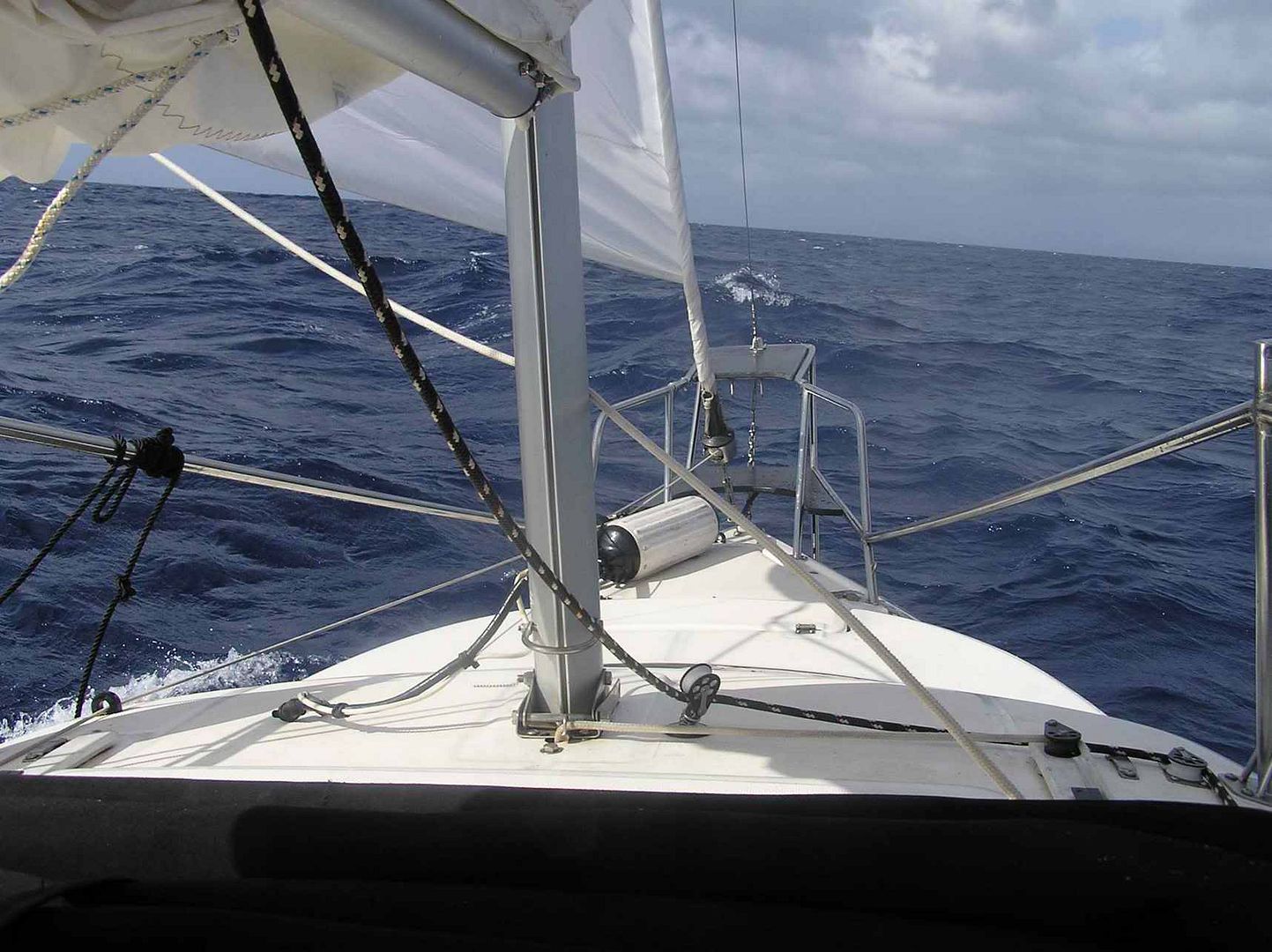
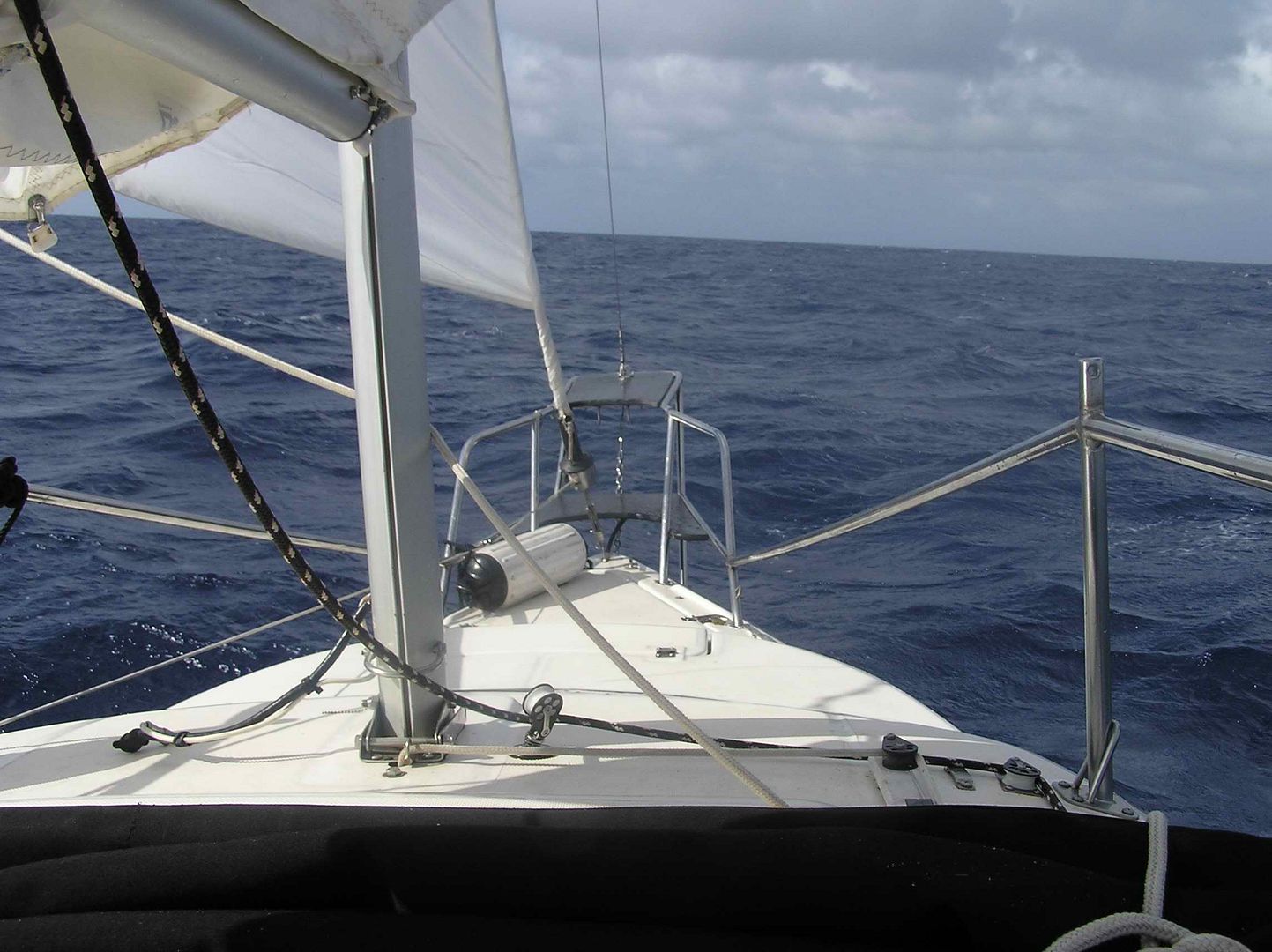
Here's some 4-6 foot waves gusting to 24mph on the North Shore of O'ahu
http://i5.photobucket.com/albums/y191/g ... 6823d7.jpg
http://i5.photobucket.com/albums/y191/g ... 428f6d.jpg [/url][/quote]

Posted: Sat Apr 23, 2005 3:04 pm
by Greg
Hey Gerald,

You have everything on the Bow that I want, extra forestay, nice pulpit and that's the first time I've seen SS-tube lifeline replacement. Your work? It looks good! You should post your upgrades on the Mods Page.

Thanks,
Greg

Posted: Sat Apr 23, 2005 4:34 pm
by James V
Dear All, I do not like to say things that people cannot easily accept, however heavy weather sailing can be a life or death matter and needs to be addressed. I do not think that a Mac will surive an 8 hour storm of 45+mph. I think that your chances of survival is greater walking the streets of Bagdad wearing nothing but an American flag.
Please read and watch all that you can about heavy weather sailing.
Another upper reef in the main sail is needed.
Somesort of back stay as well.
All hatches secured.
All gear secured.
Life jackets on and try to contact someone to let them know that you are there.
Attaching a drouge to the bow or stearn will be determined by the sea conditions.

Here is the advice of the logs of Jeane Pockel's cruisers dictionary from the sv Watermelon -
DROGUE: When we set out cruising we did not carry a drogue, thinking that trailing a rope warp with weight on the end would suffice in an emergency. Several rather nasty storms made us reconsider this idea, and when our friends survived the Queen's Birthday Storm sailing between New Zealand and Tonga with much thanks to their drogue, we started looking for something better. A careful reading of Tony Farrington's "Rescue in the Pacific" made us doubt that the traditional parachute anchor or parachute drogue was what we wanted.
Around the same time we had read in the SSCA (Seven Seas Cruising Association) Commodore's Bulletin of a Jordan Series Drogue, and the more we read about it, the more we believed that this was the right gear to carry. We made our own from scrap sail cloth out of the local sailmaker's scrap box. The pattern can be bought from the SSCA as an Extra Publication.

A few comments about our experiences and our rejection of a parachute-type drogue or anchor.

Deploying a sea anchor under the philosophy of keeping the bows to the seas where they will break with relatively little stress ignores the stresses on a boat taking on large seas on a regular basis. The most serious problem is that hanging on a sea anchor means that the boat is going backwards, albeit very slowly. Each time a wave boards the boat, it is being thrust backwards, placing severe strain on the rudder, which is not designed to take stress from that direction. No amount of lashing is going to secure the rudder sufficiently.

In K. Adlard Cole's book, "Heavy Weather Sailing", which I think is a must read for anybody going offshore, he recounts, and advocates, running with a storm whenever possible. There will be fewer collisions with waves as the boat presents a moving target and is usually lifted with the wave and rides it out. But here is where one needs a device to slow the boat down so that it doesn't go careening down the face of the wave at surfing speeds, risking pitch-poling or broaching. A drogue will slow the boat significantly and evenly - the Jordan Series Drogue that we carry consists of many (over 100) small "droguelets" or small cones, spaced about 18" apart. In this way the drogue is always exerting constant pressure on the stern of the boat. The parachute-type drogues (and sea anchors) are deployed with a long line, and when the parachute is on one side of a wave and the boat on the other, the line will fall slack, to tighten with a sudden jerk as the boat accelerates. The series drogue never allows that acceleration.

It seems to be a rule of cruising that as soon as you acquire a piece of emergency gear the emergency never arises again. We have deployed the drogue only once and that was to test it more than because we needed it. But as I've said to others: if you cross oceans carrying a drogue and never have to use it, good for you! If you do not have one and are unlucky enough to be in the path of one of those big storms, good luck!

----------------------------------------------------
This is a good site to answer a lot of questions that come up on this forum. Here is the link -
http://www.cruiser.co.za/faq2.asp

There is 2 good rules that I like to follow on the water -
1)The more know, the safer and more fun you will have.
2) God helps those who helps themselves.

Although I do not want to encourage you at ALL, there is a report of a Mac 25 that surrived a hurricane.

Posted: Sat Apr 23, 2005 5:06 pm
by Bill at BOATS 4 SAIL
For some reason James V's good post made me think of these two things:
1 - They used to dump oil on rough seas to calm them. Is there any proof that this actually works?
and 2 - West Marine has a new "Paddling Life Jacket Chest Pak Inflatable PFD - Manual Inflator", their model # 6830228, that looks interesting. Does anyone have any experience with one of these?

Posted: Sat Apr 23, 2005 5:51 pm
by Greg
Bill,

I have read about oil smoothing the seas' in a few books. It seems it was fairly common years ago - before current rules - for boats to trickle oil to smooth the waves. In "My Old Man and the Sea" (a nonfiction book about a father-son crew that sailed a 25' motorless sailboat from Connecticut, though the Panama Canal to Easter Island, then around Cape Horn and back to Connecticut) carried oil with them just for that purpose. I forget now in which book I read that said some experts are theorizing that the frequency of more severe storms at sea and rogue waves may be the result of the stringent rules for oil spills- particularly oil tankers leaking.

I did a quick search and found this article about oil causing Calm Spots.

Greg