Mac compatible "canted keel" mod?
Posted: Sun May 08, 2011 11:44 pm
So I've been looking at Canted Keel technology, which is just showing up in large race sailboats. Long story short it's a lead bulb keel that can be swung laterally forty degrees (and by swung, I mean pushed with hydraulic actuators) to entirely counteract heel with whatever righting moment is necessary to keep the boat upright against windward pressure.
So far, they've been winning everything and are achieving a 30% increase in speed--very similar to cats in their performance. The Volvo 70' race boats are doing 30 knots as monohulls, which is unheard of.
But the technology is complex and the machinery has a lot of problems, not the least of which is that canted keels are not inherently stable--accidentally tack or gybe with the keel pointed the wrong direction and you've got an immediate capsize.
But the idea is good: Use weight to counteract heel when you need it to keep the boat at the correct angle. This is what we do when we order passengers to windward to counteract heel.
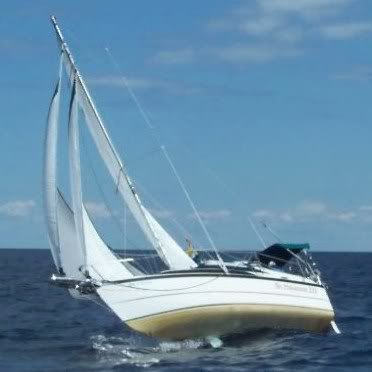
So it occurred to me how to do this quite simply in a Mac: Flood keel bulbs on the rudders. Because there are port and starboard rudders on a mac, when you heel one of the rudders comes out of the water. If that rudder had a flood bulk attached to it of some significant weight (say 50 lbs) that lifted out of the water just as the boat was coming to an optimal 15 degree heel, you would have a sudden righting moment just at the perfect amount of heel for maximum speed, and therefore a "wide" range of force that would exhibit that same sweet spot of heel. You would also have considerable righting moment for all greater angles of heel, but as soon as the neutral buoyancy bulb submerged the effect would be gone.
If the bulb's water inlets were on top, they would hold water when heeling, but would drain when pulled up. The bulbs could point well aft when up, and well forward of the rudders when down so that they could be weight balanced around the axis of steerage. This balance around the axis of steerage is important to counteracting the negative effects of additional steering weight, and you would likely want to disconnect the motor to lighten the steering load when using this technique.
Of course this would increase drag, but at speed, you will be heeling which means one bulb would be out of the water. Also, keeping optimal heel angle should more than compensate for the additional drag.
A cylinder 24" long and 8" in diameter will hold 50 lbs. of seawater.
Granted the stock rudders won't put up with this weight, but custom rudders designed for it would do the job quite well.
Anyone think of why this might be a bad idea considering that it's just shaping a different fiberglass rudder?
So far, they've been winning everything and are achieving a 30% increase in speed--very similar to cats in their performance. The Volvo 70' race boats are doing 30 knots as monohulls, which is unheard of.
But the technology is complex and the machinery has a lot of problems, not the least of which is that canted keels are not inherently stable--accidentally tack or gybe with the keel pointed the wrong direction and you've got an immediate capsize.
But the idea is good: Use weight to counteract heel when you need it to keep the boat at the correct angle. This is what we do when we order passengers to windward to counteract heel.
So it occurred to me how to do this quite simply in a Mac: Flood keel bulbs on the rudders. Because there are port and starboard rudders on a mac, when you heel one of the rudders comes out of the water. If that rudder had a flood bulk attached to it of some significant weight (say 50 lbs) that lifted out of the water just as the boat was coming to an optimal 15 degree heel, you would have a sudden righting moment just at the perfect amount of heel for maximum speed, and therefore a "wide" range of force that would exhibit that same sweet spot of heel. You would also have considerable righting moment for all greater angles of heel, but as soon as the neutral buoyancy bulb submerged the effect would be gone.
If the bulb's water inlets were on top, they would hold water when heeling, but would drain when pulled up. The bulbs could point well aft when up, and well forward of the rudders when down so that they could be weight balanced around the axis of steerage. This balance around the axis of steerage is important to counteracting the negative effects of additional steering weight, and you would likely want to disconnect the motor to lighten the steering load when using this technique.
Of course this would increase drag, but at speed, you will be heeling which means one bulb would be out of the water. Also, keeping optimal heel angle should more than compensate for the additional drag.
A cylinder 24" long and 8" in diameter will hold 50 lbs. of seawater.
Granted the stock rudders won't put up with this weight, but custom rudders designed for it would do the job quite well.
Anyone think of why this might be a bad idea considering that it's just shaping a different fiberglass rudder?