


My stock doyle sails have leech cords in them. This is new to me. (never owned a boat with em)
Pretty stiff wind yesterday and sailing with the jib, this year is the first time weve even had it up. Usually sail with the Genoa.
I noticed the leech was tucked back towards the mast like a flap on a jumbo. Knowing what little I do of aero science, I surmised this was creating additional lift and assisting the rubrail in its quest for immersion.
I had the wife motor up and point into the wind stepped on deck and just slacked the leech cord.
Boat the leveled out just a few degrees and we actually gained 1/4 to 1/2 knot. Im not sure but I think it was getting on its feet a little faster on tacks too. Cant really tell because we had a west wind and we could sail from one end of the lake to the other on 1 tack.
Today my goal is to learn me self how to use em. Broke out a couple of my old sailing books and read up on leech cords.
Got leeches?
-
marc ducharme

- Deckhand
- Posts: 43
- Joined: Thu Mar 25, 2004 4:59 pm
- Location: Salve Lake Alberta CA 04M50hp


-
Dimitri-2000X-Tampa

- Admiral
- Posts: 2043
- Joined: Fri Jan 02, 2004 5:36 am
- Sailboat: MacGregor 26X
- Location: Tampa, Florida 2000 Mercury BigFoot 50HP 4-Stroke on 26X hull# 3575.B000
I was always taught that a leach cord is tightened up to reduce the "flutter" in the trailing edge of the sail, similar to what battens do. By reducing or eliminating the flutter, you get a better airflow and more power. With windsurfer sails, you tighten the leach last...after you've done the downhaul and outhaul, I expect it is similar with all sails.
-
marc ducharme
- Deckhand
- Posts: 43
- Joined: Thu Mar 25, 2004 4:59 pm
- Location: Salve Lake Alberta CA 04M50hp
-
kmclemore

- Site Admin
- Posts: 6293
- Joined: Sun Feb 08, 2004 9:24 am
- Sailboat: MacGregor 26X
- Location: Ambler, PA -- MACX2018A898 w/ Suzuki DF60AV -- 78 BW Harpoon 4.6 -- 2018 Tahoe 550TF w/ 150 Merc
A "Leach" is the trailing edge of a sail.
A "Leech" is someone who begs for a ride on your boat, then jumps onto it with their grimy shoes, dosn't do diddly to help out, and then proceeds to drink all your beer and act like he owns the boat.
A "Leach Cord" is exactly as Dimitri explained it.
A "Leech Cord" is a thick rope with a heavy, long knot and a head-sized loop in the end of it, hanging from a high and stout yard-arm. It is used for dealing with 'Leeches' (see definition above).
-Kevin
A "Leech" is someone who begs for a ride on your boat, then jumps onto it with their grimy shoes, dosn't do diddly to help out, and then proceeds to drink all your beer and act like he owns the boat.
A "Leach Cord" is exactly as Dimitri explained it.
A "Leech Cord" is a thick rope with a heavy, long knot and a head-sized loop in the end of it, hanging from a high and stout yard-arm. It is used for dealing with 'Leeches' (see definition above).
-Kevin
-
bscott

- Admiral
- Posts: 1143
- Joined: Mon Mar 08, 2004 2:45 pm
- Sailboat: MacGregor 26X
- Location: Arvada, Colorado 2001 X, M rotating mast, E-tec 60 with Power Thruster, "HUFF n Puff"
Adjust the leach cord so that the wind exits the sail without bending. This is a very touchy adjustment as too much leach curl will stall the sail and too little will cause the leach of the sail to flap. A little flutter is preferable to a curl. Unfortunately, the stock Doyles tend to stretch alot and need to be adjusted loften. Same goes for the main.
-
Frank C
Re: what?
I'm w/ Steve M!Steve M wrote:I thought that this cord was there to create a more Baloon like sail for light air sailing... was I wrong all these years?
WTH are Schock or Tripp when needed ...
 (Sailing, no doubt!)
Last edited by Frank C on Sun Jul 04, 2004 5:07 pm, edited 2 times in total.
-
Frank C
Partially agreeing w/ Kevin:
LEECH:
1 archaic : PHYSICIAN, SURGEON
2 [from its former use by physicians for bleeding patients] : any of numerous carnivorous or bloodsucking usually freshwater annelid worms (class Hirudinea) that have typically a flattened lanceolate segmented body with a sucker at each end
3 : a hanger-on who seeks advantage or gain (*)
------------
(* Note: Hangers-on may exist in various environs, e.g. dockside, yacht clubs, discussion groups, book clubs, study groups, etc. Usually unwilling to partake of group housekeeping, homework assignments, other necessary prerequisites to participation)
LEECH:
1 archaic : PHYSICIAN, SURGEON
2 [from its former use by physicians for bleeding patients] : any of numerous carnivorous or bloodsucking usually freshwater annelid worms (class Hirudinea) that have typically a flattened lanceolate segmented body with a sucker at each end
3 : a hanger-on who seeks advantage or gain (*)
------------
(* Note: Hangers-on may exist in various environs, e.g. dockside, yacht clubs, discussion groups, book clubs, study groups, etc. Usually unwilling to partake of group housekeeping, homework assignments, other necessary prerequisites to participation)
-
Frank C
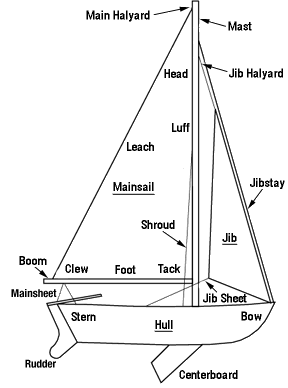
And, partly in a "mini-spelling-debate" w/ others above, refer to this Sailing Nomenclaturepage, with diagram as shown below:
LEECH - the back edge of a sail

LEECH - the back edge of a sail
Last edited by Frank C on Sun Jul 04, 2004 5:55 pm, edited 1 time in total.
-
ESPERANZA
- First Officer
- Posts: 219
- Joined: Sun Jun 27, 2004 8:09 pm
- Location: Black Hills of S.D. 97 26X nisn 50
Great, now I've got leach lines...
I just bought a 97' X a couple months ago. Haven't even had it on the lake yet. Never sailed before. I was just getting the hang of all the parts on the boat and what they do. Now I've got another one to figure out...
Thanks guys, I was wondering what those lines were for...
Thanks guys, I was wondering what those lines were for...
-
Schock Therapy

- Deckhand
- Posts: 38
- Joined: Wed May 26, 2004 8:46 pm
The LEECH line is there for the sole purpose of preventing the leech from fluttering. If at all possible it should be left slack, and you only pull on enough to stop the flutter. A slight hook in the leech caused by the leechline is more desireable than flutter for a couple of reasons. First of all, a fluttering leech is not fast. It will create quite a bit of turbulence of the trailing edge, and can disrupt laminar flow. When sailing upwind it will also mess with the attached flow on the back of the mainsail. Not to mention, fluttering sails are extremely annoying! A slight hook in the leech is not ideal either, but it is the lesser of two evils. A severe hook will also play havoc with your mainsail as well as creating turbulence induced drag. If it gets that bad, it is time to take the sail to a sailmaker for a little "nip and tuck". Of course we racers are very particular about things like that, and most of you guys couldn't care less about the loss of quarter knot of boatspeed. For those of you in that camp, consider this; sailcloth does not like to be flogged. It will get softer and softer, and eventually it will weaken. One day you will tack, and the leech will catch on the spreader or something, and it will rip a nice strip off your sail. (of course that can happen if you have the leechline too tight with a big hook too!)
-
Schock Therapy
- Deckhand
- Posts: 38
- Joined: Wed May 26, 2004 8:46 pm
I thought that this cord was there to create a more Baloon like sail for light air sailing... was I wrong all these years?
I'm afraid so Steve! The leechline has no effect on the shape of the sail at all. it affects how the air leaves the trailing edge, and that is all. In light air sailing it is even more critical to have a clean exit. The last thing you would want is something to disrupt the fragile attached flow.
I'm afraid so Steve! The leechline has no effect on the shape of the sail at all. it affects how the air leaves the trailing edge, and that is all. In light air sailing it is even more critical to have a clean exit. The last thing you would want is something to disrupt the fragile attached flow.