Page 4 of 5
Posted: Mon Aug 28, 2006 5:27 pm
by Chip Hindes
The one caveat I'll add to your note, Chip, is I think it is considered rude to wet down the ramp on the 'normally dry' part with any kind of water...
What does "normally dry" mean? You mean somebody's figured out how to pull a boat out of the water without getting the ramp wet?
Tempted to say that's ridiculous, but I won't.
But it's all the more reason (assuming you need one) to pull out just far enough to get the ballast valve out of the water, then wait the two whole minutes it takes to empty it completely.
Posted: Mon Aug 28, 2006 10:50 pm
by delevi
Although I would never sail w/o ballast, as some do, I never felt unsafe motoring w/o ballast, even in big seas. The only way I think that one would be in danger is to take a hard turn at 3/4 to WOT. Well, this is where common sense comes in. Motor boats don't have ballast and yes, they will capsize if not handled properly, just like the Mac, but with good common sense, I don't think there is a big risk. I don't agree with the 1 knt difference in speed. With my E-Tec 50, I get about 3-4 knts more speed, but more importantly, better handling, better planing, much less spray and just a better feel (as far as motoring goes.) When trying to come home fast under power at the end of the day, I usually drain the ballast under way. At that time, the chop causes much spray as the bow sits lower when ballasted. When the ballast drains, the bow rides higher, reducing the spray considerably. Just my 2 cents' worth.
Posted: Tue Aug 29, 2006 1:47 am
by Frank C
I feel that crew size determines the need for motoring ballast, not the conditions.
When motoring with a crew of 4 or less, I will always prefer it MT!
 MT = empty .... shorthand from a job in the wayback ... MT pallets.
Posted: Tue Aug 29, 2006 4:03 am
by Catigale
But it's all the more reason (assuming you need one) to pull out just far enough to get the ballast valve out of the water, then wait the two whole minutes it takes to empty it completely.
thats what I do...and you can call it ridiculous if you want, I dont offend very easily...

Posted: Tue Aug 29, 2006 4:29 am
by Frank C
Chip Hindes wrote: ... Tempted to say that's ridiculous, but I won't.
Wine mellows with age, too!
Posted: Tue Aug 29, 2006 9:38 am
by Rolf
tk and pokerick have a lot of nerve to post on here 3 or 5 times and make definitive statements about a boat they obviously barely know about. Poor workers blame their tools. Show a little respect for the EXPERIENCE the old timers have here and maybe they'll listen to you.
R
Posted: Tue Aug 29, 2006 12:04 pm
by Duane Dunn, Allegro
ssichler,
For me the only time I would add ballast when motoring is in closely spaces 3'+ chop with speeds above 7-8 knots. My experience in these seas is that the boat launches out of the water on every second or third wave then slams back down. Having the ballast in helps the boat drive through these waves rather than crashing over the top. Other than that, or a short distance to travel, say under 5 miles, my tank is always empty under power. 6 years, 1500 miles, and I am very happy with the handling of the boat under power. I see no reason to waste the time and burn the extra fuel motoring around with the tank full.
I've only one stability bad experience and that was with a half empty tank while dumping ballast when the boat was hit just right by what really didn't look like a threatening wave. Boat rolled to about 45 degrees, then righted a few seconds later. Even so, I will still continue to empty at sea as I have many times before. In 6 years I can't think of a time I have pulled the boat out with a full tank.
We never worry about spray, if things start to get wet we just zip up the full enclosure and splash our way through while we sit snug and dry in the cockpit.
Here's another good reason to empty before you take the boat out of the water. You have to do this if you are using a sling launch. You don't want to pick up the boat like this with tanks full.

Hull Shape
Posted: Tue Aug 29, 2006 12:50 pm
by Terry
Wow!

that hull sure is flatter than an M hull, I did not realize there was that much difference. I am no expert by any means but I wonder if the flatter hull contributes to stability moreso than the 300 # of permanent ballast in the M with its more curved hull shape.
Re: Hull Shape
Posted: Tue Aug 29, 2006 1:43 pm
by kevperro
Terry wrote:Wow!
that hull sure is flatter than an M hull, I did not realize there was that much difference. I am no expert by any means but I wonder if the flatter hull contributes to stability moreso than the 300 # of permanent ballast in the M with its more curved hull shape.
Under hull speed it should have more initial stability. After it starts rolling.... that may be another matter.
Posted: Tue Aug 29, 2006 1:54 pm
by Larry W
While I’m not sure if the X is more stable than the M, I can tell you that I was toying with the idea of trading in my X in for a new model. I ordered the M video and really was taken aback on how many times the boat bounced back and forth from side to side after the halyard pullover test. I dusted off my X video and was amazed on how better the X bounced back from being pulled over, with almost no roll back to the port side. Clearly the greater curvature of the M hull causes it to roll more, but that’s also what supposed to make it a better sailboat. I’m not saying the M is a bad boat, but comparing those clips of video was enough for me quash the idea of a new purchase.
Posted: Tue Aug 29, 2006 4:24 pm
by baldbaby2000
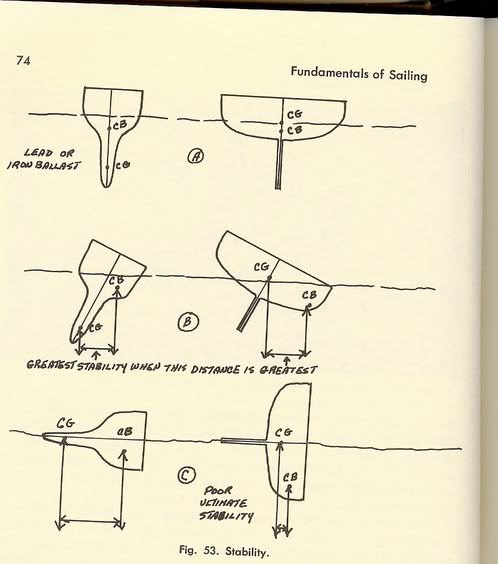
Wow! that hull sure is flatter than an M hull, I did not realize there was that much difference. I am no expert by any means but I wonder if the flatter hull contributes to stability moreso than the 300 # of permanent ballast in the M with its more curved hull shape.
The flatter hull is better initially but worse at extremes. Conversely the M with the rounder hull will be more rolly polly initially but will stiffen up eventually. It has to do with the center of gravity and center of buoyancy's relative positions. The extreme example is a catameran; very stable until a certain point. The scan shows why the flatter hull is better initially but worse if the boat heels too much.
The rounder hull also offers less wetted surface but is harder to plane. It does seem to be true that the X is a little faster under power from what I've read on this forum.
Posted: Wed Aug 30, 2006 5:33 am
by Rolf
The x is a powerboat (hull) that sails. That flat hull is a dream at anchor.
R
Posted: Wed Aug 30, 2006 5:50 pm
by Chip Hindes
You have to do this if you are using a sling launch. You don't want to pick up the boat like this with tanks full.
Why not? I would have absolutely no problem allowing my boat to be slung with the ballast full, any more than I have a problem with it on the trailer with the tank full. I would pull the handle so it could drain as the lift cleared the water; I makes no sense to leave it up in the air or dry store it full.
You guys who think emptying the ballast is the only way are simply wrong, so give it up and stop trying to convince the rest of us that it is. It's way two. Leaving it in until it's on the ramp is way one.
Re: Launch Ramps
Posted: Wed Aug 30, 2006 7:01 pm
by Jim Cate
pokerrick1 wrote:You mean there ARE some tow vehicles for boats WITHOUT 4 wheel drive??? NO??? I do move to the center to empty the ballast if there are others waiting - - - but I've never heard that it's rude to get the ramp wet? This is a water activity after all! And it IS a pretty quick operation to empty. I'm not concerned that the trailer is not rated for the extra weight for a few feet up the ramp - - -I'm not going any DISTANCE with the extra weight.


I use a Mercury sedan to launch, and bring in, our 26M and then tow it (150 yards) to the parking slot. I don't seem to have any problems getting it up the ramp with ballast full, but I do try to get a good running start while the boat is still in the water. I normally stop half-way up he ramp to
empty the ballast.
After all, isn't this the kind of vehicle Roger is using in the video?
Jim
Posted: Wed Aug 30, 2006 7:14 pm
by Jim Cate
50/50 wrote:I have been reading this post with great interest. We have had our Mac now for about a month an in that time have travelled about 150 miles. All of this on Loch Ness and the caledonian canal. Loch Ness can be very rough, 4'+ and very close together.
I have just returned from a trip up and down the Loch. On Saturday we had left with what I thought was a full ballast tank. ( I had opened the transom valve and then vented until i could feel that the tank was full and forgotton to close the valve!) We then encountered 5' waves very close together and the boat was pounding quite frightening for a novice sailor and crew. It was about this time that I'd felt I'd made the wrong choice of boat.
50/50 - Have you scanned the Loch for the Loch Ness Monster? I think your Mac would be a great boat for running patterns on the Loch to find Nessie. You can stay out there for extended periods of time, day and night, tacking back and forth as necessary. What a great scientific accomplishment that would be, and great PR for the Mac also.
I would, however, keep the ballast full when fooling around with such a beast.