Ahoy,
We were away for awhile, but now once again, I am able to work on the boat. Indeed, a couple of friends came by early this morning just to help out. If I keep using friends like this, I'll soon not have any friends left. It was hot, Arizona hot. Yes, we worked early in the morning, but even that did not seem to help. At least, though, we got a start on the mast-raising system. We're almost there, but some things are not quite right yet; maybe some of the salts and ne-er-do-wells on this site can take a look, laugh, and offer some hardy advice.
We were able to get the mast down by using our new block and tackle. Everything worked fine; there were no casualties, no one abandoned crew and ship. We did abandon the becket, though and secured the line to a cleat on the foredeck. To be able to use the becket on the block, we would need a swivel as well. Otherwise, the lines will not stay parallel.
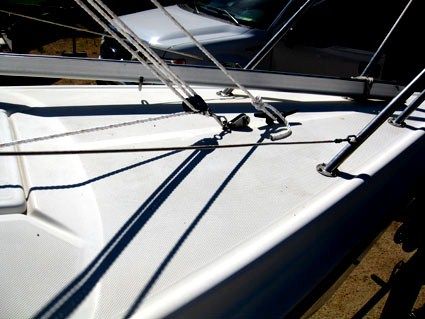
Does this set-up look right? Is there any advantage in using the becket over using the cleat? Here is another photo, just to show that we did not exaggerate when we said the mast is now down. I secured the gin pole to the mast by using the jib halyard. I suppose this is how the system works. No need to worry about the power lines in the distant background. We're a long way from Tipperary.
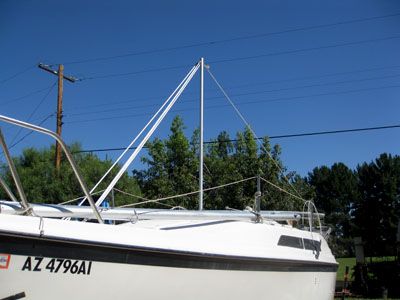
The problem were are having at the moment are the baby stays. At first, we attached the stays to the gin pole, and that kept the gin pole from swaying, but the mast began to follow
Fleetwood Mac, and go its own way.
http://www.youtube.com/watch?v=6ul-cZyuYq4
We next attached the baby stays to the mast instead, but even that did not keep the mast from swaying. Are we suppose to use the cleats on the mast to secure the two baby stays, or must we add an eye to the mast?
Oops, looks as if I may have found my answer. It's amazing how clear something can get once you read the directions and give it a try. Yes, of course, I had read this, but once on the boat, and under the Arizona sun, you forget what you may have read. Having made and used the block and tackle, everything makes much more sense now. Looks like I need to get some S hooks. All of this reminds me of another song by none other than Dr. Hook: "When you're in love with a beautiful woman . . ."
Well, shiver me timbers here's young Jim Hawkins!
Using a bowline, tie an S hook on the end of each of the 2
ten foot long lines. Hook the hooks into the metal eyes on
the deck beside the mast, and secure the other ends to the
cleats on the mast (located 5 feet above the bottom of the
mast. Pull these lines tight and secure them really well. If
they get loose, the mast will fall sideways as it goes up
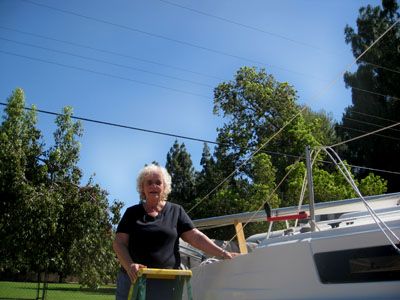
Here is a photo of Miss Pat, standing near the winch. She, too, seems rather anxious to launch. She's the beautiful woman I have been in love with for a number of years.
Neither Miss Pat nor I know much about sailing, but the few times we've sailed with others, we really liked it. I've gone out a few times with a friend or two, always a disaster with that bunch. They either capsize the small day-sailer, or knock me overboard with a boom. I don't mind getting wet, but somehow, capsizing or getting hit with a boom for most of us is something we would rather avoid. That's why I enrolled in a
ASA 101 class with real sailors. Maybe I can learn something. One capsize with the MacGregor and Miss Pat would be done with sailing forever, and I and the MacGregor would be dry-docked.
Adventure begins,
Barnacle Jim