Bad start to season: Broken mast

A forum for discussing topics relating to MacGregor Powersailor Sailboats
RJG 26S
Deckhand
Posts: 47
Joined: Mon Mar 16, 2009 8:46 pm
Sailboat: MacGregor 26X
Location: Moses Lake, WA 2000 26X Mercury 50 4S

Re: Bad start to season: Broken mast

Post by RJG 26S »

DaveB wrote:The Mast on the M and X is not strong enough for the large amout of over hang for a 2 point support system that is 5 ft. or less between supports. Adding a 12ft. 2x6 under the mast would give much more support.
Years of experance and FL. Certified Lic. Structural building/ and Certified Building Lic., I know what am talking about.
Aluminum, steel, wood fastners are just a few things to know in my trade.
Putting a 30 ft. Mast on a suv with supports 5 ft. is not the way I would do it.
Dave
I am sorry Dave, but IMO, a 12 foot 2x6 would have been unnecessary. I am a mechanical engineer and was very comfortable with the bending stresses that were applied to the mast. By supporting the mast with the carpeted wooden blocks that locked the long axis of the cross section in the vertical direction, this ensured the largest moment of inertia was available to minimize the tensile stress caused by the bending. Furthermore, when I adjusted the tension in the front tie down, it was done to place only a slight bend in the mast to keep it tight, but not too tight. The tie downs over the roof rack were very tight. I also tied another set of lines from the forward part of the roof rack to the bail bolted to the mast to help prevent sway and stop forward motion if we had to stop quickly. The mast was locked into place and barely moved during our 180 mile drive. With a 70 mph speed limit in Washington state, we had no problems going 70-75 most of the way. When we hit a bump, it sprung up and down a little but quickly dampened out. There were no resonant oscillations. I did not notice any side to side motion.

The cross sectional area moment of inertia would be very difficult to calculate since it is a complex cross section with the shape, the sail track, and the wall thickness that varies from about 0.085" to 0.130". If I had the moment of inertia, I could calculate the stresses with the maximum deflection that
I had of about 4". I would be willing to bet that it was easily less than 20-30% of its yield strength of 40,000 psi.

When you rig your mast to the boat for towing and have it bolted to the bow pulpit and mast crutch, there is about a 22 foot length between that is unsupported. If you hit a bump while driving down the road, the mast will bend at least as much as it did as I had it rigged on the Rav 4.

The wind loads on the mast were negligible with the mast pointing right into the wind. The cross sectional area that was presented for any side wind (bare pole) is really small compared to having sails out.

The drive was really relaxing and pleasant. Much less stress than towing the boat. If necessary, I would do it again. But now that my boat schooled me with the importance of the proper tuning of the rigging, I am hoping that this mast will last a good long time.

But hey, we are all entitled to our opinions.

Happy Sailing :)

Bob
User avatar
DaveB
Admiral
Posts: 2543
Joined: Mon Jan 07, 2008 2:34 pm
Sailboat: MacGregor 26X
Location: Cape Coral, Florida,1997 Mac. X, 2013 Merc.50hp Big Foot, sold 9/10/15

Re: Bad start to season: Broken mast

Post by DaveB »

Bob, I still stand by what I have stated, pot holes, wind sheer around conners, stopping to fast, etc.
It would have been much better if you had put the 2x6 under the mast to prevent spring shock and causeing a possiable stress bend or hairline crack.
For the avarage person it would be a high gamble to get the 180 miles home without damage.
Mechanical Engineering is not the same as Structual Engineering and would't recommend doing your way.
2x6 12 ft. long cost $8 and well worth the price and will take the shock out of the bounce someone may encure.
Fair Winds,
Dave
RJG 26S wrote:
DaveB wrote:The Mast on the M and X is not strong enough for the large amout of over hang for a 2 point support system that is 5 ft. or less between supports. Adding a 12ft. 2x6 under the mast would give much more support.
Years of experance and FL. Certified Lic. Structural building/ and Certified Building Lic., I know what am talking about.
Aluminum, steel, wood fastners are just a few things to know in my trade.
Putting a 30 ft. Mast on a suv with supports 5 ft. is not the way I would do it.
Dave
I am sorry Dave, but IMO, a 12 foot 2x6 would have been unnecessary. I am a mechanical engineer and was very comfortable with the bending stresses that were applied to the mast. By supporting the mast with the carpeted wooden blocks that locked the long axis of the cross section in the vertical direction, this ensured the largest moment of inertia was available to minimize the tensile stress caused by the bending. Furthermore, when I adjusted the tension in the front tie down, it was done to place only a slight bend in the mast to keep it tight, but not too tight. The tie downs over the roof rack were very tight. I also tied another set of lines from the forward part of the roof rack to the bail bolted to the mast to help prevent sway and stop forward motion if we had to stop quickly. The mast was locked into place and barely moved during our 180 mile drive. With a 70 mph speed limit in Washington state, we had no problems going 70-75 most of the way. When we hit a bump, it sprung up and down a little but quickly dampened out. There were no resonant oscillations. I did not notice any side to side motion.

The cross sectional area moment of inertia would be very difficult to calculate since it is a complex cross section with the shape, the sail track, and the wall thickness that varies from about 0.085" to 0.130". If I had the moment of inertia, I could calculate the stresses with the maximum deflection that
I had of about 4". I would be willing to bet that it was easily less than 20-30% of its yield strength of 40,000 psi.

When you rig your mast to the boat for towing and have it bolted to the bow pulpit and mast crutch, there is about a 22 foot length between that is unsupported. If you hit a bump while driving down the road, the mast will bend at least as much as it did as I had it rigged on the Rav 4.

The wind loads on the mast were negligible with the mast pointing right into the wind. The cross sectional area that was presented for any side wind (bare pole) is really small compared to having sails out.

The drive was really relaxing and pleasant. Much less stress than towing the boat. If necessary, I would do it again. But now that my boat schooled me with the importance of the proper tuning of the rigging, I am hoping that this mast will last a good long time.

But hey, we are all entitled to our opinions.

Happy Sailing :)

Bob
K9Kampers
Admiral
Posts: 2441
Joined: Thu Apr 13, 2006 7:32 am
Sailboat: MacGregor 26X
Location: NH, former 26X owner

Re: Bad start to season: Broken mast

Post by K9Kampers »

Image


Image
User avatar
Catigale
Site Admin
Posts: 10421
Joined: Fri Jun 11, 2004 5:59 pm
Sailboat: MacGregor 26X
Location: Admiral .............Catigale 2002X.......Lots of Harpoon Hobie 16 Skiffs....Island 17
Contact:

Re: Bad start to season: Broken mast

Post by Catigale »

I think two blue gate hasps on each end of the mast would have solved both the mechanical and structural engineering problems..
User avatar
DaveB
Admiral
Posts: 2543
Joined: Mon Jan 07, 2008 2:34 pm
Sailboat: MacGregor 26X
Location: Cape Coral, Florida,1997 Mac. X, 2013 Merc.50hp Big Foot, sold 9/10/15

Re: Bad start to season: Broken mast

Post by DaveB »

There is no jokes about this as for someone trying this without proper Knowledge will end up with a bent mast or do harm to others on the Highway.
I for one want to keep others informed about what could happen and keep them safe.
As I said (Don't do this at home) as in , we are proffesionals and Know how to do it.
Last week in next town from me a person had a bed spring mattress on back of pickup and was not secured proper, flew off hitting a man walking on sidewalk with wife that had major injuries and last I new was still in hospital Ft. Myers, FL. Truck never stoped and police still looking for the truck.
Dave
User avatar
seahouse
Admiral
Posts: 2182
Joined: Sun Dec 07, 2008 9:17 pm
Sailboat: MacGregor 26M
Location: Niagara at Lake Erie, Ontario. 2011 MacM, 60 hp E-Tec
Contact:

Re: Bad start to season: Broken mast

Post by seahouse »

Hey Bob!
:D

Did your wife buy a mattress at Ikea while you were there? :cry: Tell us the whole story now!

:D :D :D :o

:wink:
User avatar
seahouse
Admiral
Posts: 2182
Joined: Sun Dec 07, 2008 9:17 pm
Sailboat: MacGregor 26M
Location: Niagara at Lake Erie, Ontario. 2011 MacM, 60 hp E-Tec
Contact:

Re: Bad start to season: Broken mast

Post by seahouse »

BTW - I don't understand why Orville and Wilbur had such a hard time getting their plane to fly. I've noticed that some people have absolutely no problem whatsoever getting a 4X8 sheet of plywood (or mattress) to fly! :|
RJG 26S
Deckhand
Posts: 47
Joined: Mon Mar 16, 2009 8:46 pm
Sailboat: MacGregor 26X
Location: Moses Lake, WA 2000 26X Mercury 50 4S

Re: Bad start to season: Broken mast

Post by RJG 26S »

There are risks in everything we do. Towing a boat 360 miles on an interstate and driving through Seattle is risky, all sorts of calamity can happen if you get a blow out, have catastrophic bearing failure (BTDT while picking up my first boat) get cut off, etc.

I was very careful in how I drove. I maintained a very large space in front of me (keep in mind the overhang was less than a car length on either side). I paid very close attention to the mast and its stability throughout the drive.

FWIW, I found the manufacturers data on the mast:

Image

Calculating the bending deflection at the ends and maximum tensile / compressive stress (% Yield Strength) bending about the y axis supported on the Rav 4 with 36" block spacing:

Mast only: deflection = 0.4", max stress = 1583 psi (4% of Yield Strength)

Mast + end tie strap down force = 2 x mast weight( 43 lbs of down force at each end): deflection = 1.5", max stress = 7370 psi (18.4% of Yield Strength)

So if the forces were multiplied by 2-3 X to account for dynamic loading, there was plenty of margin left in the mast, so it seems that the DM-6 mast is plenty strong to support itself.

I actually believe a 2x6x12 would have been more of a liability than an asset. Depending on how dry it was, it could weigh anything between 24 to 65 lbs. The bare mast weighs 43.4 lbs. So doubling the mass on the roof, increasing the cross section to side winds is a good idea?

Um I guess us Mechanical Engineers have a durn time figurin this stuff out, we best go an find one of them Structural Engineerin fellas to set us straight.

Bob
K9Kampers
Admiral
Posts: 2441
Joined: Thu Apr 13, 2006 7:32 am
Sailboat: MacGregor 26X
Location: NH, former 26X owner

Re: Bad start to season: Broken mast

Post by K9Kampers »

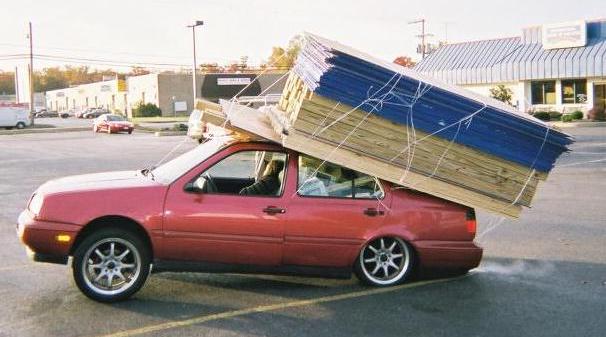
seahouse wrote:BTW - I don't understand why Orville and Wilbur had such a hard time getting their plane to fly. I've noticed that some people have absolutely no problem whatsoever getting a 4X8 sheet of plywood (or mattress) to fly! :|
Problem: plywood won't fly. Cause: too much string... :D
Image
User avatar
Catigale
Site Admin
Posts: 10421
Joined: Fri Jun 11, 2004 5:59 pm
Sailboat: MacGregor 26X
Location: Admiral .............Catigale 2002X.......Lots of Harpoon Hobie 16 Skiffs....Island 17
Contact:

Re: Bad start to season: Broken mast

Post by Catigale »

Ouch!!!
K9Kampers
Admiral
Posts: 2441
Joined: Thu Apr 13, 2006 7:32 am
Sailboat: MacGregor 26X
Location: NH, former 26X owner

Re: Bad start to season: Broken mast

Post by K9Kampers »

I intend no disrespect towards any engineer or engineering analysis. If faced with the same variables and no other transport options, I would've chosen a length of undersupport as suggested, but without having calculated it first. My first thought on the Rav4 setup was turning at intersections in traffic! Then consider Washington State vehicle projection laws, max 3' in front of vehicle, max 15' aft of rear axle.

The good thing is that the transport was a success!


Link to Ouch!!! Vastly Overloaded Car
User avatar
Catigale
Site Admin
Posts: 10421
Joined: Fri Jun 11, 2004 5:59 pm
Sailboat: MacGregor 26X
Location: Admiral .............Catigale 2002X.......Lots of Harpoon Hobie 16 Skiffs....Island 17
Contact:

Re: Bad start to season: Broken mast

Post by Catigale »

I think even two pieces of lumber from bumper to the mast, front and rear, creating a triangle brace, would have stabilized the mast from resonant motion and damage without the hassle of a full 26 foot trough...that would also eliminate the long mode oscillation of course....as well as give you lots of places to staple orange warning flags on it as well.

All in all, a good days work to get that mast home !!
User avatar
RobertB
Admiral
Posts: 1863
Joined: Sun Jun 05, 2011 7:42 pm
Sailboat: MacGregor 26M
Location: Clarksville, MD

Re: Bad start to season: Broken mast

Post by RobertB »

Just a couple of things:

Dave:
Mechanical Engineering is not the same as Structual Engineering and would't recommend doing your way.
- careful there big fella - thems there fighting words :x - I am in the Mech Eng camp - but still stick by the should have been better supported side.

RJG 26S: Your analysis is reasonable except a factor of safety of 2-3
So if the forces were multiplied by 2-3 X to account for dynamic loading
is good for static loading - not dynamic loading. A good pothole may be cause for a factor closer to 20 - mostly concentrated at either the fore or aft supports. Also, your supports look alot closer to 3 to 4 feet apart (at least a 13 foot overhang - this seems extreme for this mast) - but what really stands out is that there is no way to stop rotation horizontally on top of the car - the lines down to the hitch will not restrain the supports on the roof from shifting to one side - a couple of loops around the mast with a strap would have been good.

I stand by my original recommendation - the best way for an owner without a long truck is to transport using the boat trailer (with or without the boat, could always moor the boat for a day).
User avatar
Catigale
Site Admin
Posts: 10421
Joined: Fri Jun 11, 2004 5:59 pm
Sailboat: MacGregor 26X
Location: Admiral .............Catigale 2002X.......Lots of Harpoon Hobie 16 Skiffs....Island 17
Contact:

Re: Bad start to season: Broken mast

Post by Catigale »

Your analysis is reasonable except a factor of safety of 2-3
I caught that one too...much too low for shock loading, agreed....for line the factor is more like 15x
RJG 26S
Deckhand
Posts: 47
Joined: Mon Mar 16, 2009 8:46 pm
Sailboat: MacGregor 26X
Location: Moses Lake, WA 2000 26X Mercury 50 4S

Re: Bad start to season: Broken mast

Post by RJG 26S »

Really guys???

My Rav 4 is equipped with pneumatic tires, springs, and shock absorbers. These do a pretty good job of smoothing out the bumps in the road and keep the dynamic forces on the sprung mass of the vehicle usually well under 1 extra g, easily under 3 g's. If I were to hit a bump capable to transmit 5 g's to the sprung mass, the suspension would likely bottom out. 10-20 g's we would be talking about popping tires, passengers getting injured, breaking the engine mounts etc.

Interstate 90 is a pretty smooth ride between Seattle and Moses Lake. The way you gus are talking, you would think that I was suggesting taking the mast on a cross country race in Baja California.

if you are worried about road forces on your masts while towing your boats, look at installing an extra mast crutch to help support the 20' unsupported span.

Yes, I did not calculate the stresses prior to hauling the mast. Knowing that Seapup was successful I believed that I could do this also.

Prior to leaving BWY I applied practical engineering judgment. I looked at the deflection prior to strapping it, I tightened it enough so it was tight, but not too tight. Rotation was restrained by lines (hard to see in pic) that go from the front of the roof rack to the mast in the same plane as the mast. I tugged here and there and felt comfortable that it was rigged well enough.

I have never suggested that this is the best possible way to transport a mast, only that it is good enough.

Calculations were done only after it was suggested that this was reckless or otherwise unsafe. I stand by my decision. Looks like we are going to have to agree to disagree.

Bottom line: tune your rigging so that your mast is properly supported to prevent breakge while sailing with strong winds.

Happy Sailing,

Bob
Post Reply