Opie,
I had fun racing my

over the last 3 years until I sold it this Spring. We had to work very hard to not come last in our mixed fleet, but usually didn't. I would say my GPS tracks showed tacking angles of around 50 to 55 degrees depending on conditions, so yes, it's possible to do better than the sawtoothpattern in your pictures. Forgive me if I'm repeating info or preaching to the choir.
I think there's a clue here unless I'm misunderstanding you......
>>>>>In the past 3 years I looked up at the wind arrow and was feeling more warm and fuzzy than I should because apparent wind gave me the illusion that I was 45 degrees to the wind but I was not even close all those times in actuality.<<<<
So, are you looking up at the wind arrow and assuming that if it shows about 45 degrees from centerline, then that's the best you can do?? You're maybe not pushing hard enough...... If you have the boat maintaining speed, and trimmed in, and about 50 to 55 degrees off true wind, then you should be seeing an apparent wind angle on your pointer more like 35 degrees off center, not 45.
But achieving it is tricky, as others have said here, you have to go for speed first, angle later. Coming out of a tack you need to fall off MORE than 45 degrees from the true wind and trim the sails to that so the boat starts accelerating. As it speeds up, you will need to progressively trim in because the forward speed causes an apparent wind shift more to the front. Once you are upto speed, you then go through a progressive process where you head up a nibble, trim in a nibble, head up a nibble, trim in a nibble, etc until you're trimmed in all the way (genoa snugged close to the the shroud, boom close to centerline) and maintaining speed, all easier said than done. You have to be patient and give it time to accelerate otherwise it's just like trying to pull away from a stop light in fourth gear in a stick-shift car, it just won't go! All this assumes your sails are in good shape, and your rigging is correctly tuned and tensioned.
Other comments..... no matter what anyone says, for Close Hauled, pointing as high as is possible, you need TWO sails correctly trimmed (or the boat is "unbalanced" with the rudders trying to keep it on course but acting like brakes ) and centerboard fully down...... yes, it is true that the boat will handle better in strong winds (or mainsail only) with the centerboard 3/4 to 1/2 down, but its leeway is increased considerably. That is a compromise you accept to have better control and not have it rounding up on you in every gust.
Another comment..... >>>>GPS tracks divided by 2 equals the angle to the wind. So there. Finis.<<<<
Um... er.... No. GPS tracks divided by 2 equals combined angle to the wind plus leeway angle. A compass heading kind of assumes the boat will go where it's centerline is pointing, but it doesn't. It drifts a little sideways as if in an invisible current. A racing yacht has an efficient keel that minimizes leeway angle. The Mac has a streamlined plank! The GPS knows all, sees all, and doesn't care about angles! It just shows where you was!
Other tricks...... Getting the main trimmed in on an
is a problem because it has no traveler. To point, you need the "sheeting angle" low i.e. boom close to centerline, but with only a single mainsheet, the harder you trim in, the more the mainsheet pulls the boom down towards the center console, flattening the mainsail and hence depowering it. I used a double mainsheet in an "A" configuration, somewhat like this...
http://macgregorsailors.com/modt/index.php?view=656 It does the same as a traveler.... as you tension the windward mainsheet, the boom is pulled across without so much downforce, retaining mainsail shape and power. Windward mainsheet controls boom position, leeward mainsheet controls how open or closed the leech is (twist) and you just play with them to get the best combination according to conditions and what you need. It's also great in stronger winds too since you can let the boom fall off to leeward with a slackened windward mainsheet, and tension the leeward sheet down hard to flatten and depower the mainsail..... WAAAY better than a single mainsheet in which all you can do to keep the boat on its feet is let out the mainsheet..... the boat comes back up, but the main is luffing.
Last trick..... I removed the captain's seat and tied a short strong line between the rudder tie-down cleats. Shackled to the line I had a couple of blocks through which I had the genoa sheeted on a longer than standard jib sheet. This allowed a sheeting angle for the genoa that was a bit lower than the rear tracks would allow. This is probably too hardcore for most..... the jibsheet occupies a lot of the cockpit, but I was serious about racing! A jib will point higher than a genoa because when sheeted fully in, its sheeting angle (angle between the sail and the boat centerline) is lower than a genoa can physically achieve (it's outside the shrouds). This means for two boats with fully sheeted in foresails, both sails at the same angle to the wind (angle of attack), the one with the jib will have it's centerline a few degrees closer to the wind than the genoa boat. But in lighter winds, the genoa generates more power than a jib, so your choices are..... sail higher but slower, or lower but faster. But as Leon mentioned (I agree with everything he said) slow = leeway. Your boat with jib may have a high compass heading, but your GPS track may show you were doing a lot of sideways. Save the jib for when the winds are too overpowering for the genny.
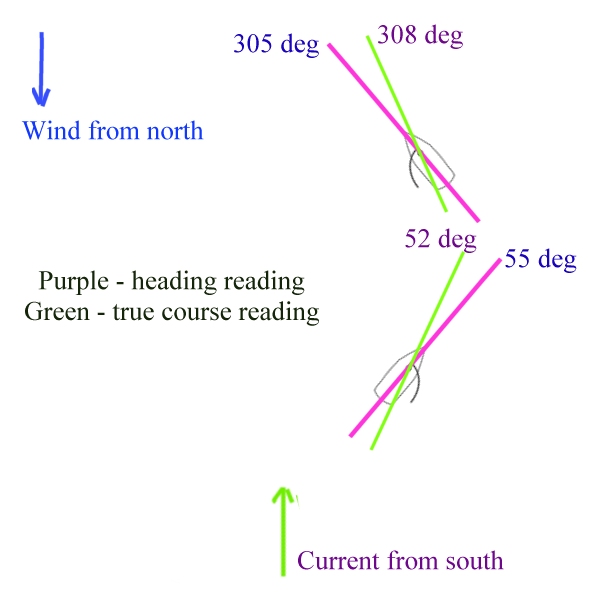


 But if you were sailing where there was no noticeble current, you might be able to roughly calculate how close you can sail into the wind just using your GPS tracks and trying to maintain a relatively constant speed on both starboard and port tacks.
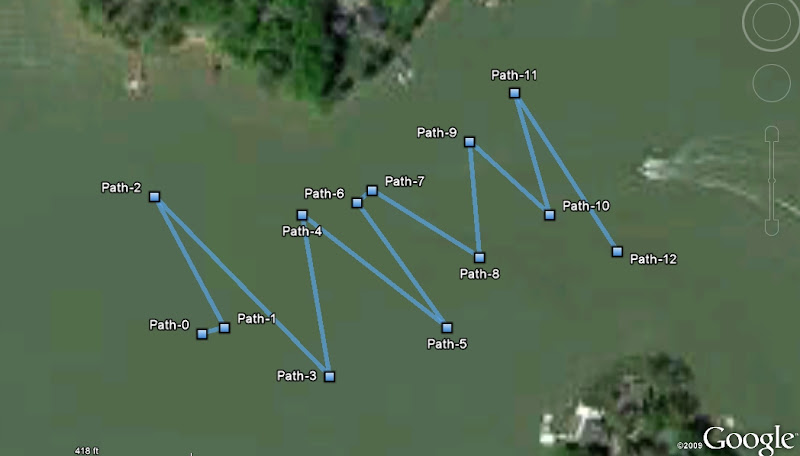

 (Note: this was before I was educated here about not using all of a 150 genoa plus loose mainsail to try to go to windward...)