

I would avoid any more "skeg-age" then I have until some one can run a computer work up of the hydrodynamics.
So far I have relied on instinct from lots of small boats and shallow water sailing.
See my work up on this mod.
In a nutshell.
They DO lessen the squirrelly stern slide BUT that can be good and bad. With no board down the boat no longer whips right around. Turns more like a keel boat.
With no board down, boat is hesitant to tack and you have to use every trick in the book to coax her to do it.
Shell do it easier in light winds and shallow waters.
I used to think there was a drag penalty under sail, but my boat was marginally faster down wind then another M that was stock and with less weight.
There is a slight drag penalty under power.
The boat motors nicer under power at displacement speeds. No more squirrly steering, or less.
At high speeds the bow rides a bit higher. No roll induction that I can tell.
My reason for these was sailing. They help the boat go off the wind and down wind in shallow water
And help while sailing with no board at all which I do a lot of.
For me the size is good. The angle I feel could be improved.
See them on you tube if wanted.
I would not run ridges or strips down the hull.
I'm no yacht designer but I do have a passing interest. I think Roger got the hull of this boat spot on for all the stuff it has to do. Any changes should be either temporary, small, or have an extensive sim done.
You could easily alter the boats stellar ballance. Not all boats will steer with a finger in 20 knots or attend themselves while you set or reef sails. People who might have only sailed on this boat are taking a lot for granted.
Ixneigh
Smart Rails installed!
-
mastreb

- Admiral
- Posts: 3927
- Joined: Wed Feb 09, 2011 9:00 am
- Sailboat: MacGregor 26M
- Location: Cardiff by the Sea, CA ETEC-60 "Luna Sea"
- Contact:
Re: Smart Rails installed!
I think Ixneigh hit the nail on the head--any modifications in the hydrodynamics of the hull change the balance between powering and sailing, so you'd be improving one to the sacrifice of the other by some degree.
What I'm surprised about is that the bow sits higher under power. At first blush, I would have thought that skegs would better direct flow under the hull to lift the stern. But drag tells the true story: enough drag to feel means drag on the stern, which pulls on the back of the boat and thereby causes additional stern squatting. Perhaps a truer wing shape to manage hydrodynamic drag off the trailing edge of the skegs will reduce the drag effect? I'd sharpen the back of the skegs to a knife bade and make sure the front edge is a perfect half circle to get a teardrop shape which will reduce this drag while powering without loosing the positive benefits of the skegs. Consider that traditional skegs are never at 15 knots so they don't have to be shaped for minimal drag.
It's also interesting to me that the skegs change tacking performance--or rather, that the flat stern is helpful in tacking the boat at all. Apparently these boat rely a lot on side slip for more than just powering.
I'm guessing without a simulation here, but I'm almost certain the rails will have less drag than skegs. The reason it's a guess is tht drag across a continuous surface can be nearly zero, but it depends on the surface characteristics of the material in question. Drag occurs mostly at the trailing edge of the object, so you get length but not depth for free.
Its cheaper to test than simulate in this circumstance. So long as you can remove and replace the rails, I'd try it. Just be careful about high speed turns until you hav ea good feel for how it's going to behave.
Matt
What I'm surprised about is that the bow sits higher under power. At first blush, I would have thought that skegs would better direct flow under the hull to lift the stern. But drag tells the true story: enough drag to feel means drag on the stern, which pulls on the back of the boat and thereby causes additional stern squatting. Perhaps a truer wing shape to manage hydrodynamic drag off the trailing edge of the skegs will reduce the drag effect? I'd sharpen the back of the skegs to a knife bade and make sure the front edge is a perfect half circle to get a teardrop shape which will reduce this drag while powering without loosing the positive benefits of the skegs. Consider that traditional skegs are never at 15 knots so they don't have to be shaped for minimal drag.
It's also interesting to me that the skegs change tacking performance--or rather, that the flat stern is helpful in tacking the boat at all. Apparently these boat rely a lot on side slip for more than just powering.
I'm guessing without a simulation here, but I'm almost certain the rails will have less drag than skegs. The reason it's a guess is tht drag across a continuous surface can be nearly zero, but it depends on the surface characteristics of the material in question. Drag occurs mostly at the trailing edge of the object, so you get length but not depth for free.
Its cheaper to test than simulate in this circumstance. So long as you can remove and replace the rails, I'd try it. Just be careful about high speed turns until you hav ea good feel for how it's going to behave.
Matt
-
Crikey

- Admiral
- Posts: 1833
- Joined: Sun Apr 17, 2011 12:43 pm
- Sailboat: MacGregor 26M
- Location: Washago, Muskoka, Ontario, Canada, Earth, Singularity.Suzuki DF60A. Boat name: Crikey!
Re: Smart Rails installed!
Quote: Final thoughts. Slightly different shape and position may reduce hit in speed. Skeg thickness should be thinner near the bottom not uniform. Skeg may be better positioned and not angled out at the bottoms but rather vertical.
Ixneigh, that was from your previous posting. Checking the Youtube pictures it looks like yours are also positioned at ahead of the rudder channels, like my feeling of correct placement. What, if any, would you change in regard to that? It seemed to me the orientation would be a straight up and down position here, when the boat was powered over to the twenty five degree point. Are yours in agreement with that, or did you cant them when you did the glassing? Are they exactly parallel?
The bow high also puzzles me.
Mastreb, how can a cross section or trailing edge be the major source of frictional drag? Like the side of a wetted hull, doesn't the turbulence of skin friction also come into play?
I have to agree changing one parameter affects another, and I'm left guessing whether the smaller depth of the rails (1 1/2inches) would be enough to still provide benefits without ruining the tacking speed, while still enhancing the performance under power. That's really the area I'm focusing on most! There are lots of sailing hulls out there though, with full length chines or lapstrakes (?) running from bow to stern - though I would only do as Ixneigh has done and confine the add on to the rearmost area.
What would be really nice is a Revell (or somebody's) functional plastic model of the Macgregor. It'd be a great way of tank testing these ideas. Maybe next Christmas then....

Ixneigh, that was from your previous posting. Checking the Youtube pictures it looks like yours are also positioned at ahead of the rudder channels, like my feeling of correct placement. What, if any, would you change in regard to that? It seemed to me the orientation would be a straight up and down position here, when the boat was powered over to the twenty five degree point. Are yours in agreement with that, or did you cant them when you did the glassing? Are they exactly parallel?
The bow high also puzzles me.
Mastreb, how can a cross section or trailing edge be the major source of frictional drag? Like the side of a wetted hull, doesn't the turbulence of skin friction also come into play?
I have to agree changing one parameter affects another, and I'm left guessing whether the smaller depth of the rails (1 1/2inches) would be enough to still provide benefits without ruining the tacking speed, while still enhancing the performance under power. That's really the area I'm focusing on most! There are lots of sailing hulls out there though, with full length chines or lapstrakes (?) running from bow to stern - though I would only do as Ixneigh has done and confine the add on to the rearmost area.
What would be really nice is a Revell (or somebody's) functional plastic model of the Macgregor. It'd be a great way of tank testing these ideas. Maybe next Christmas then....
-
Highlander

- Admiral
- Posts: 5995
- Joined: Wed Sep 21, 2005 8:25 pm
- Sailboat: MacGregor 26M
- Location: Maccutter26M 2008 75HP Merc. 4/S Victoria BC. Can. ' An Hileanto'ir III '
- Contact:
Re: Smart Rails installed!
If this helps you's its the hard chines on a mac19 powersailor
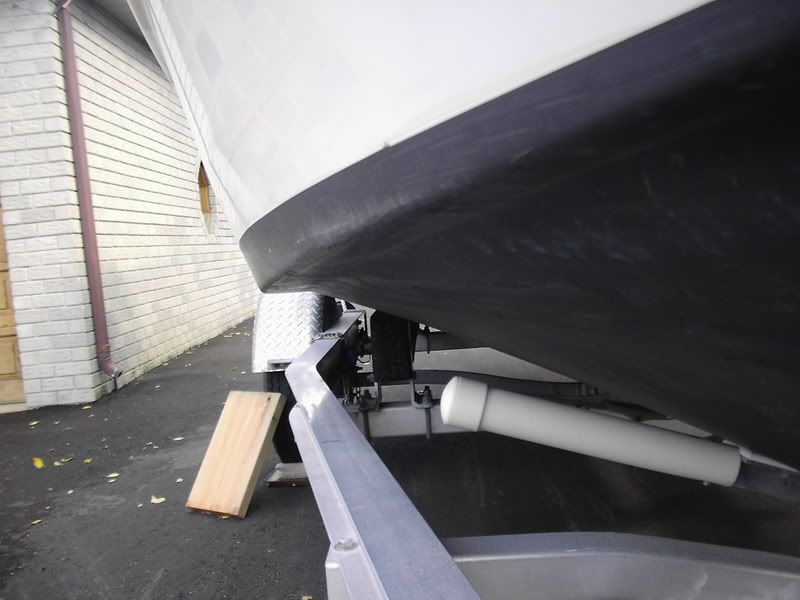
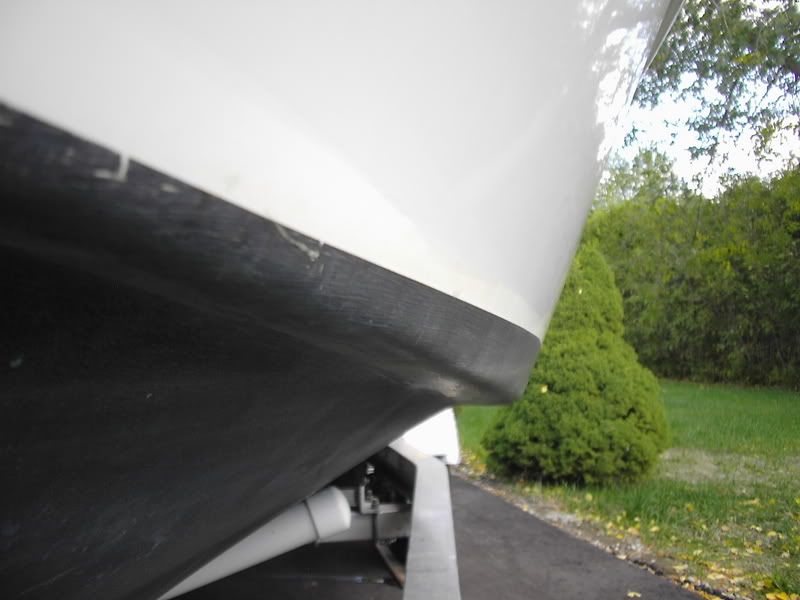
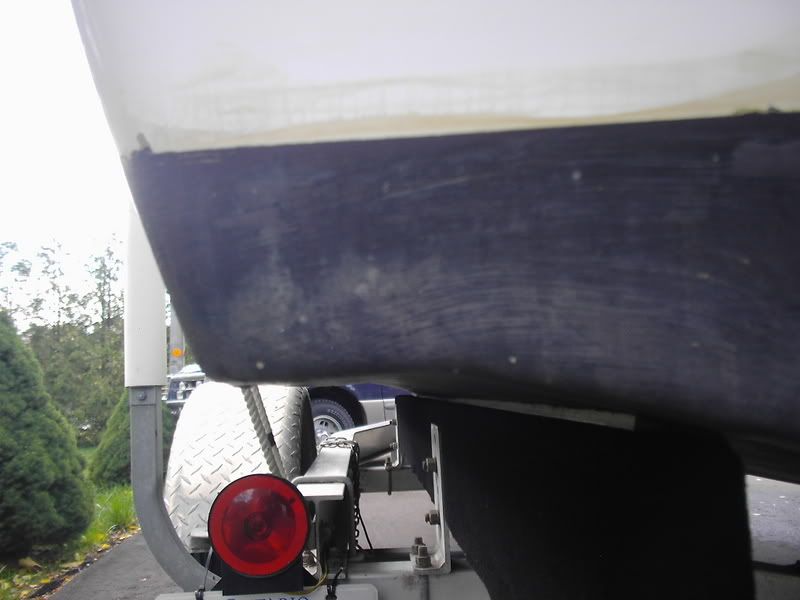
the deep V of the chine made the boat dig in when heeled & sailed like the kats a$$
J
the deep V of the chine made the boat dig in when heeled & sailed like the kats a$$
J

-
Ixneigh

- Admiral
- Posts: 2469
- Joined: Thu Sep 09, 2010 11:00 am
- Sailboat: MacGregor 26M
- Location: Key largo Florida
Re: Smart Rails installed!
Ok the skegs are parallel and they are canted outboard at the lower edge to take into account the heel.
What is happening is that angle is causing them to act as a dive plane and sucking the stern down a bit. However less angle means less effect when heeled. Aligned with water flow under power is different then needed under sail. It's a compromise. They could be a few inchEs deeper and shaped better of course. Next time I paint the bottom I'll do that perhaps. I don't motor fast very often. My boat is heavy and I have had no others to compare under power. The speed hit may not be significant. They do what I wanted at displacement speeds. So far I'm very happy with them. But they can also come right off if I later choose a different shape or position. I would have liked them a bit longer but did not want to modifie the trailer bunks. I put a lot of thought into these and other options such as chine runners and a flat plate across the bottom sort of like a wing keel. The dual nature of the boat forced the most conservative option. I myself plan no more alteration to the hull shape.
Any further mods will be to strengthen it where possible.
Ixneigh
What is happening is that angle is causing them to act as a dive plane and sucking the stern down a bit. However less angle means less effect when heeled. Aligned with water flow under power is different then needed under sail. It's a compromise. They could be a few inchEs deeper and shaped better of course. Next time I paint the bottom I'll do that perhaps. I don't motor fast very often. My boat is heavy and I have had no others to compare under power. The speed hit may not be significant. They do what I wanted at displacement speeds. So far I'm very happy with them. But they can also come right off if I later choose a different shape or position. I would have liked them a bit longer but did not want to modifie the trailer bunks. I put a lot of thought into these and other options such as chine runners and a flat plate across the bottom sort of like a wing keel. The dual nature of the boat forced the most conservative option. I myself plan no more alteration to the hull shape.
Any further mods will be to strengthen it where possible.
Ixneigh
-
mastreb
- Admiral
- Posts: 3927
- Joined: Wed Feb 09, 2011 9:00 am
- Sailboat: MacGregor 26M
- Location: Cardiff by the Sea, CA ETEC-60 "Luna Sea"
- Contact:
Re: Smart Rails installed!
So it's not the trailing edge that is the source of frictional drag, that's just where the turbulence shows up (unless surface friction or flow direction breaks laminar flow before that).Crikey wrote: Mastreb, how can a cross section or trailing edge be the major source of frictional drag? Like the side of a wetted hull, doesn't the turbulence of skin friction also come into play?
In boats we think of drag as wetted hull friction because frictional drag dominates the very large surface area of a hull compared to the small turbulent drag behind the stern. But when you're talking about wings, like skegs or rudders, turbulent drag dominates and frictional drag is in the noise floor (or should be, in a well designed wing). This is because there's not very much surface area compared to trailing edge area due to the wing shape.
So in the case of a wing, laminar flow across the entire wing breaks at the trailing edge and becomes turbulent. Turbulent drag is the force required to get that chaotic fluid back into the slipstream behind you which produces the pull on the wing. The energy to reintegrate the turbulent fluid into the slipstream has to come from somewhere, and nature ain't giving it up for free so it comes out of your forward energy.
Managing the laminar flows such that they recombine with the lowest possible turbulence is what creates the lowest possible coefficient of drag, and this is why the "teardrop" shape cross-section of a wing is so important--It brings the upper and lower laminar flows back together smoothly, reducing turbulent drag behind the wing.
The leading edge shape isn't nearly as important, although you do want to prevent the creation of vortices and you don't want to break laminar flow across the surface of your object anywhere else. Google "laminar flow" and click images to see dozens of pictures of this, and think of all the turbulence areas as a force pulling back on your forward speed. You'll see quite clearly how much difference correct aerodynamic shape can make.
As for skin friction, yes it can create substantial drag if the wing surface is rough in a way that breaks laminar flow. Nothing painted or gel-coated is going to have a substantial problem, although there are surface treatments that can lower friction for laminar flow below a smooth surface. Unpainted wood for example might have this problem, or concrete. But certainly not most plastics or anything glassed and gel-coated.
I'm not quite sure what you mean by "the side of the wetted hull"--Wetted hull just refers to the amount of hull in the water. Reducing it (such as when on a plane) reduces frictional drag overall.
The one place where Power sailor Macs really fail in hydrodynamics for sailing is the stern shape--there's a LOT of very obvious turbulence and therefore drag behind the hull when sailing that a traditional sailboat stern would have managed all the way back until the laminar flow is recombined--hence the teardrop back ends that lift smoothly out of the water on racing sailboats. The Mac just spills it, and it's got to cost a knot or two in performance. Once you're on a plane it doesn't matter, but if someone wanted to make a sailing performance improvement, Figuring out a clever way to manage that stern turbulence without interfering with the outboard and rudders would do a lot. I guess this would only matter in light air--once you've got enough force to get to 6 knots, that drag doesn't matter. But I'm usually in light air struggling to get above 4 knots, so it matters to me.
In the case of these rapid rails, shaping the back of them to a nice smooth knife edge will almost certainly reduce the vast majority of their induced drag.
The rails won't cause the squatting problem ixneigh is having with his dive wings. To avoid it, skegs should be completely vertical. Vertical skegs are going to cause lift when heeling that may contribute to leeward stern slip which is almost certainly what ixneigh was trying to avoid, which makes them kind of a damned-either-way proposition.
Vertical skegs will still function well as skegs even while heeling, but they will produce some lifting force when heeled over, similar to the amount produced by the rudders which would be at the same angle.
-
Crikey
- Admiral
- Posts: 1833
- Joined: Sun Apr 17, 2011 12:43 pm
- Sailboat: MacGregor 26M
- Location: Washago, Muskoka, Ontario, Canada, Earth, Singularity.Suzuki DF60A. Boat name: Crikey!
Re: Smart Rails installed!
I'm trying to visualize the amount of canting at heel you are talking about. Apart from that, they are mostly parallel with the rudders ... right?. I think the smart rails I want to use would sit flat on the slightly angled bottom, at that position, and end up being straight down when the boat is normally heeled (sailing). That, to me, would offer the most lateral resistance for the size and keep the tracking enhancement working. Stern to first bunk may not be enough given the size of the product.Ixneigh wrote:Ok the skegs are parallel and they are canted outboard at the lower edge to take into account the heel.
What is happening is that angle is causing them to act as a dive plane and sucking the stern down a bit. However less angle means less effect when heeled. Aligned with water flow under power is different then needed under sail. It's a compromise. They could be a few inchEs deeper and shaped better of course. Next time I paint the bottom I'll do that perhaps. I don't motor fast very often. My boat is heavy and I have had no others to compare under power. The speed hit may not be significant. They do what I wanted at displacement speeds. So far I'm very happy with them. But they can also come right off if I later choose a different shape or position. I would have liked them a bit longer but did not want to modifie the trailer bunks. I put a lot of thought into these and other options such as chine runners and a flat plate across the bottom sort of like a wing keel. The dual nature of the boat forced the most conservative option. I myself plan no more alteration to the hull shape.
Any further mods will be to strengthen it where possible.
Ixneigh
Also, under power, and on the flat, which is mostly what I'm focusing on - the pocket of trapped water I'm looking for may not be held in strongly enough with the then slightly angled out rails to provide a tangible benefit. Yet the minimal angle might generate some lift to counter that. I suppose testing is the only way to truly find out - as you have done.
I'm guessing that to ensure they would remain without a toe-out or toe-in, you'd have to measure out from the exact mid point of the bottom to the attachment location. Perhaps the toe'dness would change negatively when heeled? I can't think of how you could accurately check that!
Ross
-
Crikey
- Admiral
- Posts: 1833
- Joined: Sun Apr 17, 2011 12:43 pm
- Sailboat: MacGregor 26M
- Location: Washago, Muskoka, Ontario, Canada, Earth, Singularity.Suzuki DF60A. Boat name: Crikey!
Re: Smart Rails installed!
It's interesting that you also had thoughts about the exit off the tail end. In the channel I'm hoping to create with two rails I want to position two 'Smart Tabs', just on either side of the outboard lower end. That might represent a hull lengthening, without the mass and therefore a higher hull speed (optimistically speaking!) and in a position to interact with my chanelled water flow. Take a look at my earlier reference to an S-Boat .....mastreb wrote: The one place where Power sailor Macs really fail in hydrodynamics for sailing is the stern shape--there's a LOT of very obvious turbulence and therefore drag behind the hull when sailing that a traditional sailboat stern would have managed all the way back until the laminar flow is recombined--hence the teardrop back ends that lift smoothly out of the water on racing sailboats. The Mac just spills it, and it's got to cost a knot or two in performance. Once you're on a plane it doesn't matter, but if someone wanted to make a sailing performance improvement, Figuring out a clever way to manage that stern turbulence without interfering with the outboard and rudders would do a lot. I guess this would only matter in light air--once you've got enough force to get to 6 knots, that drag doesn't matter. But I'm usually in light air struggling to get above 4 knots, so it matters to me.
Vertical skegs will still function well as skegs even while heeling, but they will produce some lifting force when heeled over, similar to the amount produced by the rudders which would be at the same angle.
http://en.wikipedia.org/wiki/E-boat
Particularly the wedge that they later fitted to the stern end to minimize the squat at speed. I thought a retractable trim tab could emulate that somewhat for higher performance, under power. You'll also note that they also had a very similar displacement hull (a bit longer!) to the MacGregor. There'd also be a few less powerboats around here if I copied the torpedo tubes, as well!
Ross

-
Crikey
- Admiral
- Posts: 1833
- Joined: Sun Apr 17, 2011 12:43 pm
- Sailboat: MacGregor 26M
- Location: Washago, Muskoka, Ontario, Canada, Earth, Singularity.Suzuki DF60A. Boat name: Crikey!
Re: Smart Rails installed!
To which I'll add the following:
http://www.mendeley.com/research/skin-f ... nnel-flow/
It might seem like I've taken over this old post - but I haven't! I'm still using the 'Smart Rails' (an unabashedly commercial product!), just in a different location, and for a slightly different goal. Not to refute - in any way - the proven advantages of this singular idea, to reduce or eliminate hull spray - from affecting the crew.
If this underwater 'skeggage' could be formulated in such a way as to properly 'fence' the flow (think airflow) over (under) the hull ..... What would happen next, if air was bubbled (pumped) into this space, from the daggerboard location (slot) while under way?
I'm ready to wager I could beat a 90HP powerplant in a quarter trial, with my 60, with not much more than a bilge blower!
C'mon back!....
Crikey!
http://www.mendeley.com/research/skin-f ... nnel-flow/
It might seem like I've taken over this old post - but I haven't! I'm still using the 'Smart Rails' (an unabashedly commercial product!), just in a different location, and for a slightly different goal. Not to refute - in any way - the proven advantages of this singular idea, to reduce or eliminate hull spray - from affecting the crew.
If this underwater 'skeggage' could be formulated in such a way as to properly 'fence' the flow (think airflow) over (under) the hull ..... What would happen next, if air was bubbled (pumped) into this space, from the daggerboard location (slot) while under way?
I'm ready to wager I could beat a 90HP powerplant in a quarter trial, with my 60, with not much more than a bilge blower!
C'mon back!....
Crikey!
-
mastreb
- Admiral
- Posts: 3927
- Joined: Wed Feb 09, 2011 9:00 am
- Sailboat: MacGregor 26M
- Location: Cardiff by the Sea, CA ETEC-60 "Luna Sea"
- Contact:
Re: Smart Rails installed!
Trim tabs will almost certainly improve powering performance--that's what they're for. There are actually quite a few ways to improve powering performance, but in my opinion its most easily improved by getting the wetted hull farther out of the water with 90hp 
What I want to do is figure out how to somehow optimize the turbulent drag while sailing in a manner that doesn't affect the rudders or prop. It's a tall order. If I ever come up with something I'll post on it.
What I want to do is figure out how to somehow optimize the turbulent drag while sailing in a manner that doesn't affect the rudders or prop. It's a tall order. If I ever come up with something I'll post on it.
-
mastreb
- Admiral
- Posts: 3927
- Joined: Wed Feb 09, 2011 9:00 am
- Sailboat: MacGregor 26M
- Location: Cardiff by the Sea, CA ETEC-60 "Luna Sea"
- Contact:
Re: Smart Rails installed!
Interesting paper. You're essentially creating a catamaran. In fact, with an even bigger "fence" or "skirt" and an even bigger blower, you'd have a complete air cushion vehicle.Crikey wrote: If this underwater 'skeggage' could be formulated in such a way as to properly 'fence' the flow (think airflow) over (under) the hull ..... What would happen next, if air was bubbled (pumped) into this space, from the dagger-board location (slot) while under way?
So let's see: If you're doing 20mph, that's 30 feet per second, or slightly over one hull-length per second. To create a meaningful large bubble chamber, I'm going to estimate you you'll need to lay down 2 cubic feet of air per 4 feet of linear travel, or 15 cubic feet per second, which equals 900 cubic feet/minute. Two 500cfm back-pack leaf-blowers will do this job and have the advantage of being able to burn fuel you have on-board. All you'd have to do to test is put the two vent hoses into the top of the dagger-board trunk and seal the whole thing with duct tape.
Those two blowers will cost you about $500 total. Both running will consume about 0.5 gph (based on 64oz fuel tanks with 2-hour run time as reported by the mfr), so they would have to increase your top speed by 1 MPH to be as efficient as "more motor" based on the 9gph=18mph of my ETEC-60. Anything more than 1MPH improvement is a boost to overall efficiency, which is ultimately what we're talking about when we talk about these sorts of improvements, so if you got 2 or more MPH boost out of doing this I'd say it borders on worthwhile. 4MPH and you've really got something worth talking about and perhaps working on making permanent.
The interesting thing is this would work equally well to improve speed under sail (although if you're going to run a motor, the outboard will do a better job of improving speed under sail).
Best of all, the blowers are two-stroke, but you can use your XD-100!
-
Crikey
- Admiral
- Posts: 1833
- Joined: Sun Apr 17, 2011 12:43 pm
- Sailboat: MacGregor 26M
- Location: Washago, Muskoka, Ontario, Canada, Earth, Singularity.Suzuki DF60A. Boat name: Crikey!
Re: Smart Rails installed!
Yeah I guess we're gettin a little too technical when we have to fire up more than the wind, to go sailing! Sorta like having a hovercraft one bubble thick if you didn't have to think about the spinning electromagnets to make it happen. But just think - constrained air bubbles! Under power would be sweet.
Let's say it could become a NOX button if you needed the boost Ha!
Ha!
Let's say it could become a NOX button if you needed the boost
Ha!-
seahouse

- Admiral
- Posts: 2182
- Joined: Sun Dec 07, 2008 9:17 pm
- Sailboat: MacGregor 26M
- Location: Niagara at Lake Erie, Ontario. 2011 MacM, 60 hp E-Tec
- Contact:
Re: Smart Rails installed!
Hey Ross (& Mastreb)- interesting thread.
Knowing where on the hull each one is located at both ends, this would give you an indication the direction of flow over the hull at these locations, and the range they cover.
That would give you a better chance of installing your fences parallel to the flow at the speed and configuration you want than just measuring from the centreline of the hull.
Also, the transom shape is a trade-off between turbulence and effective hull length. When shaped so as to exit the water gently and produce less turbulence it effectively reduces the length at the waterline (LWL) for any given hull length. And, as we know, a shorter length at the waterline will reduce hull speed.
(So could trim tabs be used to increase hull speed by emulating a longer LWL)?
It’s a similar situation at the bow. You can tell a fairly new boat design by the entry angle that it makes to the water. Newer hulls are almost vertical. It increases the LWL for any given boat length, adding to the hull speed, and gives the added bonus of more interior space.
The old beautiful clipper ship hulls looked fast, but those same features that made it look that way, we now know, actually got in the way of wringing out the last bit of performance.
Hydrodynamics and aerodynamics have similarities. Look at the shapes of the Ford Flex, the new Chrysler minivans, and the Prius V. Because of their boxiness, and sharp edges, they intuitively look like they would produce more drag than previous models, but the reality turns out to be just the opposite.
- Brian.
interesting thread.I’m thinking you could attach (duct tape, to hold just long enough to get your results if your hull is clean, or “keel haul” a line around the boat with these attached to it at known intervals), say every 10” apart, some stiff streamer, different coloured “tell tales” that overhang the transom by a few inches. Then go different speeds under power and under sail, and look over the transom, marking their location relative to each other, and relative to the transom (grease pencil)? Or mark a scale on the transom.I'm guessing that to ensure they would remain without a toe-out or toe-in, you'd have to measure out from the exact mid point of the bottom to the attachment location. Perhaps the toe'dness would change negatively when heeled? I can't think of how you could accurately check that!
Knowing where on the hull each one is located at both ends, this would give you an indication the direction of flow over the hull at these locations, and the range they cover.
That would give you a better chance of installing your fences parallel to the flow at the speed and configuration you want than just measuring from the centreline of the hull.
Also, the transom shape is a trade-off between turbulence and effective hull length. When shaped so as to exit the water gently and produce less turbulence it effectively reduces the length at the waterline (LWL) for any given hull length. And, as we know, a shorter length at the waterline will reduce hull speed.
(So could trim tabs be used to increase hull speed by emulating a longer LWL)?
It’s a similar situation at the bow. You can tell a fairly new boat design by the entry angle that it makes to the water. Newer hulls are almost vertical. It increases the LWL for any given boat length, adding to the hull speed, and gives the added bonus of more interior space.
The old beautiful clipper ship hulls looked fast, but those same features that made it look that way, we now know, actually got in the way of wringing out the last bit of performance.
Hydrodynamics and aerodynamics have similarities. Look at the shapes of the Ford Flex, the new Chrysler minivans, and the Prius V. Because of their boxiness, and sharp edges, they intuitively look like they would produce more drag than previous models, but the reality turns out to be just the opposite.
- Brian.
-
seahouse
- Admiral
- Posts: 2182
- Joined: Sun Dec 07, 2008 9:17 pm
- Sailboat: MacGregor 26M
- Location: Niagara at Lake Erie, Ontario. 2011 MacM, 60 hp E-Tec
- Contact:
Re: Smart Rails installed!
Funny thing, about the mention of the air cushion vehicle. This summer a couple came up to me at the dock and told me that my boat looked like a hovercraft. It was the blackout design of the windows that they were referring to. 
- B.
- B.