Page 2 of 2
Posted: Mon Apr 30, 2007 5:52 pm
by Jim Cate
Aryl,
Has anyone gone out with you to demonstrate docking maneuvers with a 26M? If there is an experienced MacGregor sailor, or dealer, nearby, it would probably be helpful to go out with him at least once.
You are correct that the 26M can sometimes be difficult to "park", particularly when coming in with a strong lateral wind. Perhaps backing into the slip, as suggested above, will solve your problems. I usually come in bow first, and so far haven't had any major problems. When coming in to your slip under power, you should have both rudders and the dagger board down for maximum steering control. - Is that what you are doing?
Also, remember that, in windy conditions, the Macs must come in at a good rate of speed until you are near your dock to maintain steering control. - Perhaps 3-4 mph, depending on conditions and your particular harbor. Because they are light and have a high freeboard, it's difficult to coast in without power in windy conditions as is usually done in a heavier boat. Of course, you need to slow down as you near your docking position, putting the motor in neutral or perhaps reverse temporarily as you approach the dock. Be prepared to tie the rear docking line to the cleat or post on the windward side while maintaining a bit of forward power.
Again, the Macs are "different," as you have observed, and you will need some practice, but most of us get the hang of it fairly quickly without investing in an expensive bow thruster or the like.
Jim
Posted: Mon Apr 30, 2007 8:20 pm
by waternwaves
the other advantage about reverse...is drag, the boat is slower for any given rpm going in reverse....., something I learned on my first trip.....and thankfully could take advantage of.
Posted: Tue May 01, 2007 1:10 am
by James V
Aryl, Yes, docking the M is different than other boats. Keep the keel and rudders down and easy on the throtal. It acts like a sailboat piviting at the middle and a power boat with the strong motor on the stern. Take a look at the link below and go to the power boat section and look at it. (as well as the sail boat section)
http://www.videos.sailingcourse.com/
I hope that you can find someone in your area to help you. If not, find some open water and throw something overboard and stop the boat next to it. Then put a 2 empty bottles tied to something heavy in the water about 2/3 the boats length apart and practice docking next to them.
The power boat maneuvers is a very good one to get to know.
Posted: Tue May 01, 2007 5:08 am
by aryl
I have 5 boats and M26 is the most difficult to steer of them. As a matter of fact it is the worst I know. I normally have dagger board down and at least one rudder. When there is no wind everything is OK but even light wind makes it difficult. Going 4-5 knots is too fast in my harbour.
There are no Mac dealers nearby, I imported it myself and probably I have the only M26 in Finland. Funny thing is that there is next to my boat one X26 which was imported from Sweden.
-aryl
Posted: Tue May 01, 2007 6:30 am
by Mikebe
In this picture you can see a blue line between the inner and outer pilings on the starboard side.
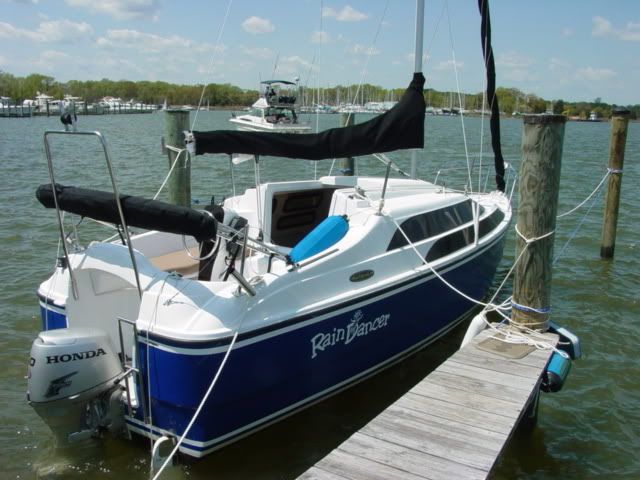
I have the same thing between the pilings on the port side.
What I do in windy condidtions is (all boards down) back the boat within boathook reach of the windward line. Once I hook the guide line with the boat hook, I pull the stern in close enough to slap on a "D-Ring" clip with a short line cleated to the stern cleat. I then give the boat a little reverse momentum with the engine, put the engine in idle, and move forward from the cockpit, keeping the guideline hooked with my boathook and pulling the boat up parallel with the guideline. At this point I can just grab the guideline and walk the boat back until I can tie off the bowline, then go aft and secure the stern...this works well except when the wind is blowing directly into the slip...I'm still working on that one.
Posted: Wed May 02, 2007 11:24 am
by Jim Cate
[When there is no wind everything is OK but even light wind makes it difficult. Going 4-5 knots is too fast in my harbour.
How about 2-3 knots?
Jim
Posted: Wed May 02, 2007 1:46 pm
by Duane Dunn, Allegro
Don't forget the usefulness of spring lines. They are like magic when you have to manouver the boat against wind or current. Spend some time reading about them and then practicing. Soon you will look like a pro around the dock. If you can get just one line around a cleat you can use it to move a completely out of position boat right up next to the dock under complete control even against wind and current. A line at either end of the boat can be used in this manner.
I'm surprised how many boaters out there today don't have a clue about spring lines. They are particularly helpful for single screw boats with lots of windage like ours. These days everyone seems to rely on twin engines, stern thrusters, bow thrusters, etc. You can get the same results with a single well placed spring line. It's scarry how many twin engine powerboats resort to a bow thruster because the operators don't even know how to work their engines against each other to pivot the boat.
Also remember another 'Best Practice', don't ever give your line to stranger on the dock and let them cleat it off. Always have them put it around a cleat and pass it back to you. That way you control it's length and when it gets cleated. Give them clear instructions. Assume they do not have a clue about how you plan to use that line.
My wife and I also have found it pays to have a 'Chalk Talk' before she heads to the bow with the lines for docking. I keep a little white board under the helm seat and after I have evaluated the conditions and the target dock area I'll draw up a quick sketch. We'll talk about where and how I want the line placed, how long, is it going to be used as a spring line, etc.
Now that we have done this enough she is beginning to learn the methods as well and I can just tell her, for instance, that we are going to set a forward spring on the starboard side and she'll know how to handle the line to make it work. She's also gotten very good about getting the end of the line back from the eager helpers on the dock. They usually look confused when she tells them not to cleat it and when she gets it back she pays out a fair length. But they are always impressed when the next thing they see is the boat pivot in place and snug right up to the dock.
Posted: Wed May 02, 2007 2:11 pm
by marsanden
my experience is:
rudders down
half db down
ballast tank full
lots of excercise to drive my boat to the slip .
Posted: Wed May 02, 2007 3:47 pm
by Duane Dunn, Allegro
spring line
Posted: Tue May 08, 2007 7:01 pm
by daver360
Thanks for the animation Duane! Ive always been very hesitant on parallel parking. I parked in front of Anthonys Homeport in Everett. Had one guy behind me already. Then had another park right in front of me. This was my first cruise out... Didn't know about this discussion site. Didn't know to put the center board down... didn't know to have the boat facing the current on take off. Bought the boat in Spokane. Anyways I didn't hit there boats but mine needed some gel coat from hitting the dock!
(very embarrassing to say the least)
So is this spring line a regular rope that you use to loop around a cleat. When backing, too shoot forward, how do you avoid hitting your rudder? Do you put a big fender at the aft end. Does someone hold the spring line and let go when the bow is facing the direction you want to go? Looks like a very good concept. Could defintely use your experience when going to Elliott Bay this Memorial day weekend... the marina there looks tight on google earth.
spring line
Posted: Tue May 08, 2007 7:47 pm
by daver360
I checked out the video in the link. Looks like something I can try myself on the forward manuver. But... The sailboat in the video was nice and round like a normal sailboat. The MacX is pretty square. Im worried about the rudder, but will give it a try.
I was interested in the bow thrusters also until I saw the animated video.
Thanks!
Backing
Posted: Mon May 14, 2007 2:24 pm
by pokerrick1
I have been thinking of trying to back into my slip just to try it, but I LOVE the idea of flushing the engine when it is backed in - - - would be sooooooo much easier. By the way, I have a 60 E-Tec and Evinrude told me (at a boat show) that it does NOT need to be flushed, even though there are ports for flushing, but I like to do it every few weeks at least anyway.
Also, I have NO problems steering my

especially at low speed (as long as I remember to have the rudders and DB down

), and I usually GLIDE into my slip in neutral after passing the bow anchor obstacles of other boats (that are backed in) in my way

Rick
Posted: Mon May 14, 2007 4:11 pm
by Duane Dunn, Allegro
The spring line can be any line you have handy. Most of the time we just use either the bow or stern dock line. A longer line is better than short. I prefer 25' lines for dock lines on my X. Having even a longer one handy helps as well, there are cases where you need a line that is longer than your boats length.
The line is almost always tended, ideally you want it to go from the boat cleat around the dock cleat and back to the boat cleat. This is particularly important when using it for leaving the dock as once you have the boat at the angle you need you can just let the line run free and pull away without needing someone on the dock to help. I also always encourage my wife on the bow to do the same when approaching. Her instructions are to have the helpful people on the dock put the line around the cleat and then hand it back to her. This puts her in charge of when and how it is cleated. It also allows the person tending to vary the length of the spring as needed to accomplish the manouver. This also lets you escape if something goes wrong and you need to get away. There's nothing worse than being in a bad position and having a line still tied to the dock.
Depending on the manouver you do want to fender well at the bow or stern. I've never had an issue with the rudders (at least not my X ones). They are more than far enough inboard to stay clear of the dock. You would really have to be at an extreme angle to hit them. Also on an X if you are worried put the dockside rudder up and leave the outboard one down (you probably can't do this on an M with the odd angle the rudders stick out at when up). I also find with the squarish back end and pointy front that I rarely need a fender way forward at the pulpit, but make your own choices on this. You'll never regret having a fender out that is not used. (Just remember to always get them in once away from the dock, don't be one of those people cruising around with fenders hanging over the side.)
We have four active, ready to go fenders on board, under normal docking circumstances we set out two, occasionally three. Usually always if at the dock for an extended time I'll put out a third when I put a dock spring line in place. There are also times when we need to fender both sides such as going through the locks and use all four. I also keep three more fenders stored below for extreme situations.
We prefer to back into slips, this is our normal position given a choice. (We sleep with the front hatch open and don't like it when it is facing the main dock.) It also lets you use shorter docks and still get out of the cockpit. With the fins down I find the boat is much more controllable in reverse than forward. It just tracks better and doesn't get blown around near as much when going into the wind and current. You can also stop much quicker with a blast of forward thrust than you can with a blast of reverse.
I must say I've never tried the swing around the end method of getting into a slip that is shown in the animations, but I have used all the other methods shown. The shape of the boat doesn't make much difference. You can do all the same stuff with our shape boats or even a fat wide square powerboat. None of it relies on the curve of a sailboat hull.
I encourage everyone to plan a trip just for practice each season. Decide to go out for a Sunday afternoon and not go anywhere, just practice stuff. Find a nice empty dock and practice coming and going. Do it from the downwind side, do it from the upwind side. Use a spring line both fore and aft to approach and depart. Have your wife do the driving, have your older kids do it as well. If you are worried put someone on the dock to help those first few trys. Start with easy approaches from upwind and move to the harder ones. Work out how you are going to communicate your desires from the helm to the person on the bow.
Draw pictures, explaining what you are going to try and then go do it (we keep a little white board in the cockpit for this). Afterward discuss what differences would have made it better and then try again. Do the wrong thing and then learn how to get out of it. Pretend the boat had just been blown bow tee'd on to the dock and learn how to still bring the boat along side without breaking a sweat. I often find that I start with one plan and due to circumstances end up having to use a different one to bring the boat to the dock. Work with what you get. You could even do some advanced course work and bring the boat in single handed.
While you are at it throw in some surprise man overboard drills. Make sure everyone can get the boat back to that cushion (which of course could be you floating away.) Find some shallow water and practice anchoring. Make sure the person on the bow and the helmsman know how to communicate what needs to be done when anchoring (I'm always on the bow and my wife or son drives when anchoring. We have a known set of hand signs.)
It may sound silly and a waste of a day but the next time you are in a tight spot in front of the superbowl size crowd at the marina your team will look like pros. I still remember fondly backing into a slip at Blakely marina up in the San Juans. Just as we got into position to stop our rearward progress the motor died (2 stroke Tohatsus hate to idle). Without a word the three of us sprang onto the dock and using lines (not muscle) brought the boat to a perfect stop without so much as a bump. It looked like a perfectly planned manouver when in reality it was a mad scramble to avoid turning everything hanging off the transom into a pretzle. It was only our experience and confidence that saved the day. Everyone can use more practice, not just the first time boaters.


