


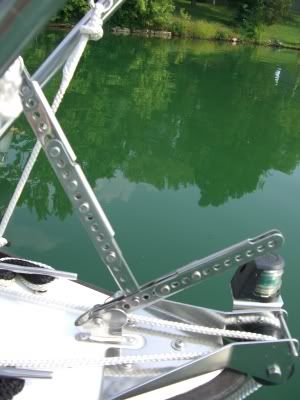
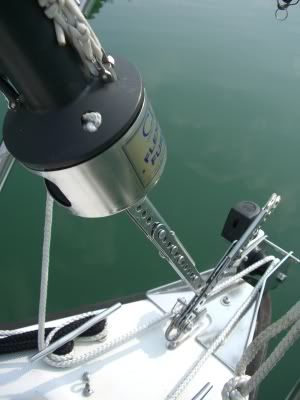


Furler extension / lever made out of stock MacGregor shroud adjuster parts, and some drilling, filing, grinding, fitting.
Furler extension, pivots on back (lower) hole of forestay chainplate tang, furler drum easily attaches with quick-pin to top of backward-upward facing "extension-arm" before it is levered down: bottom of extension-arm is left permanently pinned to a more forward hole in front-facing "lever-arm", which is pulled down, tightening the furler, until the lever can be pinned at the front hole of the chainplate tang. Original details of lever-arm found in previous mod onsite. Mine is overbuilt, doubled and overlapped, for extra strength and redundant-pinned for safety. Note you have to stretch ( file with round or rat-tail metal file ) one set of holes in the bottom adjuster of the set - to line up with chainplate tang's forward hole.
>>> Note also that the only pins to pull and put back in when rigging are the one at the top to attach the shackle at the bottom of the furler, which would have to be attached somehow anyway, and the only additonal pin to do is the large quick-pin in the forward hole of the chainplate tang. Once attached at the top, the mast is actually secured even before it is final-tightened.
Also note, that the furler is actually attached in both places on the tang. If one pin there fails, or falls out, 'still will hold, at least THERE, by the other one.
The rear "pivot" hole of the tang is pinned with a large shackle's pin, the shackle doing double duty as the attachment point for the auxiliary/alternate jib hank-wire, and the tack of the auxiliary/alternate jib sail. You could run both at the same time down-wind, but the furler Genoa would be a pain in the ass to tack with the wire behind it, so I would only use the wire when needing a better shaped smaller fore-sail that can be sheeted inside the shrouds, or if the Genoa is unusable or off the boat.
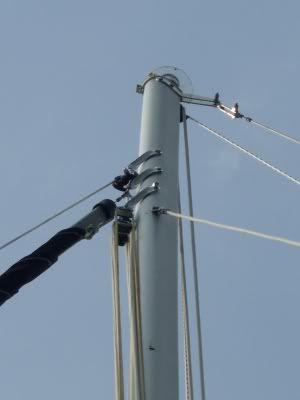
At the jib head on the mast, the three sets of hounds....even the lowest has been raised.... Might move them around some more later, next time I lower the mast...
Middle hounds are used for the furler wire.
Lower hounds have three blocks.... center block is only used for the mast raising system, has its own heavy line. Portside block carries the wire-halyard. Wire does not go thru block, just the halyard - lowest stretch line I could afford, used as a halyard to stretch the wire from the fore-tang to close to the block up there. Starboard block is for the actual auxiliary/alternate jib halyard, not to be confused with the halyard for the wire.
Keeping the lower hounds with the alternate jib stuff below the furler hound ensures no tangling or interference with the normal function of the furler parts.
The upper hounds, and block(s) are for the sock halyard, to keep it from fouling with the furler, and oriented correctly with the zipper downward. That line, a thin one, I just leave attached at the bow in front of the furler to the pulpit. No real reason, just to keep down the clutter at the base of the mast, maybe. Might delay the mast falling if it came un-pinned at the furler somewhere.
Now the jib-wire itself... I keep the alternate hank-on jib in a proper jib bag that zips over the lowered jib, while hanked on the wire. The wire is rolled up, bound with a tie, and stuffed back into the same jib bag when not being used.
To bend the jib on, wire and all, (the furler sail is rolled up of course) I bring the jib bag out the front hatch, attach the lower end of the wire and the jib tack itself too, at the shackle shown in the photo with my finger, and then attach the halyard shackle to the top of the WIRE only at first, and hoist the wire. Really tighten the wire, cleated off at the mast. Fish the sheets out of the bottom hole of the jib bag, (the jib-bag zipper is still closed around the now-hoisted and tight auxiliary wire forestay.) Then unzip the top of the bag, dig out the jib-head, and attach the jib halyard to it, and when ready, hoist the sail normally.
All this MIGHT sound complicated, but you know even regular sailing stuff SOUNDS alot more complicated than it really is. Once installedl, this double mod is really simple to understand and use.