Page 2 of 3
Posted: Tue Aug 23, 2005 8:05 am
by Catigale
Catigale's 5W solar panel, unaimed will produce 1.25 Ah per day. He already owns one so that one's free, but he'll need two or three more of them to recharge after burning a 5W anchor light all night.
You miss my point entirely again, Hindes
Ill just buy three more VWs and get three more free solar panels and then my numbers work out great..give or take a factor of 10 or so....

Posted: Tue Aug 23, 2005 8:19 am
by Moe
Stephen, if you buy into the Davis hype that the 0.110A bulb is visible for two miles

, that 5W panel should take care of it if you can mount it where it isn't shaded.
Posted: Tue Aug 23, 2005 9:30 am
by Catigale
If I get a ticket in Ohio for not having a bright enough anchor light, Ive heard waving your ACLU card at the judge will get it knocked down to illegal possession of WMD....
oooohhhh......
Posted: Tue Aug 23, 2005 9:40 am
by Chip Hindes
...buy three more VWs...
You're right, I completely missed that possibility.
BTW, that's
Admiral Hindes to you, Captain.
Do we have way too much time on our hands?
This is fun, but a poor substitute for actually sailing.
Posted: Tue Aug 23, 2005 10:34 am
by DLT
Yeah, this is screwing up that (sailing) / (talking about sailing) ratio...
Posted: Tue Aug 23, 2005 11:12 am
by Moe
An
interesting post since we're on this topic. Personally, I think the owner will win on appeal, but it really shows what some law firms (like the powerboater's in this case) will do to get their clients' damages reduced or eliminated. My ex worked for a law firm that had an investigator who would dig and dig and dig to find things the injured party did wrong, and in some cases actually turned the tables on them, as in this case. Don't get me wrong... that's what they get paid to do and I'm not judging it as unethical. That's one of the reasons I hesitate a bit to save money by building my own LED anchor light when I can certainly afford to spend the money with someone else who could share liability, or at least pay their lawyers to defend the product.
Posted: Tue Aug 23, 2005 11:19 am
by cbhinkel
In bringing this thread entirely back to the original subject,

, I converted my anchorlight over to be LED to save some amperage even though I have a three battery system. If you up for a custom/fabrication job you can do the following:
Go to
www.superbrightleds.com and check out their line of different LED bulbs. I believe they have the best selection at the best prices on the internet. If they have a bulb that is direct physical fit for your anchorlight fixture, you can give that a try. However, you might need to keep in mind the LED bulb replacement might not be as bright or the emission angle is too narrow, so you might need to add some reflective tape to the inside of your anchorlight fixture to compensate as best as possible for this.
If there isn't a direct fit bulb, you could purchase a different bulb socket (one for marine use) and splice it in using a double-crimp/glued shrink wrap connectors. This is what I did and it only cost me about $5 and one hour of my time to do the conversion. The light is less bright than what I had in there, but only uses 25mA instead of 0.5A as before.
This website also has the luxeon emittors for only $28 that would fit inside my fixture and I might upgrade to this down the road. This should surpass the brightness of the incandescent bulb that I started with.

-Chris
Posted: Tue Aug 23, 2005 11:38 am
by DLT
I find myself wanting to point out that we don't have the whole story here...
We don't know if the guy was anchored. If so, what anchor light he was using, if any.
We don't even know on which side of the boat he was hit, i.e. if he was the stand-on or give-way boat...
hull, we don't even know that he had his lights on, that the bulbs weren't burnt out, etc...
[on edit]
By the way, my understanding is that sometimes courts will look at minimum requirement type laws as setting a lower threshold, below which you are almost always negligent. But, it doesn't work the other way. In other words, just because you meet that lower threshold doesn't automatically insulate you from negligence. The court could say that in that particular situation, you should have had brighter lighting.
Kind of like a speed limit, but in reverse. The posted speed limit is for "ideal conditions". Go over, and you are subject to a ticket. But, if it is a dark and rainy night, you could still get a ticket going under the posted speed limit.
Posted: Tue Aug 23, 2005 11:42 am
by DLT
After reading the story of the guy getting sued over an accident, I'm leaning towards using standard incandescent anchor lighting. I'm even thinking I'd want to get a 10w light, rather than some 5W than might "meet" the 2nm limit... Do they make 20w lights?
Posted: Tue Aug 23, 2005 1:55 pm
by Chip Hindes
No doubt at all, brighter is better.
A 5W commercial anchor light might be only minimally compliant, but it is pretty much by definition, compliant. As Moe says, in some cases it might be wise to just bite the bullet and buy a commercial unit instead of futzing around trying to make a homemade LED unit work as well as the incandescent it's replacing.
If you decide to make your own replacement, there are additional considerations.
First, you have to accept that the stated lighting requirements are not arbitrary, they are there to protect all of us from nighttime collisions. If you do an alteration to the existing lights on the boat, you are at least by definition technically non compliant. If the lights you have are already only minimally compliant, and you randomly change out the bulbs for someting not as good, for no other reason than to reduce power consumption, besides being technically non compliant you have made it less safe not just for yourself but for us all.
Even if your homegrown LED replacement is better than standard, in the rare event that it became an issue, a good lawyer (if there is such a thing) could still argue that your lights are non compliant. The burden of proof would be on you to prove that they in fact were compliant.
I might decide to upgrade my running and anchor lights to 10W or to an LED replacement, but that decision will be mine, based on my own determination of what's best. I will take into consideration the cost of the new lights, the projected safety improvement in visibility, and the additional power consumed and/or saved.
In this particular legal case, from the limited info we have it appears the good guy (sailor) was royally screwed by a whole host of bad guys: an idiot of a judge in concert with a jerk of a lawyer on behalf a moron of a powerboater and two slimeball insurance companies. Based on the story as presented, it indeed appears a travesty of justice. And of course as sailors on a sailing website, we're predisposed to believe the story of the other sailor even without having heard from the powerboater. But while sympathetic, I've learned that you seldom get the whole story from an aggrieved party, so I guess I'll withold judgement for the time being.
But it appears by extension some are insinuating that we all ought to consider rushing out to upgrade our running lights to 1,000,000 cp because some other idiot of a judge might concude that minimal legal compliance is not good enough? (OK, OK, it's exagerration for the sake of making the point) But anyway, it's ludicrous and I quite simply refuse to go there.
Posted: Tue Aug 23, 2005 3:54 pm
by ALX357
So that's why MacGregor doesn't even put an anchor light on the boat at all.......
Posted: Tue Aug 23, 2005 4:39 pm
by Moe
You know why Roger doesn't provide an anchor light. Same reason he didn't provide a light in the head on the X. $$$ If they got him under oath on the stand in this case, and asked why he upgraded the nav lights to 10W if the 5W met requirements, he'd probably have to admit it was because he got them at a lower price than the 5W!
Posted: Tue Aug 23, 2005 7:18 pm
by ALX357
As for the solar charger, consider that many of us do not sail for days on end, week after week. Maybe two nights out, and three days on a long holiday weekend, but usually for us working stiffs, it's two weekend days' sailing, maybe with an overnight in between, once a week, so the solar charger would have 5 days to work on the battery charge, - not confined to the one day / one night basis, as was analyzed in depth in a previous post of this thread.
......With the two deep cycle 24 series batteries just for the lights, cabin amenities etc., and the other cranking battery just for the motor, there is plenty of reserve power to last thru the draw until the solar cells have time to recharge....
since i am more of a qualitative - but not really a very skilled quantitave guy, maybe some analysis could be done on the basis of 2/5 (nights use / days charge,) factoring in the same charging characteristics as before.
I really don't consider the top of the sliding hatch to be prime real estate, but is the most obvious place for the solar panel, and the flexible panels allow soft shoe or barefoot stepping anyway.
Posted: Tue Aug 23, 2005 8:18 pm
by Moe
I actually worked through these numbers when we were considering a slip in the state park with no electricity. The bottom line was that for a frugal 18AH/day for two days and a little on Sunday with only motoring out of the harbor and sailing the rest of the time, plus a week's worth of self-discharge (something not accounted for in previous calculations), we needed about 50-60W of panel, allowing for 4 sunny days out of 5. Unfortunately, the slightly bendable
Solarex MSX30Lite panels are out of production, and flexible panels like the UniSolar (also now out of production) are amorphous, which take up twice the real estate for the same power as crystaline panels. There are framed crystaline panels in that wattage that should fit. However, motor for 3 hours over the weekend with an 18 amp Suzuki or Mercury (or 25A E-TEC) and the problem is solved.
Posted: Thu Aug 25, 2005 5:19 pm
by kmclemore
Moe wrote:There are framed crystaline panels in that wattage that should fit.
That's what we have on Miss Tecumseh. I mounted a Kyocera # KC40 40W/2.34A hard panel on the sliding hatch cover. I cut several nylon bushings to keep it elevated from between 1/4" to 3/4" off of the slider allowing ventilation underneath. It's wired through a
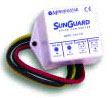
MorningStar SunGuard controller that goes into our
We$t Marine #143268 charge combiner that automatically tops up the starting battery first, then the house. I know mounting it on the cabin roof is controversial - doesn't get the best sun, reduces area for walking, etc. but it just seemed to be the best bet for us for now.. maybe later I'll make a fancy mouting for it, but I just wanted the darned thing mounted before we went our our trip last year, and this was quick and easy.