FittsFly wrote: ↑Thu Mar 12, 2026 5:56 am
Thanks Be Free and Starscream for all the info! I find myself a bit electrically challenged I'm afraid. Heres a couple of questions I have:
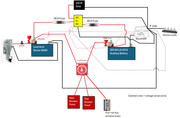
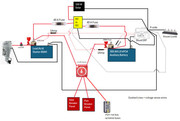
1-Im finding when reading up on the Renogy DC to DC charger when the Start battery (lead acid)has satisfied with charge the Renogy will start pulling 20 Amps to charge the Lifepo 4 house battery. with my Suzuki DF50 only putting out between 11 and 19 amps depending on RPM the renogy would start drawing off of the lead acid to satisfy the the 20 amps! This isnt good correct?
Should I be thinking of a 1,2,off switch after all to isolate the 2 batteries after all? Thats what i was trying to avoid!
Thanks in advance
The DCDC charger will look at the voltage of your start battery and will only connect to the house battery if the start battery is (and is remaining) above a set voltage. The trigger voltage is usually the float voltage for the start battery (13.2V if memory serves). If the start battery falls below another set point (12.7 IIRC) the connection to the house battery is removed.
It is incorrect to think of the house battery as "pulling" 20 amps. Your battery does not "pull" it "accepts". Your battery can only accept a charge that is offered by the charging source and only to the extent that its internal resistance allows it. While your battery could accept a very large charging current (for Li usually around between 50% and 100% of the battery's capacity due to its very low internal resistance) the actual charge current is usually limited by what the charger is willing to provide.
Your battery is only going to be above the set point of the DCDC charger
while it is being charged. Your start battery will be 12.6V - 12.8V when it is fully charged and resting (notice that is in the range where the DCDC charger shuts down). The DCDC charger cannot kill your start battery. It is a (mostly) one-way "valve" that allows charge current to "overflow" into the house battery once the start battery is full. There is no provision for the house battery to use anything until the start battery can't take any more charge and it will disconnect once the normal resting voltage is reached.
The DCDC charger is a combination of an ACR (automatic charge relay) and a boost/buck transformer.
The ACR portion connects your start battery and the DCDC charger together in parallel. The charge source (alternator, solar panel, battery charger... doesn't matter what) just sees a bigger battery that is now willing to accept a larger charge current.
The DCDC charger takes what the charge source is willing to provide and raises (boost) or lowers (buck) the voltage to match the house bank. FYI: If you have the same batteries on both sides you can just use an ACR for 1/4 the cost.
If the charge source stops the DCDC charger will be pulling from the start battery for a very short time. It usually only takes a few seconds for the start battery to go from its float voltage (13.2V) to its resting voltage (12.7V). As soon as it hits 12.7V the DCDC charger will break the connection between itself and the start battery.
This is not going to discharge your start battery any more than it would have discharged on its own after the charge source shuts off. Your start battery cannot hold that 13.2V charge (sometimes referred to as a surface charge) for long and will disappear very quickly if there is any load put on the battery (like running the DCDC charger for a few seconds). You can't make any practical use of that half-volt or so. It's just a side-effect of the charging process.
Hope that helps.
TLDR: You don't need a switch and you won't kill your start battery.