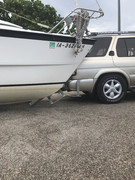
Re: The Macgregor bump
Posted: Sat May 06, 2023 2:53 pm
Bill,
Did a bit of rough estimating. I’m going to take some ketchup on my crow, please. Looks like the braking/bump loading on the shrouds could be almost double the load while sailing (wind pressure only). I didn’t bother trying to add shock loads due to chop to it, because the number of assumptions I’d have to make would reduce the estimate to a wild guess.
Based on what I could determine, maximum deceleration is going to be a smidge under 3 G. So, if your mast, Genoa furler, boom (if attached), main (if in a bag on the boom), etc, weighs in at 100 lbs; you’d be looking at 300 lbs while bumping. Should have checked the shroud loads, but ran out of curiosity for today.
There is one caveat, however. If the boat does not stop moving in the trailer before the vehicle and trailer come to a complete stop; that load - and more significantly the load at the v-block as the boat slams into it could be considerably higher.
I don’t think that will ever be the case if the boat only has to move inches; but hold my beer…
Did a bit of rough estimating. I’m going to take some ketchup on my crow, please. Looks like the braking/bump loading on the shrouds could be almost double the load while sailing (wind pressure only). I didn’t bother trying to add shock loads due to chop to it, because the number of assumptions I’d have to make would reduce the estimate to a wild guess.
Based on what I could determine, maximum deceleration is going to be a smidge under 3 G. So, if your mast, Genoa furler, boom (if attached), main (if in a bag on the boom), etc, weighs in at 100 lbs; you’d be looking at 300 lbs while bumping. Should have checked the shroud loads, but ran out of curiosity for today.
There is one caveat, however. If the boat does not stop moving in the trailer before the vehicle and trailer come to a complete stop; that load - and more significantly the load at the v-block as the boat slams into it could be considerably higher.
I don’t think that will ever be the case if the boat only has to move inches; but hold my beer…