Batteries and electrickery

A forum for discussing topics relating to MacGregor Powersailor Sailboats
User avatar
Sumner
Admiral
Posts: 2375
Joined: Sun Jan 04, 2009 3:20 pm
Sailboat: MacGregor 26S
Location: SE Utah
Contact:

Re: Batteries and electrickery

Post by Sumner »

RobertB wrote:....What is working well now is two house batteries side by side under the ladder (as installed by Mac Factory Sales) size 24 I believe.....
If you are replacing batteries and they fit use a Group 27 battery instead of a the Group 24 battery ....

GROUP NUMBER: 24
Trojan Battery #:T24-GEL (GEL)
DIMENSIONS IN INCHES*: 11.13" 6.60" 9.25" LxWxH
Amp Hours (AH): 80

27BCI GROUP NUMBER: 27
Trojan Batter #: T27-GEL (GEL)
DIMENSIONS IN INCHES*: 12.00" 6.63" 9.06" LxWxH
Amp Hours (AH): 90

..... Notice the the 27 is slightly longer but is 90 (AH) vs. 80 (AH) so two of them would give you 20 more AH capacity at 180 (AH) vs. 160 (AH). Also remember that even though they are called a deep cycle they are actually a hybrid between a true deep cycle and a start battery. A true deep cycle such as the 6 volt batteries used in golf carts have thicker plates and will last longer and not be damaged (longer life) by repetitive discharges like the marine 24 and 27 batteries.

If you are running two 12 volt batteries in parallel while in use and in charging they are going to have a longer battery life vs. using one and then the other since you won't draw them down as far which will increase their life and also they will recharge faster vs. charging one battery and then the other battery. If you have two 12 volt batteries and only use one but have them connected via a combiner you will keep them both charged but will keep pulling the house one down further as the other one isn't contributing to the house loads. If you have two house batteries and a start battery then for sure use the two house batteries in tandem to make the whole system more efficient. If you only have two batteries and no start battery then I'd just buy a small emergency start battery pack in case you somehow run the house batteries down to the point they wouldn't start the outboard.

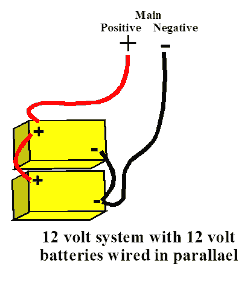
Also you can increase the efficiency of the two batteries in parallel if you wire them properly...

Image

The diagram above shows the most common way people wire them in parallel but is not the best way as electricity takes the path of least resistance and that could be through one battery or the other and not necessarily equally through both under discharge or while charging. Especially if they aren't exactly the same brand, group size or age. It is still way better though than using one battery at a time.

Image

... above you will notice that the positive wire attaches to the positive terminal of one battery and the negative wire attaches to the negative battery of the other battery and there are jumper wires between the positive and negative posts of both batteries. This ensures that current path is through both batteries.

You can't use a 1-2-Both-Off switch wired like above but you don't have to. Use the switch if you have also a start battery or just use the switch to turn the batteries off if needed. If you have that rare case happen where you actually have one battery catastrophically fail just remove either the positive or negative jumper going to it and you will be the other battery only.

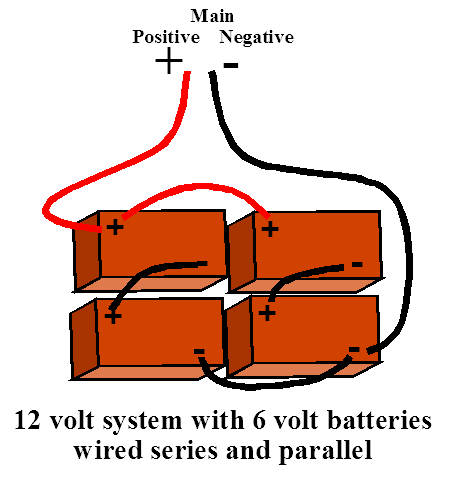
Now look what you can gain by going the 6 volt route with two 6 volt batteries wired in series to produce 12 volts.

6 Volt Deep Cycle Batteries by BCI Group Number

Trojan Battery #: T-105 (WET)
MK Battery #: 8GGC2 (GEL)
DIMENSIONS IN INCHES*: 10.38" 7.13" 10.88" LxWxH
Amp Hours (AH): 225

The T-105 is shorter than the 24 and 27 and slightly wider and taller but besides getting a battery that will last much longer under repetitive discharges the amp/hr capacity is 225 (AH) vs. the 27's 180 (AH). Since you need two 6 volt batteries for the 12 volts you have a combined AH of still 225. Still that is quite an increase vs. the group 27's and even more compared to the group 24's. I found T-105's new in Florida for about $95 each.

Don't worry about starting the outboard on T-105's as guys use those to start the diesel's in their sailboats all the time,

Sumner

============================
1300 miles to the Bahamas and back -- 2015

The MacGregor 26-S

The Endeavour 37

Trips to Utah, Idaho, Canada, Florida

Mac-Venture Links
User avatar
Mac26Mpaul
Admiral
Posts: 1066
Joined: Mon Jun 14, 2010 2:36 am
Sailboat: MacGregor 26M
Location: Gold Coast, Australia 26M "Little Annie" Etec 50

Re: Batteries and electrickery

Post by Mac26Mpaul »

Thanks again for the great responses!

Well I was leaning to AGM but then realized that not only are they a heap more expenive here, but I'd also have to go fork out more dollars for a new charger and am now thinking about just putting two DC batteries in parallel like I'v had it.

Someone recommended and swears by these:
http://www.supercharge.com.au/others/allrounder
2 of the 120ah in parallel, if they fit, would be good.

I have now pulled the boat in (its been on the hook for a month) and have had a bit of a look and noticed that the corrosion build up on my leads is pretty bad (poor maintenance), so I bought some stuff yesterday to clean all the leads, and I may just take the batteries out and put them through the Recon setting on my CTEK charger and see what happens. (fluid levels are fine by the way, in fact I topped them up with distilled water a month ago before we went out, and now this problem has developed ??).

I do seem to recall that I tested the cells with a hydrometer some time ago though, and all cells in both batteries showed 12.6 except for one cell which was considerably higher than the others for some reason. Maybe that has killed my batteries (??)
User avatar
Sumner
Admiral
Posts: 2375
Joined: Sun Jan 04, 2009 3:20 pm
Sailboat: MacGregor 26S
Location: SE Utah
Contact:

Re: Batteries and electrickery

Post by Sumner »

Mac26Mpaul wrote:....2 of the 120ah in parallel, if they fit, would be good....
Yep if they fit that might be a good deal if you didn't want to go down the two 6 volt battery road. Looks like they are about an inch (25 mm) longer than a group 27 battery. Looks like the 70 series are about the same size as a group 27 and would be 210 AH for two of them.

If you could get them at a good price I'd still go with two of the T-105's or the equivalent over there due to the fact they would last longer and and be more AH's vs. the 70 series. If compared to the V87 it might be a tossup. Longer lasting but less AH capacity. Cost might be the determining factor then,

Sumner

============================
1300 miles to the Bahamas and back -- 2015

The MacGregor 26-S

The Endeavour 37

Trips to Utah, Idaho, Canada, Florida

Mac-Venture Links
User avatar
RobertB
Admiral
Posts: 1863
Joined: Sun Jun 05, 2011 7:42 pm
Sailboat: MacGregor 26M
Location: Clarksville, MD

Re: Batteries and electrickery

Post by RobertB »

Highly recommend you avoid AGM unless you have a very good battery charger. These are great batteries but need special care.
User avatar
RobertB
Admiral
Posts: 1863
Joined: Sun Jun 05, 2011 7:42 pm
Sailboat: MacGregor 26M
Location: Clarksville, MD

Re: Batteries and electrickery

Post by RobertB »

Sumner wrote: Also you can increase the efficiency of the two batteries in parallel if you wire them properly...

Image

The diagram above shows the most common way people wire them in parallel but is not the best way as electricity takes the path of least resistance and that could be through one battery or the other and not necessarily equally through both under discharge or while charging. Especially if they aren't exactly the same brand, group size or age. It is still way better though than using one battery at a time.

Image

... above you will notice that the positive wire attaches to the positive terminal of one battery and the negative wire attaches to the negative battery of the other battery and there are jumper wires between the positive and negative posts of both batteries. This ensures that current path is through both batteries.
I usually agree with what you say but respectfully, the two diagrams above are electrically identical. The only difference is an issue of how the connections are made - the second does not require a separate terminal block and a fuse can be integrated easily into the terminal on only the battery closest to the load (fewer $$$).

And, I really forget if I have size 24 or 27 - it is whatever the boat came with.
User avatar
Mac26Mpaul
Admiral
Posts: 1066
Joined: Mon Jun 14, 2010 2:36 am
Sailboat: MacGregor 26M
Location: Gold Coast, Australia 26M "Little Annie" Etec 50

Re: Batteries and electrickery

Post by Mac26Mpaul »

Bit of an update.

My boat has been on the hook for a month and I haven't actually had a chance to look at it other than went out to move it to the lee of an island because a blow was coming, and found it wouldn't start. I had assumed solar was all good because the light was on (never assume).

I have pulled the boat in and had a chance to have a look this morning and sure enough, nothing coming out of my controller. Pulled it apart and yeah, corrosion,,, again......... Its only been six months since I killed the last one - starting to think it might not be a good idea to keep the controller in the battery compartment!

Still, my last trip was a 1.5hour motor trip and with the Etec charging at 25amps, I would have thought there would have been plenty of juice in the batteries ???
Could the corrosion be causing a short that would drain my batteries while it was sitting there for a few weeks??

Anyway, I'm going to charge the batteries up and see what happens. I will try and clean up this controller but will likely have to but another one.

Thanks for all the suggestions and the great thread which I have learnt from, and it will come in handy sooner or later for sure!

Cheers,
Paul :)
User avatar
Sumner
Admiral
Posts: 2375
Joined: Sun Jan 04, 2009 3:20 pm
Sailboat: MacGregor 26S
Location: SE Utah
Contact:

Re: Batteries and electrickery

Post by Sumner »

Sumner wrote: Also you can increase the efficiency of the two batteries in parallel if you wire them properly...

Image

The diagram above shows the most common way people wire them in parallel but is not the best way as electricity takes the path of least resistance and that could be through one battery or the other and not necessarily equally through both under discharge or while charging. Especially if they aren't exactly the same brand, group size or age. It is still way better though than using one battery at a time.

Image

... above you will notice that the positive wire attaches to the positive terminal of one battery and the negative wire attaches to the negative battery of the other battery and there are jumper wires between the positive and negative posts of both batteries. This ensures that current path is through both batteries.
RobertB wrote:I usually agree with what you say but respectfully, the two diagrams above are electrically identical. The only difference is an issue of how the connections are made - the second does not require a separate terminal block and a fuse can be integrated easily into the terminal on only the battery closest to the load (fewer $$$)...
I've seen numerous sources that say to hook the positive to one battery and the negative to the other if they are parallel for the best results...
Image

IMPORTANT: In parallel systems, always pull your main cables from opposite corners of the battery bank! (as in the above drawings)This way all the batteries are charged and discharged equally. Disappointing performance and premature battery failure await those that don't heed this simple rule.
http://www.solarray.com/TechGuides/WireDiagrams_T.php

...now saying that I didn't have mine wired like that originally and it worked but feel if you can wire like that you are doing everything you can to optimize your battery wiring,

Sumner

============================
1300 miles to the Bahamas and back -- 2015

The MacGregor 26-S

The Endeavour 37

Trips to Utah, Idaho, Canada, Florida

Mac-Venture Links
User avatar
DaveB
Admiral
Posts: 2543
Joined: Mon Jan 07, 2008 2:34 pm
Sailboat: MacGregor 26X
Location: Cape Coral, Florida,1997 Mac. X, 2013 Merc.50hp Big Foot, sold 9/10/15

Re: Batteries and electrickery

Post by DaveB »

Sumner, I installed twin Trojan Golf Cart Batteries on my 14 Ft Cargo Camper. These Batteries are much better than twin 29 group deep cycle batteries.
They can go down to 75% discharge with no harm were 12volt deepcycle max is 50 % discharge.
The 105 Trojan also has 450 amp hrs combine.
Cost is the same but the 105 Trojans are 63 lbs each.
I use them to power Refig. 63 quart top load frig. Edgestar, all dc lighting, 19 inch tv/disk, ice maker, water pump, and more.
I have a Powerhouse 2000 watt gen at 54 db sound to power AC and all others in the boonieys.
This can also work on a MacX as I have done.(AC 5000 btu in hatch 4amps Max.draw )

Dave
Sumner wrote:
Mac26Mpaul wrote:....2 of the 120ah in parallel, if they fit, would be good....
Yep if they fit that might be a good deal if you didn't want to go down the two 6 volt battery road. Looks like they are about an inch (25 mm) longer than a group 27 battery. Looks like the 70 series are about the same size as a group 27 and would be 210 AH for two of them.

If you could get them at a good price I'd still go with two of the T-105's or the equivalent over there due to the fact they would last longer and and be more AH's vs. the 70 series. If compared to the V87 it might be a tossup. Longer lasting but less AH capacity. Cost might be the determining factor then,

Sumner

============================
1300 miles to the Bahamas and back -- 2015

The MacGregor 26-S

The Endeavour 37

Trips to Utah, Idaho, Canada, Florida

Mac-Venture Links
User avatar
Sumner
Admiral
Posts: 2375
Joined: Sun Jan 04, 2009 3:20 pm
Sailboat: MacGregor 26S
Location: SE Utah
Contact:

Re: Batteries and electrickery

Post by Sumner »

DaveB wrote:Sumner, I installed twin Trojan Golf Cart Batteries on my 14 Ft Cargo Camper. These Batteries are much better than twin 29 group deep cycle batteries....
I agree :) .
DaveB wrote:....The 105 Trojan also has 450 amp hrs combine. ....
With the 6 volt batteries in series for 12 volts you can't combine the amp hours of both of them together. Two 105's in series are 225 amp hours. If you had them in parallel then you would have 450 AH but only 6 volts.

Ris will have 450 AH since he has two sets (4 batteries total) parallel to each other.

Image

He is wiring them like above for two 12 volt banks of 6 volt batteries

http://www.solarray.com/TechGuides/WireDiagrams_T.php

Sumner

============================
1300 miles to the Bahamas and back -- 2015

The MacGregor 26-S

The Endeavour 37

Trips to Utah, Idaho, Canada, Florida

Mac-Venture Links
Flightfollowing
Chief Steward
Posts: 97
Joined: Sun Aug 10, 2014 5:37 am
Sailboat: MacGregor 26X

Re: Batteries and electrickery

Post by Flightfollowing »

This may be somewhat of a stupid question, but I have not seen it mentioned much or at all in the forums. Can one simply run the engine for awhile to charge the batteries, instead of much larger and heavier battery banks or generators? I have a Suzuki 90hp which charges supposedly at 27 amps even at very low rpm, like 900 rpm and at that rpm my fuel transducer reports only 0.1 gal/hr fuel flow. So with a single 100 ah battery rated at 50% discharge I should be able to mostly recharge the battery in 2 hours of slightly fast idle using less than a liter of fuel. Combined with a low voltage cutoff to prevent excessive battery drain (and signal an engine run period to charge) and to always keep enough juice to start the engine, that set up should work theoretically well enough for most usage except A/C, with 50 amp/hr of storage to go through the night. Add a decent sized solar panel and decent shore power battery charger and cut down on required engine charging periods. What am I overlooking?
User avatar
Sumner
Admiral
Posts: 2375
Joined: Sun Jan 04, 2009 3:20 pm
Sailboat: MacGregor 26S
Location: SE Utah
Contact:

Re: Batteries and electrickery

Post by Sumner »

Flightfollowing wrote:This may be somewhat of a stupid question, but I have not seen it mentioned much or at all in the forums. Can one simply run the engine for awhile to charge the batteries, instead of much larger and heavier battery banks or generators? I have a Suzuki 90hp which charges supposedly at 27 amps even at very low rpm, like 900 rpm and at that rpm my fuel transducer reports only 0.1 gal/hr fuel flow. So with a single 100 ah battery rated at 50% discharge I should be able to mostly recharge the battery in 2 hours of slightly fast idle using less than a liter of fuel. Combined with a low voltage cutoff to prevent excessive battery drain (and signal an engine run period to charge) and to always keep enough juice to start the engine, that set up should work theoretically well enough for most usage except A/C, with 50 amp/hr of storage to go through the night. Add a decent sized solar panel and decent shore power battery charger and cut down on required engine charging periods. What am I overlooking?
A couple things come to mind.

One is that the outboard might need some of those 27 amps itself to run. The primary one is the battery's acceptance rate. You might be able to put out 25 amps but will the battery accept it? It might for a few minutes and then it will accept less and less at it becomes charged.

Image

Above you can see that at 50% discharge it might be able to accept almost the entire output but at 75% it is down to 10-15 amps and keeps dropping to the point where it takes a long time to get the last 25% in. That is where if you have a panel that can actually put out 6-10 amps ( a 100-150 watt panel in good sun) you could expect it to finish the charging over 3-5 hours depending on sun and panel angle to the sun and the type of charge controller you are using with the panel. Less if you were motoring.

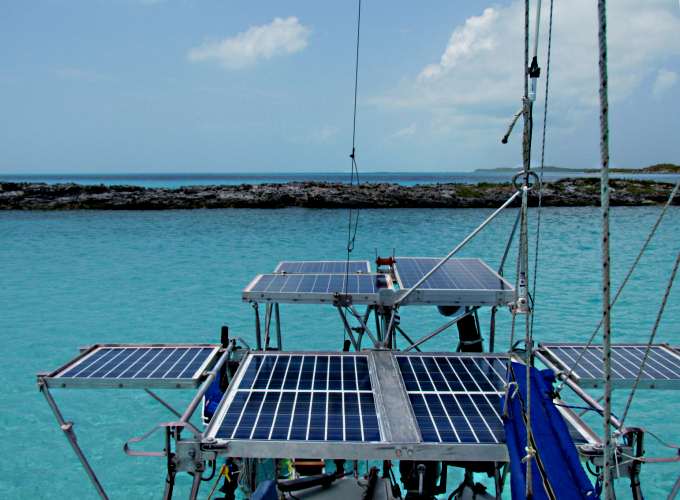
On my Bahama trip with 560 watts of ....

Image

.... solar available I never had to run the gen-set or the outboard (only 6 amp charging circuit) to keep the battery banks above 50% and I was on one anchorage where we had 3 days of cloudy weather. The trick was lots of panels and two banks of batteries with one bank being charged off of one set of panels and the other off of other panels with 120 watts of panels that could be switched from one bank to the other.

The reason for the two banks was one was the main house bank consisting of two T105's 6 volt in series and the other bank two Deka 12 volt batteries that were wired primarily in series for a 24 volt trolling motor but I could switch them into parallel as a second house bank which I did often. Using both I hardly ever ran one less than 75%. It was nice never having to run the outboard or...

Image

http://purplesagetradingpost.com/sumner ... de-13.html

...the gen-set to charge the batteries in 3 months and have the convenience of a large fridge and a lot of computer time.

When Ruth and I took the 7 week trip to Florida with 180 watts of solar at the time we ran the gen-set for probably 3-4 hours total on that trip. A couple times the batteries dropped a little below 50% (180 AH total capacity) and I ran the gen-set first thing in the morning to put a quick higher amp charge into them and then let the solar top them off. The gen-set has a 60 amp alternator on it but the most amps I ever saw going in was about 25 even when the batteries (2 of them) were drawn down to 50%, which matches up with that chart above. Then within about 20 minutes the charge rate would drop to about 12 amps going in (due to the battery's acceptance rate dropping) and I would turn the gen-set off.

So I think you could put in some of the charge with the outboard, but maybe not near as fast as you would like. Then with adequate panels could top off. If you go out for say 3-4 days at a time I'd think about 2 batteries where you might be in a loosing situation but would be home before you were dropping below 50%. For longer periods of travel the additional batteries will help get you by periods of bad sun days and also make the batteries last longer,

Sumner

============================
1300 miles to the Bahamas and back -- 2015

The MacGregor 26-S

The Endeavour 37

Trips to Utah, Idaho, Canada, Florida

Mac-Venture Links
User avatar
BOAT
Admiral
Posts: 4969
Joined: Fri Oct 19, 2012 5:12 pm
Sailboat: MacGregor 26M
Location: Oceanside, CA MACMJ213 2013 ETEC60

Re: Batteries and electrickery

Post by BOAT »

mastreb wrote:I do wish I could find a 12VDC induction cooktop because those are the most efficient and safest way to cook aboard a boat. I've gone over the circuit diagram for them and determined that the AC is rectified to DC before being re-inverted to high-speed AC to setup the induction field, so it should be possible to dig into one and convert it to 12VDC operation with just a 1:10 step-up transformer.
Yeah, I would be VERY interested in getting that too - I would like to have one in my van camper but I can't find one. Same deal in the motorhome - the inverters are a huge waste of energy and really not worth it - I installed one in the van 8 years ago and used it twice. On the boat if you are concerned about weight SKIP THE INVERTER because they are very heavy.

I do have two systems on 'boat', an AC system and a DC system each with thier own panel:

Image

AC is on the starboard side and it also has a dual battery charger that will charge the batteries when connected to shore power. I have AC outlets but also never use them. There is a breaker on the charger there on the AC panel.

DC is on the port side and that's where most of the work gets done.

I do have a separate DC panel under the dinette for the autopilot so the AP has it's own fuses and also so the autopilot will not get shut down just because the main DC panel blows. I sort of have the AP on a dedicated circuit and panel for my own reasons.

You probably could live forever without the AC stuff.
User avatar
RobertB
Admiral
Posts: 1863
Joined: Sun Jun 05, 2011 7:42 pm
Sailboat: MacGregor 26M
Location: Clarksville, MD

Re: Batteries and electrickery

Post by RobertB »

The main issue regarding using only the motor to charge your batteries is the length of time charging. There was an article a year or so ago, Practical Sailor I believe that discussed this. Batteries need to be completely charged often to maintain their capacity - that means a full charge and some additional time conditioning to get that last bit of charge in. Most boaters do not run the motors long enough to charge the batteries fully. The result is a gradual diminishing in the total capacity of the battery - sometimes pretty quick. I have had very good battery life since installing a good ProMariner charger and keeping the charger on year round in the driveway (except when on the water 8) )
User avatar
Russ
Admiral
Posts: 8314
Joined: Thu Oct 11, 2007 12:01 pm
Sailboat: MacGregor 26M
Location: Bozeman, Montana "Luna Azul" 2008 M 70hp Suzi

Re: Batteries and electrickery

Post by Russ »

It takes a long time to recharge batteries from the motor.
I have the Suzuki with the 27 amp alternator and what was said above it correct. 2 hours it won't charge your battery(s). As Sumner pointed out, it won't take 27 amps the full time. Charging amps drops way once the voltage increases.
I've seen the variable (adjustable) voltage regulators on some cruising boats that pump up the voltage so more amperage goes in. However, my guess is that it will shorten the life of the battery.
TANSTAFL You gotta feed the power back in over time.
Mastreb wrote:I do wish I could find a 12VDC induction cooktop because those are the most efficient and safest way to cook aboard a boat. I've gone over the circuit diagram for them and determined that the AC is rectified to DC before being re-inverted to high-speed AC to setup the induction field, so it should be possible to dig into one and convert it to 12VDC operation with just a 1:10 step-up transformer.
Induction is awesome. I've done a lot of research on these lately. We are considering installing an induction cooktop in our new house instead of gas. Safety, clean up and folks seem to like how fast they heat and boil. We bought a small one burner deal to play with and it works well.

The problem with electric heat is it still consumes a lot of electrons. Batteries simply don't hold that many. While a native 12v induction cooktop might be much more efficient than a 12v inverter going to 110, then to DC then back to AC, it still needs a lot of those electrons. How many watts is an induction cooktop? 1300w = 108 amps at 12v, no? I doubt you could cook for very long before draining your batteries.
My rule of thumb is anything running 12v that makes heat, will kill your batteries in no time.

--Russ
Post Reply