Okay, the mast is finally rigged!
Here's the dyneema dux stays and the carbon spreaders:
 image
image by
matthew_strebe, on Flickr
This is the dux stays at the chainplates:
 image
image by
matthew_strebe, on Flickr
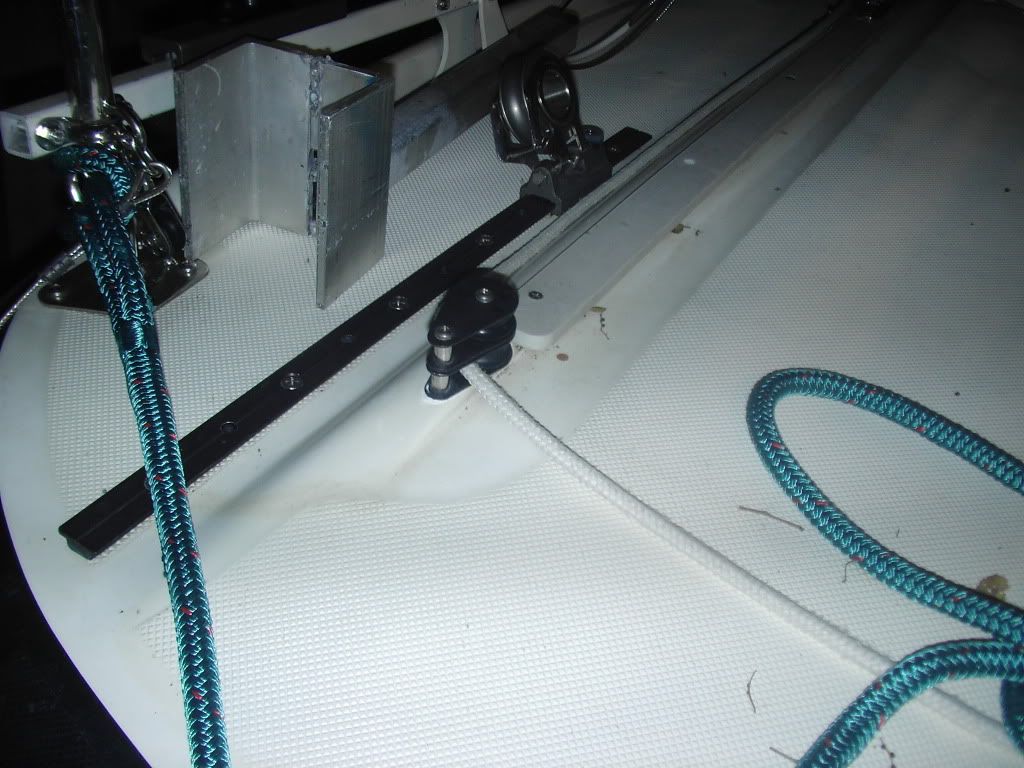
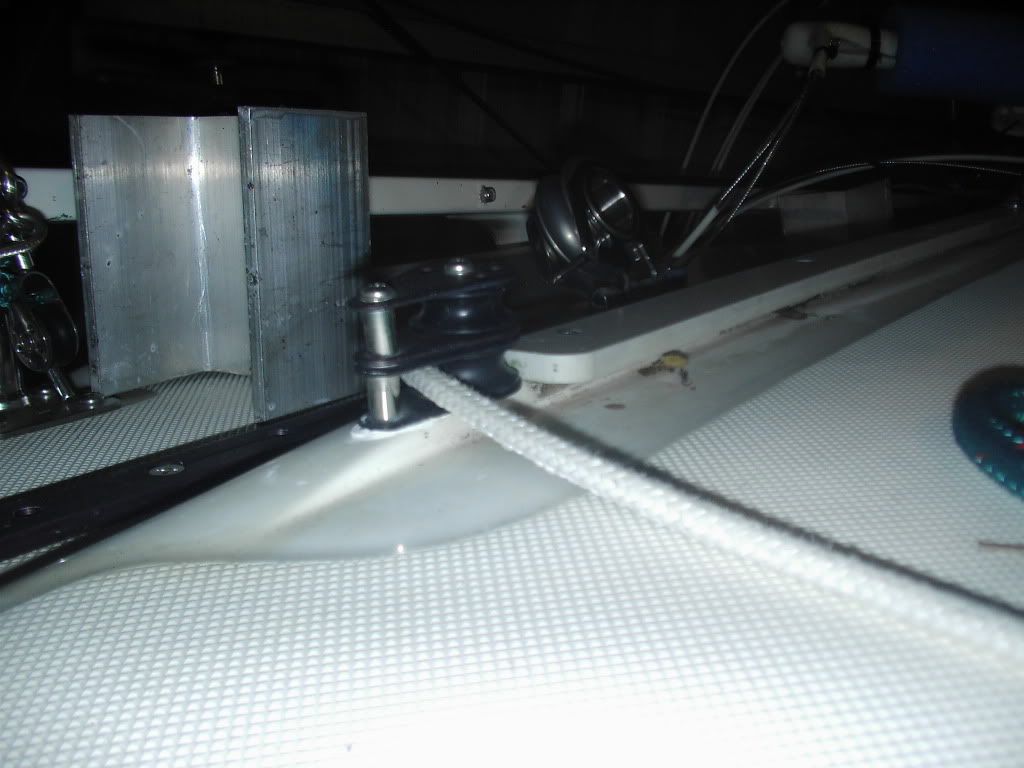
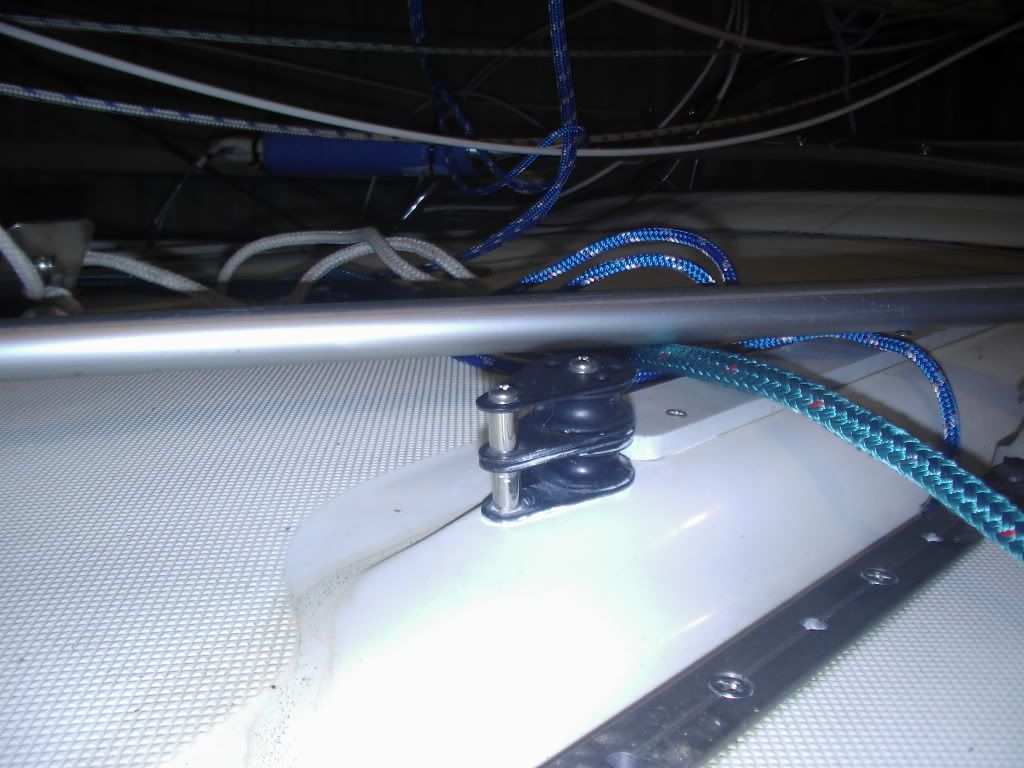
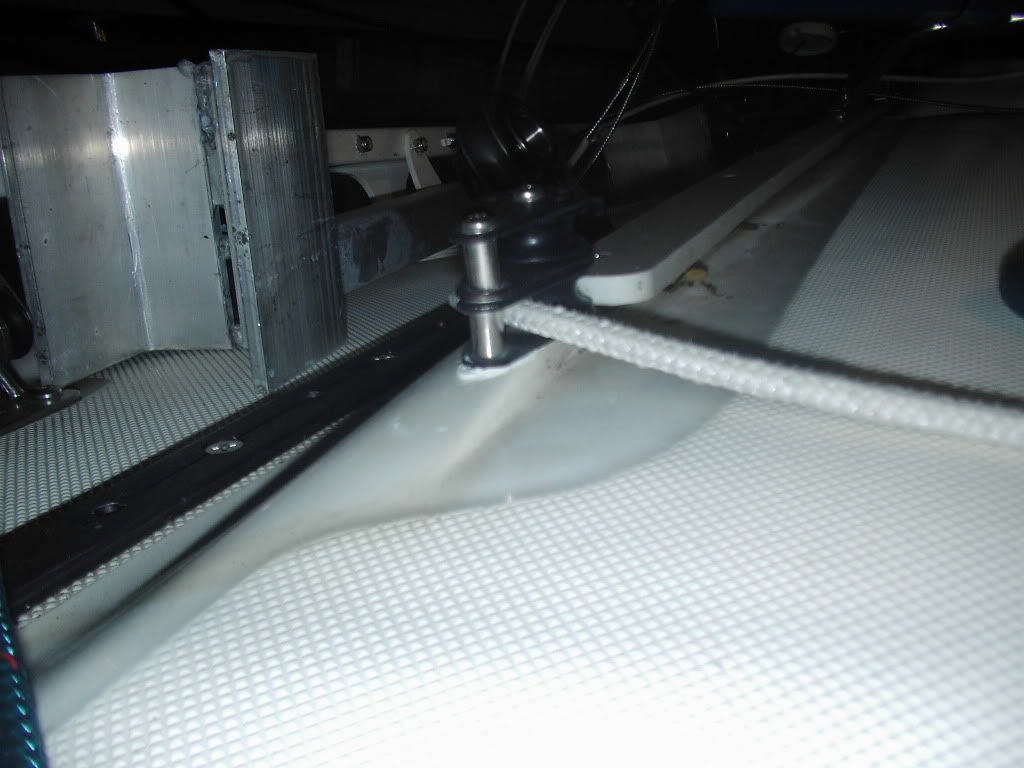
Here's detail of the mast track and gate:
 image
image by
matthew_strebe, on Flickr
We (the rigger and I) upgraded the forestay to 3/16ths because the side stays are now an additional 5000 lbs. breaking strength above stock and I wanted to ensure that the forestay would still be over the top of them in an accident (i.e. that the forestay still breaks last, not first). We swaged on a norseman swage-eye at the top rather than the factory loop. The rigger was not kind about the quality of the stock thimbled loops.
We went with 5mm dyneema vs. the "same strength" size which would have been 4mm so that I've got a extra UV penetration depth that can become UV corroded over time and still always remain above recommended breaking strength. These stays should have a lifetime of 20+ years and may last the life of the boat. They won't corrode or otherwise wear, and they lay like rope when the mast is down. Gone are the wire "hoops" when the mast is down (yay!)
Dyneema dux does have a creep issue which both JudyB and Cheryl from BWY pointed out to me. According to my rigger, he pretensioned the stays to 4000 lbs., which "sets" the weave and the splices. According to him I will only have creep problems if I coil the stays too tightly (tighter than a 2' spool) or bend the splices. If they creep, they will shorten, which will tension the rig a bit more, and if it becomes problematic I can re-set the stays them with my tow rig and a something fixed. They will not creep in such a way as to become looser under any circumstances, which is good. In any case, I will report on the performance of these dyneema dux stays over time.
The carbon spreaders are just stock tubes I ordered cut to length with matching inside and outside diameters as the aluminum tubes. Because they are the same size as the aluminum tubes, they're vastly stronger and will never bend. My experience with rig failures on these boats is that you actually want the mast to bend before anything else, because that way the rig remains under moderate tension. When spreaders bend, the rig flops around ominously and would be very unsafe in any kind of seas. Furthermore, under any kind of stress the mast is going to bend anyway, so it might as well be the only thing you need to replace.
Everything fit perfectly, and I just drilled holes for the spreader tips and the pins. The rigger opened up the spreader tips a bit and filed them rounded, and just used the stock ones with the dyneema.
Here's the parts we used:
Parts
110' 5mm Dux Dyneema @ $2.69. $295.00
8 thimbles. $68.00
4 1/4” Shackles. $64.00
30' 3/16” type 316 stainless steel 1 x 19 wire. $78.00
1 3/16” x 5/16” turnbuckle with swage stud. $42.00
1 3/16” x 5/16” Norseman eye. $41.50
Tef Gel, Sealant, rivets & Fasteners, tape, solvent, rags $65.00
Tax on Parts $52.28
Labor.
16 hours @ $65.00
The rigger didn't appreciate the fact that the factory did not isolate the aluminum mast from the stainless fittings, so he rebedded everything with Tef Gel and 4200 to isolate everything, so I shouldn't have the somewhat common failure of a mast breakage at the shroud hounds due to corrosion. Looking at the three years worth of corrosion on my old mast was worrisome.
Final build and test will likely be tomorrow when I hoist the sail and rig the new boom, which is also a stock carbon tube with a piece of mast track on it and a custom gooseneck I made which rides on a batt-car and will be down-tensioned with a vang.
Chris Chatterton of CC Rigging did the work; I wholeheartedly recommend him to anyone in the San Diego region who needs help with rigging. Very knowledgeable and had brings his whole shop with him in a Sprinter van. He did great work.
Matt


 they Gar . maybe able to sell them to u direct unless Tattoo has p/u the contract right !