Page 2 of 3
Re: Tiny bubbles
Posted: Wed Dec 12, 2012 9:37 am
by Highlander
Re: Tiny bubbles
Posted: Wed Dec 12, 2012 9:46 am
by Highlander
bscott wrote:Some elite small boat yacht racers (Neil Pryde) claim that VC-17 produces a painted surface simulating shark skin that reduces water stiction to a fiberglass hull.
Bob
I can tell u Geoff "Beene" has it on the Hull of his boat & it is super slipper dry or wet & man what a diff it made to his boat u really notice how fast his boat is in light to moderate winds he just flies but his boat is also loaded light !


J

Re: Tiny bubbles
Posted: Wed Dec 12, 2012 10:01 am
by voltzwgn
I saw a mythbusters episode where they dimpled a car similar to a golf ball and saw a dramatic increase in gas milage 15% - 20% if i remember correctly.
Re: Tiny bubbles
Posted: Wed Dec 12, 2012 10:49 am
by Crikey
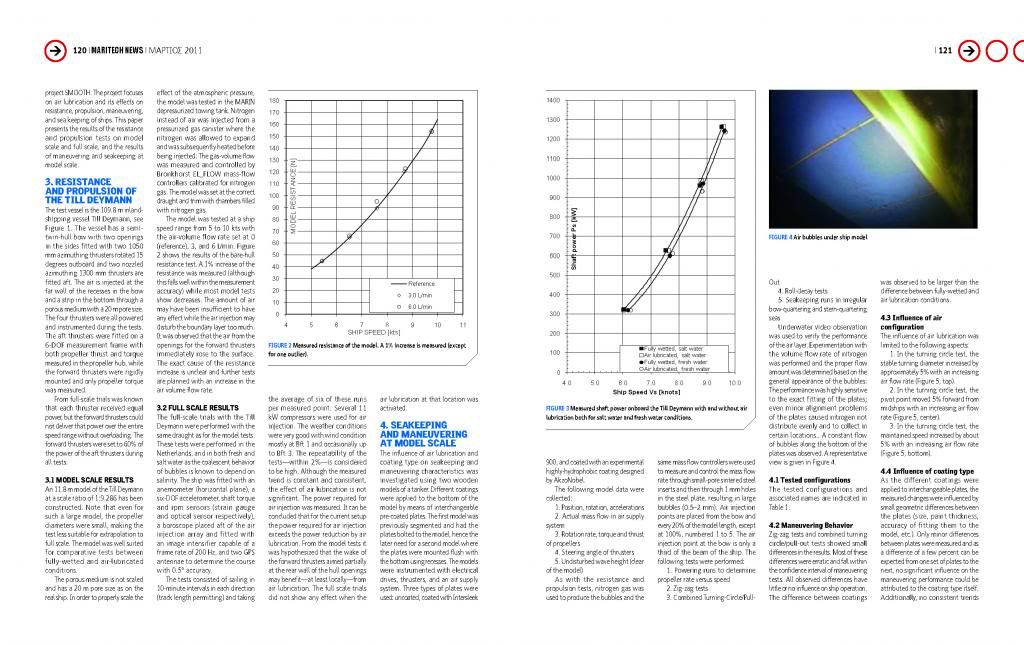
Brian, this was just one of the articles I read on a similarly titled Google search:
http://i1121.photobucket.com/albums/l52 ... Page_2.jpg
Ross
Re: Tiny bubbles
Posted: Wed Dec 12, 2012 10:53 am
by Crikey
OK, that ain't workin too well. Back shortly....

Re: Tiny bubbles
Posted: Wed Dec 12, 2012 11:18 am
by Crikey
This is the google search results page that I got my article from. Lots of other stuff there:
http://www.google.ca/#hl=en&tbo=d&outpu ... 72&bih=541
How do you make a pdf file available if it's illegal on Photobucket?
Re: Tiny bubbles
Posted: Wed Dec 12, 2012 11:54 am
by Crikey
Brian, I did initially visualize this as a power driven experience, and not from a heeled sailing perspective. If a rising bubble impinged on the hull wouldn't it increase the buoyancy instead? As with the fine ribbed coating, the bubble would be interfering with the standard boundary layer which normally imparts some friction to the hull.
There's got to be a lower resistance between air and water than water and water (that make sense?). As Kevin points out, a large infusion of air in the water will also quickly enable cavitation of the prop so even a small loss in efficiency might wipe out any gains in hull speed. If you did carry your own bubbler it could be confined to along the hull surface, and above the outboard cavitation plate as it exited.
Question is, like in the article, how much pressure would be required to blow out of the lower dagger-board slot at speed? Would any amount work - remembering we don't need a hovercraft here... This could be a great experiment for next spring. I'm thinking a leaf blower could give me proof of concept very simply, then go to electric.
If it even worked slightly while sailing, it would make for the perfect cheater switch - flame on! - "Honestly buddy, I had the engine up the whole time!"
R.
Re: Tiny bubbles
Posted: Wed Dec 12, 2012 12:05 pm
by Crikey
Highlander wrote:bscott wrote:Some elite small boat yacht racers (Neil Pryde) claim that VC-17 produces a painted surface simulating shark skin that reduces water stiction to a fiberglass hull.
Bob
I can tell u Geoff "Beene" has it on the Hull of his boat & it is super slipper dry or wet & man what a diff it made to his boat u really notice how fast his boat is in light to moderate winds he just flies but his boat is also loaded light !
J
The site mentioned it was an excellent Biocide, and contained teflon which resulted in lower water friction, and giving gains up to 1kt. I couldn't find any shark skin analogy. The denticle films have to be very precisely oriented otherwise it would increase the interface friction. I wonder if Teflon is hydrophobic?
I still like the Hot Tub idea. You could kill two birds with one stone!

R.
Re: Tiny bubbles
Posted: Wed Dec 12, 2012 4:00 pm
by DaveB
All I can say is we Mac's are a motorsailer. Not a high performance raceing boat.
That said lets keep to the Mac's as a Power Sailer and let the bubbles happen in the wine glass.
Nothing said reveals any greater speed for the long term.
Best move I made was new Sails that moves the Mac.X much closer to windward.
I also installed a new 50hp Merc. bigfoot refit over my Honda 50. Big improvements both power thrust and Amps for chargeing .
Dave
Re: Tiny bubbles
Posted: Wed Dec 12, 2012 8:40 pm
by seahouse
I see Ross. Yeah, the bubbles can't interfere with the prop, which is what I meant above when I said...
That air-entrained water also causes loss of your prop efficiency. (it’s less dense, and “pre-cavitated”).
So the trail could be split to allow unbubbled water around the prop, such as the example of following a twin-screw boat, one stream on each side of the prop.
You'd need to contain and direct the bubbles somehow too. Blow the leafblower through the daggerboard trunk, but use a skirt, then you'll have a hovercraft. The skirt was the breakthrough discovery that made the hovercraft feasibly stable. 8
-B.
Re: Tiny bubbles
Posted: Wed Dec 12, 2012 8:53 pm
by bscott
Crikey wrote:Highlander wrote:bscott wrote:Some elite small boat yacht racers (Neil Pryde) claim that VC-17 produces a painted surface simulating shark skin that reduces water stiction to a fiberglass hull.
Bob
I can tell u Geoff "Beene" has it on the Hull of his boat & it is super slipper dry or wet & man what a diff it made to his boat u really notice how fast his boat is in light to moderate winds he just flies but his boat is also loaded light !
J
The site mentioned it was an excellent Biocide, and contained teflon which resulted in lower water friction, and giving gains up to 1kt. I couldn't find any shark skin analogy. The denticle films have to be very precisely oriented otherwise it would increase the interface friction. I wonder if Teflon is hydrophobic?
I still like the Hot Tub idea. You could kill two birds with one stone!
R.
If you look at the VC-17 with a magnifying glass you can see a shark skin like texture-this is not an OEM claim, it is an observation from pro sailors.
Bob
Re: Tiny bubbles
Posted: Wed Dec 12, 2012 8:59 pm
by seahouse
Here’s a link to Beneteau’s product…
http://www.youtube.com/watch?v=czWAr0EfGus
This "Air Step" system is reported by journalists to be as effective as claimed, and not marketing hype.
Also, I’m waiting for a naval application to the (fairly recent) discovery that water is repelled by magnetic fields. Both ends of a magnet, the north and south ends, repel the water molecules. So far they’ve just used it to levitate things (live frogs, insects) against gravity. Showoffs.
You can see for yourself that the meniscus of water moves in a petri dish when you pass a neodymium (take it out of an old hard drive for free

) magnet near it.
-B.
Re: Tiny bubbles
Posted: Wed Dec 12, 2012 9:11 pm
by seahouse
I used Teflon on a shape-memory polymer project I worked on for Ontario Hydro a few years back (it was actually a test substrate to reduce ice accretion on high-tension hydro lines), and I can confirm that Teflon is very hydrophobic. The texture of its surface finish enhances the property.
- Brian.
Re: Tiny bubbles
Posted: Thu Dec 13, 2012 8:12 am
by Crikey
seahouse wrote:Here’s a link to Beneteau’s product…
http://www.youtube.com/watch?v=czWAr0EfGus
This "Air Step" system is reported by journalists to be as effective as claimed, and not marketing hype.
Also, I’m waiting for a naval application to the (fairly recent) discovery that water is repelled by magnetic fields. Both ends of a magnet, the north and south ends, repel the water molecules. So far they’ve just used it to levitate things (live frogs, insects) against gravity. Showoffs.
You can see for yourself that the meniscus of water moves in a petri dish when you pass a neodymium (take it out of an old hard drive for free
) magnet near it.
-B.
Diamagnetic water - that was interesting! I think you'd need to carry more than a leaf blower to power that...

Frikken laser beams!
I had spotted the Beneteau's site earlier. Big heavy monsters! At least it's proof of concept that you could turn off or on. Keeping the prop clean must definitely be an issue. I would guess the large amount of air they're using to pressurize the step would wash over everything during a hard turn, or slow speed.
Can you elaborate further on the surface texture of the teflon - pictures?
I sympathize with Dave's point of view somewhat, and I do go 'Walter Mitty' from time to time, but it seems like it would be cheap, and fun to do, as an experiment. I'd also like to follow up further with the VC 17 texture as most of the bubble literature seems to deal with both coatings
and bubbles combined. However, I can't see how any macroscopic orientation would be achieved with a dried paint unless brushing direction provided the results.
(The skirt was the breakthrough discovery that made the hovercraft feasibly stable.)
I thought the skirt was the invention of a need for horizontal movement using lots of hot air!
Re: Tiny bubbles
Posted: Thu Dec 13, 2012 6:27 pm
by Crikey