Page 2 of 2
Re: Floating VHF Radio Saves The Day!
Posted: Mon Aug 15, 2011 6:54 pm
by davidbourne
restless wrote:
Moral of the story. Back rail sticks have some serious advatages.
Make sure you do not scrimp on your cable. A £300 radio ain't worth a bolt with lossy wires.
Make sure you solder all connections, and do your best to keep that salty stuff out too. It can really mess with copper.
That makes a lot of sense. Signal strength trumps antennae height. Thanks!
Best,
David
Re: Floating VHF Radio Saves The Day!
Posted: Mon Aug 15, 2011 7:02 pm
by c130king
I have my 4' "Digital Antenna" mounted on my mast arch...
 2009 Installation of new electronics
However, running the cable was not "easy" and now it doesn't work very well. I had to splice some more cable in and I suspect I have a bad splice.
Cheers,
Jim
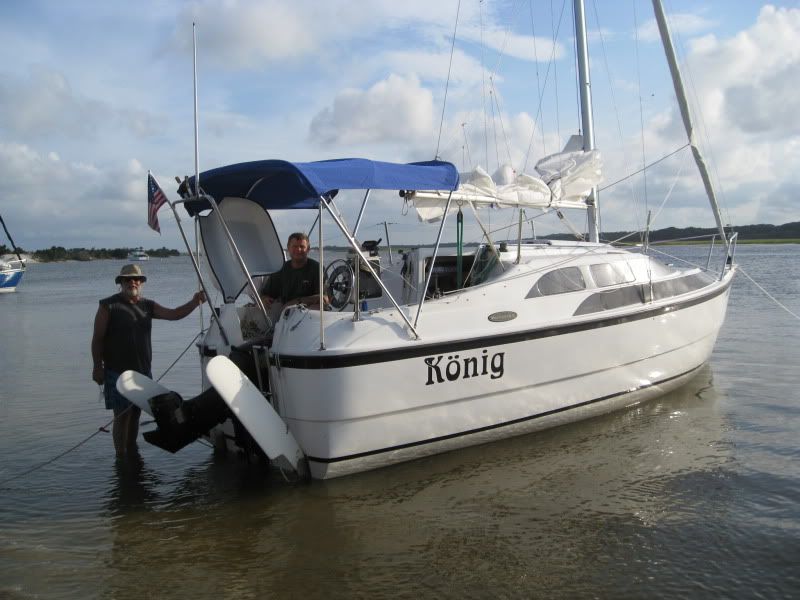
Sailing on König
Sailing on König YouTube Channel
Re: Floating VHF Radio Saves The Day!
Posted: Mon Aug 15, 2011 7:34 pm
by mastreb
My bad--meant DSC, typed AIS
Re: Floating VHF Radio Saves The Day!
Posted: Mon Aug 15, 2011 8:05 pm
by mastreb
Back rail will always beat mast top for one simple reason: Cable losses. A typical antenna coax will lose 80% of it's signal strength per 100' run. Going off the back rail is at most a 20' run, whereas going up the mast is at least 40'. The 20' run loses half the power as the 40' run. Cable length is a much bigger factor than antenna height off the deck with VHF in the 155MHz range of the marine channels. VHF curves with the ionosphere and thermal ducts (marine layer) that are common on the ocean surface. That's why they chose that band for marine comms.
Rule of thumb: Every 3db gained or lost is twice or half the power.
Height of an antenna doesn't begin to dominate until you're well into the UHF range above 600MHz and it's not critical until you're well into microwave ranges above 1.2GHz.
The other major factor with external antennas especially with handhelds is the length of the antenna itself. A 2 meter dipole antenna is theoretically perfect for omnidirectional VHF at 155MHz, and a one meter whip is the next best. The small handhelds have to use impedance matching in their smaller antennas that cost power which results in much lower gain and thus lower range.
I'm not about to put a monster 2m antenna on the back of my boat even though it's gain is double that of a 3', but a 3' whip is a good choice for a Mac IMHO. Go for thicker coax, either RG-213 or RG-8. RG-58 loses considerably more signal. For reasons Jim points out above, try to buy the cable to-length and pre-terminated. Crimping Coax sucks and you'll probably never use the crimper again.
Keep in mind though: Your floating handheld isn't going to float if it's tethered to your external antenna

Re: Floating VHF Radio Saves The Day!
Posted: Mon Aug 15, 2011 8:48 pm
by Russ
mastreb wrote:Back rail will always beat mast top for one simple reason: Cable losses. A typical antenna coax will lose 80% of it's signal strength per 100' run. Going off the back rail is at most a 20' run, whereas going up the mast is at least 40'. The 20' run loses half the power as the 40' run. Cable length is a much bigger factor than antenna height off the deck with VHF in the 155MHz range of the marine channels.
All I know is the powerboaters were always envious of my mast mounted antenna. Quality coax and connectors are a must. I could hear stations a whole lot farther away then they could. If I were at the bottom of a swell, I'd want something sticking up high.
Now if my mast came off, then I'd be clinging to that hand held.