

Has anyone made these mods on an "S" (or something similar)? I know that the valve is different on an "S", and there would be no need to be without ballast under normal circumstances, but I suspect it would still be nice to not have to fool around with the vent, and to be able to rig up a ballast pump/air system for pre-dumping the ballast before hauling the boat onto the trailer, releasing from a sandbar, etc.
By the way, Divecoz, what do you have the washdown pump plumbed into? How do you get to the water in the ballast tank? Did you make an additional penetration in the ballast tank wall?
Electric Vent?
-
Rick Westlake

- Captain
- Posts: 778
- Joined: Wed Aug 22, 2007 4:05 pm
- Sailboat: MacGregor 26X
- Location: Casa Rio Marina, Mayo, MD; MacGregor 26X, "Bossa Nova" - Bristol 29.9 "Halcyon"
- Contact:
Re: Electric Vent?
I have used a low-pressure inflator pump to pump out the ballast on Beija-Flor, my oldRussMT wrote:How long does it take for the "wash down" pump to evacuate the ballast? My wash down pump doesn't seem to have a lot of volume. But I guess if you are on a sandbar, time isn't an issue.
Still, I think blowing it out with air would be faster. I have an air pump but haven't tested the theory.
 - it works pretty well.
-
ALX357

- Admiral
- Posts: 1231
- Joined: Thu Jul 22, 2004 6:09 am
- Location: Nashville TN -- 2000 MacGregor 26X, Mercury two-stroke 50hp
Re: Electric Vent?
To my thinking, it would be impossible to evacuate the tank thru the gate valve to a safe empty point by air pressure. As soon as the water level was down to the height of the gate valve, the air would escape over the top of the water at the valve, or fart intermittently and to great aggravation. The remaining ballast water would be left at an unsafe partial level. In an emergency, you could put a bilge pump hose down the ballast vent, with no further modification except to having a longer hose to reach the bottom of the tank from the vent hole access, and a hose out the fore-hatch for the output.
-
vizwhiz
- Admiral
- Posts: 1388
- Joined: Mon Aug 23, 2010 9:48 pm
- Sailboat: MacGregor 26S
- Location: Central Florida
Re: Electric Vent?
This would definitely be true...unless the boat were pointed nose-up (especially due to change in ballast) in which case the valve would tend to stay covered until most of the water was out or the boat was level (kinda like you tilt a cooler to get the water to go out the little plug)...for example, having several large people in the back of the boat in conjunction with ballast loss could cause the boat to tilt nose-up pretty significantly.ALX357 wrote:it would be impossible to evacuate the tank thru the gate valve to a safe empty point by air pressure. As soon as the water level was down to the height of the gate valve, the air would escape over the top of the water at the valve, or fart intermittently and to great aggravation
-
c130king

- Admiral
- Posts: 2730
- Joined: Sun Nov 05, 2006 5:30 pm
- Sailboat: MacGregor 26M
- Location: Wiggins, MS --- '05 26M "König" w/ 40hp Merc
- Contact:
Re: Electric Vent?
Could you drop a "Beano" down the vent hole to stop this...ALX357 wrote: ...or fart intermittently and to great aggravation...

No matter how old you are Fart and Potty Jokes will always be funny...
Cheers,
Jim
Sailing on König
Sailing on König YouTube Channel
-
ALX357
- Admiral
- Posts: 1231
- Joined: Thu Jul 22, 2004 6:09 am
- Location: Nashville TN -- 2000 MacGregor 26X, Mercury two-stroke 50hp
Re: Electric Vent?
If two work for you, at maybe a liter of "gas", then the air in a half-empty Mac tank would take ..... 1247 ? Beanos.
Closed tank, professional sailor, do not try this at home.
Closed tank, professional sailor, do not try this at home.
-
ALX357
- Admiral
- Posts: 1231
- Joined: Thu Jul 22, 2004 6:09 am
- Location: Nashville TN -- 2000 MacGregor 26X, Mercury two-stroke 50hp
Re: Electric Vent?
Partial ballast will not in itself push the stern down but if the gate valve is being pushed downward by having all the people in the back, then it will be somewhat under water.
How much air pressure, and for how long, is needed to compress the air in the tank to force all 160 gallons of the ballast water out under the surface of water outside ?
How much air pressure, and for how long, is needed to compress the air in the tank to force all 160 gallons of the ballast water out under the surface of water outside ?
-
Retcoastie
- Captain
- Posts: 673
- Joined: Sat Sep 16, 2006 7:00 am
- Sailboat: MacGregor 26X
- Location: Gray Hawk, Kentucky 2002 X "Last Flight"
Re: Electric Vent?
When I have used air to empty the ballast, I only open the drain valve about 1/8 to 1/4 inch. A completely open drain valve would leave about two inches of water in the tank when the air came bubbling out. That could be enough to be dangerous. Just opening the valve a hair only leaves about 1/4 inch of water in the tank before the air escapes, which I think is okay.
Remember, this technique is only used when you are aground or getting ready to load onto the trailer. If you were going to go at high speed the remaining water could be dumped or for more sailing the ballast could be refilled.
Ken
Remember, this technique is only used when you are aground or getting ready to load onto the trailer. If you were going to go at high speed the remaining water could be dumped or for more sailing the ballast could be refilled.
Ken
-
vizwhiz
- Admiral
- Posts: 1388
- Joined: Mon Aug 23, 2010 9:48 pm
- Sailboat: MacGregor 26S
- Location: Central Florida
Re: Electric Vent?
Retcoastie wrote:I only open the drain valve about 1/8 to 1/4 inch
First, opening the drain valve only a little bit - great idea, and solves the issue. Good tip Ret!ALX357 wrote:How much air pressure, and for how long, is needed
Second, you need very little pressure, only a fraction of one PSI, which is why an air-mattress-blower will work just fine. You measure pressure based on the depth of the water (not volume of the water), and 1.0 PSI equals 2.31 FEET of water (or slightly less in salt water)...this means it takes a depth of 2.31 feet under water to equal 1.0 PSI pressure from the water. Considering the difference between the water surface in the ballast tanks and the water surface the boat is riding in are maybe...6-8 inches...maybe one foot at the most?...different at any time, and you have less than one-half of one PSI (0.5 psi or less). Further reducing this is the fact that the boat will continue to rise as ballast is drained, partially reducing that difference in depth as the ballast is forced out. Point is, not much pressure at all...you could do it with your mouth/lungs if you had a hose (and a lot of hot air!).
Oh, and it DOES matter which side of the boat your henweigh is on when you're doing this...(I overlook such important stuff!)
-
Divecoz

- Admiral
- Posts: 3803
- Joined: Sat Oct 16, 2004 2:54 pm
- Sailboat: MacGregor 26M
- Location: PORT CHARLOTTE FLORIDA 05 M Mercury 50 H.P. Big Foot Bill at Boats 4 Sail is my Hero
Re: Electric Vent?
HUMMMM I Never thought about that.... it makes sense.. I Think??Retcoastie wrote:When I have used air to empty the ballast, I only open the drain valve about 1/8 to 1/4 inch. A completely open drain valve would leave about two inches of water in the tank when the air came bubbling out. That could be enough to be dangerous. Just opening the valve a hair only leaves about 1/4 inch of water in the tank before the air escapes, which I think is okay.
Remember, this technique is only used when you are aground or getting ready to load onto the trailer. If you were going to go at high speed the remaining water could be dumped or for more sailing the ballast could be refilled.
Ken
-
K9Kampers
- Admiral
- Posts: 2441
- Joined: Thu Apr 13, 2006 7:32 am
- Sailboat: MacGregor 26X
- Location: NH, former 26X owner
Re: Electric Vent?
Sounds plausible, except for this part:
The water ballast taken on does not add any weight to the boat to cause it to sit lower in the water. The water ballast is the same bouyancy and level as the water outside the boat, hence it has a neutral effect, when the boat is floating level.
Now, if you used henwieghs as a ballast medium instead...
vizwhiz wrote:...Further reducing this is the fact that the boat will continue to rise as ballast is drained, partially reducing that difference in depth as the ballast is forced out....
The water ballast taken on does not add any weight to the boat to cause it to sit lower in the water. The water ballast is the same bouyancy and level as the water outside the boat, hence it has a neutral effect, when the boat is floating level.
Now, if you used henwieghs as a ballast medium instead...
-
hoaglandr

- Engineer
- Posts: 155
- Joined: Sat Aug 21, 2010 8:23 am
- Sailboat: MacGregor 26M
- Location: Springfield, Ohio - 2005 M: LazyDayz - Yamaha T50
Re: Electric Vent?
Not sure I agree with that.
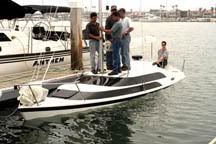
Russell
As you can see in this famous photo - adding water to the boat does make it ride lower in the water!K9Kampers wrote: The water ballast taken on does not add any weight to the boat to cause it to sit lower in the water. The water ballast is the same bouyancy and level as the water outside the boat, hence it has a neutral effect, when the boat is floating level.
Russell
-
K9Kampers
- Admiral
- Posts: 2441
- Joined: Thu Apr 13, 2006 7:32 am
- Sailboat: MacGregor 26X
- Location: NH, former 26X owner
Re: Electric Vent?
Russell,
There is a diffence between filling a below-the-waterline ballast tank, and filling an above-the-waterline-hull. But then, you already know that!
There is a diffence between filling a below-the-waterline ballast tank, and filling an above-the-waterline-hull. But then, you already know that!
-
Jim Bunnell

- First Officer
- Posts: 278
- Joined: Fri Jan 02, 2004 8:13 am
- Sailboat: MacGregor 26M
- Location: Southfield, MI; Tohatsu TLDI 50, '03 26M hull # MACM 0019 C303
Re: Electric Vent?
Seems to me the ballast only adds weight as righting movement as it is lifted above the waterline when the boat heels. Opening the ballast tank and letting it fill does, however, reduce total buoyancy since there is less air contained below the waterline which in turn causes the boat to float lower in the water. (Try using your inflatable dingy without filling the air chambers for an illustration of the principle)
-
K9Kampers
- Admiral
- Posts: 2441
- Joined: Thu Apr 13, 2006 7:32 am
- Sailboat: MacGregor 26X
- Location: NH, former 26X owner
Re: Electric Vent?
Yes, the ballast only adds weight to effect the righting moment while heeling. But an empty, vent-closed ballast tank offers no more flotation than an empty, vent-open ballast tank, the boat doesn't float higher in the water. Replacing the air with water, below the waterline doesn't make the boat sit any lower in the water because the ballast is the same density as the surrounding water. No positive nor negative bouyancy is achieved.
If I throw my uninflated dinghy in the water, it would float to the degree of the bouyancy of the material & residual air in the chambers - be they open or closed. If I now board the dinghy, it will surely sink below the surface, as my body weight being the ballast, is denser than the surrounding water.
Try this example...
I just did this in my sink with a waterbottle. Empty bottle with & without cap floats the same level in the dirty water. Dirty water scumline indicates waterline. Draw marker at scumline to illustrate waterline. Fill bottle to with water to drawn waterline, then cap. Ballasted vessel (bottle) floats at same waterline as it did with air only, with & without cap. Observed conclusion: vessel floatation doesn't change with or without ballast.
Bad example...(Try using your inflatable dingy without filling the air chambers for an illustration of the principle)
If I throw my uninflated dinghy in the water, it would float to the degree of the bouyancy of the material & residual air in the chambers - be they open or closed. If I now board the dinghy, it will surely sink below the surface, as my body weight being the ballast, is denser than the surrounding water.
Try this example...
I just did this in my sink with a waterbottle. Empty bottle with & without cap floats the same level in the dirty water. Dirty water scumline indicates waterline. Draw marker at scumline to illustrate waterline. Fill bottle to with water to drawn waterline, then cap. Ballasted vessel (bottle) floats at same waterline as it did with air only, with & without cap. Observed conclusion: vessel floatation doesn't change with or without ballast.