

I know many folks have done the addition of a second axel to our Mac trailers. The other day I decided to take the plunge and do it, as I need to start towing over small hills and long distances (the Suzuki dealer is 70 miles one way). I tow with a smaller truck (Mazda b 4000) so I am hoping for a better towing experience!
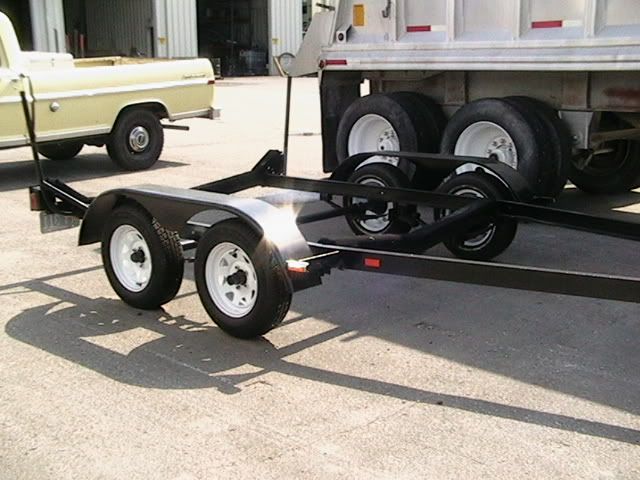
In order to do dual axels I found on champion trailers web site a bolt on kit; it looked good so I ordered it. At the same time I ordered a new second axel (the kit comes with one) I think the good thing about a bolt on kit is, I can easily move the axels to insure that they are in the best place, it comes with all galvanized parts, and the new fenders bolt to the kit also. I also ordered the tires to match the existing tires and rims. And while I was at it I decided to do the whole trailer! So I ordered the kit for disc brakes (both axels) and new bunk carpet, new wench with strap. All in total I am 2k into this. I will post my thoughts on this project when I get it done. Now is prep time, striping the trailer of old parts and rust and getting ready for painting and new parts (3 weeks for the new parts) Also at the end of this I will have many parts that someone could use to do the weld on axel project for vary little cost so I will post that list and the pictures when I am done.
I do have one question, what is everyone using to stop the rust and for paint to keep it from coming back? (I cant find what Chip said works for him)
As a foot note my boat is a 2002, and all the bolts that hold the bunks to the trailer were so rotten that they broke right off! If you use your trailer in salt water I would recommend that you change them now. I am going with new treated wood and stainless hardware!
Champion trailer dual axel bolt on
-
Rich Walton

- Chief Steward
- Posts: 79
- Joined: Mon Jan 05, 2004 1:05 pm
- Location: Dana Point CA. 2002 X 75hp E-Tec

-
sailfish02
- Chief Steward
- Posts: 64
- Joined: Sat Apr 22, 2006 7:55 am
- Location: Salt Lake City
Dual Axle
I am considering adding a second axle and I've read Chip's mod. As Chip is an engineer, I assume that moving the original axle would be necessary. Chip moved the original forward 9 inches, but is it possible to attach a second axle w/o moving the original? I measured and it appears there is room.
Chip? would you change anything on your trailer mod?
My tires rub the hull as the single axle flexes. The trailer doesn't follow well and I get a lot of fishtailing at higher speeds. I don't even load that heavy except for twelve gallons of fuel
The tandem seems like the solution
Chip? would you change anything on your trailer mod?
My tires rub the hull as the single axle flexes. The trailer doesn't follow well and I get a lot of fishtailing at higher speeds. I don't even load that heavy except for twelve gallons of fuel
The tandem seems like the solution
-
sailfish02
- Chief Steward
- Posts: 64
- Joined: Sat Apr 22, 2006 7:55 am
- Location: Salt Lake City
Second Axle
Did you have a trailer shop do it or did you do it yourself. Chip recommended welding instead of clamping.....I guess that's what you did. What did you pay for the job? Thanks Scott
-
Chip Hindes

- Admiral
- Posts: 2166
- Joined: Mon Jan 05, 2004 6:13 am
- Location: West Sand Lake, NY '01X, "Nextboat" 50HP Tohatsu
Sailfish:
It sounds like the problems you describe are symtoms of too little tongue weight and possible overloading as well. You can measure it to find out for sure. You should aim for 10% of the total towed load including trailer, which for most Mac owners puts it fairly close to 400 lbs, even moderately loaded. My own measurement before the mod put the tongue weight on my trailer at just over 200 lbs, simply inadequate for safe, worry free towing.
I'm a little surprised at your report of the tires hitting the boat; though there was ample evidence on mine of the tires hitting the undersides of the fenders, I didn't see that they had ever hit the boat. However, you're not the first person who has reported such.
You might find that moving your 12 gallons of fuel to the tow vehicle for towing (assuming your tankage is removable) or leaving the tankage empty is the difference between a slightly squirelly and a truly hair raising towing experience. It was for me with my 2 x 8 gal tanks.
You can just leave the axle where it is and add a second tandem axle behind it, but I don't recommend it. I did the numbers and for my trailer that would have jumped the tongue weight from just over 200 to 520 lbs. That will overload the hitch and rear axle of nearly any moderately sized tow vehicle; It certainly would have exceeded the 400 lb. capacity of my (at that time) Explorer. That being said, I know there are several who have done this.
The good news is, once you've decided on the tandem axle it costs almost nothing additional to move the existing axle forward, so there's no reason not to do it. You'll need all new spring brackets anyway except for the fronts on the existing axle, and based on the costs at Champion, not buying new fronts saves you a whopping $2.95 x 2, plus welding (but since you'll be welding the others anyway, that savings has to be pretty close to zero).
If you're going to spring (no pun intended) for a second axle, IMO you forfeit about half the benefit if you don't add brakes to the new axle. If you stick with standard drum brakes it costs about $220 extra compared to non braking "idler" hubs, including a second flush kit (you already have one of those, don't you? ) You can bend a few curves into the the old brake line and use it for the forward axle as is, then tee off for the second axle. I elected to go all the way with disc brakes upgrades to all four wheels; that costs about another $250 compared to the drums but the maintenace savings is (or should be at least) tremendous.
If you make the decision to stick with only two brakes, you should extend the brake line to the rear axle regardless of its location; if you only have one set of brakes it should be on the rear.
In hindsight, if I had it to do now I might spring the extra $$ for the vented rotor disc brakes instead of the stainless ones. From Champion that comes to only about $50 more for all four wheels; when I did mine Champion didn't offer them, the difference was closer to $200 and I didn't consider it.
I had some problems with the brakes which were fairly well documented on earlier posts, though they could not be attributed to stainless versus cast iron. There is of course also always the question about cast iron and salt water which I can't pretend to answer. Tie Down makes both and they say the cast iron works OK.
I would be remiss in not pointing out that a tandem axle isn't the only possible answer to inadequate load capacity and tongue weight. A few on this board have instead successfully moved up to larger capacity axle, wheels and tires and simply mounted the axle further aft to correct the tongue weight problem. This benefits have been argued pretty much ad nauseum, so I won't go into it other than delivering my own frequently voiced opinion: one bigger axle is OK; two axles are better.
It sounds like the problems you describe are symtoms of too little tongue weight and possible overloading as well. You can measure it to find out for sure. You should aim for 10% of the total towed load including trailer, which for most Mac owners puts it fairly close to 400 lbs, even moderately loaded. My own measurement before the mod put the tongue weight on my trailer at just over 200 lbs, simply inadequate for safe, worry free towing.
I'm a little surprised at your report of the tires hitting the boat; though there was ample evidence on mine of the tires hitting the undersides of the fenders, I didn't see that they had ever hit the boat. However, you're not the first person who has reported such.
You might find that moving your 12 gallons of fuel to the tow vehicle for towing (assuming your tankage is removable) or leaving the tankage empty is the difference between a slightly squirelly and a truly hair raising towing experience. It was for me with my 2 x 8 gal tanks.
You can just leave the axle where it is and add a second tandem axle behind it, but I don't recommend it. I did the numbers and for my trailer that would have jumped the tongue weight from just over 200 to 520 lbs. That will overload the hitch and rear axle of nearly any moderately sized tow vehicle; It certainly would have exceeded the 400 lb. capacity of my (at that time) Explorer. That being said, I know there are several who have done this.
The good news is, once you've decided on the tandem axle it costs almost nothing additional to move the existing axle forward, so there's no reason not to do it. You'll need all new spring brackets anyway except for the fronts on the existing axle, and based on the costs at Champion, not buying new fronts saves you a whopping $2.95 x 2, plus welding (but since you'll be welding the others anyway, that savings has to be pretty close to zero).
If you're going to spring (no pun intended) for a second axle, IMO you forfeit about half the benefit if you don't add brakes to the new axle. If you stick with standard drum brakes it costs about $220 extra compared to non braking "idler" hubs, including a second flush kit (you already have one of those, don't you?
) You can bend a few curves into the the old brake line and use it for the forward axle as is, then tee off for the second axle. I elected to go all the way with disc brakes upgrades to all four wheels; that costs about another $250 compared to the drums but the maintenace savings is (or should be at least) tremendous. If you make the decision to stick with only two brakes, you should extend the brake line to the rear axle regardless of its location; if you only have one set of brakes it should be on the rear.
In hindsight, if I had it to do now I might spring the extra $$ for the vented rotor disc brakes instead of the stainless ones. From Champion that comes to only about $50 more for all four wheels; when I did mine Champion didn't offer them, the difference was closer to $200 and I didn't consider it.
I had some problems with the brakes which were fairly well documented on earlier posts, though they could not be attributed to stainless versus cast iron. There is of course also always the question about cast iron and salt water which I can't pretend to answer. Tie Down makes both and they say the cast iron works OK.
I would be remiss in not pointing out that a tandem axle isn't the only possible answer to inadequate load capacity and tongue weight. A few on this board have instead successfully moved up to larger capacity axle, wheels and tires and simply mounted the axle further aft to correct the tongue weight problem. This benefits have been argued pretty much ad nauseum, so I won't go into it other than delivering my own frequently voiced opinion: one bigger axle is OK; two axles are better.
-
Frank C
Sailfish,
You may also want to check into the Kodiak vented rotor disks. I feel that cast iron is the best braking material, with the Silver cadmium coating (@ $126 per side), but I upgraded to 100% stainless calipers for only another 30 bucks. All of the "expendable" parts for Kodiak brakes are stock items from any local GM dealer, and candidly, they have a better rep than Tiedown's products. And now - hope you don't mind a brief, and related, vector to your thread.
I'm investigating a move of my single axle aft by 8 inches, to correctly balance the boat for tongue wt. Since this means welding new axle mounts (at the least) I'm also considering a change to a galvanized torsion axle.
I consider my welder as a real pro ... actually a muffler guy in a dying biz. He also does general welding, including some pretty major mods to boat trailers. One thing that he seems pretty intent on, he wants to weld a short section (~3 feet?) of box-steel into the factory's stock rail channel. I guess that's quicker than "boxing" the existing rail. I can't pin-down any reason not to do it, except that a box can contain (& retain) salt water. He's a bit critical of our light-weight rails, and suggests that the box will better support the axle and provide more meat for fender mounting.
Opinions?
You may also want to check into the Kodiak vented rotor disks. I feel that cast iron is the best braking material, with the Silver cadmium coating (@ $126 per side), but I upgraded to 100% stainless calipers for only another 30 bucks. All of the "expendable" parts for Kodiak brakes are stock items from any local GM dealer, and candidly, they have a better rep than Tiedown's products. And now - hope you don't mind a brief, and related, vector to your thread.
I'm investigating a move of my single axle aft by 8 inches, to correctly balance the boat for tongue wt. Since this means welding new axle mounts (at the least) I'm also considering a change to a galvanized torsion axle.
I consider my welder as a real pro ... actually a muffler guy in a dying biz. He also does general welding, including some pretty major mods to boat trailers. One thing that he seems pretty intent on, he wants to weld a short section (~3 feet?) of box-steel into the factory's stock rail channel. I guess that's quicker than "boxing" the existing rail. I can't pin-down any reason not to do it, except that a box can contain (& retain) salt water. He's a bit critical of our light-weight rails, and suggests that the box will better support the axle and provide more meat for fender mounting.
Opinions?
-
Hamin' X

- Site Admin
- Posts: 3464
- Joined: Sat Aug 27, 2005 6:02 pm
- Sailboat: MacGregor 26X
- Location: Hermiston, OR-----------2001 26X DF-50 Suz---------------(Now Sold)
- Contact:
I agree with your welder, that boxing the rail would be best. Torsion axles put a tremendous twisting moment on one spot of the frame, unlike the leaf spring axle, which spreads the load. He should be able to leave the box open on the ends, for drainage. Another concern might be, that the axle itself would trap seawater Make sure that their are drainage holes on the lower side of the axle tube. I have torsion axles on one of my horse trailers and will check tomorrow to see if there are drain holes in them.
Rich
Rich
-
sailfish02
- Chief Steward
- Posts: 64
- Joined: Sat Apr 22, 2006 7:55 am
- Location: Salt Lake City
Tandem Axles
Thanks a million, you guys (Chip and Frank)....I am continually impressed with the people on this site. The absence of tongue weight is definitely my problem, and I have already tried adding forward weight, which I don't want to do anymore. I don't load the boat with much save the fuel and some ice and beer. I want things to work well and I'll pay for it if I have to.
As I said earlier, I have a Merc 50 four stroke, with two 12 gal tanks aft and I don't really want to heft them around any more that necessary. I'm not an expert in these matters and that's why I trust the engineers. I have pulled a few trailers over the years, though, and I don't know if a 500 lb tongue weight is a lot or not. I have pulled 4 horse trailers with a lot of weight. I tow with a 3/4 ton Dodge Turbo diesel, but I want the boat trailer to work for others on a resale consideration.
I'm not doing the work myself, and I was going to ask the trailer guys, that build them, what they think. I'm not sure that I can trust them as I don't know any of them personally. I want a balanced load......maybe just a little heavy forward. What I do want, though, is to cruise at 75 with a safe, tracking, trailer that I hardly notice is back there.
What about the guys that didn't move their existing axle? The bending axle is the only thing that I can figure is causing the tire rub. I have a friend that has bent two axles on a boat trailer and the tires were tipped in at the top. They are very close on my Mac trailer as it is.
Again........thanks a lot, gentlemen......any more input would be appreciated.
As I said earlier, I have a Merc 50 four stroke, with two 12 gal tanks aft and I don't really want to heft them around any more that necessary. I'm not an expert in these matters and that's why I trust the engineers. I have pulled a few trailers over the years, though, and I don't know if a 500 lb tongue weight is a lot or not. I have pulled 4 horse trailers with a lot of weight. I tow with a 3/4 ton Dodge Turbo diesel, but I want the boat trailer to work for others on a resale consideration.
I'm not doing the work myself, and I was going to ask the trailer guys, that build them, what they think. I'm not sure that I can trust them as I don't know any of them personally. I want a balanced load......maybe just a little heavy forward. What I do want, though, is to cruise at 75 with a safe, tracking, trailer that I hardly notice is back there.
What about the guys that didn't move their existing axle? The bending axle is the only thing that I can figure is causing the tire rub. I have a friend that has bent two axles on a boat trailer and the tires were tipped in at the top. They are very close on my Mac trailer as it is.
Again........thanks a lot, gentlemen......any more input would be appreciated.
-
Frank C
Hamin X,
Thanks, that makes a lot of sense. If I move on this, I think I'll even extend the box longer, based upon the twisting you mentioned. This axle is made by UFP. The guy tells me they're used on most of the big cigarette boat trailers, which need a better ride. The axle is galv and the inner suspension cartridge is fully rubberized. Sounds right about the drainage, I'll ask for that during fabrication.
Sailfish,
If your trailer is wagging a 3/4-ton Dodge, your trailer balance must be wacky. My 1/2-ton GMC has no problem with a too-light tongue, even though my outboard weighs an extra hundred pounds more than the Bigfoot. However, of my four 6-gal tanks, I try to be sure there's only one full. What about leveling? Is the trailer rail horizontal, or is it rising to the hitch ball? You might need a deeper receiver drop.
Regarding 75 mph to Lake Mead ... that's very fast for towing a trailer hundreds of miles. The tires are your weakest link, and there's no way I'd trust the factory setup for that kind of towing duty. IMO, you are definitely a candidate for the tandem rig, probably w/four tires @ 205-14s. If a single axle, you'd need a 5,000# axle, six-lugs, 12" brakes, plus the full-monty 15" tires rated at 2,500 each.
Thanks, that makes a lot of sense. If I move on this, I think I'll even extend the box longer, based upon the twisting you mentioned. This axle is made by UFP. The guy tells me they're used on most of the big cigarette boat trailers, which need a better ride. The axle is galv and the inner suspension cartridge is fully rubberized. Sounds right about the drainage, I'll ask for that during fabrication.
Sailfish,
If your trailer is wagging a 3/4-ton Dodge, your trailer balance must be wacky. My 1/2-ton GMC has no problem with a too-light tongue, even though my outboard weighs an extra hundred pounds more than the Bigfoot. However, of my four 6-gal tanks, I try to be sure there's only one full. What about leveling? Is the trailer rail horizontal, or is it rising to the hitch ball? You might need a deeper receiver drop.
Regarding 75 mph to Lake Mead ... that's very fast for towing a trailer hundreds of miles. The tires are your weakest link, and there's no way I'd trust the factory setup for that kind of towing duty. IMO, you are definitely a candidate for the tandem rig, probably w/four tires @ 205-14s. If a single axle, you'd need a 5,000# axle, six-lugs, 12" brakes, plus the full-monty 15" tires rated at 2,500 each.
-
Chip Hindes
- Admiral
- Posts: 2166
- Joined: Mon Jan 05, 2004 6:13 am
- Location: West Sand Lake, NY '01X, "Nextboat" 50HP Tohatsu
Frank:
Your welder is right and Hamin couldn't have said it better. A torsion axle on an unreinforced Mac frame would be a recipe for disaster IMO. Where are the proposed boxes going? Under, over or beside (inside or outside) the existing frame rails.
Box rails could be closed at the ends as long as they are completely closed, no penetrations. In the long run that would probably be better than open for drainage. That's the way the box tube axles are on both the original Mac and the galvanized second axle I got from Champion. You have to make sure you don't defeat the feature by drilling through for attachments, like wiring, brake line clamps, fender brackets, etcetera. All these need to be welded or clamped on.
I'm curious though what you think you're going to gain with the torsion setup. I understand the rationale on torsion axles for a completely independent suspension, a la Airstream, or for cigarette boat trailers over 10,000 lbs tow weight, many of which have three axles, but for a single solid axle it seems to me the answer to a question that nobody asked.
It also seems to me as if it's going to be quite expensive; more than (say) a complete tandem setup with four wheel disc brakes, yadda yadda. Silk purse/sow's ear, etc.
Your welder is right and Hamin couldn't have said it better. A torsion axle on an unreinforced Mac frame would be a recipe for disaster IMO. Where are the proposed boxes going? Under, over or beside (inside or outside) the existing frame rails.
Box rails could be closed at the ends as long as they are completely closed, no penetrations. In the long run that would probably be better than open for drainage. That's the way the box tube axles are on both the original Mac and the galvanized second axle I got from Champion. You have to make sure you don't defeat the feature by drilling through for attachments, like wiring, brake line clamps, fender brackets, etcetera. All these need to be welded or clamped on.
I'm curious though what you think you're going to gain with the torsion setup. I understand the rationale on torsion axles for a completely independent suspension, a la Airstream, or for cigarette boat trailers over 10,000 lbs tow weight, many of which have three axles, but for a single solid axle it seems to me the answer to a question that nobody asked.
It also seems to me as if it's going to be quite expensive; more than (say) a complete tandem setup with four wheel disc brakes, yadda yadda. Silk purse/sow's ear, etc.
-
sailfish02
- Chief Steward
- Posts: 64
- Joined: Sat Apr 22, 2006 7:55 am
- Location: Salt Lake City
Tandem
Frank.........The boat doesn't wag my Dodge/the boat just wags back and forth behind the Dodge. I pull a 28 ft Airsteam with tandem and I don't even know it's back there at 75-80 mph. I have tried 3 different drop hitches to increase some tongue weight, and it helped a little. Yes, I am a candidate for tandem axles. It sounds like your motor is heavier than mine. Have you ever seen those guys going down the road pulling a 26 ft camper with a light suv, and they have an outrigger on the back of the trailer with an atv on it? That's what my outfit feels like.
I just need to get the job done. I did think it would be necessary to move the existing axle, but I guess I might as well do that if the balance would be better.
I just need to get the job done. I did think it would be necessary to move the existing axle, but I guess I might as well do that if the balance would be better.
-
Frank C