


This has probably been discussed before - but, anyway - has anybody made their spreaders detachable ?? I was thinking of using clevis pins to hold them in place when being used - would they be "strong" enough?
It seems to me that if they were detachable the storage and transportation of the mast 'system' would be a lot easier and 'look' a little nicer ?!
Detachable Spreaders ??
-
baldbaby2000

- Admiral
- Posts: 1382
- Joined: Sun Mar 28, 2004 8:41 am
- Location: Rapid City, SD, 2005 26M, 40hp Tohatsu
- Contact:
Sometimes I remove the bolts and take the spreaders off. I think on the M they're more of a hassle because they're swept back and so are lower to the deck and hit the stanchions when moving the mast forward. On my Mac 25 I had a quick disconnect pin the same diameter as the bolt was. Whatever you use, make sure it's strong enough and won't come out or you might end up with a broken mast.
BB
BB
-
Sloop John B

- Captain
- Posts: 871
- Joined: Sat Jan 03, 2004 2:45 am
- Sailboat: MacGregor 26X
- Location: Florida 'Big Bend'. 02x Yamaha T50
Yeah, man.
You don't want those spreaders sticking out there when you're flying down the road. Looks like an old fashioned TV antenna.
I take the time to unbolt the buggers and hide them in the cab of the tow vehicle. Nobody suspects a thing.
I tried the clevis pin route earlier but found that this made the speaders too wobbly. Having to detach the ends of the spreaders from the shrouds is time consuming, but entirely worth while in order to look sharp. It's worth it, even if you're just five miles from the launch site.
Anyway, dennis, go ahead and stay with the cap screws and nuts and forget about the clevis pins until something better comes on the scene.
You don't want those spreaders sticking out there when you're flying down the road. Looks like an old fashioned TV antenna.
I take the time to unbolt the buggers and hide them in the cab of the tow vehicle. Nobody suspects a thing.
I tried the clevis pin route earlier but found that this made the speaders too wobbly. Having to detach the ends of the spreaders from the shrouds is time consuming, but entirely worth while in order to look sharp. It's worth it, even if you're just five miles from the launch site.
Anyway, dennis, go ahead and stay with the cap screws and nuts and forget about the clevis pins until something better comes on the scene.
-
waternwaves
- Admiral
- Posts: 1499
- Joined: Wed Oct 13, 2004 8:18 pm
- Location: X less in North Puget Sound -have to sail other boats for a while
I have bought similar sized stainless fittings to try .............
Something better is screw in spreaders.......
However, the through bolts cannot take the torque of cinching down tight ....
But it is a good solid connection......
(Maybe I should find a different threading than NPT), And it still takes a couple of wrenches to adjust........
Something better is screw in spreaders.......
However, the through bolts cannot take the torque of cinching down tight ....
But it is a good solid connection......
(Maybe I should find a different threading than NPT), And it still takes a couple of wrenches to adjust........
-
ALX357

- Admiral
- Posts: 1231
- Joined: Thu Jul 22, 2004 6:09 am
- Location: Nashville TN -- 2000 MacGregor 26X, Mercury two-stroke 50hp
well, i think this is a satisfactory solution to the spreader dilemma when lowering the mast....
have bought stainless solid quick-pins 1/4" and long enough to pass a heavy-duty ring-ding thru the end-hole, to pin the spreaders and easily remove them just before they reach the life-lines.... (had only to drill the spreader holes a bit larger to take the smooth pins...)
btw, i also suggest using a jam-cleatable block on the mast raising pole... three blocks at each end and the jam-cleat makes the mast lowering and raising easy to do by hand, with the ability to stop the mast at any point and adjust things .... could use the same block and tackle as the boom-vang, but make sure its long enough... lots of extra turns...
one caveat is to remember which halyards and stays (furler ! ) are above or in front of the spreaders when re-rigging...
anyway, i store the spreaders against the mast to keep down the deck tripping and protect them from damage when trailerinig....
making then routinely removable also allows regular inspection of their ends' condition.....
have bought stainless solid quick-pins 1/4" and long enough to pass a heavy-duty ring-ding thru the end-hole, to pin the spreaders and easily remove them just before they reach the life-lines.... (had only to drill the spreader holes a bit larger to take the smooth pins...)
btw, i also suggest using a jam-cleatable block on the mast raising pole... three blocks at each end and the jam-cleat makes the mast lowering and raising easy to do by hand, with the ability to stop the mast at any point and adjust things .... could use the same block and tackle as the boom-vang, but make sure its long enough... lots of extra turns...
one caveat is to remember which halyards and stays (furler ! ) are above or in front of the spreaders when re-rigging...
anyway, i store the spreaders against the mast to keep down the deck tripping and protect them from damage when trailerinig....
making then routinely removable also allows regular inspection of their ends' condition.....
-
Sloop John B
- Captain
- Posts: 871
- Joined: Sat Jan 03, 2004 2:45 am
- Sailboat: MacGregor 26X
- Location: Florida 'Big Bend'. 02x Yamaha T50
Gees,
If you're trying to get out of the Texas two step getting the mast back under the lifelines, put a couple pelican hooks up front and detach them. Drop your lifelines below the spreaders.
I push the mast 'straight' back, pirouette to face the bow and clutch the spar in my cheeks while I insert a quarter inch SS pin, lock it with a bowtie cotter pin, and up she goes.
If you're trying to get out of the Texas two step getting the mast back under the lifelines, put a couple pelican hooks up front and detach them. Drop your lifelines below the spreaders.
I push the mast 'straight' back, pirouette to face the bow and clutch the spar in my cheeks while I insert a quarter inch SS pin, lock it with a bowtie cotter pin, and up she goes.
-
Duane Dunn, Allegro

- Admiral
- Posts: 2459
- Joined: Fri Jan 02, 2004 6:41 pm
- Sailboat: MacGregor 26X
- Location: Bellevue, Wa '96 26x, Tohatsu 90 TLDI and Plug In Hybrid Electric drive
- Contact:
I agree with Sloop, it's far easier to slack the lifelines. I replaced the ring ding shackles at the mid pulpit with a pair of same size key pin shackles. This makes it super easy to slack the forward lines. Much easier than the old pelican hooks at the bow pulpit method. The lines can't dangle overboard this way and releasing them so they slide up to the stauchion gives exactly the right amount of slack to allow the mast to be rolled forward and placed in the bow position directly without any worry about the spreaders and the lifelines.
This summer we had the mast off the boat for an extended period of time. To store it I took off the lifelines. Even with the bolts at the mast removed, I could not remove the spreaders from the sockets. I had to also remove the end caps holding the stays. I'd be leary of doing this often, Those aluminum endcaps are too easy to strip.
This summer we had the mast off the boat for an extended period of time. To store it I took off the lifelines. Even with the bolts at the mast removed, I could not remove the spreaders from the sockets. I had to also remove the end caps holding the stays. I'd be leary of doing this often, Those aluminum endcaps are too easy to strip.
-
ALX357
- Admiral
- Posts: 1231
- Joined: Thu Jul 22, 2004 6:09 am
- Location: Nashville TN -- 2000 MacGregor 26X, Mercury two-stroke 50hp
different experiences....
my spreaders can be removed easily from the mast fitting, no problem, ( of course after the bolts are taken out .) It is a Stainless Steel mast fitting, and maybe that is why..... the older fittings may have been aluminum and grabby on the spreaders......
even with the lifelines slack, the spreaders are a trip hazard, and the lifelines are no longer functional.
Leave the lifelines tight, and stow the spreaders safely against the mast. Remember to do this before unstepping the mast, OR after stepping it, depending on whether you are lowering the mast or raising it.
IF you are using the Mac as a motor boat with the mast down, you will be glad the spreaders are not in the way and the lifelines are there to do the job they were designed to.... whether anchoring, or just moving about the boat's topside. On windless, or cold days when sailing might not appeal to the trailor-slipped Mac, it's a snap to launch and go with the mast down if everything is "seaworthy"
other things to consider....
PVC 3" post with saddle of sliced T fitting, to stabilize mast, put it into the mast step on the deck, just the right size to hold the mast from bouncing up and down in the middle, and provides a much better hand-hold ; stable railing for moving forward over the deck
also, full set of four PVC furler holders, they snap onto the mast, and cradle the furler with sail, keeping it centered, balanced, and out of the way, while minimizing ( virtually eliminates ) the kinking that usually happens to the plastic foil when it flops around and is bent all over the place. A really straight furler makes attaching the fore-stay much easier.
The PVC pipes furler racks collection can be stored on the boat in the aft-berth, or left in/on the tow vehicle or trailer when not being used.
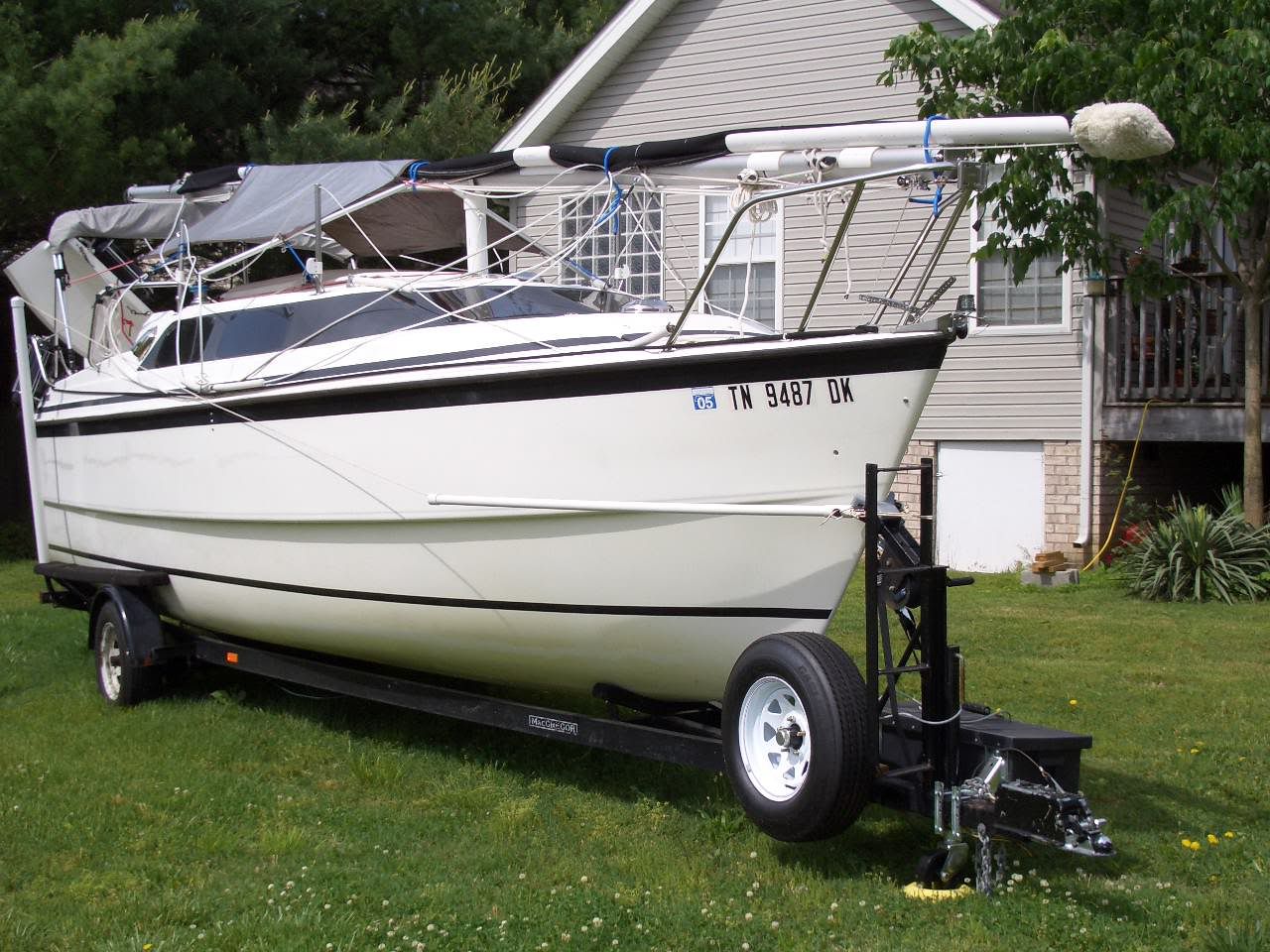
The following photo shows the furler racks, and the mast "stovepipe" support, but not yet the stowed spreaders, ....notice the slack useless lifelines. The tarp over the mast is of course not left on while motoring or towing.
my spreaders can be removed easily from the mast fitting, no problem, ( of course after the bolts are taken out .) It is a Stainless Steel mast fitting, and maybe that is why..... the older fittings may have been aluminum and grabby on the spreaders......
even with the lifelines slack, the spreaders are a trip hazard, and the lifelines are no longer functional.
Leave the lifelines tight, and stow the spreaders safely against the mast. Remember to do this before unstepping the mast, OR after stepping it, depending on whether you are lowering the mast or raising it.
IF you are using the Mac as a motor boat with the mast down, you will be glad the spreaders are not in the way and the lifelines are there to do the job they were designed to.... whether anchoring, or just moving about the boat's topside. On windless, or cold days when sailing might not appeal to the trailor-slipped Mac, it's a snap to launch and go with the mast down if everything is "seaworthy"
other things to consider....
PVC 3" post with saddle of sliced T fitting, to stabilize mast, put it into the mast step on the deck, just the right size to hold the mast from bouncing up and down in the middle, and provides a much better hand-hold ; stable railing for moving forward over the deck
also, full set of four PVC furler holders, they snap onto the mast, and cradle the furler with sail, keeping it centered, balanced, and out of the way, while minimizing ( virtually eliminates ) the kinking that usually happens to the plastic foil when it flops around and is bent all over the place. A really straight furler makes attaching the fore-stay much easier.
The PVC pipes furler racks collection can be stored on the boat in the aft-berth, or left in/on the tow vehicle or trailer when not being used.
The following photo shows the furler racks, and the mast "stovepipe" support, but not yet the stowed spreaders, ....notice the slack useless lifelines. The tarp over the mast is of course not left on while motoring or towing.
-
Catigale

- Site Admin
- Posts: 10421
- Joined: Fri Jun 11, 2004 5:59 pm
- Sailboat: MacGregor 26X
- Location: Admiral .............Catigale 2002X.......Lots of Harpoon Hobie 16 Skiffs....Island 17
- Contact:
ON the Texas two step
I found this to be really easy once I learned to always get the mast on the outboard side of the spreader you are clearing...this prevents you from falling off the boat.
Also, two sailties up at the spreaders and midway down the mast stop the furler from falling off the mast and eliminate torque on the mast while you are stepping it.
Remember to take them off before raising.
I keep the furler drum wrapped in an old towel for trailering and leave that on while stepping so that the hardware doesnt scratch the deck.
I usually step the mast singlehanded, without raising gear. I have used the jib halyard as a mast raiser successfully.
I found this to be really easy once I learned to always get the mast on the outboard side of the spreader you are clearing...this prevents you from falling off the boat.
Also, two sailties up at the spreaders and midway down the mast stop the furler from falling off the mast and eliminate torque on the mast while you are stepping it.
Remember to take them off before raising.
I keep the furler drum wrapped in an old towel for trailering and leave that on while stepping so that the hardware doesnt scratch the deck.
I usually step the mast singlehanded, without raising gear. I have used the jib halyard as a mast raiser successfully.
-
LOUIS B HOLUB
- Admiral
- Posts: 1315
- Joined: Wed Oct 19, 2005 7:40 am
- Location: 1999 Mac-X, Nissan 50 HP, Kemah, TX, "Holub Boat"
ALX357...Awesome idea !!!
Thanks for the PIC...and I've wondered how to SUPPORT the MAST before seeing your solution. Your solution of 3" PVC with a "T" top to support the MAST is my PROJECT for TODAY !! Its something that all MAC owners outta do...and is a GREAT IDEA. THANKS AGAIN !!
-
Chip Hindes

- Admiral
- Posts: 2166
- Joined: Mon Jan 05, 2004 6:13 am
- Location: West Sand Lake, NY '01X, "Nextboat" 50HP Tohatsu
Additional mast support: Not needed.
Pelican hooks for the forward lifelines: Not needed.
Removable spreaders: Really not needed. In fact, are you kidding me?
I find the more I trailer, the less I'm willing to put up with unneeded stuff which only means additional steps and more time consumed in rigging/unrigging.
Not interested in an argument; it's just that everybody has a different comfort level when it comes to such things. I have over 12,000 miles on my '01X on the trailer. I'm pretty sure that's way more than most, I've not lost nor broken anything yet, and my comfort level without these things is quite good, thanks.
Pelican hooks for the forward lifelines: Not needed.
Removable spreaders: Really not needed. In fact, are you kidding me?
I find the more I trailer, the less I'm willing to put up with unneeded stuff which only means additional steps and more time consumed in rigging/unrigging.
Not interested in an argument; it's just that everybody has a different comfort level when it comes to such things. I have over 12,000 miles on my '01X on the trailer. I'm pretty sure that's way more than most, I've not lost nor broken anything yet, and my comfort level without these things is quite good, thanks.
-
Paul S
- Site Admin
- Posts: 1672
- Joined: Tue Jan 06, 2004 10:50 am
- Sailboat: Other
- Location: Boston, MA
- Contact:
I don't know about the X. But the later M models (with the rear arch support) really should have a mast support..as I found out...almost losing the mast on the maiden voyage (good thing I tied it to the support itself).
There is a lot of flex up and down..side to side. Especially with the weight of the roller and Genny. I don't think the mast itself will break or bend..but just the force of it bouncing around...coming out of the rear support (if the owner didn't tie it down). On the M, Having the mast 'pinned' and on the support, it keep the mast from roating..which keeps the spreaders from hitting the deck.
It really is not a lot of extra work, and just makes a more secure rig IMO.
When I raise the mast..I do release the lifelines, which makes a big difference with the spreaders (I leave attached). Takes less than 30 seconds to do.
Paul
There is a lot of flex up and down..side to side. Especially with the weight of the roller and Genny. I don't think the mast itself will break or bend..but just the force of it bouncing around...coming out of the rear support (if the owner didn't tie it down). On the M, Having the mast 'pinned' and on the support, it keep the mast from roating..which keeps the spreaders from hitting the deck.
It really is not a lot of extra work, and just makes a more secure rig IMO.
When I raise the mast..I do release the lifelines, which makes a big difference with the spreaders (I leave attached). Takes less than 30 seconds to do.
Paul
I leave the spreaders on and the lifelines connected. I find if you don't get too rushed, just slow down and think through what you are doing, the two-step (to get the spreaders under the life lines) is far easier than removing the spreaders or messing with the life lines. I leave the top of the mast on the mast support and stand at the bow with the mast base in hand. I keep my body as close to the centerline of the boat as possible, so my big fat butt doesn't fall off. With the mast on the port side, I dip the starboard spreader under the life line. Then, slide it under, while lifting the mast over head. It helps if you rotate the mast such that the starboard spreader points more downward than outward. Once I get the mast on the starboard side, I lower it dipping the port spreader under the lifeline. Finally, I piroette and secure the mast base to the bow railing. Done...
I agree with Chip that a mast support is not needed, although he'll probably dissagree with my reasoning/solution... I don't like the bounce either. But, rather than supporting it, I use tie down straps to hold it down. These are like regular boat straps, used to keep the boat on the trailer. I just run them from the lower shroud attachment to the loops in the stanchion bases and cinch them down. This keeps the mast from flopping all over the place and is rather easy to deal with...
I agree with Chip that a mast support is not needed, although he'll probably dissagree with my reasoning/solution... I don't like the bounce either. But, rather than supporting it, I use tie down straps to hold it down. These are like regular boat straps, used to keep the boat on the trailer. I just run them from the lower shroud attachment to the loops in the stanchion bases and cinch them down. This keeps the mast from flopping all over the place and is rather easy to deal with...
-
Tahoe Jack

- First Officer
- Posts: 309
- Joined: Tue Jul 13, 2004 9:50 pm
- Location: Lake Tahoe Nevada 2001 26X Evin/Suz 50..'Octopus'...
Detachable Spreaders
Check out the mod on file under 'rigging' by Erik Hardtle......I haven't tried it out, but he has some good ideas. Jack
-
baldbaby2000
- Admiral
- Posts: 1382
- Joined: Sun Mar 28, 2004 8:41 am
- Location: Rapid City, SD, 2005 26M, 40hp Tohatsu
- Contact:
I haven't really mastered getting the spreaders under the lifelines without bending them so I put some cheap quick pins on the front lifeline attachment plates so I can slack the lifelines. I wrap tape around them after rigging the boat to make sure they don't come out while I'm sailing. I put a PVC mast support on mine just for piece of mind. That mast really bounces around on the M. I suspect it's not good for the mast.
BB
BB