

WHAT AM I MISSING WHEN MOTORING
-
krum
- Chief Steward
- Posts: 67
- Joined: Tue May 28, 2019 8:38 am
- Sailboat: MacGregor 26X
- Location: PLATTE CITY, MO
WHAT AM I MISSING WHEN MOTORING
Given the lack of wind her in the midwest at this time of year, I'm doing alot of powering with the outboard instead of sailing. The situation is this, I can't seem to find a way of keeping the boat going in a straight line without constant feedback from the wheel. The boat always seems to want to turn to port. I'm motoring with no sails up, full ballast and the keel most of the way up hoping that would help. Even with the keel all the way down the boat wants to turn. I aligned the both rudders straight ahead by eye with the 50 hp Nissan also pointed straight. Tried weight distribution, basically just me moving from side to side, no change. Pardon the analogy but it's like driving a car with the tires on one side softer than the other. Some of you I know motor far more than I do so what are you doing that I am not? Or is this just a curse of Macgregor x's ?
-
Russ

- Admiral
- Posts: 8330
- Joined: Thu Oct 11, 2007 12:01 pm
- Sailboat: MacGregor 26M
- Location: Bozeman, Montana "Luna Azul" 2008 M 70hp Suzi
Re: WHAT AM I MISSING WHEN MOTORING
Sideways blade pressure is something we can reduce but not totally eliminate.
The water at the bottom of the propeller is a bit denser and freer to flow than at the top of the propeller.
This makes the lower blades a bit more effective, so the propeller and the stern "walk" sideways in the direction of rotation. This is sideways blade pressure. You will see boats with 2 engines will have propellers rotating in opposite directions to cancel this out.
This also changes intensity based on RPMs of the propeller.
I find this more pronounced at higher speeds.
Most outboards have "trim tabs" mounted behind the propeller to act as a tiny "rudder" to compensate for the sideways blade pressure. (see below)
This can be adjusted to compensate for this action. Depending on the size/shape of your propeller, this may need more adjustment.
As mentioned above, the sideways blade pressure changes with RPMs and you may never find the perfect balance. Often it's best to "tune" to the speed you operate most frequently. At high RPMs I can't let go of the wheel as it will automatically turn to port.
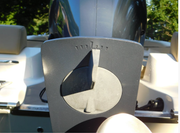
The water at the bottom of the propeller is a bit denser and freer to flow than at the top of the propeller.
This makes the lower blades a bit more effective, so the propeller and the stern "walk" sideways in the direction of rotation. This is sideways blade pressure. You will see boats with 2 engines will have propellers rotating in opposite directions to cancel this out.
This also changes intensity based on RPMs of the propeller.
I find this more pronounced at higher speeds.
Most outboards have "trim tabs" mounted behind the propeller to act as a tiny "rudder" to compensate for the sideways blade pressure. (see below)
This can be adjusted to compensate for this action. Depending on the size/shape of your propeller, this may need more adjustment.
As mentioned above, the sideways blade pressure changes with RPMs and you may never find the perfect balance. Often it's best to "tune" to the speed you operate most frequently. At high RPMs I can't let go of the wheel as it will automatically turn to port.
--Russ
-
leefrankpierce
- First Officer
- Posts: 243
- Joined: Fri Oct 06, 2017 5:13 am
- Sailboat: MacGregor 26X
- Location: Dallas Ft-Worth Texas
Re: WHAT AM I MISSING WHEN MOTORING
100% agree with Russ on all points, but will add...
Normal power boats have chines on the side to help steer the boat, our hull being a sailboat hull might have less resistance to prop walk meaning it will act exactly as you describe even more.
Look up how long keel sailboats have to park.
The prop walk at slow speeds can be sooo bad that they can only turn in 1 direction using the prop walk.
Normal power boats have chines on the side to help steer the boat, our hull being a sailboat hull might have less resistance to prop walk meaning it will act exactly as you describe even more.
Look up how long keel sailboats have to park.
The prop walk at slow speeds can be sooo bad that they can only turn in 1 direction using the prop walk.
26X in Dallas Fort-Worth area Texas
Slip at Eagle Mountain Lake

Slip at Eagle Mountain Lake
-
Russ
- Admiral
- Posts: 8330
- Joined: Thu Oct 11, 2007 12:01 pm
- Sailboat: MacGregor 26M
- Location: Bozeman, Montana "Luna Azul" 2008 M 70hp Suzi
Re: WHAT AM I MISSING WHEN MOTORING
Prop walk is a great tool if you know how to use it.
Typically, a propeller thrusts water past a rudder. Not so much in reverse.
My boat will naturally tend to back on one direction. I exploit this when I can in tight places. Fortunately we have the benefit of also turning the motor with the steering. My keelboat had almost no steering in reverse until I got some movement over the rudder. I would exploit the sideway crawl to back out of the slip in one direction.
Typically, a propeller thrusts water past a rudder. Not so much in reverse.
My boat will naturally tend to back on one direction. I exploit this when I can in tight places. Fortunately we have the benefit of also turning the motor with the steering. My keelboat had almost no steering in reverse until I got some movement over the rudder. I would exploit the sideway crawl to back out of the slip in one direction.
--Russ
-
krum
- Chief Steward
- Posts: 67
- Joined: Tue May 28, 2019 8:38 am
- Sailboat: MacGregor 26X
- Location: PLATTE CITY, MO
Re: WHAT AM I MISSING WHEN MOTORING
Russ, you hit on something that naver occured to me. I only considered prop walk when trying to dock. I will definetly try adjusting the trim tab to compensate for the turning. I'm smiling again Thanks
-
DaveC426913
- Admiral
- Posts: 1912
- Joined: Mon Jul 14, 2008 8:05 am
- Sailboat: MacGregor 26X
- Location: Toronto Canada
- Contact:
Re: WHAT AM I MISSING WHEN MOTORING
I find that, prop walk aside, she wanders all over the course - port and starboard alike. I fear for the nerves of oncoming vessels when they see me coming because my course varies by 5 degrees to either side of true."Oh, he's breaking to my port. Good. Oh. Nope! He's breaking to my starbo-Nope. Port again."
It's worse at higher speeds and it's worse with blades up, which is one of the reasons why I tend to keep my cruising speed low enough to keep my blades down.
MacX 2000 Honda BF50A 'SeaSaw'
-
tuxonpup
- Engineer
- Posts: 148
- Joined: Fri Oct 25, 2024 10:37 am
- Sailboat: MacGregor 26X
- Location: Tucson AZ
Re: WHAT AM I MISSING WHEN MOTORING
Weird, my 26X won't hold a straight course in any kind of waves until I hit about 7.5 knots, when she lifts a little and I stop requiring continuous carpal tunnel course corrections. I don't usually motor with the centerboard down at all, maybe that's the difference.DaveC426913 wrote: ↑Sun Oct 05, 2025 6:55 amI find that, prop walk aside, she wanders all over the course - port and starboard alike. I fear for the nerves of oncoming vessels when they see me coming because my course varies by 5 degrees to either side of true."Oh, he's breaking to my port. Good. Oh. Nope! He's breaking to my starbo-Nope. Port again."
It's worse at higher speeds and it's worse with blades up, which is one of the reasons why I tend to keep my cruising speed low enough to keep my blades down.
1996 Macgregor 26X w/150% RF Genoa & Nissan 50hp 2-stroke
-
OverEasy
- Admiral
- Posts: 2915
- Joined: Mon Sep 28, 2020 11:16 am
- Sailboat: MacGregor 26X
- Location: NH & SC
Re: WHAT AM I MISSING WHEN MOTORING
Hi Krum!
We primarily motor cruise and have found that with our Mac26X that keeping the rudders up and out of the water while extending the swing keel 1/3 of its travel so that it acts like a Skeg has vastly improved our motoring directional stability along with slight adjustment to the engine’s trim tab. I won’t say that it eliminated ‘all’ variation but it’s been substantially better at almost all motoring speeds, especially at the higher speeds. As others have excellently pointed out the prop walk aspect is a variable and a fact of life that varies with engine speed.
Functionally, from my experience, the trim tab adjustment is a must do item. I found it best to do this incrementally with trial runs while in the water while standing in the shallows rather than hauling in/out.
The 1/3 partially deployed swing keel has helped considerably! (Note: I don’t believe this would work on a Mac26M given the hydrodynamics of a partially extended daggerboard are going to be quite different that that of a partially extended swing keel.)
I’ve also found that the inevitable wear of the various pivot points in the crossover steering linkage bar that connects the engine and rudders together has an influence on steering variables. That ‘slop’ as it were can account for several degrees of wheel rotation before actual engine or rudder movement. (One of these days I’d like to install oiled bronze or other lubricated bushings to address that aspect…)
A while back I did a temporary trial fix by slipping in curled sections of Stainless Steel shim stock to fill the slack between the pins and holes and that stiffened up the steering nicely. It wasn’t permanent but it did work as a proof of concept.
Best Regards,
Over Easy
We primarily motor cruise and have found that with our Mac26X that keeping the rudders up and out of the water while extending the swing keel 1/3 of its travel so that it acts like a Skeg has vastly improved our motoring directional stability along with slight adjustment to the engine’s trim tab. I won’t say that it eliminated ‘all’ variation but it’s been substantially better at almost all motoring speeds, especially at the higher speeds. As others have excellently pointed out the prop walk aspect is a variable and a fact of life that varies with engine speed.
Functionally, from my experience, the trim tab adjustment is a must do item. I found it best to do this incrementally with trial runs while in the water while standing in the shallows rather than hauling in/out.
The 1/3 partially deployed swing keel has helped considerably! (Note: I don’t believe this would work on a Mac26M given the hydrodynamics of a partially extended daggerboard are going to be quite different that that of a partially extended swing keel.)
I’ve also found that the inevitable wear of the various pivot points in the crossover steering linkage bar that connects the engine and rudders together has an influence on steering variables. That ‘slop’ as it were can account for several degrees of wheel rotation before actual engine or rudder movement. (One of these days I’d like to install oiled bronze or other lubricated bushings to address that aspect…)
A while back I did a temporary trial fix by slipping in curled sections of Stainless Steel shim stock to fill the slack between the pins and holes and that stiffened up the steering nicely. It wasn’t permanent but it did work as a proof of concept.
Best Regards,
Over Easy
-
Russ
- Admiral
- Posts: 8330
- Joined: Thu Oct 11, 2007 12:01 pm
- Sailboat: MacGregor 26M
- Location: Bozeman, Montana "Luna Azul" 2008 M 70hp Suzi
Re: WHAT AM I MISSING WHEN MOTORING
There are certain conditions that my  won't stay on course. The "wobble" back and forth.
At lower speeds ( < 7mph ) I will lower the dagger a foot or so. This seems to help the problem.
won't stay on course. The "wobble" back and forth.At lower speeds ( < 7mph ) I will lower the dagger a foot or so. This seems to help the problem.
--Russ

-
NiceAft

- Admiral
- Posts: 6728
- Joined: Tue Feb 01, 2005 7:28 pm
- Sailboat: MacGregor 26M
- Location: Upper Dublin,PA, USA: 2005M 50hp.Honda4strk.,1979 Phantom Sport Sailboat, 9'Achilles 6HP Merc 4strk
Re: WHAT AM I MISSING WHEN MOTORING
krum,
I don’t disagree with anything above, but after twenty years with my , I just simplify it all by saying it happens with Macs. It ishould be the worst thing that happens to either one of us  I have seen posts about this for years, it’s not just you.
I just learned to anticipate the pattern, and correct as soon as it begins.
I don’t disagree with anything above, but after twenty years with my
, I just simplify it all by saying it happens with Macs. It ishould be the worst thing that happens to either one of us I have seen posts about this for years, it’s not just you.I just learned to anticipate the pattern, and correct as soon as it begins.
Ray ~~_/)~~
-
dlandersson

- Admiral
- Posts: 4965
- Joined: Fri Aug 27, 2010 10:00 am
- Sailboat: MacGregor 26X
- Location: Michigan City
Re: WHAT AM I MISSING WHEN MOTORING
Ok, it's not a bug, it's a feature. I find that other boaters assume I'm drunk, high or crazy (or a combination) and scurry out of any possible way.
Like walking down the street with a 100 lb pit bull - everyone gets out of your way
Like walking down the street with a 100 lb pit bull - everyone gets out of your way
-
dlandersson
- Admiral
- Posts: 4965
- Joined: Fri Aug 27, 2010 10:00 am
- Sailboat: MacGregor 26X
- Location: Michigan City
-
45Plus+
- Chief Steward
- Posts: 72
- Joined: Thu Dec 02, 2021 4:42 pm
- Sailboat: MacGregor 26M
- Location: Rockland, Ontario
Re: WHAT AM I MISSING WHEN MOTORING
The wander on my M at all speeds was pretty bad last summer. I had to spin the wheel 45 degrees or so - back and forth to try to get it to go in a zig zag motion forward. This was pretty exhausting. I changed out the steering cable this year and this improved things quite a bit. Now I am correcting about 10- 20 degrees motoring forward with the rudders and dagger board up. Sometimes the boat seems to find its balance and no correction is required at all - well, for a few seconds anyway. I have learned to see and feel the boat about to begin to track port or starboard and how to compensate lightly on the wheel to preempt the swing. While I know I am correcting, the crew and Admiral do not seem to feel the gentle adjustments. I certainly no longer feel I am alarming oncoming traffic as I did last season - who likely thought I was practicing my tacking even though the sails were not up  .
.
Having the rudders down up to 7 knots or so helps quite a bit. I added washers made of some plexiglass sheet I had in the garage to take the former extensive play out of the rudder mounts (there was lots) and to better align the two rudders. With the rudders down, I can leave the wheel and the boat holds its course much better than it did last year. The boat tracks well when they are down but I am conscious of the drag so I don't often have them down now that I've got the knack of subtle preemptive steering. That said, the rudders definitely have to be down at slow/docking speeds otherwise the boat fishtails all over the place.
Before I made the changes, I was really wondering if a Mac was for me. But now, all's good and I'm looking forward to next summer getting to better know my boat.
. Having the rudders down up to 7 knots or so helps quite a bit. I added washers made of some plexiglass sheet I had in the garage to take the former extensive play out of the rudder mounts (there was lots) and to better align the two rudders. With the rudders down, I can leave the wheel and the boat holds its course much better than it did last year. The boat tracks well when they are down but I am conscious of the drag so I don't often have them down now that I've got the knack of subtle preemptive steering. That said, the rudders definitely have to be down at slow/docking speeds otherwise the boat fishtails all over the place.
Before I made the changes, I was really wondering if a Mac was for me. But now, all's good and I'm looking forward to next summer getting to better know my boat.