

Re: M capsize
I’ve had mine out in some pretty breezy conditions. She heels until the wind spills from the sails, of if it’s really windy, she lies on her side or thereabouts and goes to leeward in a hurry. I’m not a lake sailor. In the Florida nearshore waters, can usually see bad weather coming but sometimes I still get caught because I’m not sure how bad it will be, or I think it might pass quickly. The boat does well with a double reefed main in otherwise protected waters. With the engine running you can jam her nose into the wind with the sail sheeted flat, and ride out 35 knots in a pinch. Off shore in larger waves, this operation would probably get pretty messy. This boat is not an offshore boat, the gentleman from Puerto Rico not withstanding. I feel quite safe in areas where it’s too shallow for large steep waves. A good sized wave, say a breaking wave of 8 foot or above, could knock the boat flat or worse because of the high sides and lack of keel. Even the ventures would be safer since their iron keel can be lowered and are supposed to be locked in that position with the locking pin.
I personally feel the M is a very unusual boat, sold as a beginner or intermediate boat, but which actually requires more skill to sail than similar sized keel boats, which will perform somewhat ok even with poor sail trim blown out sails, or other nautical faux pas, and are very safe in all but the worst weather if they are not holed.
In short. I could see the M knocked down or capsized if caught by a breaking wave. I don’t think the wind alone would do it. She might swamp if held down long enough while hatches or ports were open.
Ix
What would happen if I fell overboard? (Single handing)
-
Ixneigh

- Admiral
- Posts: 2469
- Joined: Thu Sep 09, 2010 11:00 am
- Sailboat: MacGregor 26M
- Location: Key largo Florida
Re: What would happen if I fell overboard? (Single handing)
"Shoal Idea"
2011 M, white
Tohatsu 20
South Fl.
2011 M, white
Tohatsu 20
South Fl.
-
Be Free

- Admiral
- Posts: 1892
- Joined: Fri Nov 23, 2012 6:08 pm
- Sailboat: MacGregor 26X
- Location: Steinhatchee, FL
Re: What would happen if I fell overboard? (Single handing)
I encourage all who are following this thread who have NOT heard of a fully ballasted MAC capsizing to chime in. It is to be expected that anyone who HAS heard of it will mention it but if the other side of the question is not represented then we won't be able to say with certainty whether its a case of no one hearing the question or no one knowing of a case. That still won't definitively answer the question (you can't prove the negative case) but it will make the likelihood vanishingly small.
I have never heard of a fully ballasted MAC capsizing.
The wind alone cannot capsize a Mac. It would take a combination of wind and waves to do so. Any boat can be rolled over given the proper combination of wind and waves. For a Mac that would mean getting hit broadside with a 13' (or higher) breaking wave. That's going to be a minimum of a Force 7 and and even I am not crazy enough to go out in those conditions.
I will grant that it can happen but even if it did, I don't see how it could remain capsized ("turtled"). With the wrong side down and 1400 pounds of ballast above the waterline I don't see how a Mac could stay upside down.
Strap in. Even with a PLB you are better off staying in the boat.
I have never heard of a fully ballasted MAC capsizing.
The wind alone cannot capsize a Mac. It would take a combination of wind and waves to do so. Any boat can be rolled over given the proper combination of wind and waves. For a Mac that would mean getting hit broadside with a 13' (or higher) breaking wave. That's going to be a minimum of a Force 7 and and even I am not crazy enough to go out in those conditions.
I will grant that it can happen but even if it did, I don't see how it could remain capsized ("turtled"). With the wrong side down and 1400 pounds of ballast above the waterline I don't see how a Mac could stay upside down.
Strap in. Even with a PLB you are better off staying in the boat.
Bill
2001 26X Simple Interest
Honda BF40D
"If I were in a hurry I would not have bought a sailboat." Me
2001 26X Simple Interest
Honda BF40D
"If I were in a hurry I would not have bought a sailboat." Me
-
MYCBC Commodore

- Posts: 5
- Joined: Fri Dec 13, 2019 4:37 pm
- Sailboat: MacGregor 26M
- Location: Vancouver, BC
- Contact:
Re: What would happen if I fell overboard? (Single handing)
I am surprised no one has mentioned a "Ray Line".
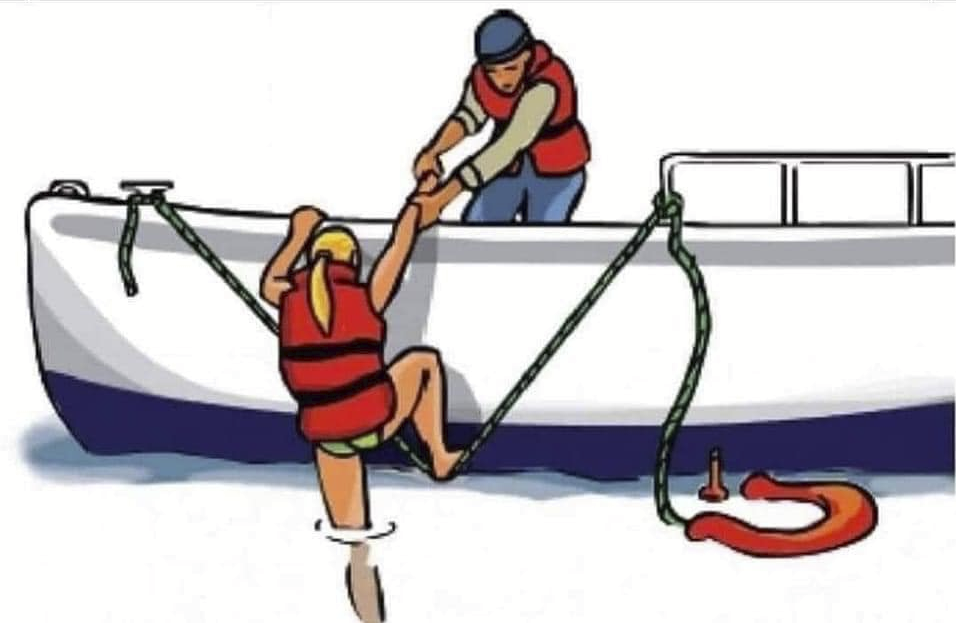
When we bought Gemini (26M) from BWY in 2010, we were given an introductory sail by Ray Copin. Ray was a long time BWY sales and demo guy. He was also a retired Coast Guard Captain. One of the highlights of his demo/sailing lesson was an introduction to what we at the MacGregor Yacht Club of BC now call a "Ray Line" in his honor. He suggested tying your Bow line back along the side of the boat to the stern cleat. The purpose is two-fold. One is for when you approach a dock. You can simply ask the dock hand to grab the "Ray Line" that is attached bow and stern as the boat comes along side the dock. One person on the dock can control both the bow and the stern while the captain hops off and secures the boat. Neat and tidy without tossing/catching any lines. The second function of the "Ray Line" is more applicable to this conversation. If you should happen to fall into the water, you can reach the "Ray Line" and it will stretch downward enough that you can hook your foot on it and then using the line and a stanchion, step up to pull yourself back on board. I have not had to do this in an emergency but was able to reboard over the side of our M relatively easily while at anchor in Desolation Sound a few years back.
Unfortunately Ray passed away last year. He is missed by all those who knew him, but his legacy lives on with the many boats in the MacGregor Yacht Club of B.C. who have "Ray Lines" on their boat.
When we bought Gemini (26M) from BWY in 2010, we were given an introductory sail by Ray Copin. Ray was a long time BWY sales and demo guy. He was also a retired Coast Guard Captain. One of the highlights of his demo/sailing lesson was an introduction to what we at the MacGregor Yacht Club of BC now call a "Ray Line" in his honor. He suggested tying your Bow line back along the side of the boat to the stern cleat. The purpose is two-fold. One is for when you approach a dock. You can simply ask the dock hand to grab the "Ray Line" that is attached bow and stern as the boat comes along side the dock. One person on the dock can control both the bow and the stern while the captain hops off and secures the boat. Neat and tidy without tossing/catching any lines. The second function of the "Ray Line" is more applicable to this conversation. If you should happen to fall into the water, you can reach the "Ray Line" and it will stretch downward enough that you can hook your foot on it and then using the line and a stanchion, step up to pull yourself back on board. I have not had to do this in an emergency but was able to reboard over the side of our M relatively easily while at anchor in Desolation Sound a few years back.
Unfortunately Ray passed away last year. He is missed by all those who knew him, but his legacy lives on with the many boats in the MacGregor Yacht Club of B.C. who have "Ray Lines" on their boat.
 2010 70 hp Suzuki from BWY with all the bells and whistles
Moored in my backyard in Maple Ridge, BC
MYCBC Commodore Rick
-
NiceAft

- Admiral
- Posts: 6706
- Joined: Tue Feb 01, 2005 7:28 pm
- Sailboat: MacGregor 26M
- Location: Upper Dublin,PA, USA: 2005M 50hp.Honda4strk.,1979 Phantom Sport Sailboat, 9'Achilles 6HP Merc 4strk
Re: What would happen if I fell overboard? (Single handing)
I have never heard of the term "Ray Line", yet, I have two. In fact I consider Ray lines essential.
Years ago, on this site, I read about tying a line from the bow to the stern cleat for docking. I use it quite frequently in the following manner.
I approach the dock slowly, and pull up to it closely. I just hop off NiceAft, grab the Ray Line, and proceed to tie off. It is so simple. In a strong wind blowing my away from the dock, the Ray Line allows me to forcibly pull NiceAft to the dock.
Now, as to the need to report ones lack of knowledge about a Mac capsizing with a full ballast, The amount of Macs capsizing at all, being such a small number, is proof enough of the safety of our boats. Many thousands of Macs produced.
Years ago, on this site, I read about tying a line from the bow to the stern cleat for docking. I use it quite frequently in the following manner.
I approach the dock slowly, and pull up to it closely. I just hop off NiceAft, grab the Ray Line, and proceed to tie off. It is so simple. In a strong wind blowing my
away from the dock, the Ray Line allows me to forcibly pull NiceAft to the dock.Now, as to the need to report ones lack of knowledge about a Mac capsizing with a full ballast, The amount of Macs capsizing at all, being such a small number, is proof enough of the safety of our boats. Many thousands of Macs produced.
Ray ~~_/)~~
-
Jimmyt
- Admiral
- Posts: 3402
- Joined: Sat Jul 18, 2015 9:52 am
- Sailboat: MacGregor 26M
- Location: Mobile AL 2013 26M, 60 Etec
Re: What would happen if I fell overboard? (Single handing)
Never heard of a fully ballasted Mac capsizing.
Jimmyt
P-Cub-Boo
2013 26M, Etec 60, roller Genoa, roller main
Cruising Waters: Mobile Bay, Western Shore, Fowl River
P-Cub-Boo
2013 26M, Etec 60, roller Genoa, roller main
Cruising Waters: Mobile Bay, Western Shore, Fowl River
-
kurz
- Admiral
- Posts: 1307
- Joined: Mon Dec 06, 2010 9:07 am
- Sailboat: MacGregor 26M
- Location: Zürich, Switzerland, Europe
Re: What would happen if I fell overboard? (Single handing)
To be honest... to answer the thread question, if you fall ober bord mostly you will die. With life west somewhat later. Ray-line may help to get contact to the boat. Or a line you pull back of the Mac. May give you a small chance.
But imagine how fast the boat rides... Und and how slow you are... You will have some seconds for this swimming manoevre...
Even worse if the water is cold... With all big clothes...
But imagine how fast the boat rides... Und and how slow you are... You will have some seconds for this swimming manoevre...
Even worse if the water is cold... With all big clothes...
-
Russ

- Admiral
- Posts: 8305
- Joined: Thu Oct 11, 2007 12:01 pm
- Sailboat: MacGregor 26M
- Location: Bozeman, Montana "Luna Azul" 2008 M 70hp Suzi
Re: What would happen if I fell overboard? (Single handing)
Ray took us out when we bought our boat. I also installed that line although it didnt have a name. Worked well as a “handle” when docking to grab onto. One day while docking my son slipped and hung on to the “Ray line” to hold on. Works well.
I have since retired it as my slip and docking procedures changed.
Sad to learn of his passing. He was a great captain
--Russ
-
kmclemore

- Site Admin
- Posts: 6256
- Joined: Sun Feb 08, 2004 9:24 am
- Sailboat: MacGregor 26X
- Location: Ambler, PA -- MACX2018A898 w/ Suzuki DF60AV -- 78 BW Harpoon 4.6 -- 2018 Tahoe 550TF w/ 150 Merc
Re: What would happen if I fell overboard? (Single handing)
It is sad to hear of Ray’s passing. Great sailors are always a great loss.
His ”Ray-line” is indeed a good rescue method, though. I posted about it a while back, but I considered it a temporary line. The docking use angle is a nice thought, though, and I’ll have to try it on my Mac.
Previous thread…
viewtopic.php?p=365272#p365272
His ”Ray-line” is indeed a good rescue method, though. I posted about it a while back, but I considered it a temporary line. The docking use angle is a nice thought, though, and I’ll have to try it on my Mac.
Previous thread…
viewtopic.php?p=365272#p365272
- Kevin McLemore, Mac Site Admin
-
NiceAft
- Admiral
- Posts: 6706
- Joined: Tue Feb 01, 2005 7:28 pm
- Sailboat: MacGregor 26M
- Location: Upper Dublin,PA, USA: 2005M 50hp.Honda4strk.,1979 Phantom Sport Sailboat, 9'Achilles 6HP Merc 4strk
Re: What would happen if I fell overboard? (Single handing)
That sagging line is basically how the line looks; it is not attached from a stanchion, but rather from the most forward cleat. I have one on each side. It has come to my aid in docking quite frequently when no one is around to help. Slowww down, and step off while holding the line, and move forward towards midships to place the line over a cleat or pylon. This holds the boat in place so forward and stern lines can be tied to cleats.
Ray ~~_/)~~
-
OverEasy
- Admiral
- Posts: 2885
- Joined: Mon Sep 28, 2020 11:16 am
- Sailboat: MacGregor 26X
- Location: NH & SC
Re: What would happen if I fell overboard? (Single handing)
Hi All!
That Ray Line sounds interesting!
One down either side bow cleat to stern cleat drooping to the waterline.
The climb-back-in function as McLemore gave the illustration of is nice too!
I don’t think anyone is ever gonna be able to catch up to a rigged sailing boat… I’d immediately skip the wasted effort and time …Start heading to shore.
I’ve been on a ski rope and towed behind a boat at low speed. Even having a tow handle with a bar to hold on to can be a bit of a challenge, never mind attempting to pull one’s self “up current” on a smooth wet line! Gonna be nearly impossible to then maneuver one’s feet to get on a ladder in moving water (and not lose grip on the wet line!).
A tether needs to be properly rigged to one’s body to be effective and not drown you while being towed. There have been multiple accidents where people have been drowned by a tether. Currently the best arrangement for a tether line attachment is at the upper mid back between the shoulders. That way your body acts as a shield or “ski” deflecting the water away from your face so the water doesn’t get rammed down your throat.
Yes you can use trousers to make a flotation device by taking them off, knot each leg individually as near the ankle as possible, the try to inflate the wet knotted trousers by “wind socking” them over head. Once you get some air rammed in hold the waist end down to keep the air in. Works best with tight weave fabrics that swell when wet like cotton jeans. The process isn’t perfect and will need to be periodically repeated to reinflate. To use it one is best to only put one arm though between the inflated legs, not your torso.
We prefer the worn high vis PFD method personally and “the keep you in the cockpit” tether” approach.
For getting up on deck a dual line that clips onto each lifeline with you clipped in the middle is a common approach on small boats. The lines are long enough to reach either side so if/when you slip/fall you can’t actually go over board. A variation of this is the addition of a tight “central” lifeline from bow to stern that you are clipped on to which works in cockpit to bow. The tether should limit you to stay on deck.
“Solo sailing” is basically all about planning for degrees of realistic “self rescue”.
I was trained that if I were to fall into the water modesty is the last thing you concerns yourself with. Ideally on a solo boat one would be taking the precautions of a PFD and a short tether to a lifeline so making it out of the boat into the water doesn’t happen. But if you do find yourself in the water without a floatation device get rid of anything that restricts your movements. Coats, shoes, boots, dresses, slacks, shirts…( ok maybe keep the skivies and bra) as soon as you can while you can. Start gradually swimming toward a safe place (not the bottom of cliffs or reefs in heavy seas which will only beat you to a pulp and tear you up). The swimming will help keep you warm and give purpose to your keeping your head above water. Remember that people regularly swim the English Channel !!
Best Regards,
Over Easy
That Ray Line sounds interesting!
One down either side bow cleat to stern cleat drooping to the waterline.
The climb-back-in function as McLemore gave the illustration of is nice too!
I don’t think anyone is ever gonna be able to catch up to a rigged sailing boat… I’d immediately skip the wasted effort and time …Start heading to shore.
I’ve been on a ski rope and towed behind a boat at low speed. Even having a tow handle with a bar to hold on to can be a bit of a challenge, never mind attempting to pull one’s self “up current” on a smooth wet line! Gonna be nearly impossible to then maneuver one’s feet to get on a ladder in moving water (and not lose grip on the wet line!).
A tether needs to be properly rigged to one’s body to be effective and not drown you while being towed. There have been multiple accidents where people have been drowned by a tether. Currently the best arrangement for a tether line attachment is at the upper mid back between the shoulders. That way your body acts as a shield or “ski” deflecting the water away from your face so the water doesn’t get rammed down your throat.
Yes you can use trousers to make a flotation device by taking them off, knot each leg individually as near the ankle as possible, the try to inflate the wet knotted trousers by “wind socking” them over head. Once you get some air rammed in hold the waist end down to keep the air in. Works best with tight weave fabrics that swell when wet like cotton jeans. The process isn’t perfect and will need to be periodically repeated to reinflate. To use it one is best to only put one arm though between the inflated legs, not your torso.
We prefer the worn high vis PFD method personally and “the keep you in the cockpit” tether” approach.
For getting up on deck a dual line that clips onto each lifeline with you clipped in the middle is a common approach on small boats. The lines are long enough to reach either side so if/when you slip/fall you can’t actually go over board. A variation of this is the addition of a tight “central” lifeline from bow to stern that you are clipped on to which works in cockpit to bow. The tether should limit you to stay on deck.
“Solo sailing” is basically all about planning for degrees of realistic “self rescue”.
I was trained that if I were to fall into the water modesty is the last thing you concerns yourself with. Ideally on a solo boat one would be taking the precautions of a PFD and a short tether to a lifeline so making it out of the boat into the water doesn’t happen. But if you do find yourself in the water without a floatation device get rid of anything that restricts your movements. Coats, shoes, boots, dresses, slacks, shirts…( ok maybe keep the skivies and bra) as soon as you can while you can. Start gradually swimming toward a safe place (not the bottom of cliffs or reefs in heavy seas which will only beat you to a pulp and tear you up). The swimming will help keep you warm and give purpose to your keeping your head above water. Remember that people regularly swim the English Channel !!
Best Regards,
Over Easy
-
NiceAft
- Admiral
- Posts: 6706
- Joined: Tue Feb 01, 2005 7:28 pm
- Sailboat: MacGregor 26M
- Location: Upper Dublin,PA, USA: 2005M 50hp.Honda4strk.,1979 Phantom Sport Sailboat, 9'Achilles 6HP Merc 4strk
Re: What would happen if I fell overboard? (Single handing)
I double checked to see if this video wasn’t already posted in this thread.
Ray ~~_/)~~
-
OverEasy
- Admiral
- Posts: 2885
- Joined: Mon Sep 28, 2020 11:16 am
- Sailboat: MacGregor 26X
- Location: NH & SC
Re: What would happen if I fell overboard? (Single handing)
Hi All!
I like the video disclaimer



Not something easily done by an old retired foggy that’s fer sure!
Best Regards,
Over Easy
I like the video disclaimer
Not something easily done by an old retired foggy that’s fer sure!
Best Regards,
Over Easy
-
Be Free
- Admiral
- Posts: 1892
- Joined: Fri Nov 23, 2012 6:08 pm
- Sailboat: MacGregor 26X
- Location: Steinhatchee, FL
Re: What would happen if I fell overboard? (Single handing)
Thank you. It is a very informative video and well-made. I appreciate the fact that he stresses the importance of staying on the boat and the difficulty of the single-handed recovery even under controlled, best-case conditions.
Add in even one less-than-best-case condition and your chances for success go down very quickly. Even something as minor as wearing an off-shore life jacket may have made the outcome quite different.
With apologies to Mr. Gilbert, while "(T)here are the remains of a fine (athlete) about (me)", I doubt that at my age I could do what he did in this video. I certainly don't want to bet my life that I could.
Plan, prepare, practice, do whatever you can to increase your chances of getting back on the boat but first put your efforts into gear and habits that will keep you from going overboard.
Add in even one less-than-best-case condition and your chances for success go down very quickly. Even something as minor as wearing an off-shore life jacket may have made the outcome quite different.
With apologies to Mr. Gilbert, while "(T)here are the remains of a fine (athlete) about (me)", I doubt that at my age I could do what he did in this video. I certainly don't want to bet my life that I could.
Plan, prepare, practice, do whatever you can to increase your chances of getting back on the boat but first put your efforts into gear and habits that will keep you from going overboard.
Bill
2001 26X Simple Interest
Honda BF40D
"If I were in a hurry I would not have bought a sailboat." Me
2001 26X Simple Interest
Honda BF40D
"If I were in a hurry I would not have bought a sailboat." Me
-
JamesToBoot
- Engineer
- Posts: 150
- Joined: Thu Aug 14, 2025 11:59 am
- Sailboat: MacGregor 26S
- Location: SC
Re: What would happen if I fell overboard? (Single handing)
Two more cent for you:
Don't fall overboard. Equate in your head that falling overboard means death. The ultimate goal for many of us is exploring. The eventuality of that is to venture past our local lake / bay and into places not often frequented, where help is not close by. So don't give into the idea that help will be close by. When you get knocked overboard it will not be planned. The only thing garenteed is what you have on you, your body and your wits (if you weren't knocked out in the process of falling overboard or injured).
I have gotten off the back of my boat in calm days. I've gotten off when it seems the boat speed is "ehhh, its not moving". My experience tells me its a risk for me and for anyone on the boat with me (as I am normally the only one who knows how to, has the ability to, has the time to, or has the interest to work the boat without my guidance).
-When I got my first boat it was a stretch to lift my leg high enough to go up the mob ladder while on the trailer. I got used to it and now its easy.
-once that was easy, it was a cumbersome act to actually make it into the boat. But I got pretty good at it and I wonder when I watch others 'why do they struggle so much'... because you've done it hundreds of times.
-Then it was almost impossible to do without shoes because 1" bar underfoot is painful for an adult. Now I only notice it a bit.
-now that I've been for a quick dip I see how much upper strength is needed and the great amount of middle/lower flexibility is needed to get your feet onto the ladder and your weight over your feet.
I am not yet well versed in getting back on from the water and I am warry.
What I do know is that the slightest bit of movement through the water has caught me off guard and is quite scary to think about. But I have done it.
That is on a lake, in perfectly calm weather, no waves, no bodily fatigue, and no mental fatigue, from a mob ladder, without having to reach or swim for it.
IF we were to fall overboard, it is likely NONE of these conditions would be met. Add onto that the pause from surprise, the water temp gasp reflex, and any injury we got from falling overboard.
I doubt any of us regularly practice falling overboard and probably never have. I don't believe the odds are in our favor. Being that I am likely half the age and half the weight of a large majority of the population, I'd say I'm in OK health. Being a cautious man, I would not make a bet in favor of a super fit ninja warrior who has never practiced this obstical and much less bet in my favor.
Playing in a calm lake is tough... Being knocked unexpectantly overboard with possible injuries to the head and/or body in bad circumstances/weather, with the boat going 4 or more mph, when I'm likely already mentally and physically exhausted from fighting the elements, is an exercise in futilitiy.
Be cautious, make sure your tether does NOT extend past the edge of your deck when stretched, practice, and pretend the water is lava... because in reality, if you fall overboard you are dead along with anyone relying in you. Life is risky, but stupidity hurts. Learn as much as possible not to be stupid. Create as much as a buffer as possible so when mistakes are made and/or start piling up, you have room to grow instead of getting hurt.
That's my two cent anyway...
Don't fall overboard. Equate in your head that falling overboard means death. The ultimate goal for many of us is exploring. The eventuality of that is to venture past our local lake / bay and into places not often frequented, where help is not close by. So don't give into the idea that help will be close by. When you get knocked overboard it will not be planned. The only thing garenteed is what you have on you, your body and your wits (if you weren't knocked out in the process of falling overboard or injured).
I have gotten off the back of my boat in calm days. I've gotten off when it seems the boat speed is "ehhh, its not moving". My experience tells me its a risk for me and for anyone on the boat with me (as I am normally the only one who knows how to, has the ability to, has the time to, or has the interest to work the boat without my guidance).
-When I got my first boat it was a stretch to lift my leg high enough to go up the mob ladder while on the trailer. I got used to it and now its easy.
-once that was easy, it was a cumbersome act to actually make it into the boat. But I got pretty good at it and I wonder when I watch others 'why do they struggle so much'... because you've done it hundreds of times.
-Then it was almost impossible to do without shoes because 1" bar underfoot is painful for an adult. Now I only notice it a bit.
-now that I've been for a quick dip I see how much upper strength is needed and the great amount of middle/lower flexibility is needed to get your feet onto the ladder and your weight over your feet.
I am not yet well versed in getting back on from the water and I am warry.
What I do know is that the slightest bit of movement through the water has caught me off guard and is quite scary to think about. But I have done it.
That is on a lake, in perfectly calm weather, no waves, no bodily fatigue, and no mental fatigue, from a mob ladder, without having to reach or swim for it.
IF we were to fall overboard, it is likely NONE of these conditions would be met. Add onto that the pause from surprise, the water temp gasp reflex, and any injury we got from falling overboard.
I doubt any of us regularly practice falling overboard and probably never have. I don't believe the odds are in our favor. Being that I am likely half the age and half the weight of a large majority of the population, I'd say I'm in OK health. Being a cautious man, I would not make a bet in favor of a super fit ninja warrior who has never practiced this obstical and much less bet in my favor.
Playing in a calm lake is tough... Being knocked unexpectantly overboard with possible injuries to the head and/or body in bad circumstances/weather, with the boat going 4 or more mph, when I'm likely already mentally and physically exhausted from fighting the elements, is an exercise in futilitiy.
Be cautious, make sure your tether does NOT extend past the edge of your deck when stretched, practice, and pretend the water is lava... because in reality, if you fall overboard you are dead along with anyone relying in you. Life is risky, but stupidity hurts. Learn as much as possible not to be stupid. Create as much as a buffer as possible so when mistakes are made and/or start piling up, you have room to grow instead of getting hurt.
That's my two cent anyway...
Last edited by JamesToBoot on Thu Sep 04, 2025 8:43 am, edited 10 times in total.
-james
Novice Sailor
'91 26S, fixer-upper, 55lb w 280ah lithium, need stern rail
Cruising Grounds: Lake Murray, youtube
Novice Sailor
'91 26S, fixer-upper, 55lb w 280ah lithium, need stern rail
Cruising Grounds: Lake Murray, youtube